
BuddhistCatholicContemplativeEvangelicalGeneral ChristianHinduJewishLatter-day SaintMuslimNew VisionsProgressive Christian
Beliefs
- Buddhist
- Catholic
- Contemplative
- Evangelical
- General Christian
- Hindu
- Jewish
- Latter-day Saint
- More Voices
- Muslim
- New Visions
- Pagan
- Progressive Christian
Topics
- Religion News
- Food and Religion
- Sports and Religion
- Religious Art
- Religious Music and Entertainment
- Religious Events
- History and Religion
- Style and Religion
- Politics and Religion
- Women in Religion
- Recreation Outdoors and Religion
- Business Finance and Religion
- Careers Workplace and Religion
- Education and Religion
- Family Parenting and Religion
- Health Fitness and Religion
- Home and Religion
- Relationships and Religion
- Technology and Religion
- Travel and Religion
Columnists
- Buddhist Columnists
- Business Finance and Religion Columnists
- Careers Workplace and Religion Columnists
- Catholic Columnists
- Contemplative Columnists
- Education and Religion Columnists
- Evangelists Columnists
- Family Parenting and Religion Columnists
- General Christian Columnists
- Health Fitness and Religion Columnists
- Hindu Columnists
- History and Religion Columnists
- Home and Religion Columnists
- Jewish Columnists
- More Voices Columnists
- Latter Day Columnists
- Muslim Columnists
- New Visions Columnists
- Nonreligious Columnists
- Pagan Columnists
- Politics and Religion Columnists
- Progressive Columnists
- Recreation Outdoors and Religion Columnists
- Relationships and Religion Columnists
- Religion News Columnists
- Religious Art Columnists
- Religious Events Columnists
- Religious Music and Entertainment Columnists
- Sports and Religion Columnists
- Style and Religion Columnists
- Technology and Religion Columnists
- Travel and Religion Columnists
- Women in Religion Columnists
Resource Library
- 2026 Calendar
- Library of World Religions
- The 100 Most Holy Places on Earth
- Patheos Answers
- Podcasts
- Videos
- Faith Leaders Database
- Anglican Episcopalian
- Bahai
- Baptist
- Buddhism
- Christianity
- Confucianism
- Eastern Orthodoxy
- Hinduism
- Holiness and Pentecostal
- ISKCON
- Islam
- Judaism
- Lutheran
- Methodist
- The Church of Jesus Christ of Latter-day Saints
- New Age
- Paganism
- Presbytarian and Reformed
- Protestantism
- Religion Behind the Scenes
- Roman Catholic
- Scientology
- Shia Islam
- Sikhism
- Sufism
- Sunni Islam
- Taoism
- Zen
- See all religions
Research Tools
 Ad-Free & Subscriber Log-In Subscription Support
Ad-Free & Subscriber Log-In Subscription Support
Follow Patheos 

- Trending:
- Forgiveness
- |
- Marriage
- |
- Consciousness
- |
- Death Penalty
- |
- Election
- |
- Halloween
 altmuslim
- Home
- Muslim
- Being a Black American Muslim Woman – A Study of Challenges
Being a Black American Muslim Woman – A Study of Challenges
Last updated on: December 10, 2015 at 11:33 pm by Guest Contributor
Being a Black American Muslim Woman – A Study of Challenges 2015-12-10T23:33:23-04:00 Guest Contributor
Patheos Explore the world's faith through different perspectives on religion and spirituality! Patheos has the views of the prevalent religions and spiritualities of the world.
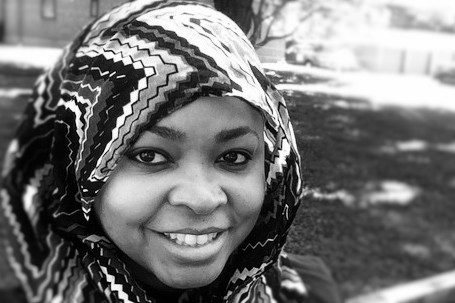
Margari Hill of Muslim ARC
By Margari Hill
On November 21st, the Muslim Anti-Racism Collaborative kick-started the #BlackInMSA hashtag. It began with a conversation on our steering committee’s WhatsApp group about the current tensions between black students and their non-black peers in Muslim Student Associations the night before. This conversation was important given the current struggle Black Muslim students face in light of Islamophobia and #BlackLivesMatter.
I tweeted about my own 15 years of experience with Muslim student organizing. Over the years, I have found that children of African immigrants and descendants of enslaved Africans, Black Muslims in the United States, are often silenced and sidelined in discourses on what it means to be black in this country, as well as what it means to be Muslim. I experience marginalization my intersecting identities as a Black American Muslim woman. But Black Muslim women remain some of the most powerful voices to challenge dominant narratives.
While the twitter conversation focused on black experiences in Muslim settings, the conversation could have easily been #MuslimInBSU (Black Student Union). There was little said about the diversity of beliefs within the African Diaspora. At my Pan African student graduation ceremony at Stanford years ago, a speaker mentioned the church and temple as a cornerstone for our community but left out the mosque.
I have experienced anti-Muslim bigotry from my own community. I’ve been insulted on the street and in college cafeterias. One evangelical brother swore up and down that Muslims don’t use soap and deodorant, when in fact Europeans learned of soap during the Crusades in Aleppo. Su’ad Abdul Khabeer, Assistant professor of Anthropology at Purdue, has written about Black Islamophobes.
Recently when I visited Vanderbilt University, I thought about how Carol Swain’s anti-Muslim op-ed, and wondered how it would fare in her course.
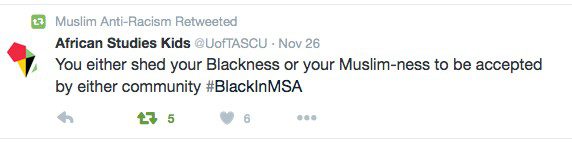 @UofTASCU wrote. “You either shed your Blackness or your Muslim-ness to be accepted by either community #BlackInMSA.”
Black Muslim women are often judged for the personal choices we make. When our practice is non-normative, we are judged by our non-Muslim, often Christian, families for not being “real Muslims.” When we become more devout, our friends and relatives sometimes put us down for being phony now that we’ve changed.
Our spiritual journey becomes a subject of jokes, derision, and name-calling. I have heard people describe the Muslim garb as bat suits or wearing garbage bags. I have seen Black women on twitter speculating what is under our scarves, daring each other to snatch off one of our scarves.
But the anti-Muslim sentiment is not just about hurt feelings. There are real world consequences for women like me. In “A Serious Function of Racism,” Makka Ali writes “I’m just as Black as I am Muslim as I am female and my understanding of oppression is heavily influenced by my experience as a member of any one of these groups.”
Carolyn Moxley Rouse’s Engaged Surrender and Jamillah Karim’s American Muslim Women are two important works to understand the ways in which Muslim women navigate multiple oppressions. As Black Muslim women, we have to fight on numerous fronts facing deadly force, sanctioned violence, detainment and surveillance.
Our gender, our race and our faith make us more vulnerable. We are profiled racially and religiously, often with little support from the multiple communities in which we belong. Through it all, our faith sustains us.
Black American Muslim women are also marginalized by the cultural hegemonies that plague the American Muslim community. With one-third Black American, one-third South Asian and one-third Arab, American Muslims are one of the most diverse religious groups. Makka Ali explains, “ … from conversations with my Muslim peers whose families are from other countries, I learned that they didn’t have as much of an understanding of or concern about racism before the widespread backlash against Muslims began.”
Since 9/11, non-Black Muslims have decried the anti-Muslim bigotry and xenophobia they have faced. The pressure is intense, coming from the Islamophobia industry, laws and programs that target Muslims and media coverage that often leads to spikes in anti-Muslim bias. Anti-Islamophobia activism in the American Muslim community has been led by immigrants, as well as second and third generation American Muslims who have often measured their sense of belonging relative to their acceptance by white Americans.
Most non-Black Muslim national organizations have not rooted their civil rights advocacy in black liberation struggles. And only a few have begun to build multi-racial coalitions to address racial profiling. Some argue that our blackness makes us immune to Islamophobia. But look at Robert Doggart, a white Christian minister who plotted to attack the predominantly Black Muslim Islamberg, And, recently the FBI went on alert because armed anti-Muslim protester Jon Ritzheimer threatened the same community. However, because the targets are Black and Muslim, the terrorist threat draws little media attention.
In terms of media representation of American Muslims, Black Muslim women are often erased. A recent example was a featured segment on Muslims on the Today Show, which failed to include a Black Muslim among the five guests. In many ways, this fits the stereotype that Muslims only come from the Middle East and South Asia.
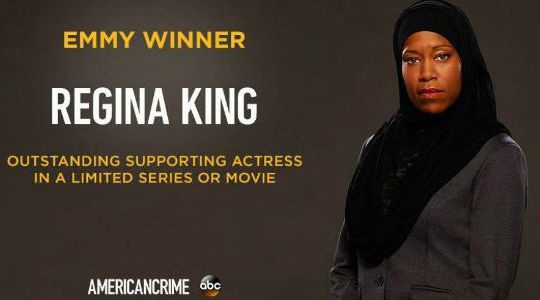
Image source MPAC
But slowly, the image is shifting in both media portrayals and in community life. This year Regina King won an Emmy for portraying a Black Muslim woman.
We have powerful Muslim women who have been game changers. This year, the Islamic Society of North America brought community organizer, motivation speaker and author Ilyasah Shabazz, the daughter of Malcolm X, on as a main speaker. We have Mara Brock Akil and Ameena Matthews who have shown also shown us how Black Girls Rock. Black Muslim women, who come from all parts of the African Diaspora, have been a powerful force in dispelling stereotypes and building community.
Margari Aziza Hill is co-founder and Programming Director of Muslim Anti-Racism Collaborative (MuslimARC), assistant editor at AltM, columnist at MuslimMatters, and co-founder of Muslims Make it Plain. An educator and independent researcher, she has given talks and lectures at various universities and Muslim community organizations across the country. Find her on Twitter @margari_aziza and on her blog here.
Muslim Anti-Racism Collaborative
Next Post

December 16, 2015 What's Islamic About "Star Wars"?
Browse Our Archives
Select a Category 2012 Elections 30 Dayd 30 Writers (2017) 30 Days 30 Writers 30 Days 30 Writers (2015) 30 Days 30 Writers (2016) 30 Days 30 Writers (2018) 30 Days 30 Writers 2017 Ali Asadullah Ali Eteraz Alper Bilgili Arthur Richards Asides Asma Uddin Black History Month Briefings Charles Turner Commentary Cyrus McGoldrick Eman H Aly Fatimah Popal Hajj Hajj and Dhul Hijjah Hesham Hassaballa Hisham Hellyer Ibrahim Abusharif Inas Younis Irfan Yusuf Jalal Baig Junaid Afeef Laila Alawa Laila Alwala Mas'ood Cajee Muqtedar Khan Nakia Jackson Newsmakers Parvez Ahmed Podcasts Rabia Chaudry Rafia Zakaria Ramadan Reviews Safiyyah Ally Saud Inam Shahed Amanullah Svend White The Opinionated Oncologist Visions Wajahat Ali Zahed Amanullah Zahir Janmohamed Zainab Khan
Select a Month November 2018 October 2018 September 2018 August 2018 July 2018 June 2018 May 2018 April 2018 March 2018 February 2018 January 2018 December 2017 November 2017 October 2017 September 2017 August 2017 July 2017 June 2017 May 2017 April 2017 March 2017 February 2017 January 2017 December 2016 November 2016 October 2016 September 2016 August 2016 July 2016 June 2016 May 2016 April 2016 March 2016 February 2016 January 2016 December 2015 November 2015 October 2015 September 2015 August 2015 July 2015 June 2015 May 2015 April 2015 March 2015 February 2015 January 2015 December 2014 November 2014 October 2014 September 2014 August 2014 July 2014 June 2014 May 2014 April 2014 March 2014 February 2014 January 2014 December 2013 November 2013 October 2013 September 2013 August 2013 July 2013 June 2013 May 2013 April 2013 March 2013 February 2013 January 2013 December 2012 November 2012 October 2012 September 2012 August 2012 July 2012 June 2012 May 2012 April 2012 March 2012 February 2012 January 2012 December 2011 November 2011 October 2011 September 2011 August 2011 July 2011 June 2011 May 2011 April 2011 March 2011 February 2011 January 2011 December 2010 November 2010 October 2010 September 2010 August 2010 July 2010 June 2010 May 2010 April 2010 March 2010 February 2010 January 2010 December 2009 November 2009 October 2009 September 2009 August 2009 July 2009 June 2009 May 2009 April 2009 March 2009 February 2009 January 2009 December 2008 November 2008 October 2008 September 2008 August 2008 July 2008 June 2008 May 2008 April 2008 March 2008 February 2008 January 2008 December 2007 November 2007 October 2007 September 2007 August 2007 July 2007 June 2007 May 2007 April 2007 March 2007 February 2007 January 2007 December 2006 November 2006 October 2006 September 2006 August 2006 July 2006 June 2006 May 2006 April 2006 March 2006 February 2006 January 2006 December 2005 November 2005 October 2005 September 2005 August 2005 July 2005 June 2005 May 2005 April 2005 March 2005 February 2005 January 2005 December 2004 November 2004 October 2004 September 2004 August 2004 July 2004 June 2004 May 2004 April 2004 March 2004 February 2004 January 2004 December 2003 November 2003 October 2003 September 2003 August 2003 July 2003 June 2003 May 2003 April 2003 March 2003 February 2003 January 2003 December 2002 November 2002 October 2002 September 2002 August 2002 July 2002 June 2002 May 2002 April 2002 March 2002
Follow Us!
TAKE THE
Religious Wisdom Quiz
Who said, "I have fought the good fight, I have finished the race"?
Select your answer to see how you score.
James Paul Peter John
Related posts from altmuslim

Mawlid 2018: Praise Songs from Around the World

Gaslighting, Anti-Jewish and Anti-Muslim Rhetoric: What to Know

How One Ottoman Reconciled Islamic Teachings with Darwin's...

As #TreeofLife Shows, Trump's Mainstreaming of Hate Puts...
TRENDING AT PATHEOS Muslim

25 Years Later: How Much Has Changed for...
As we approach the 25th anniversary of September 11th, I’ve found myself...

Podcast: Third Spaces & The Rise of Yemeni...
In the latest episode of The Artistic Foodies Podcast, hosts Abbas...

HalalFest Picks: Best 60 Halal Spots for Super...
Back in 2016, I came up with a list of 29...

Unity Is America’s Strength — Division Is Its...
by Hidayatullah Ahsan When Valentina Gomez, a Republican candidate for Congress in...

Zohran Mamdani and New York’s Fight Against Islamophobia
This past June, against all odds, Zohran Mamdani won the Democratic primary...

What the Fourth of July Means to a...
As we mark another Fourth of July, millions of Americans will celebrate...
view all Muslim blogs
Ad-Free & Subscriber Log-In Subscription Support
- About Us
- 2026 Calendar
- Videos
- Podcasts
- Library of World Religions
- Faith In Media Tracker
- Advertise With Us
- Write for Us
- Privacy Policy
- Terms of Service
- Do Not Sell My Data
- Contact Us
- Radiant Digital
- Manage Newsletter Subscriptions
- Unsubscribe From Notifications
- Sitemap
Copyright 2008-2026, Patheos. All rights reserved.
Subscription Support Ad-Free & Subscriber Log-In
Follow Patheos