
BuddhistCatholicContemplativeEvangelicalGeneral ChristianHinduJewishLatter-day SaintMuslimNew VisionsProgressive Christian
Beliefs
- Buddhist
- Catholic
- Contemplative
- Evangelical
- General Christian
- Hindu
- Jewish
- Latter-day Saint
- More Voices
- Muslim
- New Visions
- Pagan
- Progressive Christian
Topics
- Religion News
- Food and Religion
- Sports and Religion
- Religious Art
- Religious Music and Entertainment
- Religious Events
- History and Religion
- Style and Religion
- Politics and Religion
- Women in Religion
- Recreation Outdoors and Religion
- Business Finance and Religion
- Careers Workplace and Religion
- Education and Religion
- Family Parenting and Religion
- Health Fitness and Religion
- Home and Religion
- Relationships and Religion
- Technology and Religion
- Travel and Religion
Columnists
- Buddhist Columnists
- Business Finance and Religion Columnists
- Careers Workplace and Religion Columnists
- Catholic Columnists
- Contemplative Columnists
- Education and Religion Columnists
- Evangelists Columnists
- Family Parenting and Religion Columnists
- General Christian Columnists
- Health Fitness and Religion Columnists
- Hindu Columnists
- History and Religion Columnists
- Home and Religion Columnists
- Jewish Columnists
- More Voices Columnists
- Latter Day Columnists
- Muslim Columnists
- New Visions Columnists
- Nonreligious Columnists
- Pagan Columnists
- Politics and Religion Columnists
- Progressive Columnists
- Recreation Outdoors and Religion Columnists
- Relationships and Religion Columnists
- Religion News Columnists
- Religious Art Columnists
- Religious Events Columnists
- Religious Music and Entertainment Columnists
- Sports and Religion Columnists
- Style and Religion Columnists
- Technology and Religion Columnists
- Travel and Religion Columnists
- Women in Religion Columnists
Resource Library
- 2026 Calendar
- Library of World Religions
- The 100 Most Holy Places on Earth
- Patheos Answers
- Podcasts
- Videos
- Faith Leaders Database
- Anglican Episcopalian
- Bahai
- Baptist
- Buddhism
- Christianity
- Confucianism
- Eastern Orthodoxy
- Hinduism
- Holiness and Pentecostal
- ISKCON
- Islam
- Judaism
- Lutheran
- Methodist
- The Church of Jesus Christ of Latter-day Saints
- New Age
- Paganism
- Presbytarian and Reformed
- Protestantism
- Religion Behind the Scenes
- Roman Catholic
- Scientology
- Shia Islam
- Sikhism
- Sufism
- Sunni Islam
- Taoism
- Zen
- See all religions
Research Tools
 Ad-Free & Subscriber Log-In Subscription Support
Ad-Free & Subscriber Log-In Subscription Support
Follow Patheos 

- Trending:
- Forgiveness
- |
- Marriage
- |
- Consciousness
- |
- Death Penalty
- |
- Election
- |
- Halloween
 altmuslim
- Home
- Muslim
- CVE Critics are Right, and CVE is Still Necessary
CVE Critics are Right, and CVE is Still Necessary
Last updated on: July 27, 2015 at 10:30 am by Guest Contributor
CVE Critics are Right, and CVE is Still Necessary 2015-07-26T22:53:03-04:00 Guest Contributor
Patheos Explore the world's faith through different perspectives on religion and spirituality! Patheos has the views of the prevalent religions and spiritualities of the world.
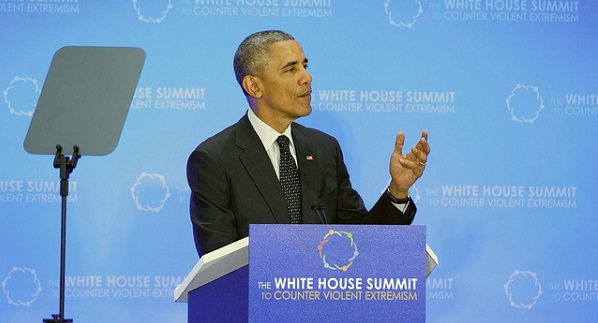
President Obama speaking at the CVE Summit, photo courtesy of Department of State
By Junaid M. Afeef & Alejandro J. Beutel
The Charlie Hebdo murders in Paris in January 2015 seemed to renew the Obama Administration’s push for implementing countering violent extremism (CVE) as an alternative paradigm to the excesses of the War on Terror. However, many civil liberties groups, including several within the American Muslim community, have raised important criticisms and concerns about CVE that must be addressed to the satisfaction of the public.
There are lessons to be learned from the failed and ineffective government-led CVE efforts of the past, and it is necessary for American Muslim communities to take up the challenge of developing programs that incorporate these lessons in order to prevent Muslims from succumbing to ISIS’s powerful online recruitment efforts. The legitimate grievances of Americans — including Muslims — cannot be a reason to not do the right thing.
With ISIS’s social media onslaught raging and Islamophobia at home helping ISIS make the case for an “Us vs. Them” mindset, the future portends the possibility (but not the inevitability) of more young American Muslims succumbing to ISIS’s call to engage in political violence. The right thing to do in this case is to save as many of young people from hurting others and themselves. And, that requires community-led, research-informed and law enforcement-partnered programs to prevent recruitment in the first place. It also requires programs to successfully intervene when a person has begun traveling down the path towards political violence.
What the Government Got Wrong
Countering violent extremism (CVE) is a concept. It is also a generic name for various programs developed and deployed over the last decade. Some of these programs suffer serious design flaws. The biggest flaw of current and previous programs is that they existed within a law enforcement framework. This led to misunderstandings in the least egregious cases, and serious breaches of civil liberties in other instances.
In several communities the same law enforcement agency attempting to conduct community outreach to Muslims simultaneously deployed informants into mosques seeking to entice individuals into engaging in criminal acts. In other cases law enforcement used “community outreach” as a cover for engaging in warrantless intelligence gathering when there was no basis for obtaining a warrant.
In a post 9/11 era where every threat, no matter how remote, must be thoroughly investigated, law enforcement is struggling to find insights into who is most likely to engage in political violence. Using questionable research, many CVE programs were based on the notion that greater religiosity was evidence of movement into extreme ideas, which in turn, was believed to be the gateway to violent action. This “conveyor-belt” theory has been roundly criticized, even by proponents of CVE. The notion that there is one pathway towards political violence or that there is a particular reason why individuals choose to engage in political violence, has been discredited as well.
Preventing Targeted Violence on the Community’s Own Terms
Experts in behavioral psychology, psychiatry and other related fields, who focus on terrorism, acknowledge that very little is known about why individuals choose to engage in political violence. However, they also note that there may be other indicators that can help narrow the scope of potential threats. Not surprisingly, these other indicators are similar to those that relate to other types of criminal or antisocial behaviors.
Rather than wasting time, money and legitimacy with communities on fixing flawed programs built on questionable research, there is an opportunity to develop a new program focused on preventing targeted violence, which is more appropriately framed as a public health and human services issue. Instead of exclusively seeking to preempt every act of political violence (that law enforcement agencies increasingly acknowledge is untenable), this new approach would seek to help those who are most susceptible to recruitment and will work to re-direct them off the path to violence.
This approach, based on fairly well researched studies in the context of juvenile delinquency and preventing mass shootings in schools and public places, will accomplish this by assessing at-risk individuals who are brought to the attention of community-led prevention and intervention programs by parents, teachers, friends and, in certain instances, by law enforcement. These assessments, performed by a “crisis intervention team” comprised of community members, social workers, mental health professionals and others as deemed necessary, will then identify any psychosocial deficits that may be interfering with the at-risk individual’s cognitive abilities to the extent that he or she believes that killing innocent people is a rational course of action.
At that point, working in coordination with social service providers, healthcare professionals, community-based mentors, and religious advisers, the identified deficits can be ameliorated and the at-risk individual may then be better equipped to re-direct him or herself away from a path of violence. Approaching at-risk individuals to re-direct them away from political violence does not negate the vitally important role of law enforcement in ensuring the public’s safety. If these programs can reduce the pipeline of individuals committed to political violence, then law enforcement’s job may become more manageable and our communities will become safer.
This is not ground-breaking thinking. Violence prevention efforts have often sought to identify and address risk-factors that contribute to individuals engaging in mass shootings and gang violence. It is also not a simple task. Ideally, these community-led programs will partner with academics to evaluate the effectiveness of these efforts, and whenever possible, these studies will seek to identify what works and what does not work.
Furthermore, an effective targeted violence prevention program, even when developed and led by the community, has to coordinate with law enforcement. That will require trust. This is why the concerns raised by civil liberties organizations must be addressed effectively and quickly. The threats are ongoing, and law enforcement agencies are themselves recognizing that they need help from the communities to stanch the flow of potential recruits. It is in the best interests of public safety that law enforcement be able to collaborate with communities when individuals are on their intelligence radar but have not yet committed any crimes.
Community Introspection on Current Threats
Some American Muslims are interested in, and are buying into, ISIS. This is a fact. There have been enough American Muslims who have gone abroad to fight to make this fact very clear. More recently, there have been a number of recruits who are turning their violent focus inward toward American soil. The shootings in Texas and the alleged plot in New York City are a few recent examples. In addition to the American Muslim cadre of foreign fighters are the ones who have been indicted and convicted of terrorism or related offenses.
How many young people need to screw up their lives and put the public’s safety at risk before American Muslims see that they need to take care an active role in addressing this problem?
It is true that there are other threats to our collective public safety in the form of hate crimes and political violence committed by white supremacists and others, and these acts of violence must be addressed as well. However, American Muslim community members are better situated to address the threats created by ISIS’s online recruitment efforts, as the targets of this recruitment are all Muslims, and this why this particular form of political violence must be a priority of American Muslim communities.
The other threats noted above must be effectively addressed by law enforcement not only because they are statistically more likely to erode public safety, but also because these other forms of political violence are used by ISIS in its recruitment narratives.
The work of civil liberties groups in raising public awareness of government overreach is invaluable. Many of the issues raised by these organizations must be addressed. However, the need for effective prevention and intervention is urgent, and alternative strategies for preventing political violence must be intelligently and diligently pursued. Seeking to protect the most vulnerable members of American Muslim communities from becoming killers or convicted felons or both makes sense in every instance.
Junaid M. Afeef is a Partner at the Truman National Security Project and the former Executive Director of the Council of Islamic Organizations of Greater Chicago. Alejandro J. Beutel is a Researcher for Countering Violent Extremism at the National Consortium for the Study of Terrorism and Responses to Terrorism (START) at the University of Maryland, College Park.
Next Post

August 21, 2015 On Motherhood: 22 Things on Having Two Babies Under Two
Browse Our Archives
Select a Category 2012 Elections 30 Dayd 30 Writers (2017) 30 Days 30 Writers 30 Days 30 Writers (2015) 30 Days 30 Writers (2016) 30 Days 30 Writers (2018) 30 Days 30 Writers 2017 Ali Asadullah Ali Eteraz Alper Bilgili Arthur Richards Asides Asma Uddin Black History Month Briefings Charles Turner Commentary Cyrus McGoldrick Eman H Aly Fatimah Popal Hajj Hajj and Dhul Hijjah Hesham Hassaballa Hisham Hellyer Ibrahim Abusharif Inas Younis Irfan Yusuf Jalal Baig Junaid Afeef Laila Alawa Laila Alwala Mas'ood Cajee Muqtedar Khan Nakia Jackson Newsmakers Parvez Ahmed Podcasts Rabia Chaudry Rafia Zakaria Ramadan Reviews Safiyyah Ally Saud Inam Shahed Amanullah Svend White The Opinionated Oncologist Visions Wajahat Ali Zahed Amanullah Zahir Janmohamed Zainab Khan
Select a Month November 2018 October 2018 September 2018 August 2018 July 2018 June 2018 May 2018 April 2018 March 2018 February 2018 January 2018 December 2017 November 2017 October 2017 September 2017 August 2017 July 2017 June 2017 May 2017 April 2017 March 2017 February 2017 January 2017 December 2016 November 2016 October 2016 September 2016 August 2016 July 2016 June 2016 May 2016 April 2016 March 2016 February 2016 January 2016 December 2015 November 2015 October 2015 September 2015 August 2015 July 2015 June 2015 May 2015 April 2015 March 2015 February 2015 January 2015 December 2014 November 2014 October 2014 September 2014 August 2014 July 2014 June 2014 May 2014 April 2014 March 2014 February 2014 January 2014 December 2013 November 2013 October 2013 September 2013 August 2013 July 2013 June 2013 May 2013 April 2013 March 2013 February 2013 January 2013 December 2012 November 2012 October 2012 September 2012 August 2012 July 2012 June 2012 May 2012 April 2012 March 2012 February 2012 January 2012 December 2011 November 2011 October 2011 September 2011 August 2011 July 2011 June 2011 May 2011 April 2011 March 2011 February 2011 January 2011 December 2010 November 2010 October 2010 September 2010 August 2010 July 2010 June 2010 May 2010 April 2010 March 2010 February 2010 January 2010 December 2009 November 2009 October 2009 September 2009 August 2009 July 2009 June 2009 May 2009 April 2009 March 2009 February 2009 January 2009 December 2008 November 2008 October 2008 September 2008 August 2008 July 2008 June 2008 May 2008 April 2008 March 2008 February 2008 January 2008 December 2007 November 2007 October 2007 September 2007 August 2007 July 2007 June 2007 May 2007 April 2007 March 2007 February 2007 January 2007 December 2006 November 2006 October 2006 September 2006 August 2006 July 2006 June 2006 May 2006 April 2006 March 2006 February 2006 January 2006 December 2005 November 2005 October 2005 September 2005 August 2005 July 2005 June 2005 May 2005 April 2005 March 2005 February 2005 January 2005 December 2004 November 2004 October 2004 September 2004 August 2004 July 2004 June 2004 May 2004 April 2004 March 2004 February 2004 January 2004 December 2003 November 2003 October 2003 September 2003 August 2003 July 2003 June 2003 May 2003 April 2003 March 2003 February 2003 January 2003 December 2002 November 2002 October 2002 September 2002 August 2002 July 2002 June 2002 May 2002 April 2002 March 2002
Follow Us!
TAKE THE
Religious Wisdom Quiz
Who said, "We ought to obey God rather than men"?
Select your answer to see how you score.
James John Paul Peter
Related posts from altmuslim

Mawlid 2018: Praise Songs from Around the World

Gaslighting, Anti-Jewish and Anti-Muslim Rhetoric: What to Know

How One Ottoman Reconciled Islamic Teachings with Darwin's...

As #TreeofLife Shows, Trump's Mainstreaming of Hate Puts...
TRENDING AT PATHEOS Muslim

25 Years Later: How Much Has Changed for...
As we approach the 25th anniversary of September 11th, I’ve found myself...

Podcast: Third Spaces & The Rise of Yemeni...
In the latest episode of The Artistic Foodies Podcast, hosts Abbas...

HalalFest Picks: Best 60 Halal Spots for Super...
Back in 2016, I came up with a list of 29...

Unity Is America’s Strength — Division Is Its...
by Hidayatullah Ahsan When Valentina Gomez, a Republican candidate for Congress in...

Zohran Mamdani and New York’s Fight Against Islamophobia
This past June, against all odds, Zohran Mamdani won the Democratic primary...

What the Fourth of July Means to a...
As we mark another Fourth of July, millions of Americans will celebrate...
view all Muslim blogs
Ad-Free & Subscriber Log-In Subscription Support
- About Us
- 2026 Calendar
- Videos
- Podcasts
- Library of World Religions
- Faith In Media Tracker
- Advertise With Us
- Write for Us
- Privacy Policy
- Terms of Service
- Do Not Sell My Data
- Contact Us
- Radiant Digital
- Manage Newsletter Subscriptions
- Unsubscribe From Notifications
- Sitemap
Copyright 2008-2026, Patheos. All rights reserved.
Subscription Support Ad-Free & Subscriber Log-In
Follow Patheos