
BuddhistCatholicContemplativeEvangelicalGeneral ChristianHinduJewishLatter-day SaintMuslimNew VisionsProgressive Christian
Beliefs
- Buddhist
- Catholic
- Contemplative
- Evangelical
- General Christian
- Hindu
- Jewish
- Latter-day Saint
- More Voices
- Muslim
- New Visions
- Pagan
- Progressive Christian
Topics
- Religion News
- Food and Religion
- Sports and Religion
- Religious Art
- Religious Music and Entertainment
- Religious Events
- History and Religion
- Style and Religion
- Politics and Religion
- Women in Religion
- Recreation Outdoors and Religion
- Business Finance and Religion
- Careers Workplace and Religion
- Education and Religion
- Family Parenting and Religion
- Health Fitness and Religion
- Home and Religion
- Relationships and Religion
- Technology and Religion
- Travel and Religion
Columnists
- Buddhist Columnists
- Business Finance and Religion Columnists
- Careers Workplace and Religion Columnists
- Catholic Columnists
- Contemplative Columnists
- Education and Religion Columnists
- Evangelists Columnists
- Family Parenting and Religion Columnists
- General Christian Columnists
- Health Fitness and Religion Columnists
- Hindu Columnists
- History and Religion Columnists
- Home and Religion Columnists
- Jewish Columnists
- More Voices Columnists
- Latter Day Columnists
- Muslim Columnists
- New Visions Columnists
- Nonreligious Columnists
- Pagan Columnists
- Politics and Religion Columnists
- Progressive Columnists
- Recreation Outdoors and Religion Columnists
- Relationships and Religion Columnists
- Religion News Columnists
- Religious Art Columnists
- Religious Events Columnists
- Religious Music and Entertainment Columnists
- Sports and Religion Columnists
- Style and Religion Columnists
- Technology and Religion Columnists
- Travel and Religion Columnists
- Women in Religion Columnists
Resource Library
- 2026 Calendar
- Library of World Religions
- The 100 Most Holy Places on Earth
- Patheos Answers
- Podcasts
- Videos
- Faith Leaders Database
- Anglican Episcopalian
- Bahai
- Baptist
- Buddhism
- Christianity
- Confucianism
- Eastern Orthodoxy
- Hinduism
- Holiness and Pentecostal
- ISKCON
- Islam
- Judaism
- Lutheran
- Methodist
- The Church of Jesus Christ of Latter-day Saints
- New Age
- Paganism
- Presbytarian and Reformed
- Protestantism
- Religion Behind the Scenes
- Roman Catholic
- Scientology
- Shia Islam
- Sikhism
- Sufism
- Sunni Islam
- Taoism
- Zen
- See all religions
Research Tools
 Ad-Free & Subscriber Log-In Subscription Support
Ad-Free & Subscriber Log-In Subscription Support
Follow Patheos 

- Trending:
- Forgiveness
- |
- Marriage
- |
- Consciousness
- |
- Death Penalty
- |
- Election
- |
- Halloween
 altmuslim
- Home
- Muslim
- Women Struggle to be Heard in the Mosque
Women Struggle to be Heard in the Mosque
Last updated on: January 17, 2014 at 4:35 pm by Guest Contributor
Women Struggle to be Heard in the Mosque 2014-01-17T16:35:32-04:00 Guest Contributor
Patheos Explore the world's faith through different perspectives on religion and spirituality! Patheos has the views of the prevalent religions and spiritualities of the world.
 By Safiya Ravat
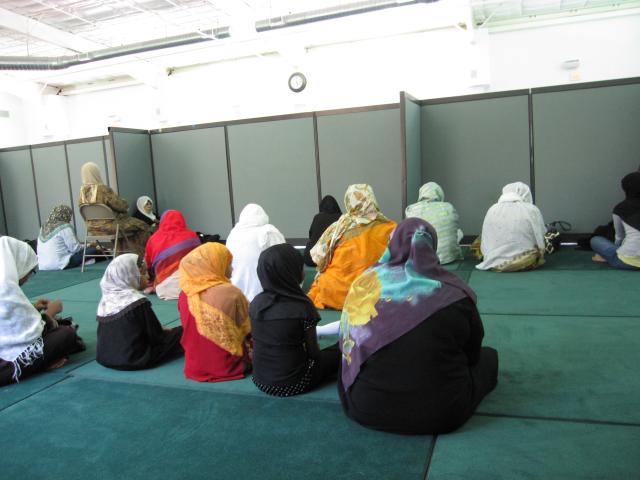
Two Muslim women enter a mosque (no, this isn’t the opener of a lame joke). Both sisters join the prayer, enjoying the Imam’s melodious recitation over the loud speaker — the only communication they have with the walled off men’s prayer area where the Iman stands, leading the prayer. They kneel down and touch their foreheads to the ground. Some time passes and one sister begins to wonder why the prostration, typically no more than 10 to 30 seconds, is now in its second minute. She had enjoyed the extra time to fit in some much needed supplication, but two minutes?
Finally the Imam calls out “Allah is Great,” the sign for the congregation to rise out of prostration. The sister raises her head and, to her surprise, finds that her friend on the right is standing in prayer while the woman to her left is still sitting! A confused panic breaks out, as sisters on all sides begin to make hurried movements, trying to catch up to where they think the Imam is in his prayer. After another two excruciating minutes of silence interrupted only by static, “May the peace and mercy of Allah be upon you” booms out of the loud speaker, signaling the end of prayer.
Every sister rises, finishing off the remainder of yet another haphazard attempt at prayer in the mosque, all the while skeptical of the validity of the prayer itself.
Behind that opaque, impenetrable barrier that separates the believing men from believing women, nobody makes mention of the not-so-uncommon “technical difficulty.” There’s no one to complain to anyhow; neither the Imam nor the mosque administrators can see the women behind the forbidding wall.
Such is the state of the majority of mosques in the U.S. and across the world today. Sadly this is a step above the countries which have yet to even designate a section in the mosque for women.
The BARRIER
The barrier comes in all shapes and sizes ranging from a completely separate room to a curtain or a flimsy screen. Whatever the shape, the objective is always the same – keep the women and men out of sight of one another. Certainly it’s what our dear Prophet (peace be upon him) would have wanted, right?
Actually … no.
It’s a widely accepted practice, no doubt, but ironically not at all in keeping with the example set by Prophet Muhammad. If you had walked into the Prophet’s mosque in Medina some 1400 years ago, you would find no physical barrier separating the men from the women. Many hadith give proof to this open arrangement, including one in which a companion of the Prophet, while in the Prophet’s presence, advised women to wait a few moments before raising their heads from prostration so the men praying in front of them would have a moment to stand and the ladies would not catch a glimpse of the men’s private parts–some men did not have the means to purchase long garments which fully covered them when they bent down in prostration (Sahih Muslim, Vol. 441, Book 4, Hadith 149). Clearly, this indicates that there was no barrier, for the men were in clear sight of the women. Certainly the Prophet could have erected a curtain or a short mud wall to spare his congregation from this embarrassing scenario, but he never did.
Another hadith tells us that the Prophet Muhammad would wait a while after the prayer finished, giving the women time to leave the mosque first without causing a traffic jam at the exit door where men and women would be standing close to and jostling against one another (Sahih Bukhari, Vol. 1, Book 12, Hadith #809). This is yet another indication that both genders entered, prayed in and left the very same room of the mosque.
And finally, nearly every Muslim is familiar with the story of the woman who spoke up and contested the Prophet’s companion and second caliph, Umar, when he was lecturing at the mosque on the rules of dowry. Did she have a microphone that allowed her to pose the question? Of course not, she spoke from where she sat in the mosque — behind the gathering of men, with no barrier in between her and them, and close enough to be heard and answered.
I know what you’re thinking. These men and women were the Companions of the Prophet who embodied a standard of faith and ethics we cannot dream of reaching. We are nothing like them and cannot expect to be treated like them. True, they were among the best of men and women, but does this mean they were free from temptation? The answer is a resounding no. In fact, one companion confessed to kissing a woman who was neither his wife nor a relative (Sahih Bukhari, Vol. 1, Book 10, Hadith #504). More than one confessed to adultery or fornication (Sahih Bukhari, Vol. 7, Book 63, Hadith #196).
These men and women were human begins; their characters came in all shades, just as those of today’s Muslims, yet the Prophet did not resort to erecting a wall to enforce modest etiquette. If we are to believe that there is wisdom in his every example, then why stray from it in this situation?
But today a barrier is needed, some would still argue. Our men don’t lower their gaze and our women don’t dress appropriately! To this I ask, how can we check our transgressions and strengthen our morals in a mosque segregated by a barrier? After all, an Imam must see a man’s wandering eyes or a man or woman’s immodest dress in order to correct him or her.
Some men argue that the women’s prayer space should be set apart from that of the men because the ladies section is noisy and chaotic. I agree. You will find women chatting on cell phones and children racing around from one end of the room to the other. Yet perhaps this unruly atmosphere comes from the lack of an Imam’s presence? An Imam whose face the listener can see creates a sense of attentiveness and accountability.
Of course the effect of the barrier between the men and the women does not stop at prayers alone. It also stands in the way of a Muslim woman fully engaging in her community. Unable to chime in during the post prayer discussion, unable to raise her hand to volunteer for a committee and unable stand up and donate during a fundraiser, a women is left in the back and in the dark. We disable ourselves when we hide half of the congregation and pretend that they do not exist.
I would argue that the root of the problem is not the barrier itself, because we cannot deny that some women enjoy the privacy it affords, allowing them to unabashedly rest or even nurse, but rather the lack of choice on the matter. We were never asked whether or not we would like a separation between us and the Imam. Men assumed this setup was our preference. Well, how could they asked us? There’s a barrier.
So where do we go from here? A few forward thinking mosques have come up with multipurpose partitions accommodating all women in their congregation. The Nueces mosque in Austin, Texas, hung a mobile curtain that women can draw when and how they prefer. The ISNA mosque in Mississauga, Canada, set up a waist high partition that allows the women to see the Imam and be heard when speaking up. Others still have chosen to erect a barrier concealing only half of the women’s section; those who prefer complete separation can stand behind it, and those who do not, can stand in the open area.
At the end of the day, the answer doesn’t lie in either-or, but rather in our communities encouraging frank discussions about the barrier itself —discussions in which women are given a chance to voice their feelings about the wall that they will face every day.
Formerly a writer for the Houston Chronicle – Texas’s largest daily paper – Safiya Ravat now works as a freelance journalist, who is currently enjoying the adventure of pursuing Islamic Studies at the International Islamic University of Malaysia with her husband. You can find other articles by Safiya Ravat here. This article originally appeared in Altmuslimah, which is not affiliated with Altmuslim.
Previous Post

January 10, 2014
Celebrating Prophet Muhammad (saw) - The Best of Muhsins
Next Post

January 29, 2014 The Problem with Petitions - for Muslim School Holidays and Otherwise
Browse Our Archives
Select a Category 2012 Elections 30 Dayd 30 Writers (2017) 30 Days 30 Writers 30 Days 30 Writers (2015) 30 Days 30 Writers (2016) 30 Days 30 Writers (2018) 30 Days 30 Writers 2017 Ali Asadullah Ali Eteraz Alper Bilgili Arthur Richards Asides Asma Uddin Black History Month Briefings Charles Turner Commentary Cyrus McGoldrick Eman H Aly Fatimah Popal Hajj Hajj and Dhul Hijjah Hesham Hassaballa Hisham Hellyer Ibrahim Abusharif Inas Younis Irfan Yusuf Jalal Baig Junaid Afeef Laila Alawa Laila Alwala Mas'ood Cajee Muqtedar Khan Nakia Jackson Newsmakers Parvez Ahmed Podcasts Rabia Chaudry Rafia Zakaria Ramadan Reviews Safiyyah Ally Saud Inam Shahed Amanullah Svend White The Opinionated Oncologist Visions Wajahat Ali Zahed Amanullah Zahir Janmohamed Zainab Khan
Select a Month November 2018 October 2018 September 2018 August 2018 July 2018 June 2018 May 2018 April 2018 March 2018 February 2018 January 2018 December 2017 November 2017 October 2017 September 2017 August 2017 July 2017 June 2017 May 2017 April 2017 March 2017 February 2017 January 2017 December 2016 November 2016 October 2016 September 2016 August 2016 July 2016 June 2016 May 2016 April 2016 March 2016 February 2016 January 2016 December 2015 November 2015 October 2015 September 2015 August 2015 July 2015 June 2015 May 2015 April 2015 March 2015 February 2015 January 2015 December 2014 November 2014 October 2014 September 2014 August 2014 July 2014 June 2014 May 2014 April 2014 March 2014 February 2014 January 2014 December 2013 November 2013 October 2013 September 2013 August 2013 July 2013 June 2013 May 2013 April 2013 March 2013 February 2013 January 2013 December 2012 November 2012 October 2012 September 2012 August 2012 July 2012 June 2012 May 2012 April 2012 March 2012 February 2012 January 2012 December 2011 November 2011 October 2011 September 2011 August 2011 July 2011 June 2011 May 2011 April 2011 March 2011 February 2011 January 2011 December 2010 November 2010 October 2010 September 2010 August 2010 July 2010 June 2010 May 2010 April 2010 March 2010 February 2010 January 2010 December 2009 November 2009 October 2009 September 2009 August 2009 July 2009 June 2009 May 2009 April 2009 March 2009 February 2009 January 2009 December 2008 November 2008 October 2008 September 2008 August 2008 July 2008 June 2008 May 2008 April 2008 March 2008 February 2008 January 2008 December 2007 November 2007 October 2007 September 2007 August 2007 July 2007 June 2007 May 2007 April 2007 March 2007 February 2007 January 2007 December 2006 November 2006 October 2006 September 2006 August 2006 July 2006 June 2006 May 2006 April 2006 March 2006 February 2006 January 2006 December 2005 November 2005 October 2005 September 2005 August 2005 July 2005 June 2005 May 2005 April 2005 March 2005 February 2005 January 2005 December 2004 November 2004 October 2004 September 2004 August 2004 July 2004 June 2004 May 2004 April 2004 March 2004 February 2004 January 2004 December 2003 November 2003 October 2003 September 2003 August 2003 July 2003 June 2003 May 2003 April 2003 March 2003 February 2003 January 2003 December 2002 November 2002 October 2002 September 2002 August 2002 July 2002 June 2002 May 2002 April 2002 March 2002
Follow Us!
TAKE THE
Religious Wisdom Quiz
Who was turned into a pillar of salt?
Select your answer to see how you score.
Lot’s wife Lot Sarah Rachel
Related posts from altmuslim

Mawlid 2018: Praise Songs from Around the World

Gaslighting, Anti-Jewish and Anti-Muslim Rhetoric: What to Know

How One Ottoman Reconciled Islamic Teachings with Darwin's...

As #TreeofLife Shows, Trump's Mainstreaming of Hate Puts...
TRENDING AT PATHEOS Muslim

25 Years Later: How Much Has Changed for...
As we approach the 25th anniversary of September 11th, I’ve found myself...

Podcast: Third Spaces & The Rise of Yemeni...
In the latest episode of The Artistic Foodies Podcast, hosts Abbas...

HalalFest Picks: Best 60 Halal Spots for Super...
Back in 2016, I came up with a list of 29...

Unity Is America’s Strength — Division Is Its...
by Hidayatullah Ahsan When Valentina Gomez, a Republican candidate for Congress in...

Zohran Mamdani and New York’s Fight Against Islamophobia
This past June, against all odds, Zohran Mamdani won the Democratic primary...

What the Fourth of July Means to a...
As we mark another Fourth of July, millions of Americans will celebrate...
view all Muslim blogs
Ad-Free & Subscriber Log-In Subscription Support
- About Us
- 2026 Calendar
- Videos
- Podcasts
- Library of World Religions
- Faith In Media Tracker
- Advertise With Us
- Write for Us
- Privacy Policy
- Terms of Service
- Do Not Sell My Data
- Contact Us
- Radiant Digital
- Manage Newsletter Subscriptions
- Unsubscribe From Notifications
- Sitemap
Copyright 2008-2026, Patheos. All rights reserved.
Subscription Support Ad-Free & Subscriber Log-In
Follow Patheos