
BuddhistCatholicContemplativeEvangelicalGeneral ChristianHinduJewishLatter-day SaintMuslimNew VisionsProgressive Christian
Beliefs
- Buddhist
- Catholic
- Contemplative
- Evangelical
- General Christian
- Hindu
- Jewish
- Latter-day Saint
- More Voices
- Muslim
- New Visions
- Pagan
- Progressive Christian
Topics
- Religion News
- Food and Religion
- Sports and Religion
- Religious Art
- Religious Music and Entertainment
- Religious Events
- History and Religion
- Style and Religion
- Politics and Religion
- Women in Religion
- Recreation Outdoors and Religion
- Business Finance and Religion
- Careers Workplace and Religion
- Education and Religion
- Family Parenting and Religion
- Health Fitness and Religion
- Home and Religion
- Relationships and Religion
- Technology and Religion
- Travel and Religion
Columnists
- Buddhist Columnists
- Business Finance and Religion Columnists
- Careers Workplace and Religion Columnists
- Catholic Columnists
- Contemplative Columnists
- Education and Religion Columnists
- Evangelists Columnists
- Family Parenting and Religion Columnists
- General Christian Columnists
- Health Fitness and Religion Columnists
- Hindu Columnists
- History and Religion Columnists
- Home and Religion Columnists
- Jewish Columnists
- More Voices Columnists
- Latter Day Columnists
- Muslim Columnists
- New Visions Columnists
- Nonreligious Columnists
- Pagan Columnists
- Politics and Religion Columnists
- Progressive Columnists
- Recreation Outdoors and Religion Columnists
- Relationships and Religion Columnists
- Religion News Columnists
- Religious Art Columnists
- Religious Events Columnists
- Religious Music and Entertainment Columnists
- Sports and Religion Columnists
- Style and Religion Columnists
- Technology and Religion Columnists
- Travel and Religion Columnists
- Women in Religion Columnists
Resource Library
- 2026 Calendar
- Library of World Religions
- The 100 Most Holy Places on Earth
- Patheos Answers
- Podcasts
- Videos
- Faith Leaders Database
- Anglican Episcopalian
- Bahai
- Baptist
- Buddhism
- Christianity
- Confucianism
- Eastern Orthodoxy
- Hinduism
- Holiness and Pentecostal
- ISKCON
- Islam
- Judaism
- Lutheran
- Methodist
- The Church of Jesus Christ of Latter-day Saints
- New Age
- Paganism
- Presbytarian and Reformed
- Protestantism
- Religion Behind the Scenes
- Roman Catholic
- Scientology
- Shia Islam
- Sikhism
- Sufism
- Sunni Islam
- Taoism
- Zen
- See all religions
Research Tools
 Ad-Free & Subscriber Log-In Subscription Support
Ad-Free & Subscriber Log-In Subscription Support
Follow Patheos 

- Trending:
- Forgiveness
- |
- Marriage
- |
- Consciousness
- |
- Death Penalty
- |
- Election
- |
- Halloween
 altmuslim
- Home
- Muslim
- Confronting Fear One Month After the Boston Marathon Bombings
Confronting Fear One Month After the Boston Marathon Bombings
Last updated on: May 21, 2013 at 10:00 pm by Guest Contributor
Confronting Fear One Month After the Boston Marathon Bombings 2013-05-21T22:00:22-04:00 Guest Contributor
Patheos Explore the world's faith through different perspectives on religion and spirituality! Patheos has the views of the prevalent religions and spiritualities of the world.
Associated Press
By Obaid H. Siddiqui
“To him who is in fear, everything rustles.” — Sophocles
At about the 23rd mile of the Boston Marathon, Azeem Khan started receiving texts on his phone. The stream of messages weren’t out of the ordinary because he informed friends and supporters earlier via Facebook to text him with encouraging thoughts to get him through the grueling marathon.
Running for the American Liver Foundation, Azeem needed the extra push to get through the 26.2 mile gauntlet that stretches from the steep decline in Hopkinton through the winding roads of Ashland, into the rolling hills of Natick and on through the “Screech Tunnel” of encouraging onlookers in Wellesley, up and over “Heartbreak Hill” in Newtown, through the neighborhoods of Brighton and Brookline and culminating at the finish line in the city amid a roaring crowd of supporters.
When Azeem turned his attention to the buzzing phone, the texts he found weren’t the kind of supportive messages he was expecting. “Be safe,” one read. “Are you okay?” another one asked. At first, Azeem was confused. He looked around and noticed nothing odd about his surroundings – just other runners trying to make it to the finish line.
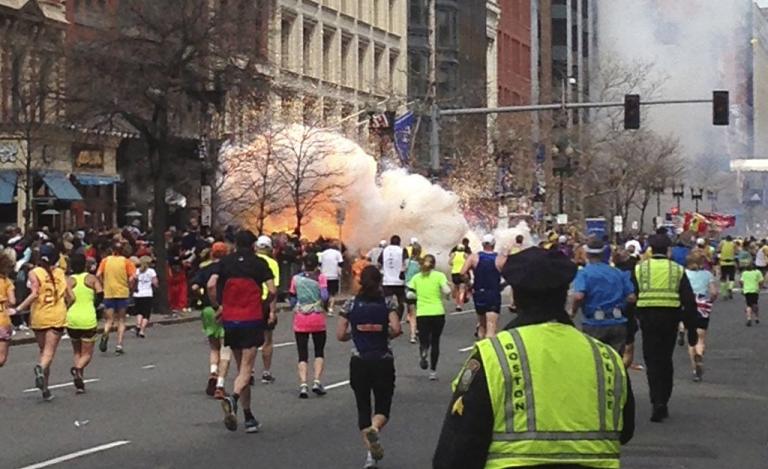
As he reached mile 24, about 10 minutes later, the texts began to make sense: The last two miles to the finish line, the path that cut through downtown Boston were quarantined off. Instead of the distant rumble of cheers and applause saved for the end of the marathon, a growing cacophony of ambulances, police, FBI, and SWAT members began to fill the air.
I Really Hope a Muslim Didn’t Do This
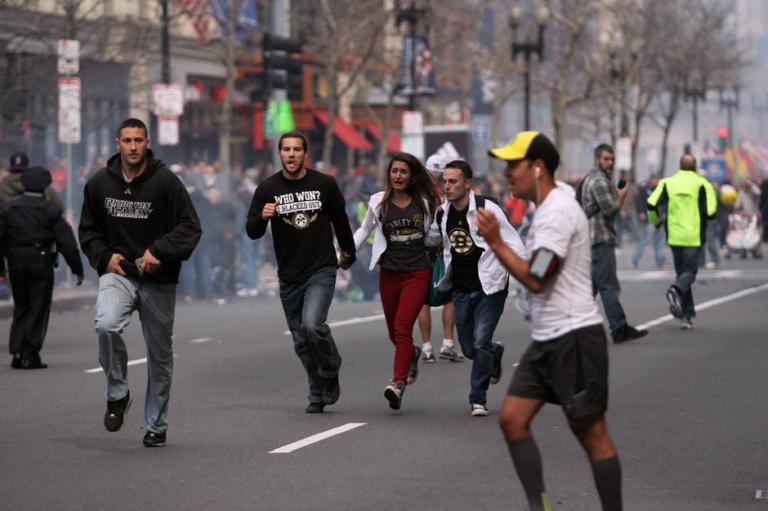
The news of what happened 10 minutes prior began to ripple through the crowd of runners looking forward to completing the race. Explosions. Smoke. Screams. Was it an accident? Was it an attack? An unfolding tragedy waited ahead. Azeem wasn’t sure what it was, but a subtle fear pulsed through him. Not a fear for his safety and health, but for what may come next. “I really hope a Muslim didn’t do this,” he thought to himself, not even fully knowing what “this” was at the moment.
The same thought occurred to Dr. Shereef Elnahal. The reverberation of the bombs awoke the young doctor, who lives close to the finish line. Working night rotations, the doctor maintained a demanding schedule overnight at the hospital and returned for a few hours of cherished sleep at his apartment during the day. Initially he thought the sounds that awoke him were from a construction crew. He soon turned on the television and was confronted with the horror outside his windows: A bomb had gone off near the finish line of the Boston Marathon.
Sensing his hospital, Brigham and Women’s, would soon be flooded with victims in need of critical care, he went into work early to assist in any way he could. As he got dressed he thought “I really hope this was not at the hands of a Muslim.”
Noora Hasan, a “bandit” runner in the marathon – one who wasn’t officially registered, but joined the race anyway – went into what she described as “survival mode” once she heard that bombs exploded at the finish line. The Wellesley senior, who has watched and cheered on the runners during her three previous years at the school, determined to exit the growing chaos surrounding her.
She walked to a nearby restaurant, asked first for a trash bag in which she could slowly cool her exhausted body and then for a phone to reach loved ones. Immediately upon realizing she was safe, the fear crossed her mind: she hoped that a Muslim wasn’t ultimately responsible.
Like Azeem, Shereef, and Noora, Muslims throughout America shared the fear the moment they heard of the tragedy. This better not be a Muslim, we all silently thought; please don’t let the culprit of this be someone justifying a horrific crime against humanity in the name of Islam. Each of us kept our faith close and lived our lives as Muslims in America, following every day routines, engaging with our communities, and disabusing non-Muslims of the notion that Islam equals violence. If this was an act of terror committed by a Muslim, the fear that all Muslims are prone to and support violence as an article of faith would certainly arise.
Associated Press
Stoking the Fear
The media was only too willing to oblige in stoking this fear. By Tuesday morning, the NY Post sensationally reported that a “Saudi national” was taken into custody and was a potential suspect. Despite the report being debunked – the “Saudi” was Abdul Rehman Ali Al-Harbi, a 20-year old student who was watching the race when the bombs went off and was hospitalized with severe burns to his hands – his name is still part of larger Muslim/Saudi conspiracy theories all over the internet.
By Wednesday afternoon, the media began to report increasingly egregious and false claims. Shortly after 1 p.m., CNN’s John King ominously reported on live television that a “dark-skinned male” was in custody. Even King knew his words seemed inflammatory; he attempted to soften the blow by acknowledging some viewers may find the phrase offensive, but was using “personal judgment” to deem the false report relevant.
The only two “facts” erroneously reported of the supposedly apprehended suspect – that he was male and had dark skin – had no journalistic value and served only to reinforce the xenophobic stereotype of a foreign menace. It was such a ridiculous report, that MSNBC’s Chris Hayes publicly excoriated CNN for such irresponsible journalism.
But the match to light the fear — that what we were facing was a dark-skinned Muslim man lurking within mainstream society awaiting orders to inflict deadly violence upon an innocent civilian population — had been struck.
Despite the corrections and backtracking, the image presented already began to take hold. It was only further intensified when, again, the NY Post published the image of Moroccan-American teenager Salah Eddine Barhoum on the cover of its Thursday issue, falsely connecting him with the attack. The narrative of a dark Muslim male as the perpetrator was so clear, that when authorities revealed the men believed to be the suspects later that same day, many American Muslims took a deep breath.
The images of Caucasian-looking men were somewhat of a relief, as later parodied by Aasif Mandvi for the Daily Show. In a spoof news report segment titled “Arrest Development,” Mandvi states “Thank God they weren’t Muslim.” Jon Stewart then clarifies for Mandvi that the suspects were in fact Muslim. “Yeah, but not Muslim Muslim,” responded Mandvi, referring to how the actual suspects, who are of Eastern European descent, didn’t fit the dark-skinned menacing Muslim image.
But that slight relief and cathartic comedy was only temporary. Tamerlan and Dzhokhar Tsarnaev were Muslim, and allegedly responsible for an attack that killed three and injured over 260 at the marathon, and for killing an officer during a robbery and shootout three days later.
Just as quickly as the men in the images were identified, their estranged uncle, Ruslan Tsarni, was holding an impromptu press conference in his Maryland driveway, denouncing his nephews as “losers.” Before knowing the full details of the story, Ruslan, fearful of the backlash his nephews may bring to his family, castigated the men as fools who fell under the effects of a virulent strain of jihadi rhetoric.
When Fear Drives the Discourse
Tsarni was smart to distance himself quickly because fear reared its insidious head again immediately. Heba Abolaban, a doctor of Palestinian descent, was punched by a man who shouted “F**k you Muslims” in the Boston area. Abdullah Faruque, a Bangladeshi man in the Bronx, was attacked by men who accused him of being Arab. Muhammad Salim, a Somali cab driver and Iraq War veteran, had his jaw broken by a man who threatened to “slice [his] f**king throat.”
The actual violence perpetrated on innocent Muslims throughout the country was only further inflamed by the ravings of television pundits like Ann Coulter, who stated that Tamerlan Tsarnaev’s widow, Katherine Russell, should be imprisoned simply for wearing a hijab. The Islamaphobes rushed from their caves of hate and fear to impugn Muslims and Islam as a threat to be handled outside of our laws and constitutional rights.
Fear once again followed, this time within the Muslim community. Imam Suhaib Webb, a well-respected and well-known Muslim-American leader who presides over the Islamic Society of Boston Cultural Center — a mosque Tamerlan reportedly attended at times — published a well-written op-ed in the New York Times distancing himself and the Boston community from the alleged bombers. So did the popular Pakistani-American writer, Wajahat Ali, who stated the Tsarnaev brothers were not the same as him and the vast majority of American Muslims.
Most disturbingly, Asra Nomani, writing for the Washington Post, drew a foolish and irrational conclusion by claiming the word Insha’Allah — Arabic for “God Willing” — was, when used increasingly, a red flag for radicalization. In effect, she was using Uncle Ruslan’s statement during his impromptu appearance that he noticed Tamerlan saying Insha’Allah more often as indicative of abnormal behavior. Nomani, who has sided with New York Congressmen Peter King in his witch hunt of Muslim Americans, irresponsibly opined that such a simple expression of religious faith should be judged with a watchful, untrusting eye.
Such fear followed Tamerlan to his grave, as mosques and cemeteries refused to bury his body, despite it being the obligation of a Muslim community to do so for its dead.
As the story of the Tsarnaev brothers began to unfold, a picture emerged of seemingly normal American young men. The elder was a Golden Glove boxer; the younger a well-liked, mild-mannered student at a local university. We were all left wondering: Why did they do this?
Fear made us not want to listen to the answer. According to hospital-bed confessions by Dzhokhar, which came after he was refused access to a lawyer, the “why” emerged: The brothers carried out the act in response to U.S. troops in Iraq and Afghanistan. The same rationale was used by Major Nidal Hassan, the Fort Hood killer; Najibullah Zazi, the attempted New York City subway bomber; Faisal Shahzad, the attempted Times’ Square bomber; and Umar Farouk Abdulmutallab, the attempted “underwear bomber.”
Fear Shouldn’t Stop Us from Confronting Hard Issues
We cannot be afraid to tackle the hard issues that we are confronted with in the wake of such attacks. We cannot be afraid to acknowledge the serious repercussions of our foreign policy abroad — not only in how it targets innocent foreign civilians, but how it motivates others, even Americans, to attack us. Fear tells us that seeking to examine the motivation of grotesque actions equates to justifying such acts. This is dangerously false.
If the Tsarnaev brothers are found guilty of the crimes that occurred the week of April 15th, starting with the bombing of the Boston Marathon and ending with the bloody shootout that left an officer dead and terrorized an entire city, then they deserve to be punished accordingly, and only God knows the punishment that awaits Tamerlan Tsarnaev in the afterlife. But, as the great Russian writer, Fyodor Dostoevsky once stated: “Nothing is easier than to denounce the evildoer; nothing is more difficult than to understand him.” We mustn’t fear to understand what drove these two men to act as they did.
The immediate condemnation of the murder of innocent people is necessary and driven by the Islamic imperative that to kill innocent people is to inflict murder upon all of humankind. Learning from the sustained backlash against Muslims and Islam in the wake of 9/11, Muslim organizations and individuals rightfully rushed to label the perpetrators as anti-Islam. Yet the essence of this public relations move, which in its swiftness subscribes to the very language of fear-mongering and stereotyping we abhor, is a manifestation of our fear as Muslim Americans.
We fear that any hesitation in declaring violent extremists as outside the fold of Islam will be used against us as proof of our sympathies for terrorists. A well-reasoned fear, but fear nonetheless. We must challenge these preconceived notions about what Islam is about. And as importantly, we must allow for an honest and provocative conversation about the development of a terrorist. In our haste to distance ourselves from such evil atrocities, we don’t allow ourselves to question the narrative presented to us.
The Tsarnaev brothers were Muslim, as am I. They were disgusted with U.S. foreign policy and the indiscriminate attacks on civilians throughout the Muslim world, as am I. Where we diverge is that they used a twisted, perverted, psychopathic logic to confront injustice perpetrated by our government leaders abroad and at home. While we must condemn their actions and punish them accordingly as well as others who use such tactics, we mustn’t fear to honestly examine why they followed the path they did. It is in seeking this knowledge that we will find the tools to combat such crimes.
Evil will never be conquered by fear; it will only be fueled by it. In order to defeat such evil, we have to understand it. Dr. Philip Zimbardo, the renowned psychologist who devised the Stanford Prison Experiment (SPE) and authored the insightful The Lucifer Effect — which used the lessons learned from SPE and Stanley Milgram’s Obedience to Authority experiment to astutely describe the dynamics that caused the horrific actions of the American men and women on watch at Abu Ghraib prison in Iraq — makes it clear: To understand what makes people do evil things, you have to focus on the interplay of three aspects: the dispositional, the situational and the systemic.
The dispositional refers to the individual — what about a person makes them commit an act? The situational looks for the cause within that individual’s environment. The third, and hardest to identify due to its vast nature, is the systemic. This examines on an institutional level what allows the disposition and situation to incubate such evil.
In Abu Ghraib, as Dr. Zimbardo points out, it was the interplay of the disposition (untrained military police) along with the situation (a dungeon prison under no supervision) within a system (an unwritten government ordinance that used illegal and immoral means in an attempt to extract information) that allowed the evil development of what occurred in that prison. Without acknowledging the interplay of these three elements, we will never come to understand why the Tsarnaev brothers did what they are suspected of doing.
As suggested by Sophocles, when we allow ourselves to be ruled by fear, we allow it to color our perception. The only way to avoid the fear that pulsed through Azeem, Shereef, and Noora; the fear that was exacerbated by erroneous reporting from the NY Post and CNN; the fear that caused the likes of Imam Webb and Wajahat Ali to distance themselves publicly from these men; the fear that caused Islamaphobes to denigrate the whole of the Muslim world and the religion of Islam; the fear that caused multiple Americans to attack their fellow innocent Americans based on their perception of Muslims; the fear that Asra Nomani finds in the simple exultation of God in Islam through the term Insha’Allah — is to understand that we are all capable of such.
Evil is plain and banal, and when the right elements within a human’s self, environment and institution coalesce, evil expands.
The distressing emotion of fear is aroused by impending danger, the anticipation of pain and the helplessness felt in the presence of a real or imagined threat. It is the feeling or condition of being afraid. Fear’s antidote is courage. We must reject the notion that to investigate the origins of why terrorists do what they do is to sympathize with them.
We must have the courage to not only ask but answer for ourselves these difficult questions. We can only do so when we discard the fear and fear-mongering and instead seek to understand the cause and motivation for acts of terror. Otherwise, the cycle will only continue. An enraged individual or group will inflict pain upon our citizenry, and we will, like clockwork, allow fear to keep us in a vacuum of ignorance. Everything serves to justify our fear, and in fear we justify everything. We must break this cycle.
Obaid H. Siddiqui is a freelance writer and independent journalist based in Philadelphia. He is a contributor to the anthology “All-American: 45 American Men on Being Muslim.”
Previous Post

May 13, 2013
A Convert's Story - How Becoming a Muslim is a Work in Progress
Next Post

June 7, 2013 I Chose to Have an Abortion (Part One): A Muslimah's Story
Browse Our Archives
Select a Category 2012 Elections 30 Dayd 30 Writers (2017) 30 Days 30 Writers 30 Days 30 Writers (2015) 30 Days 30 Writers (2016) 30 Days 30 Writers (2018) 30 Days 30 Writers 2017 Ali Asadullah Ali Eteraz Alper Bilgili Arthur Richards Asides Asma Uddin Black History Month Briefings Charles Turner Commentary Cyrus McGoldrick Eman H Aly Fatimah Popal Hajj Hajj and Dhul Hijjah Hesham Hassaballa Hisham Hellyer Ibrahim Abusharif Inas Younis Irfan Yusuf Jalal Baig Junaid Afeef Laila Alawa Laila Alwala Mas'ood Cajee Muqtedar Khan Nakia Jackson Newsmakers Parvez Ahmed Podcasts Rabia Chaudry Rafia Zakaria Ramadan Reviews Safiyyah Ally Saud Inam Shahed Amanullah Svend White The Opinionated Oncologist Visions Wajahat Ali Zahed Amanullah Zahir Janmohamed Zainab Khan
Select a Month November 2018 October 2018 September 2018 August 2018 July 2018 June 2018 May 2018 April 2018 March 2018 February 2018 January 2018 December 2017 November 2017 October 2017 September 2017 August 2017 July 2017 June 2017 May 2017 April 2017 March 2017 February 2017 January 2017 December 2016 November 2016 October 2016 September 2016 August 2016 July 2016 June 2016 May 2016 April 2016 March 2016 February 2016 January 2016 December 2015 November 2015 October 2015 September 2015 August 2015 July 2015 June 2015 May 2015 April 2015 March 2015 February 2015 January 2015 December 2014 November 2014 October 2014 September 2014 August 2014 July 2014 June 2014 May 2014 April 2014 March 2014 February 2014 January 2014 December 2013 November 2013 October 2013 September 2013 August 2013 July 2013 June 2013 May 2013 April 2013 March 2013 February 2013 January 2013 December 2012 November 2012 October 2012 September 2012 August 2012 July 2012 June 2012 May 2012 April 2012 March 2012 February 2012 January 2012 December 2011 November 2011 October 2011 September 2011 August 2011 July 2011 June 2011 May 2011 April 2011 March 2011 February 2011 January 2011 December 2010 November 2010 October 2010 September 2010 August 2010 July 2010 June 2010 May 2010 April 2010 March 2010 February 2010 January 2010 December 2009 November 2009 October 2009 September 2009 August 2009 July 2009 June 2009 May 2009 April 2009 March 2009 February 2009 January 2009 December 2008 November 2008 October 2008 September 2008 August 2008 July 2008 June 2008 May 2008 April 2008 March 2008 February 2008 January 2008 December 2007 November 2007 October 2007 September 2007 August 2007 July 2007 June 2007 May 2007 April 2007 March 2007 February 2007 January 2007 December 2006 November 2006 October 2006 September 2006 August 2006 July 2006 June 2006 May 2006 April 2006 March 2006 February 2006 January 2006 December 2005 November 2005 October 2005 September 2005 August 2005 July 2005 June 2005 May 2005 April 2005 March 2005 February 2005 January 2005 December 2004 November 2004 October 2004 September 2004 August 2004 July 2004 June 2004 May 2004 April 2004 March 2004 February 2004 January 2004 December 2003 November 2003 October 2003 September 2003 August 2003 July 2003 June 2003 May 2003 April 2003 March 2003 February 2003 January 2003 December 2002 November 2002 October 2002 September 2002 August 2002 July 2002 June 2002 May 2002 April 2002 March 2002
Follow Us!
TAKE THE
Religious Wisdom Quiz
Which Christian tradition uses the rosary for prayer?
Select your answer to see how you score.
Presbyterian Anglican Catholicism Baptist
Related posts from altmuslim

Mawlid 2018: Praise Songs from Around the World

Gaslighting, Anti-Jewish and Anti-Muslim Rhetoric: What to Know

How One Ottoman Reconciled Islamic Teachings with Darwin's...

As #TreeofLife Shows, Trump's Mainstreaming of Hate Puts...
TRENDING AT PATHEOS Muslim

25 Years Later: How Much Has Changed for...
As we approach the 25th anniversary of September 11th, I’ve found myself...

Podcast: Third Spaces & The Rise of Yemeni...
In the latest episode of The Artistic Foodies Podcast, hosts Abbas...

HalalFest Picks: Best 60 Halal Spots for Super...
Back in 2016, I came up with a list of 29...

Unity Is America’s Strength — Division Is Its...
by Hidayatullah Ahsan When Valentina Gomez, a Republican candidate for Congress in...

Zohran Mamdani and New York’s Fight Against Islamophobia
This past June, against all odds, Zohran Mamdani won the Democratic primary...

What the Fourth of July Means to a...
As we mark another Fourth of July, millions of Americans will celebrate...
view all Muslim blogs
Ad-Free & Subscriber Log-In Subscription Support
- About Us
- 2026 Calendar
- Videos
- Podcasts
- Library of World Religions
- Faith In Media Tracker
- Advertise With Us
- Write for Us
- Privacy Policy
- Terms of Service
- Do Not Sell My Data
- Contact Us
- Radiant Digital
- Manage Newsletter Subscriptions
- Unsubscribe From Notifications
- Sitemap
Copyright 2008-2026, Patheos. All rights reserved.
Subscription Support Ad-Free & Subscriber Log-In
Follow Patheos