
BuddhistCatholicContemplativeEvangelicalGeneral ChristianHinduJewishLatter-day SaintMuslimNew VisionsProgressive Christian
Beliefs
- Buddhist
- Catholic
- Contemplative
- Evangelical
- General Christian
- Hindu
- Jewish
- Latter-day Saint
- More Voices
- Muslim
- New Visions
- Pagan
- Progressive Christian
Topics
- Religion News
- Food and Religion
- Sports and Religion
- Religious Art
- Religious Music and Entertainment
- Religious Events
- History and Religion
- Style and Religion
- Politics and Religion
- Women in Religion
- Recreation Outdoors and Religion
- Business Finance and Religion
- Careers Workplace and Religion
- Education and Religion
- Family Parenting and Religion
- Health Fitness and Religion
- Home and Religion
- Relationships and Religion
- Technology and Religion
- Travel and Religion
Columnists
- Buddhist Columnists
- Business Finance and Religion Columnists
- Careers Workplace and Religion Columnists
- Catholic Columnists
- Contemplative Columnists
- Education and Religion Columnists
- Evangelists Columnists
- Family Parenting and Religion Columnists
- General Christian Columnists
- Health Fitness and Religion Columnists
- Hindu Columnists
- History and Religion Columnists
- Home and Religion Columnists
- Jewish Columnists
- More Voices Columnists
- Latter Day Columnists
- Muslim Columnists
- New Visions Columnists
- Nonreligious Columnists
- Pagan Columnists
- Politics and Religion Columnists
- Progressive Columnists
- Recreation Outdoors and Religion Columnists
- Relationships and Religion Columnists
- Religion News Columnists
- Religious Art Columnists
- Religious Events Columnists
- Religious Music and Entertainment Columnists
- Sports and Religion Columnists
- Style and Religion Columnists
- Technology and Religion Columnists
- Travel and Religion Columnists
- Women in Religion Columnists
Resource Library
- 2026 Calendar
- Library of World Religions
- The 100 Most Holy Places on Earth
- Patheos Answers
- Podcasts
- Videos
- Faith Leaders Database
- Anglican Episcopalian
- Bahai
- Baptist
- Buddhism
- Christianity
- Confucianism
- Eastern Orthodoxy
- Hinduism
- Holiness and Pentecostal
- ISKCON
- Islam
- Judaism
- Lutheran
- Methodist
- The Church of Jesus Christ of Latter-day Saints
- New Age
- Paganism
- Presbytarian and Reformed
- Protestantism
- Religion Behind the Scenes
- Roman Catholic
- Scientology
- Shia Islam
- Sikhism
- Sufism
- Sunni Islam
- Taoism
- Zen
- See all religions
Research Tools
 Ad-Free & Subscriber Log-In Subscription Support
Ad-Free & Subscriber Log-In Subscription Support
Follow Patheos 

- Trending:
- Forgiveness
- |
- Marriage
- |
- Consciousness
- |
- Death Penalty
- |
- Election
- |
- Halloween
 altmuslim
- Home
- Muslim
- The War in Iraq Ten Years Later – How Cheerleader Journalism Fueled the Fire
The War in Iraq Ten Years Later – How Cheerleader Journalism Fueled the Fire
Last updated on: March 25, 2013 at 7:19 pm by Guest Contributor
The War in Iraq Ten Years Later – How Cheerleader Journalism Fueled the Fire 2013-03-25T19:19:42-04:00 Guest Contributor
Patheos Explore the world's faith through different perspectives on religion and spirituality! Patheos has the views of the prevalent religions and spiritualities of the world.
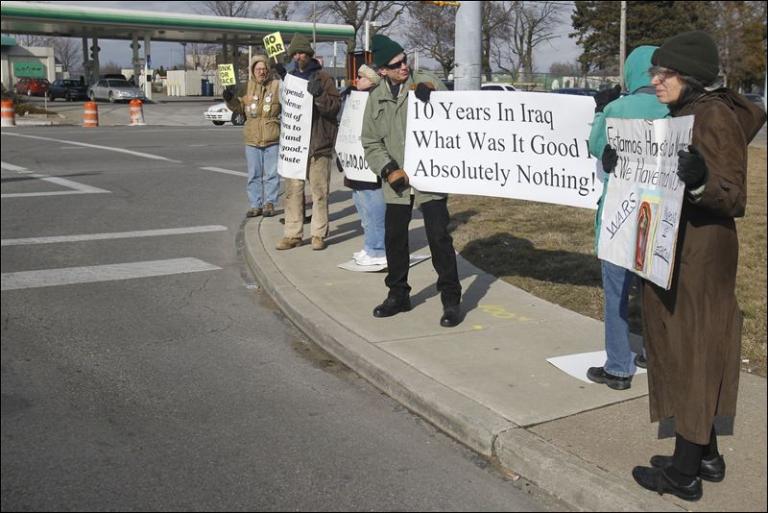
Courtesy of Toledo Blade
By Mark LeVine
A bit over a decade ago, in that liminal political period between September 11, 2001 and the US invasion of Iraq, I attended a reading by well-known German writer and Holocaust survivor Ruth Kluger of her just-translated memoir of life in the death camps, Still Alive: A Holocaust Girlhood Remembered. It was the height of the al-Aqsa intifada, and during the Q&A several audience members asked her about Israel’s treatment of Palestinians. How could Jews, who suffered unimaginably under the Nazis, in turn oppress Palestinians? They wondered.
Kluger’s response, in the still heavily German accented English that has all but died out with the passing of the last of the World War II generation of German-speaking Jews, was as simple as it was profound: “The Holocaust wasn’t a school,” she responded. “It didn’t teach you anything.” The only lesson, if that’s what it could be called, was survival. Indeed, all too often suffering hardened people’s hearts, making them less sympathetic to the plights of others, especially those perceived as adversaries.
I have often thought about Kluger’s remarks while travelling through the Middle East’s many conflict zones. Violence does not need to be genocidal to inflict unhealable scars, to teach lessons that cannot be learned. Americans have for two generations been forced to confront only the damage done to the perpetrators – its soldiers, who from Vietnam to Iraq have suffered injuries – mental as well as physical – by the hundreds of thousands as a result of the wars in which they’ve been ordered to fight. Only once since the start of World War II have Americans been victims en masse of such violence. Horrific as 9/11 was, it was only one day and one thousandth of a percent of the population that fell victim.
The rupture in the very fabric of American identity and ideals merely hints at the extent of the wounds experienced by other societies, like Iraq, where the victims far outnumber the perpetrators and the level of suffering is greater by orders of magnitude. We can imagine that George Bush, Dick Cheney, Tony Blair and the other masterminds behind the Iraq war and occupation have lost little sleep over the destruction they’ve wrought. The narcissism and sociopathic personalities they share seem, sadly, to be all too common among the political and military leaders around the world, in Bush’s America no less than Saddam’s Iraq.
The Enablers
But what of the enablers and errand-boys and girls of the Iraq war – the journalists who so eagerly parroted the lies and abdicated their responsibility to act as a check on governments’ propensity to resort to violence and war without legitimate justification. Not surprisingly, with the invasion’s 10th anniversary, those who either openly supported the invasion or did nothing to put the arguments for it to the test, are attempting to rewrite history to expiate their guilt in making the invasion possible.
A typical example of such historical revision is a piece by the Huffington Post’s Howard Fineman, who in 2003 was a senior editor at Newsweek covering the lead-up to the invasion. His article, “Iraq War 10th Anniversary Reminds Us Of The Questions We Didn’t Ask“, offers an object lesson in precisely how the media continues to abdicate its responsibility to have known better when there was still the chance to educate Americans about the disastrous adventure upon which they were about embark.
Fineman at least admits that he and other mainstream journalists were part of the “decision-making machinery” that led the country to war, which in his view included “elected lawmakers, appointed officials, and the national media”. As he explains it, “Too few questions were asked, too many assumptions were allowed to go unchallenged, too many voices of doubt were muffled or rejected in a toxic atmosphere of patriotism, ignorance and political fear.” He even owns up to “misguided patriotism” as part of the reason why he was so gullible when scepticism and distrust of those in power was most needed (not least from someone who was already a journalist in the Vietnam and Watergate eras and had already gone through this process several times before).
Justifying Ignorance
It is very well and good that Mr Fineman wants to admit he should not have been so gullible when wisdom was most desperately needed. But his admission is rendered worthless by the explanation he provides for his ignorance. “American ignorance of the Arab and Muslim worlds 10 years ago was alarmingly vast. More than ignorance, there was fear, prejudice and propaganda,” he explains.
Fineman’s justification for his ignorance – that it was merely part of a broader American ignorance of the Arab and Muslim worlds – is a lie. All the evidence was there for anyone who wanted to see it. To begin with, some journalists even in the mainstream press where consistenly challenging the official line. The then Knight Ridder (now McClatchy) news service, for example, was consistenly pushing back against the Bush Administration’s narrative, with a stream of articles by its Washington reporters whom colleagues like Fineman had to know were on to a good story (if he didn’t, then he really had no business working as a journalist). At the same time, leading progressive publications such as The Nation, Mother Jones, Tikkun and newer web-based media like Alternet were all filled with articles by the experts Fineman says were in such short supply, sharing their knowledge with anyone who cared to read. Democracy Now! And other progressive radio stations featured innumerable scholars in, from and with long experience studying the region.
As important, American universities were and remain filled with people who knew all about the Muslim world, and who were in fact desperately reaching out to anyone in the media or government who’d listen to explain the realities on the ground, from the bogus nature of the WMD argument to the surety of disaster if the US invaded. Fineman could have taken one day and driven, taken the metro or train, or flown to any East Coast university, from Washington to Boston, and met with the supposedly missing experts. Pretty much every legitimate scholar of the Middle East opposed the war, and yet no one not named Bernard Lewis, Fouad Ajami or Samuel Huntington was given the time of day by people like him. And progressive think tanks were putting out analyses on a weekly basis challenging every major claim of the warmongers.
Then there is the singularly important issue that the vast majority of experts engaged in the weapons inspection programme – Scott Ritter, Hans Blix, Joseph Wilson among them – were declaring that Iraq’s WMD programme did not exist in any substantive form and that the stories used to bolster the Bush Administration arguments were implausible.
Not to mention that millions of people around the world were screaming as loud as they could for the US not to invade. When the whole world is screaming at you not to do something, perhaps it’s a good idea to at least see what they’re screaming about.
Journalists of Conscience
Quite simply, no one who lived through Vietnam, who was old enough to have experienced the unmistakable lies and their aftermath (not to mention Watergate, the invasions of Grenada and Panama, the Iran-Contra Scandal), and who worked as a journalist, could claim ignorance. If Fineman and his colleagues were deaf, dumb and blind it was because they chose to cover their ears, tape their mouths, and close their eyes to reality.
For being guilty of such professional misconduct, Fineman and his colleagues should have been run out of the profession. Instead, they simply moved on, without consequence for aiding and abetting one of the biggest crimes against humanity of the last century, which almost brought the American economy to its knees and enabled the creation of a security-intelligence-military order in this country that has trampled the most basic rights enshrined in the Constitution.
In a different world, where journalists still had a shred of their former dignity, those who failed so miserably to do their jobs when they were most desperately needed would have left the profession, and devoted the last decade to working to redress the incredible harm this war did to the Iraqi people, never mind Americans and the world more broadly.
Instead, they merely write about their experiences and “hope [they] are the wiser now”, which seems pretty unlikely given the continued sorry state of reporting about the Middle East.
Meanwhile, whatever good might somehow come to Iraq, the reality is that the war was and remains one giant war crime, not to mention the greatest theft of citizens’ wealth in American, if not world, history (trillions of dollars and counting). As the drone wars heat up and the vioations of (once) Constitutional rights continues, the mainstream media remains largely compliant with Washington’s agenda, regardless of which party is in power. Yet we were constantly learning just how brazen the administration lies were, with new evidence that the CIA and MI6 were told before the Iraq invasion that there were no WMDs.
I have no idea if Mr Fineman ever visited Iraq unembedded in the wake of the US invasion and occupation that he enabled, and experienced the results of the nightmare he helped make possible. I did, and I would like to ask Mr Fineman: Do you still have that smell from Iraqi hospitals and morgues in your nose a decade later? Do you still see the blank stares of American soldiers patrolling the streets of Baghdad, so scared that they will barely say a word to you when you go up to them and offer a word of support or encouragement? Do you still feel the absolute fear in Fallujah, or the disgust of Iraqi doctors, without any medicine to treat their wounded because the US military couldn’t be bothered to provide adequate medical supplies even a year after the invasion (as they were required to do under international law)? Can you get the image of cars overloaded with multiple coffins on their roofs on the way to the daily funerals? Do you still feel the updraft from an Apache helicopter circling over your car, never knowing what slight movement or stop might cause the gunner to blow you out of existence?
What precisely is the price you paid for this war, Mr Fineman? And do you think your accounts are settled now with a lessons-learned column?
I hope Howard Fineman’s wisdom allows him and all the journalists and commentators who cheeleaded this war out of laziness, cowardice, incompetence, or all three to sleep at night. For millions of Iraqis, and Americans as well, such wisdom has come at a price he and his colleagues can neither imagine nor will ever have to pay.
This article was orginally published on Al Jazeera. Mark LeVine is professor of Middle Eastern history at UC Irvine and distinguished visiting professor at the Centre for Middle Eastern Studies at Lund University in Sweden and the author of the forthcoming book about the revolutions in the Arab world, The Five Year Old Who Toppled a Pharaoh. His book, Heavy Metal Islam, which focused on ‘rock and resistance and the struggle for soul’ in the evolving music scene of the Middle East and North Africa, was published in 2008.
Follow him on Twitter: @culturejamming
Previous Post

March 22, 2013
The Muslim Way to Handle a Divorce (Part II) - Separate with Kindness
Next Post

March 28, 2013 On DOMA, Proposition 8, Homosexuality and My Progressive Islamic Viewpoint
Browse Our Archives
Select a Category 2012 Elections 30 Dayd 30 Writers (2017) 30 Days 30 Writers 30 Days 30 Writers (2015) 30 Days 30 Writers (2016) 30 Days 30 Writers (2018) 30 Days 30 Writers 2017 Ali Asadullah Ali Eteraz Alper Bilgili Arthur Richards Asides Asma Uddin Black History Month Briefings Charles Turner Commentary Cyrus McGoldrick Eman H Aly Fatimah Popal Hajj Hajj and Dhul Hijjah Hesham Hassaballa Hisham Hellyer Ibrahim Abusharif Inas Younis Irfan Yusuf Jalal Baig Junaid Afeef Laila Alawa Laila Alwala Mas'ood Cajee Muqtedar Khan Nakia Jackson Newsmakers Parvez Ahmed Podcasts Rabia Chaudry Rafia Zakaria Ramadan Reviews Safiyyah Ally Saud Inam Shahed Amanullah Svend White The Opinionated Oncologist Visions Wajahat Ali Zahed Amanullah Zahir Janmohamed Zainab Khan
Select a Month November 2018 October 2018 September 2018 August 2018 July 2018 June 2018 May 2018 April 2018 March 2018 February 2018 January 2018 December 2017 November 2017 October 2017 September 2017 August 2017 July 2017 June 2017 May 2017 April 2017 March 2017 February 2017 January 2017 December 2016 November 2016 October 2016 September 2016 August 2016 July 2016 June 2016 May 2016 April 2016 March 2016 February 2016 January 2016 December 2015 November 2015 October 2015 September 2015 August 2015 July 2015 June 2015 May 2015 April 2015 March 2015 February 2015 January 2015 December 2014 November 2014 October 2014 September 2014 August 2014 July 2014 June 2014 May 2014 April 2014 March 2014 February 2014 January 2014 December 2013 November 2013 October 2013 September 2013 August 2013 July 2013 June 2013 May 2013 April 2013 March 2013 February 2013 January 2013 December 2012 November 2012 October 2012 September 2012 August 2012 July 2012 June 2012 May 2012 April 2012 March 2012 February 2012 January 2012 December 2011 November 2011 October 2011 September 2011 August 2011 July 2011 June 2011 May 2011 April 2011 March 2011 February 2011 January 2011 December 2010 November 2010 October 2010 September 2010 August 2010 July 2010 June 2010 May 2010 April 2010 March 2010 February 2010 January 2010 December 2009 November 2009 October 2009 September 2009 August 2009 July 2009 June 2009 May 2009 April 2009 March 2009 February 2009 January 2009 December 2008 November 2008 October 2008 September 2008 August 2008 July 2008 June 2008 May 2008 April 2008 March 2008 February 2008 January 2008 December 2007 November 2007 October 2007 September 2007 August 2007 July 2007 June 2007 May 2007 April 2007 March 2007 February 2007 January 2007 December 2006 November 2006 October 2006 September 2006 August 2006 July 2006 June 2006 May 2006 April 2006 March 2006 February 2006 January 2006 December 2005 November 2005 October 2005 September 2005 August 2005 July 2005 June 2005 May 2005 April 2005 March 2005 February 2005 January 2005 December 2004 November 2004 October 2004 September 2004 August 2004 July 2004 June 2004 May 2004 April 2004 March 2004 February 2004 January 2004 December 2003 November 2003 October 2003 September 2003 August 2003 July 2003 June 2003 May 2003 April 2003 March 2003 February 2003 January 2003 December 2002 November 2002 October 2002 September 2002 August 2002 July 2002 June 2002 May 2002 April 2002 March 2002
Follow Us!
TAKE THE
Religious Wisdom Quiz
What did the Israelites eat in the wilderness?
Select your answer to see how you score.
Bread and fish Honey and milk Manna Grapes and figs
Related posts from altmuslim

Mawlid 2018: Praise Songs from Around the World

Gaslighting, Anti-Jewish and Anti-Muslim Rhetoric: What to Know

How One Ottoman Reconciled Islamic Teachings with Darwin's...

As #TreeofLife Shows, Trump's Mainstreaming of Hate Puts...
TRENDING AT PATHEOS Muslim

25 Years Later: How Much Has Changed for...
As we approach the 25th anniversary of September 11th, I’ve found myself...

Podcast: Third Spaces & The Rise of Yemeni...
In the latest episode of The Artistic Foodies Podcast, hosts Abbas...

HalalFest Picks: Best 60 Halal Spots for Super...
Back in 2016, I came up with a list of 29...

Unity Is America’s Strength — Division Is Its...
by Hidayatullah Ahsan When Valentina Gomez, a Republican candidate for Congress in...

Zohran Mamdani and New York’s Fight Against Islamophobia
This past June, against all odds, Zohran Mamdani won the Democratic primary...

What the Fourth of July Means to a...
As we mark another Fourth of July, millions of Americans will celebrate...
view all Muslim blogs
Ad-Free & Subscriber Log-In Subscription Support
- About Us
- 2026 Calendar
- Videos
- Podcasts
- Library of World Religions
- Faith In Media Tracker
- Advertise With Us
- Write for Us
- Privacy Policy
- Terms of Service
- Do Not Sell My Data
- Contact Us
- Radiant Digital
- Manage Newsletter Subscriptions
- Unsubscribe From Notifications
- Sitemap
Copyright 2008-2026, Patheos. All rights reserved.
Subscription Support Ad-Free & Subscriber Log-In
Follow Patheos