
BuddhistCatholicContemplativeEvangelicalGeneral ChristianHinduJewishLatter-day SaintMuslimNew VisionsProgressive Christian
Beliefs
- Buddhist
- Catholic
- Contemplative
- Evangelical
- General Christian
- Hindu
- Jewish
- Latter-day Saint
- More Voices
- Muslim
- New Visions
- Pagan
- Progressive Christian
Topics
- Religion News
- Food and Religion
- Sports and Religion
- Religious Art
- Religious Music and Entertainment
- Religious Events
- History and Religion
- Style and Religion
- Politics and Religion
- Women in Religion
- Recreation Outdoors and Religion
- Business Finance and Religion
- Careers Workplace and Religion
- Education and Religion
- Family Parenting and Religion
- Health Fitness and Religion
- Home and Religion
- Relationships and Religion
- Technology and Religion
- Travel and Religion
Columnists
- Buddhist Columnists
- Business Finance and Religion Columnists
- Careers Workplace and Religion Columnists
- Catholic Columnists
- Contemplative Columnists
- Education and Religion Columnists
- Evangelists Columnists
- Family Parenting and Religion Columnists
- General Christian Columnists
- Health Fitness and Religion Columnists
- Hindu Columnists
- History and Religion Columnists
- Home and Religion Columnists
- Jewish Columnists
- More Voices Columnists
- Latter Day Columnists
- Muslim Columnists
- New Visions Columnists
- Nonreligious Columnists
- Pagan Columnists
- Politics and Religion Columnists
- Progressive Columnists
- Recreation Outdoors and Religion Columnists
- Relationships and Religion Columnists
- Religion News Columnists
- Religious Art Columnists
- Religious Events Columnists
- Religious Music and Entertainment Columnists
- Sports and Religion Columnists
- Style and Religion Columnists
- Technology and Religion Columnists
- Travel and Religion Columnists
- Women in Religion Columnists
Resource Library
- 2026 Calendar
- Library of World Religions
- The 100 Most Holy Places on Earth
- Patheos Answers
- Podcasts
- Videos
- Faith Leaders Database
- Anglican Episcopalian
- Bahai
- Baptist
- Buddhism
- Christianity
- Confucianism
- Eastern Orthodoxy
- Hinduism
- Holiness and Pentecostal
- ISKCON
- Islam
- Judaism
- Lutheran
- Methodist
- The Church of Jesus Christ of Latter-day Saints
- New Age
- Paganism
- Presbytarian and Reformed
- Protestantism
- Religion Behind the Scenes
- Roman Catholic
- Scientology
- Shia Islam
- Sikhism
- Sufism
- Sunni Islam
- Taoism
- Zen
- See all religions
Research Tools
 Ad-Free & Subscriber Log-In Subscription Support
Ad-Free & Subscriber Log-In Subscription Support
Follow Patheos 

- Trending:
- Forgiveness
- |
- Marriage
- |
- Consciousness
- |
- Death Penalty
- |
- Election
- |
- Halloween

- Home
- Progressive Christian
- Politics and Religion
- Why I converted to Catholicism in 2016
Why I converted to Catholicism in 2016
Last updated on: August 9, 2022 at 3:39 pm by Julie Nichols
Why I converted to Catholicism in 2016 2022-08-09T15:39:11-05:00 Julie Nichols
Patheos Explore the world's faith through different perspectives on religion and spirituality! Patheos has the views of the prevalent religions and spiritualities of the world.
Since I converted to Catholicism in 2016, many have asked, “why?” I believe there are faithful Christians from every Church body who are born into these bodies and know Christ in a particular way. I will always believe that the Lord honors faithfulness and goodness. Even the catechism of the Catholic Church recognizes faithfulness and goodness while Pope Francis says, “different faith traditions are pleasing to God.” In my opinion, nothing is more misunderstood than the Roman Catholic Church. The late Archbishop Fulton Sheen describes what I am trying to articulate.
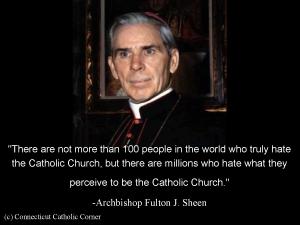
Now I am going to list the top five reasons why I converted to Catholicism. There are more reasons than these, but these are the most crucial.
Authority
Jesus Christ Himself started the Catholic Church, and He gave the authority to the Apostles to establish it, primarily St. Peter. EVERY single major secular history source, including Encyclopedia Britannia and the New World Encyclopedia state this from a historical perspective.
https://www.britannica.com/topic/Roman-Catholicism
http://www.newworldencyclopedia.org/e…/Roman_Catholic_Church
There are additional secular sources at the end, and they all say that Jesus and the Apostles started the Catholic Church.
- St. Peter is given the keys of the kingdom by Jesus to start the Church.–Matthew 16:15-19
- St. Peter is mentioned more than all of the other Apostles put together—Mark 16:5-8, Luke 24:12-16, Acts 2:14-16, Acts 3:4-10, Acts 10:44-46, and Acts 15:5-10
- His name starts at the top of every Apostle list.—–Matthew 10:1-4, Mark 3:16-19, Acts 1:12-16
- Many accounts from the Church Fathers both East and West throughout centuries refer to the authority/primacy of Peter.
- Pope Francis is 266th Successor to St. Peter. EVERY major secular textbook says this. Watch the video and scroll down to the list of Popes in Encyclopedia Britannica. https://www.britannica.com/topic/pope
The Apostles were the first Bishops of the Church, and they have an unbroken line of succession all the way to the Bishops, priests, and deacons we have today. This is called Apostolic Succession. This “pedigree” was essential in the Early Church because it has passed down the faith delivered by Christ and the saints. Bishop Barron explains this well in this video while it’s defined well in Encyclopedia Britannica.
https://www.britannica.com/topic/apostolic-succession
——–The Early Church was distinctly Catholic from the start in theology and beliefs, and those beliefs didn’t change until the Protestant Reformation, not one. The Orthodox and Catholic Churches still hold these beliefs after 2000 years.
The Bible is a Catholic Book
God used fallible men to write and canonize the New Testament which wasn’t canonized until the late fourth century by the Council of Hippo and the Council of Carthage .
Here is a video from a top Catholic Bible scholar, Dr. Brant Pitre, on the subject of Bible Origin.
Jesus did not hand His Apostles a Bible. He started the Church and gave the Apostles the authority to establish The Church. I could no longer understand the Bible under the doctrine of Sola Scriptura which didn’t start until the 1500s, some say later. I couldn’t interpret the Bible for myself although I had read it for years.
Even Martin Luther himself admitted that the misinterpretation of Scripture and the lack of Church authority were huge problems.
- “If the world lasts for a long time, it will again be necessary, on account of the many interpretations which are now given to the Scriptures, to receive the decrees of councils, and take refuge in them, in order to preserve the unity of faith.” .” Epis. ad. Zwingli (ap. Balmes, p. 423)
- “There are almost as many sects and beliefs as there are heads; this one will not admit Baptism; that one rejects the Sacrament of the altar; another places another world between the present one and the day of judgment; some teach that Jesus Christ is not God. There is not an individual, however clownish he may be, who does not claim to be inspired by the Holy Ghost, and who does not put forth as prophecies his ravings and dreams.” “An Meine Kritiker” (by Johannes Jorgensen, p. 181).
Worship
Christians from the first century on had a priest/presbyter in their Church, and He provided the Eucharist to God’s people. From the very start of the Church until the 1500s, Christians believed the consecrated elements became the actual Body and Blood of Christ. Even Martin Luther and Henry VIII believed in the Real Presence Doctrine of the Eucharist. The Orthodox Church did not break the historic priesthood and start a new Church with new theology and new teachings. Confession and repentance of sin have been a part of receiving the Eucharist for 2000 years in the Roman Catholic and Eastern Orth9odox traditions. Centuries of Church history and the Church Fathers support this.
The Protestant reformers sharply disagreed with each other and each started their own church after Martin Luther in 1517. Here is a list of quotes from Protestant Reformers confirmed by a late Presbyterian seminary.
- Luther and Lutherans on Zwingli and His Followers: – “I will not read the works of these people, because they are out of the Church, and are not only damned themselves, but draw many miserable creatures after them.” (113;v.1:466)
- “Zwingli was an offspring of hell, an associate of Arius (13), a man who did not deserve to be prayed for . . .” (113;v.1:466)
- “Zwingli was greedy of honour . . . he had learnt nothing from me . . . Oecolampadius thought himself too learned to listen to me or to learn from me.” (51;v.4:309/14)
- “Zwinglians . . . are fighting against God and the sacraments as the most inveterate enemies of the Divine Word.” (111;v.5:220-21/15)
- “Heretics who had broken away . . . ministers of Satan, against whom no exercise of severity, however great, would be excessive.” (50:286)
- “It would be better to announce eternal damnation than salvation after the style of Zwingli or Oecolampadius.” (46:85)
- Luther rejoiced at the news of Zwingli’s death on the battlefield in 1531, and said that he had met “an assassin’s end” (46:86). And when Zwingli’s associate Oecolampadius shortly followed him to the grave, Luther concluded that “the devil’s blows have killed him.” (46:86)
- “It is well that Zwingli . . . lies dead on the battlefield . . . Oh, what a triumph this is . . . How well God knows his business.” (45:139)
- “Zwingli is dead and damned, having desired like a thief and a rebel, to compel others to follow his error.” (113; v.1:466)
- The Lutherans proclaimed in full synod:
- “The Zwinglians . . . we do not even grant to them a place in the church, far from recognizing as brethren, a set of people, whom we see agitated by the spirit of lying, and uttering blasphemies against the Son of Man.” (113;v.1:466)
2. Zwingli and His Cohorts on Luther:
- Zwingli, not to be outdone, returned the compliment:
- “The devil has made himself master of Luther, to such a degree, as to make one believe he wishes to gain entire possession of him.” (113;v.1:463)
- “To see him in the midst of his followers, you would believe him to be possessed by a phalanx of devils.” (113;v.1:464)
- “We do you no injustice when we reproach and condemn you as a worse betrayer and denier of Christ than the ancient heretic Marcion (16).” (50:288)Oecolampadius was also not without a retort:
- “He is puffed up with pride and arrogance, and seduced by Satan.” (113;v.1:463)
- Zwingli’s Church of Zurich wrote of Luther:
- “He will not and can not associate himself with those who confess Christ . . . He wrote all his works by the impulse and the dictation of the devil.” (113;v.1:464)
- At least the insults exhibit some vehemence, perhaps revealing the felt importance of their object. Today, on the other hand, many Protestants are utterly indifferent towards Luther, as if their faith was a product solely of their own invention and ingenuity; oftentimes, such self-professed generic “Christians” eschew even the title of “Protestant.
3. Luther on Bucer:
- “They think much of themselves, which, indeed, is the cause and wellspring of all heresies . . . Thus Zwingli and Bucer now put forward a new doctrine . . . So dangerous a thing is pride in the clergy.” (51;v.6:283/17)
- “A gossip . . . a miscreant through and through . . . I trust him not at all, for Paul says (18) `A man that is a heretic, after the first and second admonition, avoid.'” (51;v.6:289/19)
4. Luther on Calvin and Oecolampadius
- “Oecolampadius, Calvin . . . and the other heretics have in-deviled, through-deviled, over-deviled, corrupt hearts and lying mouths.” (122:448/20)
5. Calvin on Luther and Lutherans:
- “What to think of Luther I know not . . . with his firmness there is mixed up a good deal of obstinacy . . . Nothing can be safe as long as that rage for contention shall agitate us . . . Luther . . . will never be able to join along with us in . . . the pure truth of God. For he has sinned against it not only from vainglory . . . but also from ignorance and the grossest extravagance. For what absurdities he pawned upon us . . . when he said the bread is the very body! . . . a very foul error. What can I say of the partisans of that cause? Do they not romance more wildly than Marcion respecting the body of Christ? . . . Wherefore if you have an influence or authority over Martin, use it . . . that he himself submit to the truth which he is now manifestly attacking . . . Contrive that Luther . . . cease to bear himself so imperiously.” (126:46-8/21)
- “Luther had done nothing to any purpose . . . people ought not to let themselves be duped by following his steps and being half-papist; it is much better to build a church entirely afresh.” (113;v.1:465)
- “I am carefully on the watch that Lutheranism gain no ground, nor be introduced into France. The best means . . . for checking the evil would be that the confession written by me . . . should be published.” (126:76/22)
6. Calvin on Zwingli:
- Historian Philip Hughes tells us that Calvin “abhorred” Zwingli also. (45:229)
7. Calvin on Melanchthon:
- Calvin had some sort of friendship with Melanchthon (rare among differing Protestant leaders), but wrote harshly of him in letters to others:
- “He openly opposes sound doctrine; or . . . cunningly, or at least, with but little manliness, disguises his own opinion . . . The inconstancy of Philip moves both my anger and detestation.” (126:52,65/23)
8. Melanchthon on Zwingli
- The timid Melanchthon was “manly” enough, however, to launch at least one salvo against Zwingli:
- “Zwingli says almost nothing about Christian sanctity. He simply follows the Pelagians, the Papists and the philosophers.” (46:261)
9. Bucer on Calvin:
- Despite theological affinities, Bucer had quite a low opinion of Calvin:
- “Calvin is a true mad dog. The man is wicked, and he judges of people according as he loves or hates them.” (113;v.1:467)
10. Luther on Protestant “Heretics”:
- “Heresiarchs . . . remain obdurate in their own conceit. They allow none to find fault with them and brook no opposition. This is the sin against the Holy Ghost for which there is no forgiveness.” (51;v.6:282/24)
- “Those are heretics and apostates who follow their own ideas rather than the common tradition of Christendom, who . . . out of pure wantonness, invent new ways and methods.” (51;v.6:282-3/25)
11. Grisar adds:
- “In his frame of mind it became at last an impossibility for him to realise that his hostility and intolerance towards `heretics’ within his fold could redound on himself.” (51;v.6:283)
- “We must needs decry the fanatics as damned . . . They actually dare to pick holes in our doctrine; ah, the scoundrelly rabble do a great injury to our Evangel.” (51; v.6:289/26)
- “I am on the heels of the Sacramentaries (27) and the Anabaptists; . . . I shall challenge them to fight; and I shall trample them all underfoot.” (46:86)
The Catholic Church is rooted in Jesus Christ, the Apostles, and the Church Fathers and what they said collectively and with uniformity over centuries starting in the first century. The New Testament came from the Church Fathers and the Inspiration of the Holy Spirit, not the Bible from the start of the Church.
My journey to the Catholic Church and the ups and downs of Protestantism and Anglicanism have been wonderful yet rocky at times. I will always be grateful to both the Baptist and the Anglican traditions for my faith in Christ today. After my personal faith journey, converting to Catholicism was the resting place on the Church Christ founded.
God bless everyone, all brothers and sisters in Christ!
________________________________________________________________________________
Who started the Catholic Church? Secular Sources Say Jesus Christ
- The New Book of Knowledge, Page 287
“Roman Catholic Church –the history of the Roman Catholic Church begun in an upper room in Jerusalem almost 2,000 years ago. About 120 persons were gathered there. They were followers of Jesus Christ, and they were awaiting the coming of Holy Spirit he had promised to send them from heaven. The day on which the Holy Spirit came down is considered the birthday of the Church. The Church may be described as the society that Jesus founded, which is vitalized by the Spirit of God and organized to a structure which he establish. The history of Roman Catholic Church traces the destinies of that society from its beginning until now.”
2. The World Almanac and Book of Facts <Edition 2009> Page 688
“Roman Catholics –traditionally founded by Jesus who named St. Peter the 1stvicar, developed in early Christian proselytizing, especially after the conversion of imperial Rome in the 4thcentury.”
- The Old World and America, Page 100
“More than 1900 years ago, Jesus Christ Son of God, came upon earth to save mankind. After His atoning death on the cross He rose glorious and immortal. Before leaving this world to go to the Father, Our Lord founded the Catholic Church and gave to that Church the command to teach all nations.”
- The New Webster’s Dictionary of English Language <International Edition> Page 155.
” Catholic – of the original Christian Church before the schism between East and West – of the Roman or Western Church after this schism and before the reformation.”
- International Encyclopedia, Volume 20, Page 520 “Roman Catholic Church – There are two equally valid definition of the Catholic Church, comparable to the twofold nature of Jesus Christ, its founder, who was both human and divine.”
- Young Students Encyclopedia, Volume 17, Page 261
“Roman Catholicism – the largest of the Christian denomination is the Roman Catholic Church. As an institution it has existed since the 1stcentury AD. For the first 1,000 years all christians belongs to Catholic Church”
- Compton’s Encyclopedia & Fact-Index, Volume 20, Page 2024
“Roman Catholic Church – For the first thousand years after the death of Jesus Christ, all Christians were members of one religion – Christianity. There were no separate sects, or branches, of Christianity as there are today. The word “catholic” means “universal,” and for those first thousand years, all Christians were members of the Catholic Church.”.
- Grollier Encyclopedia, Volume V, page 106
“Catholic Church – (Gr. Katholikos, universal, general). Term generally applied to the Divine society founded by Jesus Christ, and endowed by the outpouring of the Holy Ghost on the day of Pentecost”
- Encyclopedia Britannica
“Catholic Church – a Christian church that has been the decisive spiritual force in the history of western civilization. The Catholic Church traces its history to Jesus Christ and the Apostles.”
- The New American Desk Encyclopedia, Page 267
“Catholic Church – the community of Christian believers, a society founded by Jesus Christ. It is One, Holy, Catholic & Apostolic.”
- The World Book Encyclopedia, Vol.13, Page 5730
“The Catholic Church recognizes the Bishop of Rome, the Pope, as the vicar of Christ on Earth. It traces its origin from the naming of Apostle Peter as the Chief of Apostles.”
- The National Almanac 1996
“Roman Catholic authority rests upon the mandate that is traced to the action of Jesus Christ himself, when he vested Peter and through Peter his successors with the power of the keys in the Church. Christ is the invisible head of the Church and by his authority, the Pope is the visible head.”
Previous Post

August 8, 2022
"Wokeness," Liberalism, and Socialism vs. The GOP Jesus
Next Post
August 11, 2022 The Chair of Peter or Donald Trump
Browse Our Archives
Select a Category Uncategorized
Select a Month April 2026 March 2026 January 2026 December 2025 July 2025 May 2025 March 2025 February 2025 January 2025 December 2024 November 2024 October 2024 September 2024 August 2024 July 2024 April 2024 March 2024 February 2024 January 2024 December 2023 November 2023 October 2023 September 2023 August 2023 July 2023 June 2023 May 2023 April 2023 March 2023 February 2023 January 2023 December 2022 November 2022 October 2022 September 2022 August 2022
TAKE THE
Religious Wisdom Quiz
What book comes after Proverbs?
Select your answer to see how you score.
Psalms Isaiah Daniel Ecclesiastes
Related posts from All Texans, Not Some Texans
Reconciling Spirituality and a LGBTQ+ Ally's and Mom's...
Traditional Settings, Inclusivity, & LGBTQ+ Affirmation
Reembracing Black Spirituality; MAGA White Church Betrayal
Republican Reactions to McCain Were a Warning Sign...
TRENDING AT PATHEOS Progressive Christian

The Iron Gates and the Lion of the...
Yesterday, I didn't finish my report about, well, yesterday. So I'll...

Dolly Parton’s Last Song Wins Dove Award with...
Bluegrass band The Grascals, speaking on the red carpet at the 57th...

The Image: On the Horror of Capitalism and...
The Image Then went the Pharisees, and took counsel how they might...

We are approaching the date of our new American national holiday: October...

Letters on Living the Faith by C.S. Lewis
Most of us met C.S. Lewis as a public intellectual. Mere Christianity....

When Halloween Unmasks Married Hearts
Written by Dr. David K. Ewen from Eternal Truth Bible College Behind...
view all Progressive Christian blogs
Ad-Free & Subscriber Log-In Subscription Support
- About Us
- 2026 Calendar
- Videos
- Podcasts
- Library of World Religions
- Faith In Media Tracker
- Advertise With Us
- Write for Us
- Privacy Policy
- Terms of Service
- Do Not Sell My Data
- Contact Us
- Radiant Digital
- Manage Newsletter Subscriptions
- Unsubscribe From Notifications
- Sitemap
Copyright 2008-2026, Patheos. All rights reserved.
Subscription Support Ad-Free & Subscriber Log-In
Follow Patheos