
BuddhistCatholicContemplativeEvangelicalGeneral ChristianHinduJewishLatter-day SaintMuslimNew VisionsProgressive Christian
Beliefs
- Buddhist
- Catholic
- Contemplative
- Evangelical
- General Christian
- Hindu
- Jewish
- Latter-day Saint
- More Voices
- Muslim
- New Visions
- Pagan
- Progressive Christian
Topics
- Religion News
- Food and Religion
- Sports and Religion
- Religious Art
- Religious Music and Entertainment
- Religious Events
- History and Religion
- Style and Religion
- Politics and Religion
- Women in Religion
- Recreation Outdoors and Religion
- Business Finance and Religion
- Careers Workplace and Religion
- Education and Religion
- Family Parenting and Religion
- Health Fitness and Religion
- Home and Religion
- Relationships and Religion
- Technology and Religion
- Travel and Religion
Columnists
- Buddhist Columnists
- Business Finance and Religion Columnists
- Careers Workplace and Religion Columnists
- Catholic Columnists
- Contemplative Columnists
- Education and Religion Columnists
- Evangelists Columnists
- Family Parenting and Religion Columnists
- General Christian Columnists
- Health Fitness and Religion Columnists
- Hindu Columnists
- History and Religion Columnists
- Home and Religion Columnists
- Jewish Columnists
- More Voices Columnists
- Latter Day Columnists
- Muslim Columnists
- New Visions Columnists
- Nonreligious Columnists
- Pagan Columnists
- Politics and Religion Columnists
- Progressive Columnists
- Recreation Outdoors and Religion Columnists
- Relationships and Religion Columnists
- Religion News Columnists
- Religious Art Columnists
- Religious Events Columnists
- Religious Music and Entertainment Columnists
- Sports and Religion Columnists
- Style and Religion Columnists
- Technology and Religion Columnists
- Travel and Religion Columnists
- Women in Religion Columnists
Resource Library
- 2026 Calendar
- Library of World Religions
- The 100 Most Holy Places on Earth
- Patheos Answers
- Podcasts
- Videos
- Faith Leaders Database
- Anglican Episcopalian
- Bahai
- Baptist
- Buddhism
- Christianity
- Confucianism
- Eastern Orthodoxy
- Hinduism
- Holiness and Pentecostal
- ISKCON
- Islam
- Judaism
- Lutheran
- Methodist
- The Church of Jesus Christ of Latter-day Saints
- New Age
- Paganism
- Presbytarian and Reformed
- Protestantism
- Religion Behind the Scenes
- Roman Catholic
- Scientology
- Shia Islam
- Sikhism
- Sufism
- Sunni Islam
- Taoism
- Zen
- See all religions
Research Tools
 Ad-Free & Subscriber Log-In Subscription Support
Ad-Free & Subscriber Log-In Subscription Support
Follow Patheos 

- Trending:
- Forgiveness
- |
- Marriage
- |
- Consciousness
- |
- Death Penalty
- |
- Election
- |
- Halloween

- Home
- Progressive Christian
- Religion News
- 10 Things The Last of Us Teaches Us About Our World
10 Things The Last of Us Teaches Us About Our World
Last updated on: April 2, 2026 at 8:03 am by Matthew Distefano
10 Things The Last of Us Teaches Us About Our World 2026-04-02T08:03:04-06:00 Matthew Distefano
Patheos Explore the world's faith through different perspectives on religion and spirituality! Patheos has the views of the prevalent religions and spiritualities of the world.
Note: Spoilers for The Last of Us (Part I and II) ahead.
I didn’t write a book about The Last of Us because I was trying to be clever. Rather, I wrote it because I couldn’t stop thinking about it. Because after playing both games repeatedly, I kept asking questions that no amount of ruminating could answer.
Questions like: Why does a story about a fungal apocalypse feel more honest than the real-world news? Why does Joel’s lie feel more complicated than most sermons I’ve ever heard? Why does Ellie’s grief feel more real than the grief we witness certain widows perform in front of the cameras?
The answer, I think, is that The Last of Us is simply a story about the world we’re already living in, though it is set in a fictional apocalypse (but are these really that different?).
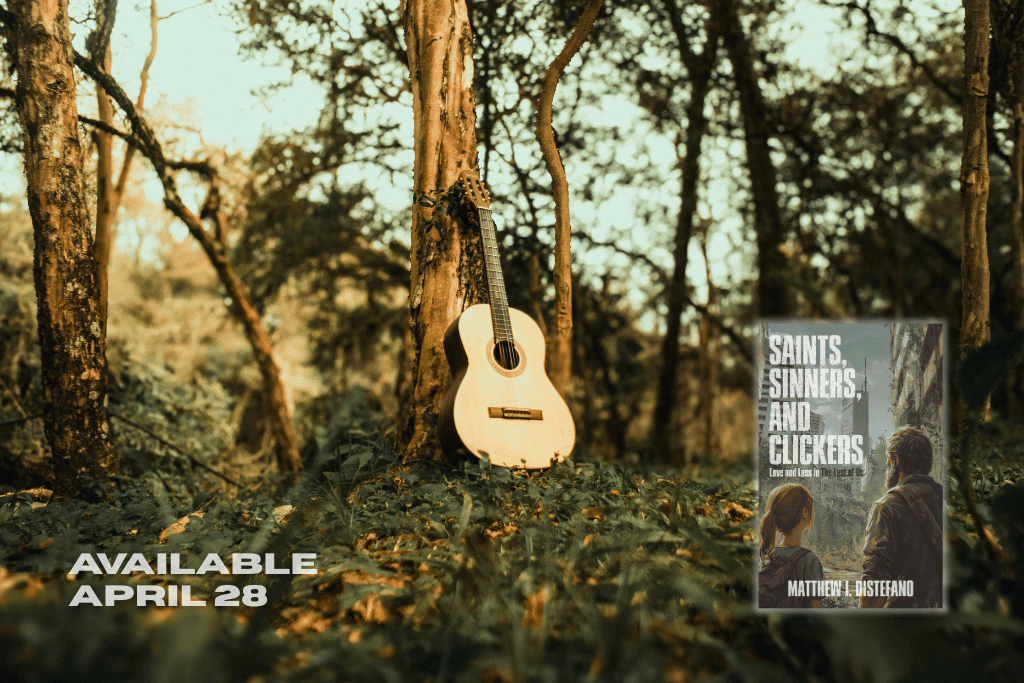
So, before my book Saints, Sinners, and Clickers drops on April 28, here are ten things this brutal, beautiful franchise—and apocalyptic storytelling more broadly—can teach us about the moment we’re living through.
1. The Infected Were Never the Real Threat
The thing about the infected is they’re predictable. Joel’s “friend” Bill says it plainly: ‘as bad as those things are, at least they’re predictable. It’s the normal people that scare me.’ And he’s right. In The Last of Us, the runners and bloaters are terrifying, sure, but it’s FEDRA’s soldiers who shoot children at checkpoints. It’s David’s little commune that practices cannibalism under a thin, Calvinistic coat of scripture. It’s the Fireflies who strap a fourteen-year-old to a table without asking her permission.
The thing we should fear most in our world isn’t some external monster—not the immigrant, not the radical, not the Other with a capital O. It’s what we, the so-called “normal” people, are willing to do when fear gets enough leverage on us. The apocalypse, in fiction and in life, reveals that we are the monsters we fear. We are the ones we were warned about.
2. Authoritarians Start Out as Liberation Movements
The Fireflies began as freedom fighters. Freedom, liberation, and the restoration of the constitutional republic all sounded great on paper. Their motto was poetic: ‘When you’re lost in the darkness, look for the light’ It’s terribly difficult to argue with that.
Then they gained access to power and immediately started doing things that looked suspiciously like the people they were fighting against.
Likewise, the Washington Liberation Front overthrew FEDRA in Seattle and then built something that, in the words of the game itself, looked an awful lot like the system they’d just destroyed. Meet the new boss. Same as the old boss.
This isn’t cynicism for cynicism’s sake. But it is mimetic theory 101 (something Saints, Sinners, and Clickers explores on multiple occasions, borrowing from the work of René Girard). We become what we fight, imitating our enemies the entire time, building new cages from the rubble of old ones and calling it liberation.
This should give every revolutionary movement serious pause. The revolution that believes it is exempt from this pattern is the most dangerous revolution of all.
3. Survival Without Something to Survive For Is Just a Slow Death
Joel Miller survived for twenty years after his daughter Sarah died. He ate, breathed, traded, fought, and killed his way through a collapsed civilization. And by any metric, he was succeeding at survival.
He was also, in every way that mattered, completely dead inside.
The Last of Us is insistent on the fact that staying alive is the lowest bar, not the highest calling. Ellie reads ‘Endure and survive’ from her Savage Starlight comic, half as a joke and half as a desperate prayer. But the story keeps pushing us toward the harder question: endure and survive for what?
We live in an era obsessed with productivity, optimization, and the hustle. It is a cultural moment that treats mere continuation as the goal. Get through the week. Make it to the weekend. Survive the quarter. But people don’t flourish on survival alone. We need meaning. We need something or someone to fight for, or we become exactly the type of soulless machine Joel becomes.
The antidote to despair is never comfort. It’s purpose. And purpose, unlike comfort, requires risking something.
4. Trauma Doesn’t Excuse Us, But It Does Explain Us
One of the reasons The Last of Us hits so hard is that it refuses to let anyone off the hook while simultaneously refusing to let anyone be simply, conveniently evil. Joel is a liar and a murderer. He is also a devastated father. Abby is a war criminal. She is also a grieving daughter who watched her father get executed in front of her. Ellie burns everything she loves to the ground. She is also a teenager who was robbed of agency, meaning, and the chance to grieve honestly.
These things are all simultaneously true.
We live in a culture that too often swings between two equally useless poles: either trauma explains and therefore excuses everything, or it explains nothing and everyone should just get over it. The Last of Us rejects both. Trauma is real. It shapes us in ways we can’t always control. But it doesn’t determine us absolutely. The space between ‘this happened to me’ and ‘this is what I do next’ is where all the moral weight lives.
Joel’s lie to Ellie at the end of Part I is born of trauma, but it’s still a lie. Both of those things are true. Holding them together without binarily collapsing into either pure condemnation or pure excuse is the hard work of actually understanding what it means to be human.
5. The “Good Guy With a Gun” Myth Is Dead
Joel Miller is our case study in the death of the Manichean hero. He doesn’t exist in The Last of Us, and if we’re being honest, he didn’t really exist anywhere else either. We just preferred the illusion.
In the Salt Lake City hospital, Joel doesn’t save Ellie because it’s the morally correct answer to the trolley problem (is there one?). He saves her because he cannot survive another loss. He’s not heroic. He’s desperate. And in that desperation, he slaughters an entire floor of medical professionals, including a surgeon who was, at least in the way the story sets things up, trying to save the world.
We understand Joel. Most of us, if we’re honest, would have done the same thing to save our “baby girl.” And that is the most unsettling truth in the entire franchise.
What The Last of Us understands (and what our culture badly needs to reckon with) is that the person most convinced of their own righteousness is often the most dangerous person in the room. Joel doesn’t think of himself as a villain. Neither do the Fireflies. Neither does FEDRA. Hell, neither does David. Everyone in this story believes they’re protecting something sacred.
6. Community Is Both the Best and Worst Thing About Us
Jackson, Wyoming, in The Last of Us universe, is the closest thing to utopia the apocalypse offers. Children laugh and crops grow. And there are actual holiday dances and movie nights. It’s warm and communal and almost achingly normal.
It also has a wall, tons of guns and ammo, a bigot named Seth, and rules that can get you exiled or worse.
The thing about community is we can’t live without it, and we inevitably corrupt it. We bring our prejudices, our power dynamics, our need for scapegoats, and our tribal instincts to every collective we build. The Seraphites started as a community organized around simplicity and egalitarianism, and then ended up gutting people as a religious ritual.
The WLF started as a liberation movement and became an authoritarian military state. FEDRA was supposed to protect people and devolved into a fascistic police apparatus.
This doesn’t mean community is hopeless. But it does mean it requires unceasing vigilance, humility, and the willingness to name the rot when it appears, especially when the rot is looking back at us through in a mirror. The communities that survive with any integrity intact are the ones willing to confront their own shadows. The ones that aren’t end up building new prisons from the rubble of the old ones.
7. Vengeance Is a Wave That Destroys Everything on Its Way to Shore
Ellie’s arc in Part II is one of the most grueling things I have ever experienced in any medium. You watch her lose Jesse, lose Dina (effectively), lose JJ, lose two fingers, lose her ability to play the guitar Joel taught her, all in service of a vengeance that, if we’re being ruthlessly honest, she knew going in wouldn’t actually heal her.
And yet. Off she goes.
This is the most honest depiction of the revenge fantasy I’ve ever encountered, precisely because it refuses to be a fantasy. It shows us, beat by brutal beat, what vengeance actually costs. Not just in bodies—though there are plenty of those—but in the pieces of yourself you burn along the way.
Abby gets her revenge on Joel at the beginning of Part II. She finishes the job. She “wins.” And then she stands there in the aftermath, surrounded by the bodies of almost everyone she loved, still haunted by nightmares and still disturbingly empty.
The cycle only breaks when someone decides not to complete it. Not because they’ve necessarily found peace, or achieved closure, or arrived at some neat narrative resolution, but because they’re exhausted enough to glimpse what mercy might feel like.
We are a civilization in love with the revenge narrative. We have built entire political movements on it. We should all be paying very close attention to what The Last of Us has to say about where that road actually leads.
8. The Truth Is Complicated
Joel’s lie to Ellie at the end of Part I is simultaneously one of the most loving and most destructive things one person does to another in the entire franchise. He lies to protect her. He lies because he cannot lose her. He lies because, on some level, he doesn’t think she can bear the weight of the truth.
And here’s the genuinely uncomfortable thing: he might be right.
But it doesn’’’t matter. Because the lie robs Ellie of her agency. It steals her ability to decide for herself what her life should mean, what her immunity should mean, what the Fireflies’ plan should mean. It turns her into a character in a story someone else is writing, a story she didn’t choose and wasn’t told about.
This is what we do to each other all the time, in families and in politics and in religion. We tell ourselves we’re protecting people from hard truths. We’re cushioning the unbearable. We’re being “merciful.” And sometimes we are. But often, we’re protecting ourselves from the discomfort of being honest. We’re controlling the narrative. We’re deciding what other people get to know about their own lives.
Joel pays for this with his life. The people around him pay for it with their peace. The story suggests there’s almost no version of this that ends well. Not because honesty is always kind, but because deception, no matter how loving its origins, tends to compound interest at a rate that eventually bankrupts everyone involved.
9. Nature Doesn’t Care About Our Feelings
One of the quietest and most radical things about The Last of Us is what happens to the world after humanity loses its grip on it. In all reality, it gets better.
Giraffes wander through the ruins of skyscrapers. Ivy swallows highways. Deer reclaim the suburbs. The planet doesn’t mourn the loss of our infrastructure and never pauses to eulogize our civilization. It just exhales and gets back to doing what it was doing before we arrived and decided we owned everything.
This is uncomfortable information for a species that has staked its entire self-image on being the protagonists of Earth’s story. The Last of Us gently, insistently, and sometimes brutally suggests that we might be more like a particularly aggressive invasive species in need of substantial pruning.
In my book, I call this a ‘rewilded eschatology’—an end-of-the-world story that doesn’t end with judgment, but with recalibration. The Cordyceps outbreak is fictional, but the ecological truth it’s built on is very real. We have been living so far outside of balance with the natural world that any movement back toward homeostasis is going to feel, from our side of things, like catastrophe.
10. Mercy Is Harder Than Violence
At the end of Part II, Ellie has Abby pinned beneath the waves in the shallows off Santa Barbara. She is drowning her. Finally. Abby is too weak to fight back. Ellie’s fingers—most of them, anyway—are wrapped around her enemy’s throat.
And then she stops, not because she suddenly achieves inner peace or because she’s become a saint or received divine revelation or completed a tidy redemption arc. She stops because she remembers Joel playing guitar on his front porch. A single image. An improbable and eucatastrophic grace.
She lets Abby go.
Tolkien called it eucatastrophe and described it as the sudden turn that pierces the darkness without denying it, the moment of grace that arrives not because it was earned or deserved but because someone, against all odds and all reasonable expectations, chose differently.
We live in a moment that glorifies toughness and mistakes cruelty for strength. A moment that sees mercy as naivety and calls vengeance ‘justice.’ The Last of Us looks at all of that and says, very quietly but very firmly: you’re wrong. You’ve always been wrong. And the way through is to put down the knife.
Saints, Sinners, and Clickers: Love and Loss in The Last of Us, is available April 28, 2026 from Quoir.
Religious Art
About Matthew J. Distefano
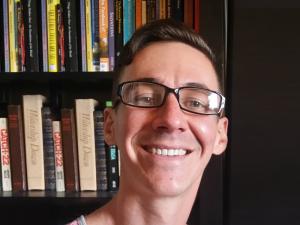
Matthew J. Distefano is an award-winning author, best known for The Wisdom of Hobbits and Mimetic Theory & Middle-earth. He is the co-host of the popular Heretic Happy Hour podcast, co-owner of Quoir Publishing, and owner of Happy Woods Farm—a small permaculture farm nestled in the Sierra Nevada foothills of California. Matthew's thought-provoking work explores spirituality, theology, philosophy, politics, and culture, and his writing has been featured in Sojourners, Patheos, and beyond. He is a graduate of Chico State University, and when he's not writing, farming, or playing The Last of Us, he enjoys spending time with his wife and daughter. You can read more about the author here.
Previous Post
March 22, 2026
A Second Coming That Undoes the First
Next Post
April 14, 2026 The Strange Line MAGA Christianity Just Decided to Draw
Recent Comments
"I have to admit I was stunned by this show. I couldn't tell if y'all ..."
Addressing the Recent Heretic Happy Hour ..."
"I'm so perplexed at how people who talk about others (women, immigrants, etc) with such ..."
Addressing the Recent Heretic Happy Hour ..."
"Guys like Andrew miss the whole point of being Christian, relationship at any cost, hence ..."
I Debated Andrew Wilson, Here’s What ..."
"I went to an evangelical website and ask them why they would vote for Trump ..."
An Evangelical Case for Trump as ..."
Browse Our Archives
Select a Category Atonement Book Review Early Church Eschatology eternal torment Hell Hermeneutics LGBTQ+ Mimetic Theory Mysticism News Old Testament Podcast Poetry Politics Prayer Religion Sacrifice Satire Soteriology Theology Uncategorized Violence
Select a Month October 2026 September 2026 August 2026 July 2026 June 2026 May 2026 April 2026 March 2026 February 2026 June 2025 December 2024 November 2024 October 2024 September 2024 August 2024 July 2024 June 2024 May 2024 April 2024 February 2024 January 2024 December 2023 November 2023 October 2023 September 2023 August 2023 June 2023 April 2023 March 2023 February 2023 January 2023 December 2022 November 2022 October 2022 September 2022 August 2022 July 2022 June 2022 May 2022 April 2022 March 2022 February 2022 January 2022 December 2021 November 2021 October 2021 September 2021 August 2021 July 2021 June 2021 May 2021 April 2021 March 2021 February 2021 January 2021 December 2020 November 2020 June 2019 May 2019 April 2019 March 2019 January 2019 December 2018 November 2018 October 2018 September 2018 August 2018 July 2018 June 2018 May 2018 April 2018 March 2018 February 2018 January 2018 December 2017 November 2017 October 2017 July 2017 June 2017 May 2017 April 2017 March 2017 February 2017 January 2017 December 2016 November 2016 October 2016 September 2016 July 2016 June 2016 May 2016 April 2016 March 2016 February 2016 January 2016 December 2015 November 2015 October 2015 September 2015 August 2015 July 2015 June 2015
Follow Us!
TAKE THE
Religious Wisdom Quiz
What year was the Temple in Jerusalem destroyed by the Romans?
Select your answer to see how you score.
33 AD 120 AD 586 BC 70 AD
Books by This Author Books by All Set Free
Related posts from All Set Free


Addressing the Recent Heretic Happy Hour Podcast Episode
Yes, Max Miller, She Would Have Made You...

TRENDING AT PATHEOS Progressive Christian

Emotion in Early Christianity by Andrew Crislip
Andrew Crislip’s Emotion in Early Christianity examines an often overlooked dimension of...

16 Spiritual Touchstones for a More Grounded Life
After decades of spiritual study, here are 16 principles I try...

Catholic Evangelization: Sharing Your Faith Every Day
Welcome back to the Graceful Awakening mini-series called, “From Faith to Mission.” ...

The Pillar of the Boatmen: the Ancient Monument...
The Pillar of the Boatmen is a Romano-Gaulish sculpture that dates from...

In one sense walking into Westminster Abbey is like walking down the...

'Super Scam Me' Exposes AI Jon Bon Jovi...
Leslie Pickett believed she was in a relationship with Jon Bon Jovi....
view all Progressive Christian blogs
What Are Your Thoughts?leave a comment
Ad-Free & Subscriber Log-In Subscription Support
- About Us
- 2026 Calendar
- Videos
- Podcasts
- Library of World Religions
- Faith In Media Tracker
- Advertise With Us
- Write for Us
- Privacy Policy
- Terms of Service
- Do Not Sell My Data
- Contact Us
- Radiant Digital
- Manage Newsletter Subscriptions
- Unsubscribe From Notifications
- Sitemap
Copyright 2008-2026, Patheos. All rights reserved.
Subscription Support Ad-Free & Subscriber Log-In
Follow Patheos