
BuddhistCatholicContemplativeEvangelicalGeneral ChristianHinduJewishLatter-day SaintMuslimNew VisionsProgressive Christian
Beliefs
- Buddhist
- Catholic
- Contemplative
- Evangelical
- General Christian
- Hindu
- Jewish
- Latter-day Saint
- More Voices
- Muslim
- New Visions
- Pagan
- Progressive Christian
Topics
- Religion News
- Food and Religion
- Sports and Religion
- Religious Art
- Religious Music and Entertainment
- Religious Events
- History and Religion
- Style and Religion
- Politics and Religion
- Women in Religion
- Recreation Outdoors and Religion
- Business Finance and Religion
- Careers Workplace and Religion
- Education and Religion
- Family Parenting and Religion
- Health Fitness and Religion
- Home and Religion
- Relationships and Religion
- Technology and Religion
- Travel and Religion
Columnists
- Buddhist Columnists
- Business Finance and Religion Columnists
- Careers Workplace and Religion Columnists
- Catholic Columnists
- Contemplative Columnists
- Education and Religion Columnists
- Evangelists Columnists
- Family Parenting and Religion Columnists
- General Christian Columnists
- Health Fitness and Religion Columnists
- Hindu Columnists
- History and Religion Columnists
- Home and Religion Columnists
- Jewish Columnists
- More Voices Columnists
- Latter Day Columnists
- Muslim Columnists
- New Visions Columnists
- Nonreligious Columnists
- Pagan Columnists
- Politics and Religion Columnists
- Progressive Columnists
- Recreation Outdoors and Religion Columnists
- Relationships and Religion Columnists
- Religion News Columnists
- Religious Art Columnists
- Religious Events Columnists
- Religious Music and Entertainment Columnists
- Sports and Religion Columnists
- Style and Religion Columnists
- Technology and Religion Columnists
- Travel and Religion Columnists
- Women in Religion Columnists
Resource Library
- 2026 Calendar
- Library of World Religions
- The 100 Most Holy Places on Earth
- Patheos Answers
- Podcasts
- Videos
- Faith Leaders Database
- Anglican Episcopalian
- Bahai
- Baptist
- Buddhism
- Christianity
- Confucianism
- Eastern Orthodoxy
- Hinduism
- Holiness and Pentecostal
- ISKCON
- Islam
- Judaism
- Lutheran
- Methodist
- The Church of Jesus Christ of Latter-day Saints
- New Age
- Paganism
- Presbytarian and Reformed
- Protestantism
- Religion Behind the Scenes
- Roman Catholic
- Scientology
- Shia Islam
- Sikhism
- Sufism
- Sunni Islam
- Taoism
- Zen
- See all religions
Research Tools
 Ad-Free & Subscriber Log-In Subscription Support
Ad-Free & Subscriber Log-In Subscription Support
Follow Patheos 

- Trending:
- Forgiveness
- |
- Marriage
- |
- Consciousness
- |
- Death Penalty
- |
- Election
- |
- Halloween

- Home
- Progressive Christian
- Religion News
- Praying Without Words: Integrating Prayer With An Uncontrolling God
Praying Without Words: Integrating Prayer With An Uncontrolling God
Last updated on: September 20, 2023 at 4:00 am by Matthew Distefano
Praying Without Words: Integrating Prayer With An Uncontrolling God 2023-09-19T14:15:44-06:00 Matthew Distefano
Patheos Explore the world's faith through different perspectives on religion and spirituality! Patheos has the views of the prevalent religions and spiritualities of the world.
You hear a friend of yours is in an auto accident, but you don’t yet know whether he’s alive or not. What good will prayer do since he’s in fact either alive or dead? Well, God knows how you’ll freely pray in response to hearing the news of this accident; so, in his foreknowledge, he may have worked out his purposes in advance so that your friend would live in direct response to the prayer you offered up—but die if you hadn’t. The prayer of a righteous person can accomplish much (James 5:16). — Paul Copan
When we make petitions to God, we let God know exactly where we stand and what we would like to see happen. In our prayers, we must admit that God is greater than we are and ultimately knows what is best in any given situation. — Got Questions Ministry
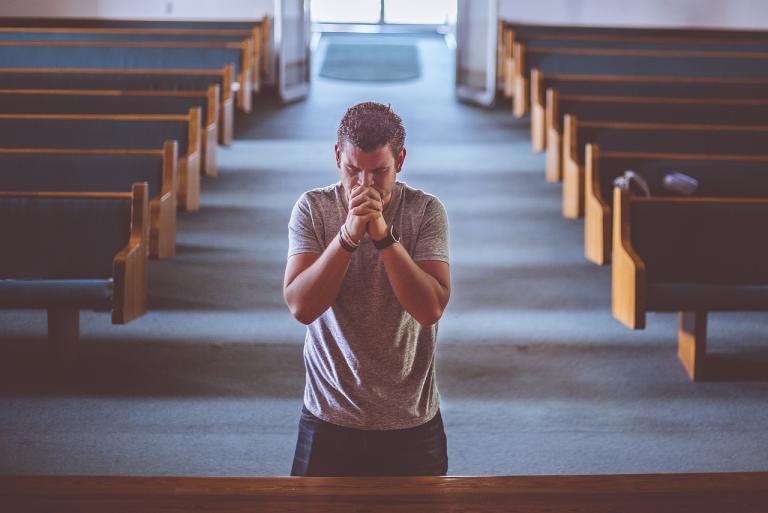
I no longer pray in any “traditional” sense of the word. I don’t “talk to God” before meals, or prior to laying my head down for the night. I don’t clasp my hands, bow my head, or recite any pledges. In fact, I don’t petition God to act in any sort of way, shape, or form … ever. Does that make me a bad Christian? Maybe, but I’m considered a bad (or non?) Christian for so many other reasons that I’ve run out of give-a-shits.
The motivation for not praying this way is simple: there is no scientific evidence that actively petitioning God does a damn bit of good. Just ask yourself how many prayers have gone unanswered during hurricanes, forest fires, global pandemics, flash floods, tornadoes, and earthquakes? How many heartfelt requests have spouses, parents, children, and friends made for their loved ones to be healed from some debilitating ailment, only to watch them decline to the point of death? How many times has God been lobbied to end racism, hunger, and political and corporate corruption? And yet, all these things persist to this day, in spite of the millions and millions of earnest and honest prayers offered up to the Almighty.
On the flipside, however, I paradoxically still find some version of “prayer” helpful, so long as we have an appropriate working understanding of what prayer is, and perhaps more importantly, what it isn’t.
WHAT PRAYER IS NOT
When I say prayer influences God and the world, I’m not saying prayer controls others or creation. I’m not saying our prayers guarantee the results we want. And I’m not saying prayer allows God to control. Petitionary prayer doesn’t “turbocharge” God to determine results singlehandedly. Our prayers are not coins in a vending machine that automatically dispenses the drink we want. — Thomas Jay Oord
Many in the so-called post-deconstruction community still hold to a version of prayer that involves actual words and petitions to God. And though I just put forth a succinct yet obvious retort as to why I have moved off of such a view, others have valid reasons for continuing to engage this practice, though perhaps with large asterisks. Regardless of where you personally stand, however, some things should be fairly obvious, given most people’s direct experience.
First, praying to God in any mature, mystical, enlightened, or spiritual sense, is not like playing a magical slot machine. God is not a dictator, dolling our rewards when they’re feeling giving … but only if you ask first. At least, I hope this is not the case! Because if God is this way, then they’re really bad at it—one could even say capricious or, worse yet, malicious. Why do I say this? Look around you. As I just stated, prayers seemingly go unanswered every day, the worst part being that God’s seemingly lack of concern disenfranchises people when tragedy strikes. Think of all those weather-related events where some Christian blowhard brags about how God saved a church building amidst the chaos—apparently not realizing that for every Christian church that is spared, 1,000 Christian homes are lost. Or, my favorite, from a Tweet from my former editor at Patheos, Benjamin L. Corey:
Beverly Russler Bell: My sister-in-law died in a fire, her Bible was beside her bed on a stand, not a burn mark on the Bible … awesome … miracle from God …
Benjamin L. Corey: But Beverly … she died.
Second, prayer is not that which replaces our need to do something about situations we find reprehensible. For instance, if we are against systemic injustices like homophobia, bigotry, racism, and the patriarchy, we can’t just pray to God before bedtime and think we’ve done anything meaningful. We have to actually get our hands dirty and our boots on the ground. We have to engage our politicians and leaders, and be relentless in our pursuit of actual justice. We have to organize and activate in our communities to bring comfort to the aggrieved. As Pope Francis once said, “You pray for the hungry. Then you feed them. That’s how prayer works.” Because if we just leave it up to God to fix things, then we’ll never solve any of our problems. History has proven as much, over and over, ad nauseam.
With these two caveats out of the way, we should now have a better understanding of what prayer is not; so, we can move into a discussion about what prayer is. First though, we need to revisit what God is like, because that is going to certainly color the lens through which we view this topic.
THE UNCONTROLLING LOVE OF GOD
For those of your who haven’t heard of theologian Dr. Thomas Oord, you are missing out. Though he and I disagree on some matters of philosophy and theology—our understanding of free will, for instance—Oord has done humanity a great service in how he approaches the uncontrolling love of God. In his view, there are certain things God can’t do because it is contradictory to the nature of love—and God is love, according to 1 John 4:8. To put it this way: because love is not controlling or coercive, God cannot control or coerce. Given how much evil and suffering is in the world, this stance largely makes sense. Why? Because if God is A) all powerful, and B) entirely benevolent, then it follows that evil wouldn’t exist. But because evil does exist—or, at minimum, that it is experienced—the logic goes like this: either God is not all powerful, or God is not benevolent.
Some Christians choose to believe that God is not all powerful in the way we typically think of power, but only because God doesn’t want to violate our so-called free will. These folks are known as Arminians. For them, God could be all powerful if God chose to be, but tempers their own power for the sake of human volition. This view only gets us so far, however, as it still doesn’t address all the suffering that is not caused by human freedom—weather-related tragedies, disease processes, etc. Not to mention, such a view of human freedom is entirely absurd, as no truly free person would ever choose evil over good (sorry Dr. Oord!). Such a choice is always presupposed by a lack of some kind of true freedom (i.e., the freedom to choose “the good”).
The second way Christians approach the problem above is to suggest that God is not entirely benevolent. Of course, they wouldn’t say this explicitly, but that’s exactly what Calvinism asserts. With all sorts of mental gymnastics, they may talk about God’s goodness being good simply because God does it, but at the end of the day, what they go on to describe is what we would call evil—preordaining the eternal suffering of children, sending hurricanes to punish the LGBTQ+ community, etc. I’ve discussed the atrociousness of Calvinism on numerous occasions—as well as the linguistic nihilism needed in order to hold to such an absurd worldview—so I won’t delve too deeply here. I think we can all agree that it’s beyond ridiculous, so deserves no more of our collective energy at this time.
The third way to approach the current problem is the route Dr. Oord (and others like Mark Karris and Jonathan Foster) have taken, and somewhat resembles that of the Arminians (though there is a caveat). Not only is God not all-powerful in the traditional sense—that God chooses to allow room for human volition—but God literally can’t controllingly or coercively do anything about evil and suffering even if they wanted to. Instead, God can only work in tandem with sentient human beings who can. Now, while this view presents some issues in and of itself—e.g., that love in fact does control some situations—it takes us much closer to a more consistently loving picture of the divine. In other words, instead of beginning with a definition of God—all powerful and thoroughly benevolent—we begin with love and define everything in that context.
WHAT PRAYER IS
Now that we have a snapshot of what God is like, we arrive at a place where we can talk more specifically about prayer. If God is not a slot-machine, dispensing blessings upon people when they get their prayers just right (or when God’s in the right mood), then how does prayer “work?” As we mentioned in the opening, from a scientific standpoint, it doesn’t. When looking at double-blind studies, there is simply no evidence. But experientially, perhaps there are some benefits. What do I mean?
As people of faith, this may not be what you want to hear. But I’ll say it nonetheless: we have a phrase for this seemingly contradictory statement—the placebo effect. Now, you may be saying to yourself: is that all prayer is? In truth, I believe it is, but don’t be so off-handed when it comes to the power of placebo. According to Dr. Robert Buckman, a clinical oncologist and professor of medicine, “placebos are extraordinary drugs. They seem to have some effect on almost every symptom known to mankind, and work in at least a third of patients and sometimes in up to sixty percent.” While this statement is not about prayer per se, the truth of the matter remains: if you believe something will work, oftentimes it will. Whether that is a so-called sugar pill or a petitionary prayer to a God you wholeheartedly believe in, belief can a powerful tool, and can in fact serve as just the “medicine” someone needs in some situations. Here’s my friend Chuck McKnight on how prayer acts in this manner:
Even though God was already doing all that God could do, and even though the prayer does not cause God to act any differently, the person about whom the prayer was given still hears the prayer. That person then has an increased awareness of the love and concern shown for them by those praying. And this can have a positive impact on the individual’s openness to receiving God’s love and healing.
Furthermore, for those of you who are Christians, there is a little-known doctrine—at least within Protestantism—called “the communion of the saints” that posits how all those who are in Christ are connected in some mystical way that transcends space and time. Meaning: perhaps prayer can “work” even when those you are praying for aren’t physically in your presence. Commenting on this, here’s McKnight once again:
Could it not be that when we pray for those who are not physically present, they are still able—in a mystical, spiritual manner—to sense the prayers being offered on their behalf, even if not consciously? And could this not perhaps influence their own openness to God’s love and healing?
Whether this is true or not is open to interpretation. In some way, it does make sense. In the quantum realm, for instance, particles that are split will influence one another instantaneously, and will not need to travel the space between in order to “communicate.” This is called quantum entanglement. Hence, a kind of “mystical, spiritual” interconnectedness can and does happen within the universe. However, whether this applies to prayer is a matter of conjecture. But one thing can be certain: the prayers are not changing God in any way whatsoever. Pardon the obvious tautology, but if God is love—and I believe God is—then God is love. Full stop. Love always does that which is loving, and can’t be manipulated in any way. Prayer, then, is always done to change our hearts and minds, orienting ourselves and others toward love so that empathy and compassion can become the driving force in our lives.
IN CLOSING
No matter what our prayers look like, or if we even pray at all, remember this: God will always work for the benefit of their creation. But there are limitations. For one, human beings indeed have some kind of free will; hence, God’s power to act is limited. Too often, our wills are blinded by our egos, thus rendering us enslaved by something—illusion, delusion, genetics, mental or physical health, and so on. But with patience, diligence, practice, and true community, we can become freer to do that which is good. Prayer can help with that. But rather than being something that changes God and their mind about us, prayer is something that changes our minds about … well, anything.
So, that is what I mean when I suggest that I don’t pray in any traditional way. Like the prayer that concludes my chapter in the forthcoming book, Sitting in the Shade of Another Tree, it is a type of praying that attempts to influence my own self toward being a more loving person, whose goal is to bring comfort to the afflicted. How God works in accordance with this, while mysterious, is perhaps quite simple: God is love, and as such, God is always compelling us toward that true light. How we respond, then, is up to us. That is where prayer can play its part; perhaps not with words, but with actions oriented toward the benefit of others. And even though St. Francis of Assisi never actually said the following, I believe it’s a lovely quote that resonates deeply with me: “Preach the gospel at all times and if necessary, use words.” If that’s not a prayer we can all get down with, I don’t know what is.
And all God’s people said … amen.
Also, if you’ve been digging my work on here, and want to see me be able to continue writing as close to full-time as humanly possible, please take a look at my Patreon page at www.patreon.com/mjdistefano. Even $1 a month helps bigly!

About Matthew J. Distefano
Matthew J. Distefano is an author, blogger, podcaster, and social worker. He lives in Northern California with his wife and daughter You can read more about the author here.
Previous Post

September 5, 2023
The Curious Case of Tom Bombadil
Next Post

September 25, 2023 Following Jesus: The Way Of The Bodhisattva
Recent Comments
"I have to admit I was stunned by this show. I couldn't tell if y'all ..."
Addressing the Recent Heretic Happy Hour ..."
"I'm so perplexed at how people who talk about others (women, immigrants, etc) with such ..."
Addressing the Recent Heretic Happy Hour ..."
"Guys like Andrew miss the whole point of being Christian, relationship at any cost, hence ..."
I Debated Andrew Wilson, Here’s What ..."
"I went to an evangelical website and ask them why they would vote for Trump ..."
An Evangelical Case for Trump as ..."
Browse Our Archives
Select a Category Atonement Book Review Early Church Eschatology eternal torment Hell Hermeneutics LGBTQ+ Mimetic Theory Mysticism News Old Testament Podcast Poetry Politics Prayer Religion Sacrifice Satire Soteriology Theology Uncategorized Violence
Select a Month October 2026 September 2026 August 2026 July 2026 June 2026 May 2026 April 2026 March 2026 February 2026 June 2025 December 2024 November 2024 October 2024 September 2024 August 2024 July 2024 June 2024 May 2024 April 2024 February 2024 January 2024 December 2023 November 2023 October 2023 September 2023 August 2023 June 2023 April 2023 March 2023 February 2023 January 2023 December 2022 November 2022 October 2022 September 2022 August 2022 July 2022 June 2022 May 2022 April 2022 March 2022 February 2022 January 2022 December 2021 November 2021 October 2021 September 2021 August 2021 July 2021 June 2021 May 2021 April 2021 March 2021 February 2021 January 2021 December 2020 November 2020 June 2019 May 2019 April 2019 March 2019 January 2019 December 2018 November 2018 October 2018 September 2018 August 2018 July 2018 June 2018 May 2018 April 2018 March 2018 February 2018 January 2018 December 2017 November 2017 October 2017 July 2017 June 2017 May 2017 April 2017 March 2017 February 2017 January 2017 December 2016 November 2016 October 2016 September 2016 July 2016 June 2016 May 2016 April 2016 March 2016 February 2016 January 2016 December 2015 November 2015 October 2015 September 2015 August 2015 July 2015 June 2015
Follow Us!
TAKE THE
Religious Wisdom Quiz
True or False: David committed adultery with Bathsheba and arranged for her husband Uriah to be killed.
Select your answer to see how you score.
FALSE TRUE
Books by This Author Books by All Set Free
Related posts from All Set Free


A Second Coming That Undoes the First

TRENDING AT PATHEOS Progressive Christian

Nearly every morning, I make the drive to Detroit with my high-school-age...

The Real AI Story Is Adoption Without Trust
Artificial intelligence has crossed a political threshold. It is no longer a...

A new article, written by Jeff Lindsay and Gale L. Pooley,...

Swimfan: Forgotten Aughts Pleasures
This is a recovery effort. In 2002, My Big Fat Greek Wedding...

Top Three Anti-Catholic Lies About Catholicism
This is my initial transcript for the video, "THE 3 WORST...

Pope Leo Celebrates Mass for Nurses & Docs...
I don't have any idea how he did it, but Pope Leo...
view all Progressive Christian blogs
What Are Your Thoughts?leave a comment
Ad-Free & Subscriber Log-In Subscription Support
- About Us
- 2026 Calendar
- Videos
- Podcasts
- Library of World Religions
- Faith In Media Tracker
- Advertise With Us
- Write for Us
- Privacy Policy
- Terms of Service
- Do Not Sell My Data
- Contact Us
- Radiant Digital
- Manage Newsletter Subscriptions
- Unsubscribe From Notifications
- Sitemap
Copyright 2008-2026, Patheos. All rights reserved.
Subscription Support Ad-Free & Subscriber Log-In
Follow Patheos