
BuddhistCatholicContemplativeEvangelicalGeneral ChristianHinduJewishLatter-day SaintMuslimNew VisionsProgressive Christian
Beliefs
- Buddhist
- Catholic
- Contemplative
- Evangelical
- General Christian
- Hindu
- Jewish
- Latter-day Saint
- More Voices
- Muslim
- New Visions
- Pagan
- Progressive Christian
Topics
- Religion News
- Food and Religion
- Sports and Religion
- Religious Art
- Religious Music and Entertainment
- Religious Events
- History and Religion
- Style and Religion
- Politics and Religion
- Women in Religion
- Recreation Outdoors and Religion
- Business Finance and Religion
- Careers Workplace and Religion
- Education and Religion
- Family Parenting and Religion
- Health Fitness and Religion
- Home and Religion
- Relationships and Religion
- Technology and Religion
- Travel and Religion
Columnists
- Buddhist Columnists
- Business Finance and Religion Columnists
- Careers Workplace and Religion Columnists
- Catholic Columnists
- Contemplative Columnists
- Education and Religion Columnists
- Evangelists Columnists
- Family Parenting and Religion Columnists
- General Christian Columnists
- Health Fitness and Religion Columnists
- Hindu Columnists
- History and Religion Columnists
- Home and Religion Columnists
- Jewish Columnists
- More Voices Columnists
- Latter Day Columnists
- Muslim Columnists
- New Visions Columnists
- Nonreligious Columnists
- Pagan Columnists
- Politics and Religion Columnists
- Progressive Columnists
- Recreation Outdoors and Religion Columnists
- Relationships and Religion Columnists
- Religion News Columnists
- Religious Art Columnists
- Religious Events Columnists
- Religious Music and Entertainment Columnists
- Sports and Religion Columnists
- Style and Religion Columnists
- Technology and Religion Columnists
- Travel and Religion Columnists
- Women in Religion Columnists
Resource Library
- 2026 Calendar
- Library of World Religions
- The 100 Most Holy Places on Earth
- Patheos Answers
- Podcasts
- Videos
- Faith Leaders Database
- Anglican Episcopalian
- Bahai
- Baptist
- Buddhism
- Christianity
- Confucianism
- Eastern Orthodoxy
- Hinduism
- Holiness and Pentecostal
- ISKCON
- Islam
- Judaism
- Lutheran
- Methodist
- The Church of Jesus Christ of Latter-day Saints
- New Age
- Paganism
- Presbytarian and Reformed
- Protestantism
- Religion Behind the Scenes
- Roman Catholic
- Scientology
- Shia Islam
- Sikhism
- Sufism
- Sunni Islam
- Taoism
- Zen
- See all religions
Research Tools
 Ad-Free & Subscriber Log-In Subscription Support
Ad-Free & Subscriber Log-In Subscription Support
Follow Patheos 

- Trending:
- Forgiveness
- |
- Marriage
- |
- Consciousness
- |
- Death Penalty
- |
- Election
- |
- Halloween

- Home
- Progressive Christian
- Religion News
- God Saves Us (But Not From God’s Self)
God Saves Us (But Not From God’s Self)
Last updated on: June 30, 2021 at 6:00 am by Matthew Distefano
God Saves Us (But Not From God’s Self) 2021-06-29T06:47:19-06:00 Matthew Distefano
Patheos Explore the world's faith through different perspectives on religion and spirituality! Patheos has the views of the prevalent religions and spiritualities of the world.

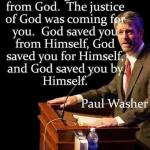
In my last entry, I discussed a ridiculous Paul Washer quote about how God saves us from himself, by himself, and for himself (his simple and stupid way of summarizing his atonement theory). Because I didn’t really offer a better understanding of salvation in that piece, in this entry, I’m going to do just that.
Unbeknownst to some, the Gospel isn’t synonymous with Calvin’s (and by extension, Washer’s) penal substitutionary atonement theory. In fact, when thinking about atonement (how so-called sinners are reconciled to God), there are many theories. There’s Christus Victor, Moral Influence, Satisfaction, Recapitulation, Ransom, Scapegoating, Penal Substitution, and others (including different variations of the ones I just mentioned). For our purposes, we are going to keep things super simple and not really label things.
Now, put most simply, this is how I understand Christian salvation: God, in the form of Jesus, came to live as one of us to show us three things, 1) what God is like, 2) how we are to treat one another and, 3) how not to treat one another. Let’s break these three things down a bit.
I. What God is Like
The first part of this is the theological one. Forever, we have misconstrued what God is like. We have assumed God is sacrificial, that God is violent, that God demands quid pro quo. We have justified our wars with God on our side (to paraphrase Bob Dylan). In short, God has always been on the side of the victors. Jesus, however, expanding on his Jewish prophetic tradition, reorients these assumptions. Jesus tells us that God is for all people, especially the oppressed. God is not a blessing and cursing God (like Deuteronomy 28 says) but a blessing God . . . full stop (see Matthew 5). God is a peacemaker, not a warmonger.
By believing that God is like this, we are, in a way, saved. We are saved from our sacrificial systems that only demand more and more blood. We are also saved from bad thinking. When Jesus tells people to repent, he means for them to change their mind. That’s what the Greek word metanoia means. Changing our mind about God can be salvific, especially if the God we believe in is a monster (like the one Washer promulgates).
II. How To Treat One Another
This second point is the anthropological one. In addition to reorienting our view of what God is like, Jesus offers us an example of what humans are to be like. In many places throughout the gospels, Jesus says to “follow me.” Newsflash, literalists: he means it. He wants people to follow him in how he treats others. He wants us to show empathy for the downtrodden, for the oppressed, for the vulnerable, for the scapegoated. For the mimetic theorist, this is really, really important.
What mimetic theory teaches us is that our desires are derived by the perceived desires of others. This ultimately leads to violence (I’ve discussed this ad nauseam in many, many places). With Jesus, however, we have a model who doesn’t really engage in negative (or unconscious) mimesis. Instead, as he states all throughout John’s Gospel, he consciously only does what he sees the Father doing. In other words, the non-rivalrous Father is his model. In turn, Jesus can then be our model as he moves us away from treating others with malice and disdain. Like Point I, this too becomes salvific in that it saves us from being both the scapegoated and scapegoaters.
III. How Not To Treat One Another
Point III is very similar to Point II, but it focuses on the negative. Jesus’ life and mission, among other things, was an example of how to be truly human. The response to Jesus, then, is what not to do. When someone like Jesus comes along and subvert the power systems that run shit, we’ve got to do our best to listen. If we don’t, we’ll end up scapegoating (perhaps even killing) messengers of God. This is not a good thing. But for Jesus, it was super predictable. He understood the powers and principalities. He predicted his death, not because he had God in his ear a la Cyrano de Bergerac, but because he understood how human beings behaved. We are THAT predictable.
Knowing this, then, becomes salvific. We can be spared by the powers and principalities we allow to run things, often at the expense of our own human flourishing. The problem, of course, is that those at the top like the status quo (I’m talking to you, old straight white dudes). But just remember, there will always be prophets to call y’all on your shit.
Of course, these three points don’t include the ultimate salvific punchline: the Resurrection. Now, say what you want about the Resurrection (was it literal, bodily, spiritual, or whatever?), but I for one affirm it in some regard. I don’t know how the metaphysics work, but I don’t need to. For me, the Resurrection is the confirmation that Jesus’ life – what he taught us about God and how he treated those around him – is worth following. Put most simply, the Resurrection is the vindication of the victim. It’s also the rejection of the traditionally sacrificial (God takes our sacrifice of death and turns it back into a living sacrifice). Furthermore, the Resurrection also removes the neurotic death anxiety that plagues the human mind (to learn more about that, do some research on Ernest Becker). How so? If we affirm and trust it, we no longer have to fear death because upon Jesus’ return, he only breathed the Spirit of Shalom. Take solace in that.
Now, much more could be said about atonement, but that’s enough for now. If you want to read more, I’ve got plenty of books on the topic. I hope you enjoy them more than I enjoy reading Paul Washer quotes. It’s a pretty low bar, but hey, whatever.
Peace!
If you wanna get to know me better, please follow me on social media. I’m pretty active on all platforms:
Also, if you’ve been digging my work on here, and want to see me be able to continue writing as close to full-time as humanly possible, please take a look at my Patreon page at www.patreon.com/mjdistefano. Even $1 a month helps bigly!!!

About Matthew Distefano
Matthew is a best-selling author, blogger, podcaster, long-time social worker, and hip-hop artist. He is an outspoken advocate for nonviolence, happily married, with one daughter. Outside of writing, his interests include gardening, hiking, and European football. He lives in Northern California You can read more about the author here.
Previous Post
June 29, 2021
God Saves Us From God?
Next Post

July 5, 2021 Repeat After Me
Browse Our Archives
Select a Category Atonement Book Review Early Church Eschatology eternal torment Hell Hermeneutics LGBTQ+ Mimetic Theory Mysticism News Old Testament Podcast Poetry Politics Prayer Religion Sacrifice Satire Soteriology Theology Uncategorized Violence
Select a Month October 2026 September 2026 August 2026 July 2026 June 2026 May 2026 April 2026 March 2026 February 2026 June 2025 December 2024 November 2024 October 2024 September 2024 August 2024 July 2024 June 2024 May 2024 April 2024 February 2024 January 2024 December 2023 November 2023 October 2023 September 2023 August 2023 June 2023 April 2023 March 2023 February 2023 January 2023 December 2022 November 2022 October 2022 September 2022 August 2022 July 2022 June 2022 May 2022 April 2022 March 2022 February 2022 January 2022 December 2021 November 2021 October 2021 September 2021 August 2021 July 2021 June 2021 May 2021 April 2021 March 2021 February 2021 January 2021 December 2020 November 2020 June 2019 May 2019 April 2019 March 2019 January 2019 December 2018 November 2018 October 2018 September 2018 August 2018 July 2018 June 2018 May 2018 April 2018 March 2018 February 2018 January 2018 December 2017 November 2017 October 2017 July 2017 June 2017 May 2017 April 2017 March 2017 February 2017 January 2017 December 2016 November 2016 October 2016 September 2016 July 2016 June 2016 May 2016 April 2016 March 2016 February 2016 January 2016 December 2015 November 2015 October 2015 September 2015 August 2015 July 2015 June 2015
Follow Us!
TAKE THE
Religious Wisdom Quiz
Why did God command the Israelites to eat unleavened bread?
Select your answer to see how you score.
It was a symbol of humility They had to leave Egypt quickly Yeast was considered unclean It was the only bread they knew how to make
Books by This Author Books by All Set Free
Related posts from All Set Free


Addressing the Recent Heretic Happy Hour Podcast Episode

I Debated Andrew Wilson, Here's What I Learned

TRENDING AT PATHEOS Progressive Christian

57th Dove Awards Honor Dolly Parton, Crown New...
On gospel music’s biggest night, the 57th annual GMA Dove Awards honored...

The First Eucharistic Controversy: Christ’s Real Presence
For Catholics, the Eucharist is the source and summit of the Christian...

What a Stop Sign Can Teach Us About...
How to Make a Decision When You Can't Hear God Main point:...

Archdiocese Hosts Military Marriage Retreat in Germany
RASTATT, Germany — The transient military lifestyle, with its frequent deployments and...

Nearly every morning, I make the drive to Detroit with my high-school-age...

The Real AI Story Is Adoption Without Trust
Artificial intelligence has crossed a political threshold. It is no longer a...
view all Progressive Christian blogs
Ad-Free & Subscriber Log-In Subscription Support
- About Us
- 2026 Calendar
- Videos
- Podcasts
- Library of World Religions
- Faith In Media Tracker
- Advertise With Us
- Write for Us
- Privacy Policy
- Terms of Service
- Do Not Sell My Data
- Contact Us
- Radiant Digital
- Manage Newsletter Subscriptions
- Unsubscribe From Notifications
- Sitemap
Copyright 2008-2026, Patheos. All rights reserved.
Subscription Support Ad-Free & Subscriber Log-In
Follow Patheos