
BuddhistCatholicContemplativeEvangelicalGeneral ChristianHinduJewishLatter-day SaintMuslimNew VisionsProgressive Christian
Beliefs
- Buddhist
- Catholic
- Contemplative
- Evangelical
- General Christian
- Hindu
- Jewish
- Latter-day Saint
- More Voices
- Muslim
- New Visions
- Pagan
- Progressive Christian
Topics
- Religion News
- Food and Religion
- Sports and Religion
- Religious Art
- Religious Music and Entertainment
- Religious Events
- History and Religion
- Style and Religion
- Politics and Religion
- Women in Religion
- Recreation Outdoors and Religion
- Business Finance and Religion
- Careers Workplace and Religion
- Education and Religion
- Family Parenting and Religion
- Health Fitness and Religion
- Home and Religion
- Relationships and Religion
- Technology and Religion
- Travel and Religion
Columnists
- Buddhist Columnists
- Business Finance and Religion Columnists
- Careers Workplace and Religion Columnists
- Catholic Columnists
- Contemplative Columnists
- Education and Religion Columnists
- Evangelists Columnists
- Family Parenting and Religion Columnists
- General Christian Columnists
- Health Fitness and Religion Columnists
- Hindu Columnists
- History and Religion Columnists
- Home and Religion Columnists
- Jewish Columnists
- More Voices Columnists
- Latter Day Columnists
- Muslim Columnists
- New Visions Columnists
- Nonreligious Columnists
- Pagan Columnists
- Politics and Religion Columnists
- Progressive Columnists
- Recreation Outdoors and Religion Columnists
- Relationships and Religion Columnists
- Religion News Columnists
- Religious Art Columnists
- Religious Events Columnists
- Religious Music and Entertainment Columnists
- Sports and Religion Columnists
- Style and Religion Columnists
- Technology and Religion Columnists
- Travel and Religion Columnists
- Women in Religion Columnists
Resource Library
- 2026 Calendar
- Library of World Religions
- The 100 Most Holy Places on Earth
- Patheos Answers
- Podcasts
- Videos
- Faith Leaders Database
- Anglican Episcopalian
- Bahai
- Baptist
- Buddhism
- Christianity
- Confucianism
- Eastern Orthodoxy
- Hinduism
- Holiness and Pentecostal
- ISKCON
- Islam
- Judaism
- Lutheran
- Methodist
- The Church of Jesus Christ of Latter-day Saints
- New Age
- Paganism
- Presbytarian and Reformed
- Protestantism
- Religion Behind the Scenes
- Roman Catholic
- Scientology
- Shia Islam
- Sikhism
- Sufism
- Sunni Islam
- Taoism
- Zen
- See all religions
Research Tools
 Ad-Free & Subscriber Log-In Subscription Support
Ad-Free & Subscriber Log-In Subscription Support
Follow Patheos 

- Trending:
- Forgiveness
- |
- Marriage
- |
- Consciousness
- |
- Death Penalty
- |
- Election
- |
- Halloween

- Home
- Progressive Christian
- Religion News
- The Messiness of Deconstruction
The Messiness of Deconstruction
Last updated on: March 9, 2021 at 9:51 am by Matthew Distefano
The Messiness of Deconstruction 2021-03-09T09:51:42-06:00 Matthew Distefano
Patheos Explore the world's faith through different perspectives on religion and spirituality! Patheos has the views of the prevalent religions and spiritualities of the world.
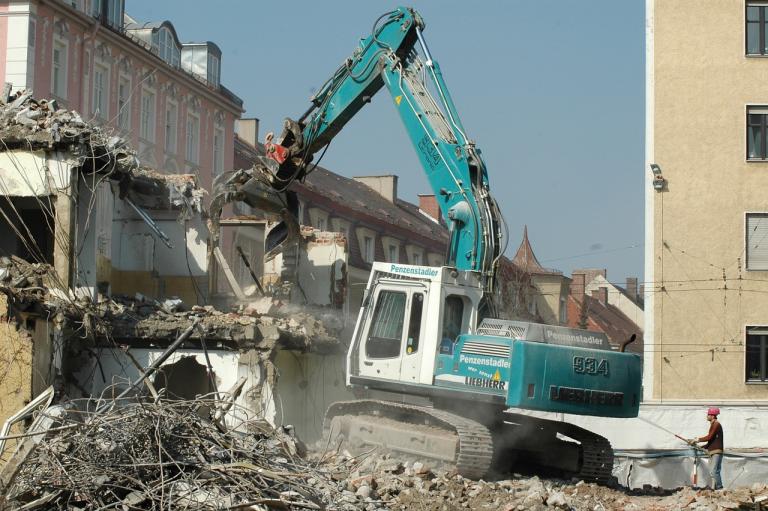
Courtesy of Pixabay
Everyone is talking about deconstruction. Conservative Christians are talking about it. Progressive Christians are talking about it. Hell, even agnostics and atheists are talking about it. But what is it, exactly? And why are so many groups coming at it from such different angles?
What is Deconstruction?
The term “deconstruction” is nothing new, though the modern, colloquial meaning of the word may be. Although it was around before French philosopher Jacques Derrida, he is basically considered the “founder of deconstruction.” For him, however, it didn’t mean what we mean when we use the word (indeed, even the term itself has been deconstructed). Instead of it being a word that basically describes a rethinking of one’s faith, it was about our use of language and the meaning of terms. Put most simply, deconstruction for Derrida was about semiotics (the study of sign processes [semiosis], which are any activity, conduct, or process that involves signs, where a sign is defined as anything that communicates a meaning that is not the sign itself to the sign’s interpreter). That is to say, what do we mean when we use certain words in certain situations?
Deconstruction Deconstructed
Today, however, the term and its usage has come to mean something a bit different. For many, it is a process that involves a rigorous questioning of one’s faith-based presuppositions. It involves a careful critique of one’s handed-down worldview. It is often painful for it is a process that leads to an epistemological reevaluation (how do we know what we know?) and then from there, some pretty heavy-handed existential crises. Deconstruction is nothing to take lightly, nor is it something that should be explained away. Further, it is not a process with a linear timeline where a person of faith goes from point A to point Z. Deconstruction can be messy. It can be confusing. And often, it leaves you with more questions than answers.
At first, this is not an easy pill to swallow. When you initially question a doctrinal staple like eternal conscious torment, or your inerrant Bible, or your Calvinistic atonement theory, you may think that you’ll easily replace it with something more palatable, something that makes more sense to your curious mind. And perhaps you do. I did, and I’m really quite happy about that. However, as is the nature of deconstruction, even the doctrines you’ve replaced other doctrines with need deconstructing.
What I mean by this is that life and life’s experiences are such that you are always reevaluating what you think you know. For example, you may think that since you’ve replaced Calvin’s penal substitutionary atonement theory with something “better” like Christus Victor that you’ve completed your “deconstruction.” You may think you’ve “reconstructed” something and now you are good to go. But that’s not how this works. Often, you’ll have more life experiences that lead you to a perpetual deconstruction and reconstruction approach. You’ll run into Buddhists, for instance, who have as much to teach you about the cosmos as Christians do. Or, you’ll evaluate Christus Victor and decide you don’t believe in an ontological devil and then have to deconstruct what you mean by that particular atonement theory. And so on and so forth.
Learning To Float
The realization that just because you’ve changed your doctrinal affirmations doesn’t mean you aren’t constantly evaluating and reevaluating things is what led me to coauthor a soon-to-released book called Learning to Float. We landed on this title because what happens in this deconstruction process is that often, you don’t actually go anywhere. You don’t go from believing in hell to believing in Universalism, for example, and then conclude, “I’ve made it to the promised land.” You may change your beliefs in this way (just like I did), and it may totally help you in your journey, but then you’re still left in a place where you are asking yourself, “Now what?” You are always nearly forced to ask, “How does this newly-affirmed doctrine aid me in the present moment? How do my new life experiences fit into this belief system? What about this situation? What about that situation?”
As I said just a moment ago, the deconstruction process is really a perpetual deconstruction and reconstruction process. You don’t go from certainty about your beliefs, to deconstructing them entirely, to finally reconstructing and then reconstructed. You are constantly evaluating your beliefs based on new direct experiences. Sure, when you first start to question, you may have out the sledge hammer only. But as time goes, perhaps you put that away and bust out some sandpaper and a chisel. But there is always something to whittle away at.
This is a good thing, though. It may not be a comfortable thing, especially in the beginning, but as time goes, you learn that it’s okay. Just like a swim in the ocean, it may be unsettling at first. As you sink, you may think that splashing about vigorously is the best way to stay afloat. But then it dawns on you that all you need to do is be still and trust that if you can lie back and relax and you’ll stay at the surface of the water. You may not make it anywhere near the shore, but as long as you can stop flailing about, you’ll be just fine.
A Final Word
So, why are so many dissimilar groups talking about this? Well, because so many people are either going through it or witnessing friends and family go through it.
Conservative Christians – folks like The Gospel Coalition and Alisa Childers – are bemoaning the deconstruction movement. They’ve dipped their toes in the waters and are finding it quite uncomfortable, so they are now speaking out against it. The problem with this, of course, is twofold. First, most of these folks aren’t listening to those who are deconstructing. They aren’t taking seriously their (our) experiences. And second, these folks always have fear imbued in their theology: Hell as eternal conscious torment, atonement laden with violence, an eschatology of wrath and vengeance, and so on and so forth. And, as my best friend Michael Machuga says in A Journey With Two Mystics, “fear is a trap and the fear of hell is the greatest trap of all.”
On the flipside, many Progressive Christians – those who have deconstructed their Evangelical faith – seem to think there is a certain way to deconstruct. I’ve seen books and articles that read as “how-to” guides and, honestly, this seems flippant and irresponsible. Sure, you may have experienced something that is more linear, but that is not the case for many of us. As Michelle Collins will talk about in her soon-to-be-released book, Into the Grey, the deconstruction process is more like the grief cycle. You can be all over the cycle at any given day, and just because you were at point A today, doesn’t mean in 6 months you won’t be right back at point A.
My advice, then? If you know someone who is deconstructing, listen to them. Validate their experiences. They may not be YOUR experiences, but that’s okay. They are their experiences and they are valid. If you are the one deconstructing, know that while it is painful, the only way out is through. Keep asking questions. Keep pursuing the truth. Keep an open mind. And understand that while you may not get from point A to point B, you will learn to at least accept the process of learning to float.
If you wanna get to know me better, please follow me on social media. I’m pretty active on all platforms:
Also, if you’ve been digging my work on here, and want to see me be able to continue writing as close to full-time as humanly possible, please take a look at my Patreon page at www.patreon.com/mjdistefano. Even $1 a month helps bigly!!!
Previous Post

February 28, 2021
I'm Just Gonna Leave This Here...
Next Post

March 16, 2021 What Would Jesus Quote?
Browse Our Archives
Select a Category Atonement Book Review Early Church Eschatology eternal torment Hell Hermeneutics LGBTQ+ Mimetic Theory Mysticism News Old Testament Podcast Poetry Politics Prayer Religion Sacrifice Satire Soteriology Theology Uncategorized Violence
Select a Month October 2026 September 2026 August 2026 July 2026 June 2026 May 2026 April 2026 March 2026 February 2026 June 2025 December 2024 November 2024 October 2024 September 2024 August 2024 July 2024 June 2024 May 2024 April 2024 February 2024 January 2024 December 2023 November 2023 October 2023 September 2023 August 2023 June 2023 April 2023 March 2023 February 2023 January 2023 December 2022 November 2022 October 2022 September 2022 August 2022 July 2022 June 2022 May 2022 April 2022 March 2022 February 2022 January 2022 December 2021 November 2021 October 2021 September 2021 August 2021 July 2021 June 2021 May 2021 April 2021 March 2021 February 2021 January 2021 December 2020 November 2020 June 2019 May 2019 April 2019 March 2019 January 2019 December 2018 November 2018 October 2018 September 2018 August 2018 July 2018 June 2018 May 2018 April 2018 March 2018 February 2018 January 2018 December 2017 November 2017 October 2017 July 2017 June 2017 May 2017 April 2017 March 2017 February 2017 January 2017 December 2016 November 2016 October 2016 September 2016 July 2016 June 2016 May 2016 April 2016 March 2016 February 2016 January 2016 December 2015 November 2015 October 2015 September 2015 August 2015 July 2015 June 2015
Follow Us!
TAKE THE
Religious Wisdom Quiz
What is the main Christian denomination in the Philippines?
Select your answer to see how you score.
Roman Catholic Presbyterian Anglican Lutheran
Books by This Author Books by All Set Free
Related posts from All Set Free


Addressing the Recent Heretic Happy Hour Podcast Episode


TRENDING AT PATHEOS Progressive Christian

16 Spiritual Touchstones for a More Grounded Life
After decades of spiritual study, here are 16 principles I try...

Catholic Evangelization: Sharing Your Faith Every Day
Welcome back to the Graceful Awakening mini-series called, “From Faith to Mission.” ...

The Pillar of the Boatmen: the Ancient Monument...
The Pillar of the Boatmen is a Romano-Gaulish sculpture that dates from...

In one sense walking into Westminster Abbey is like walking down the...

'Super Scam Me' Exposes AI Jon Bon Jovi...
Leslie Pickett believed she was in a relationship with Jon Bon Jovi....

The Brazilian Remake of Kendricks' 'Flywheel' Opens in...
“Flywheel,” the story that launched the Kendrick Brothers’ filmmaking career is getting...
view all Progressive Christian blogs
Ad-Free & Subscriber Log-In Subscription Support
- About Us
- 2026 Calendar
- Videos
- Podcasts
- Library of World Religions
- Faith In Media Tracker
- Advertise With Us
- Write for Us
- Privacy Policy
- Terms of Service
- Do Not Sell My Data
- Contact Us
- Radiant Digital
- Manage Newsletter Subscriptions
- Unsubscribe From Notifications
- Sitemap
Copyright 2008-2026, Patheos. All rights reserved.
Subscription Support Ad-Free & Subscriber Log-In
Follow Patheos