
BuddhistCatholicContemplativeEvangelicalGeneral ChristianHinduJewishLatter-day SaintMuslimNew VisionsProgressive Christian
Beliefs
- Buddhist
- Catholic
- Contemplative
- Evangelical
- General Christian
- Hindu
- Jewish
- Latter-day Saint
- More Voices
- Muslim
- New Visions
- Pagan
- Progressive Christian
Topics
- Religion News
- Food and Religion
- Sports and Religion
- Religious Art
- Religious Music and Entertainment
- Religious Events
- History and Religion
- Style and Religion
- Politics and Religion
- Women in Religion
- Recreation Outdoors and Religion
- Business Finance and Religion
- Careers Workplace and Religion
- Education and Religion
- Family Parenting and Religion
- Health Fitness and Religion
- Home and Religion
- Relationships and Religion
- Technology and Religion
- Travel and Religion
Columnists
- Buddhist Columnists
- Business Finance and Religion Columnists
- Careers Workplace and Religion Columnists
- Catholic Columnists
- Contemplative Columnists
- Education and Religion Columnists
- Evangelists Columnists
- Family Parenting and Religion Columnists
- General Christian Columnists
- Health Fitness and Religion Columnists
- Hindu Columnists
- History and Religion Columnists
- Home and Religion Columnists
- Jewish Columnists
- More Voices Columnists
- Latter Day Columnists
- Muslim Columnists
- New Visions Columnists
- Nonreligious Columnists
- Pagan Columnists
- Politics and Religion Columnists
- Progressive Columnists
- Recreation Outdoors and Religion Columnists
- Relationships and Religion Columnists
- Religion News Columnists
- Religious Art Columnists
- Religious Events Columnists
- Religious Music and Entertainment Columnists
- Sports and Religion Columnists
- Style and Religion Columnists
- Technology and Religion Columnists
- Travel and Religion Columnists
- Women in Religion Columnists
Resource Library
- 2026 Calendar
- Library of World Religions
- The 100 Most Holy Places on Earth
- Patheos Answers
- Podcasts
- Videos
- Faith Leaders Database
- Anglican Episcopalian
- Bahai
- Baptist
- Buddhism
- Christianity
- Confucianism
- Eastern Orthodoxy
- Hinduism
- Holiness and Pentecostal
- ISKCON
- Islam
- Judaism
- Lutheran
- Methodist
- The Church of Jesus Christ of Latter-day Saints
- New Age
- Paganism
- Presbytarian and Reformed
- Protestantism
- Religion Behind the Scenes
- Roman Catholic
- Scientology
- Shia Islam
- Sikhism
- Sufism
- Sunni Islam
- Taoism
- Zen
- See all religions
Research Tools
 Ad-Free & Subscriber Log-In Subscription Support
Ad-Free & Subscriber Log-In Subscription Support
Follow Patheos 

- Trending:
- Forgiveness
- |
- Marriage
- |
- Consciousness
- |
- Death Penalty
- |
- Election
- |
- Halloween

- Home
- Progressive Christian
- Religion News
- The Myth of a Violent Jesus: Part 2, Swords
The Myth of a Violent Jesus: Part 2, Swords
Last updated on: March 12, 2018 at 12:12 pm by Matthew Distefano
The Myth of a Violent Jesus: Part 2, Swords 2018-03-12T12:12:17-06:00 Matthew Distefano
Patheos Explore the world's faith through different perspectives on religion and spirituality! Patheos has the views of the prevalent religions and spiritualities of the world.
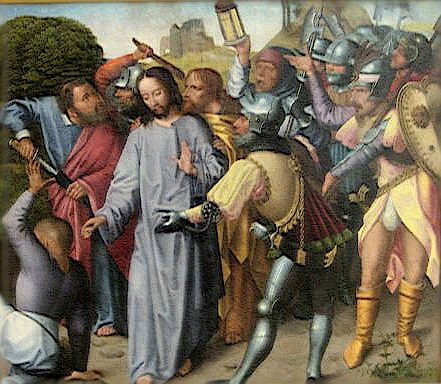
Jesus healing the ear of a servant during his arrest, Museu de Évora, Portugal, c. 1500
In Part 1, we briefly covered the so-called “cleansing of the Temple,” arguing for an interpretation that removes violence from Jesus. We’ll do something similar in this piece. Only we’ll be discussing those passages that, on the surface at least, seem to imply that Jesus not only condones violence, but commands it.
The first passage comes from Matthew 10:34–36, and reads:
“Do not think that I have come to bring peace to the earth; I have not come to bring peace, but a sword. For I have come to set a man against his father, and a daughter against her mother, and a daughter-in-law against her mother-in-law; and one’s foes will be members of one’s own household.”
Game. Set. Match. Jesus is violent, right?
Well, no, not so much. Please let me explain.
What is happening here is something much deeper than a simple rejection of peace as such. Instead, it’s a rejection of the way that humanity tends to bring about peace. The differences are important.
You see, the way our human cultures and religions bring about peace is, paradoxically, through the use of violence. From the blood of Abel to that of Zechariah, it’s been done in this manner. Simply put, it’s a peace that is nothing more than the catharsis that occurs when all-against-all societal violence is transferred onto a surrogate other, a scapegoat if you will. This is witnessed, most strikingly, when, just prior to Jesus’ bloody death on a cross, the high priest Caiaphas admits: “You do not understand that it is better for you to have one man die for the people than to have the whole nation destroyed.”
Not for nothing, but this is the exact sort of peace the Roman Empire brought about. Pax Romana, as it’s known, is peace through war, peace through conquest, peace through strife, peace through the elimination or subduing of an enemy other. But for Jesus, this is not peace at all. Therefore, as he says, he isn’t going to be in the business of bringing about this sort of peace. Instead, he is going to bring a sword.
However, news flash: It’s not going to be Jesus’ sword. There is no evidence that Jesus ever carried a sword. The swords that are brought, then, are the swords we bring against Jesus as he attempts to announce the coming of the kingdom of God that has no dividing lines whatsoever.
Case in point: when Jesus delivers his first sermon at the synagogue in Nazareth (Luke 4:18–30), he includes a reading of Isaiah 61 but leaves off the expected vengeance that the enemies of God are going to be getting. In other words, the Day of Jubilee that the Jews are waiting for—where the good news is to be brought to the poor, where release is to be brought to those in captivity, where sight is to be recovered by the blind, and where the oppressed are to all be set free—doesn’t include violence against those doing the oppressing. And it causes so much scandal and offense that the listeners then attempt to toss Jesus off a cliff.
Here, Jesus doesn’t bring peace, but division. Division, not because Jesus is commanding such a thing, but because the people can’t handle one who renounces division, hence it divides them against Jesus.
This is the type of “sword” Jesus brings. It is a sword that comes down on Jesus first, and then to the disciples, whom Jesus sends out to the world “like sheep into the midst of wolves.”
Nevertheless, in Luke 22:36, Jesus then seems to contradict all his talk of nonviolence and nonretaliation when he gives his disciples the following advice:
“But now, the one who has a purse must take it, and likewise a bag. And the one who has no sword must sell his cloak and buy one.”
Huh? What?! After all that enemy love talk from places like the Sermon on the Mount, Jesus is now telling his disciples to take up arms?
Well, not so fast.
Take a look at the very next verse: “For I tell you, this scripture must be fulfilled in me, ‘And he was counted among the lawless.” Which Scripture is Jesus talking about? Isaiah 53:12, to be exact:
“Therefore I will allot him a portion with the great, and he shall divide the spoil with the strong; because he poured out himself to death, and was numbered with the transgressors; yet he bore the sin of many, and made intercession for the transgressors.”
And so, like the incident in the Temple, this isn’t so much about Jesus being violent, as we’ve all probably so often heard, rather, it’s the playing out of a drama where the swords are but a prop. They are there simply so that Jesus could fulfill the role of the Suffering Servant of God, the one who “had done no violence.”
Incidentally, the only violence delivered that night from the “transgressors” is when one of the disciples uses one of the swords to cut off the ear of one of the high priest’s slaves. So, what does Jesus do about it? Wait for it . . . He immediately puts a halt to the violence: “No more of this!” Then Jesus actually heals the wound and warns his disciples that “all who take the sword will perish by the sword.”
As I said in the previous post, we must always remember to interpret these supposed “violence texts” through the lens of Jesus’ entire ministry, not the other way around. We mustn’t assume Jesus is violent because he talks about swords and even commands his disciples to get two of them (as if they were going to take on the Roman Empire with two weapons . . . how absurd!) That is not at all the point of this story, so please stop trying to say it is. In fact, like the incident in the Temple, the point of the story is quite the opposite.
Peace, and stay tuned for Part 3.
Previous Post

March 8, 2018
The Myth of a Violent Jesus: Part 1, The Temple Incident
Next Post

March 17, 2018 The Myth of a Violent Jesus: Part 3, The Return
Browse Our Archives
Select a Category Atonement Book Review Early Church Eschatology eternal torment Hell Hermeneutics LGBTQ+ Mimetic Theory Mysticism News Old Testament Podcast Poetry Politics Prayer Religion Sacrifice Satire Soteriology Theology Uncategorized Violence
Select a Month October 2026 September 2026 August 2026 July 2026 June 2026 May 2026 April 2026 March 2026 February 2026 June 2025 December 2024 November 2024 October 2024 September 2024 August 2024 July 2024 June 2024 May 2024 April 2024 February 2024 January 2024 December 2023 November 2023 October 2023 September 2023 August 2023 June 2023 April 2023 March 2023 February 2023 January 2023 December 2022 November 2022 October 2022 September 2022 August 2022 July 2022 June 2022 May 2022 April 2022 March 2022 February 2022 January 2022 December 2021 November 2021 October 2021 September 2021 August 2021 July 2021 June 2021 May 2021 April 2021 March 2021 February 2021 January 2021 December 2020 November 2020 June 2019 May 2019 April 2019 March 2019 January 2019 December 2018 November 2018 October 2018 September 2018 August 2018 July 2018 June 2018 May 2018 April 2018 March 2018 February 2018 January 2018 December 2017 November 2017 October 2017 July 2017 June 2017 May 2017 April 2017 March 2017 February 2017 January 2017 December 2016 November 2016 October 2016 September 2016 July 2016 June 2016 May 2016 April 2016 March 2016 February 2016 January 2016 December 2015 November 2015 October 2015 September 2015 August 2015 July 2015 June 2015
Follow Us!
TAKE THE
Religious Wisdom Quiz
How did God respond to Job’s complaints?
Select your answer to see how you score.
In a dream Through a prophet By sending an angel From a whirlwind
Books by This Author Books by All Set Free
Related posts from All Set Free


Addressing the Recent Heretic Happy Hour Podcast Episode

I Debated Andrew Wilson, Here's What I Learned

TRENDING AT PATHEOS Progressive Christian

When Halloween Unmasks Married Hearts
Written by Dr. David K. Ewen from Eternal Truth Bible College Behind...

Aristotle. He’s been called the father of logic, the father of the...

Methodist Central Hall and Westminster Abbey
Situated on the same square is Methodist Central Hall and Westminster Abbey. ...

57th Dove Awards Honor Dolly Parton, Crown New...
On gospel music’s biggest night, the 57th annual GMA Dove Awards honored...

The First Eucharistic Controversy: Christ’s Real Presence
For Catholics, the Eucharist is the source and summit of the Christian...

What a Stop Sign Can Teach Us About...
How to Make a Decision When You Can't Hear God Main point:...
view all Progressive Christian blogs
Ad-Free & Subscriber Log-In Subscription Support
- About Us
- 2026 Calendar
- Videos
- Podcasts
- Library of World Religions
- Faith In Media Tracker
- Advertise With Us
- Write for Us
- Privacy Policy
- Terms of Service
- Do Not Sell My Data
- Contact Us
- Radiant Digital
- Manage Newsletter Subscriptions
- Unsubscribe From Notifications
- Sitemap
Copyright 2008-2026, Patheos. All rights reserved.
Subscription Support Ad-Free & Subscriber Log-In
Follow Patheos