
BuddhistCatholicContemplativeEvangelicalGeneral ChristianHinduJewishLatter-day SaintMuslimNew VisionsProgressive Christian
Beliefs
- Buddhist
- Catholic
- Contemplative
- Evangelical
- General Christian
- Hindu
- Jewish
- Latter-day Saint
- More Voices
- Muslim
- New Visions
- Pagan
- Progressive Christian
Topics
- Religion News
- Food and Religion
- Sports and Religion
- Religious Art
- Religious Music and Entertainment
- Religious Events
- History and Religion
- Style and Religion
- Politics and Religion
- Women in Religion
- Recreation Outdoors and Religion
- Business Finance and Religion
- Careers Workplace and Religion
- Education and Religion
- Family Parenting and Religion
- Health Fitness and Religion
- Home and Religion
- Relationships and Religion
- Technology and Religion
- Travel and Religion
Columnists
- Buddhist Columnists
- Business Finance and Religion Columnists
- Careers Workplace and Religion Columnists
- Catholic Columnists
- Contemplative Columnists
- Education and Religion Columnists
- Evangelists Columnists
- Family Parenting and Religion Columnists
- General Christian Columnists
- Health Fitness and Religion Columnists
- Hindu Columnists
- History and Religion Columnists
- Home and Religion Columnists
- Jewish Columnists
- More Voices Columnists
- Latter Day Columnists
- Muslim Columnists
- New Visions Columnists
- Nonreligious Columnists
- Pagan Columnists
- Politics and Religion Columnists
- Progressive Columnists
- Recreation Outdoors and Religion Columnists
- Relationships and Religion Columnists
- Religion News Columnists
- Religious Art Columnists
- Religious Events Columnists
- Religious Music and Entertainment Columnists
- Sports and Religion Columnists
- Style and Religion Columnists
- Technology and Religion Columnists
- Travel and Religion Columnists
- Women in Religion Columnists
Resource Library
- 2026 Calendar
- Library of World Religions
- The 100 Most Holy Places on Earth
- Patheos Answers
- Podcasts
- Videos
- Faith Leaders Database
- Anglican Episcopalian
- Bahai
- Baptist
- Buddhism
- Christianity
- Confucianism
- Eastern Orthodoxy
- Hinduism
- Holiness and Pentecostal
- ISKCON
- Islam
- Judaism
- Lutheran
- Methodist
- The Church of Jesus Christ of Latter-day Saints
- New Age
- Paganism
- Presbytarian and Reformed
- Protestantism
- Religion Behind the Scenes
- Roman Catholic
- Scientology
- Shia Islam
- Sikhism
- Sufism
- Sunni Islam
- Taoism
- Zen
- See all religions
Research Tools
 Ad-Free & Subscriber Log-In Subscription Support
Ad-Free & Subscriber Log-In Subscription Support
Follow Patheos 

- Trending:
- Forgiveness
- |
- Marriage
- |
- Consciousness
- |
- Death Penalty
- |
- Election
- |
- Halloween

- Home
- Progressive Christian
- Religion News
- The Myth of a Violent Jesus: Part 1, The Temple Incident
The Myth of a Violent Jesus: Part 1, The Temple Incident
Last updated on: March 8, 2018 at 6:42 pm by Matthew Distefano
The Myth of a Violent Jesus: Part 1, The Temple Incident 2018-03-08T18:42:34-06:00 Matthew Distefano
Patheos Explore the world's faith through different perspectives on religion and spirituality! Patheos has the views of the prevalent religions and spiritualities of the world.
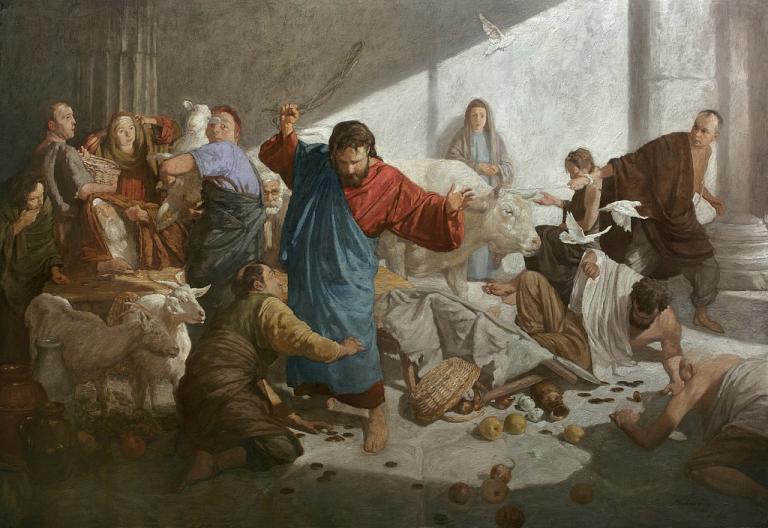
Expulsion of the merchants from the temple by A.N. Mironov, courtesy of Wikipedia
It’s fascinating how many Christians argue for a violent Jesus. In spite of the fact that all throughout his ministry, Jesus told his listeners to do things like love their enemies, bless those who persecute them, turn the other cheek, and so on, some Jesus-followers still insist that Jesus was, in so many ways, okay with violence. One place they generally turn to as proof is the so-called “cleansing of the Temple” (cf. Mark 11:15–19, 27–33; Matt 21:12–17, 23–27; Luke 19:45–48, 20:1–8; John 2:13–16).
In this piece, I’d like to show how this is an ill-advised move.
First off, I will admit that in this scene, Jesus does use force to make a point. In fact, he uses so much force that tables get flipped over in dramatic fashion. In John’s version, he even makes a whip of cords that some commentators believe was used to whoop up on some money-changer-ass. But that would be to read something into the text that is simply not there. John doesn’t tell us that Jesus whipped people. Rather, it seems much more reasonable to believe he did what anyone would do if they wanted to drive animals from one place to another: he made a whip of cords, perhaps yelled the Jewish version of “Giddy up, yaw!” and out the sheep and cattle went. This is an anti-sacrificial move, if it is anything.
Nevertheless, some still insist that what Jesus did was violent, that it shows how angry and hostile Jesus will get when you piss him off. But is this so?
Well, not quite. He is much cooler and more calculated than that.
You see, Jesus was a prophet, and as such, often quoted the prophets before him. In fact, just prior to entering the Temple he quotes from Jeremiah 7. Why is this important? Because, just like Jeremiah, Jesus is extremely grieved that his people are about to have their entire world come crashing down at the hands of foreign armies. He foresees their fate and feels obliged to create a dramatic display of what is going to happen within that generation (Luke 21:32; Matt 24:34).
Jeremiah did the same thing hundreds of years prior. In Jeremiah 19, God tells the prophet to “violently” destroy a ceramic jar at the gate that leads to the Valley of Hinnom/Gehenna/Hell. Then, he heads to the Temple to do the same thing. All this represents what the Babylonians are about to do to Jerusalem, which is that they are going to lay waste to everything, including their beloved Temple system.
So, was Jeremiah being violent when he destroyed the ceramic jar? I suppose, if that is how you want to define violence. But it’s not how the Bible defines it. As my friend Brad Jersak teaches: “Throughout the Bible, the word ‘violence’ is associated with injustice, bloodshed and death.” None of that is going on here. And none of that was going on when Jesus essentially performed the same drama.
In fact, it’s quite the opposite.
You see, within 40 years of this event, everything Jesus dramatized—and Jeremiah before him—within the walls of the Temple actually comes to pass. Only much, much worse. Not only are the tables turned over in 70 CE, but every brick comes down. Not only are all the animals driven out, but everything that is breathing is utterly destroyed and literally thrown into the Valley of Hinnom/Gehenna/Hell, where their bodies are burned in a “lake of fire.”
That is violence. Jesus just warned his people about it, not simply by saying “Hey, guys, the Romans are going to destroy you all soon if you don’t change your ways,” but by showing them exactly what is going to happen: tables are going to be overturned; the priests and attendants, along with all the sacrificial animals, are going to be driven out and/or killed; and, to reiterate, everyone is going to end up in the Valley of Hinnom/Gehenna/Hell just like they did after they failed to listen to Jeremiah.
To that end, my advice to my fellow brothers and sisters in Christ who believe Jesus was being violent in this scene is this: interpret it through the lens of Jesus’ entire ministry, not the other way around. Duh, right? Most specifically, interpret it through the lens of the Sermon on the Mount, as well as Jesus’ warning that “those who live by the sword will die by the sword.” Don’t just assume Jesus is violent because he uses force during a dramatization. That is not at all the point of this story, so please stop trying to say it is. In fact, the point of the story is quite the opposite. It is a warning that if we are going to continue in our violent and sacrificial ways, then we are going to end up burning in a lake of fire at the hands of those who are running the political show.
May we begin to see this.
Peace, and stay tuned for Part 2.
Previous Post

March 2, 2018
Holy Scriptures and Faith-Based Violence: A Quiz
Next Post

March 12, 2018 The Myth of a Violent Jesus: Part 2, Swords
Browse Our Archives
Select a Category Atonement Book Review Early Church Eschatology eternal torment Hell Hermeneutics LGBTQ+ Mimetic Theory Mysticism News Old Testament Podcast Poetry Politics Prayer Religion Sacrifice Satire Soteriology Theology Uncategorized Violence
Select a Month October 2026 September 2026 August 2026 July 2026 June 2026 May 2026 April 2026 March 2026 February 2026 June 2025 December 2024 November 2024 October 2024 September 2024 August 2024 July 2024 June 2024 May 2024 April 2024 February 2024 January 2024 December 2023 November 2023 October 2023 September 2023 August 2023 June 2023 April 2023 March 2023 February 2023 January 2023 December 2022 November 2022 October 2022 September 2022 August 2022 July 2022 June 2022 May 2022 April 2022 March 2022 February 2022 January 2022 December 2021 November 2021 October 2021 September 2021 August 2021 July 2021 June 2021 May 2021 April 2021 March 2021 February 2021 January 2021 December 2020 November 2020 June 2019 May 2019 April 2019 March 2019 January 2019 December 2018 November 2018 October 2018 September 2018 August 2018 July 2018 June 2018 May 2018 April 2018 March 2018 February 2018 January 2018 December 2017 November 2017 October 2017 July 2017 June 2017 May 2017 April 2017 March 2017 February 2017 January 2017 December 2016 November 2016 October 2016 September 2016 July 2016 June 2016 May 2016 April 2016 March 2016 February 2016 January 2016 December 2015 November 2015 October 2015 September 2015 August 2015 July 2015 June 2015
Follow Us!
TAKE THE
Religious Wisdom Quiz
Why did God command the Israelites to eat unleavened bread?
Select your answer to see how you score.
It was a symbol of humility They had to leave Egypt quickly Yeast was considered unclean It was the only bread they knew how to make
Books by This Author Books by All Set Free
Related posts from All Set Free


Addressing the Recent Heretic Happy Hour Podcast Episode

I Debated Andrew Wilson, Here's What I Learned

TRENDING AT PATHEOS Progressive Christian

57th Dove Awards Honor Dolly Parton, Crown New...
On gospel music’s biggest night, the 57th annual GMA Dove Awards honored...

The First Eucharistic Controversy: Christ’s Real Presence
For Catholics, the Eucharist is the source and summit of the Christian...

What a Stop Sign Can Teach Us About...
How to Make a Decision When You Can't Hear God Main point:...

Archdiocese Hosts Military Marriage Retreat in Germany
RASTATT, Germany — The transient military lifestyle, with its frequent deployments and...

Nearly every morning, I make the drive to Detroit with my high-school-age...

The Real AI Story Is Adoption Without Trust
Artificial intelligence has crossed a political threshold. It is no longer a...
view all Progressive Christian blogs
Ad-Free & Subscriber Log-In Subscription Support
- About Us
- 2026 Calendar
- Videos
- Podcasts
- Library of World Religions
- Faith In Media Tracker
- Advertise With Us
- Write for Us
- Privacy Policy
- Terms of Service
- Do Not Sell My Data
- Contact Us
- Radiant Digital
- Manage Newsletter Subscriptions
- Unsubscribe From Notifications
- Sitemap
Copyright 2008-2026, Patheos. All rights reserved.
Subscription Support Ad-Free & Subscriber Log-In
Follow Patheos