
BuddhistCatholicContemplativeEvangelicalGeneral ChristianHinduJewishLatter-day SaintMuslimNew VisionsProgressive Christian
Beliefs
- Buddhist
- Catholic
- Contemplative
- Evangelical
- General Christian
- Hindu
- Jewish
- Latter-day Saint
- More Voices
- Muslim
- New Visions
- Pagan
- Progressive Christian
Topics
- Religion News
- Food and Religion
- Sports and Religion
- Religious Art
- Religious Music and Entertainment
- Religious Events
- History and Religion
- Style and Religion
- Politics and Religion
- Women in Religion
- Recreation Outdoors and Religion
- Business Finance and Religion
- Careers Workplace and Religion
- Education and Religion
- Family Parenting and Religion
- Health Fitness and Religion
- Home and Religion
- Relationships and Religion
- Technology and Religion
- Travel and Religion
Columnists
- Buddhist Columnists
- Business Finance and Religion Columnists
- Careers Workplace and Religion Columnists
- Catholic Columnists
- Contemplative Columnists
- Education and Religion Columnists
- Evangelists Columnists
- Family Parenting and Religion Columnists
- General Christian Columnists
- Health Fitness and Religion Columnists
- Hindu Columnists
- History and Religion Columnists
- Home and Religion Columnists
- Jewish Columnists
- More Voices Columnists
- Latter Day Columnists
- Muslim Columnists
- New Visions Columnists
- Nonreligious Columnists
- Pagan Columnists
- Politics and Religion Columnists
- Progressive Columnists
- Recreation Outdoors and Religion Columnists
- Relationships and Religion Columnists
- Religion News Columnists
- Religious Art Columnists
- Religious Events Columnists
- Religious Music and Entertainment Columnists
- Sports and Religion Columnists
- Style and Religion Columnists
- Technology and Religion Columnists
- Travel and Religion Columnists
- Women in Religion Columnists
Resource Library
- 2026 Calendar
- Library of World Religions
- The 100 Most Holy Places on Earth
- Patheos Answers
- Podcasts
- Videos
- Faith Leaders Database
- Anglican Episcopalian
- Bahai
- Baptist
- Buddhism
- Christianity
- Confucianism
- Eastern Orthodoxy
- Hinduism
- Holiness and Pentecostal
- ISKCON
- Islam
- Judaism
- Lutheran
- Methodist
- The Church of Jesus Christ of Latter-day Saints
- New Age
- Paganism
- Presbytarian and Reformed
- Protestantism
- Religion Behind the Scenes
- Roman Catholic
- Scientology
- Shia Islam
- Sikhism
- Sufism
- Sunni Islam
- Taoism
- Zen
- See all religions
Research Tools
 Ad-Free & Subscriber Log-In Subscription Support
Ad-Free & Subscriber Log-In Subscription Support
Follow Patheos 

- Trending:
- Forgiveness
- |
- Marriage
- |
- Consciousness
- |
- Death Penalty
- |
- Election
- |
- Halloween

- Home
- Progressive Christian
- Religion News
- Is Christian Universalism a Slippery Slope?
Is Christian Universalism a Slippery Slope?
Last updated on: January 19, 2018 at 8:59 pm by Guest Contributor
Is Christian Universalism a Slippery Slope? 2018-01-19T20:59:50-06:00 Guest Contributor
Patheos Explore the world's faith through different perspectives on religion and spirituality! Patheos has the views of the prevalent religions and spiritualities of the world.
 *Note, this is a guest piece by Charles Watson, author of Hell in a Nutshell, available now from Wipf & Stock Publishers. You can read my review of this book here.
Christians are usually caught off-guard when they are first introduced to the doctrine of Universal Reconciliation (UR). Since it challenges their understanding of the Atonement, many have become defensive of their model of Christianity. Since Scripture states that the wages of sin is death and that the second death is the Lake of Fire, many believe that Jesus came to save us from an all too real lake of burning sulfur; one in which people are tormented day and night—forever and ever. Therefore, when they witness Christians denying the doctrine of Endless Conscious Torment (ECT), they tend to either ignore the naysayers or they valiantly defend their doctrinal convictions.
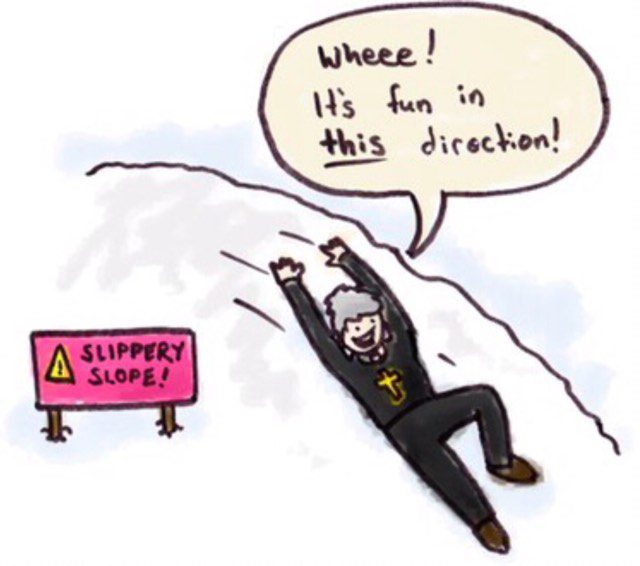
When I started to doubt ECT, my Christian friends were compelled to rebuke me. I was told that I was wandering onto a slippery slope, which put me in danger of backsliding. At first, I felt alarmed. Was I sliding down a frictionless slope toward heresy? It surely felt like it at the time. I constantly caught myself arguing with myself: “You mustn’t accept CU, regardless of how much it comforts your soul.” It was heresy and I would not become a heretic.
However, as time went on, I realized that I needed to look into what actually makes heresy heretical. Did CU deny some essential truth of the Christian faith, such as the exclusivity of Jesus? It must have—since it apparently denied the reality of that from which Christ came to save us: ECT. Did Jesus come to save us from ECT? I did not, until that point, ask that question.
At the time, I was questioning so much of what I was taught as a child. Had I crossed the threshold of no-return? Could I escape this slippery-slope of death? Just how close was I to the fiery pit that I was questioning?
After seasons of doubt, I realized that I was not backsliding or even in danger of doing so. I was following biblical instruction. Scripture commands us to “test all things” and to “hold onto what is good and true.” Therefore, I decided to accept God’s invitation, to come and reason with him, rather than to blindly trust in what I was told is good and true.
Growing up, I was often reminded to beware of false teachers and to avoid strange theology; which sounds like great advice. Even though I was instructed to avoid false teachers, I was never taught how to identify them or their teachings. The company with which I surrounded myself identified strange doctrine as that which is unfamiliar or “unorthodox”; they assumed that one of the first steps onto a slippery slope included a willingness to entertain unorthodox ideas.
Backsliding definitely sounds like something which ought to be avoided at all costs, but what is it that constitutes backsliding? Is questioning orthodoxy spiritually unhealthy? Is it spiritually unhealthy to question the purpose of hell or any other particular concept? Does possessing great hope in the ultimate reconciliation of all things make one backslidden? Consider what Jeremiah had to say about this subject:
“Your own wickedness will correct you, And your backslidings will rebuke you. Know therefore and see that it is an evil and bitter thing—that you have forsaken the LORD your God. And the fear of Me is not in you,’ Says the LORD God of hosts.” ~ Jeremiah 2:19
Firstly, where is the wickedness in questioning orthodoxy? Where is it in the doctrine of UR? I am not referring to the supposed wickedness in denying what many see as the “clear” teaching of Scripture. When the Bible speaks of wickedness, it always pertains to moral misdeeds, which leads to spiritual error. Questioning the validity of orthodoxy is anything but spiritual error because Scripture calls us to test such things.
Secondly, how are those who question orthodoxy forsaking the LORD? It seems to me that church authorities are the ones who feel forsaken. They are the ones fighting opposition, refusing to allow there to be diversity among their lambs. We who are committed to the testing all things are not forsaking the LORD. If anything, we are trying to escape religious oppression so that we may walk toward a less distorted image of Christ.
Finally, is the fear of the LORD necessarily in anyone who believes in any particular doctrine of postmortem judgement? What is the fear of the LORD, exactly? We know that it is the beginning of wisdom; but what is a fear of the LORD that gives birth to wisdom? Does it spring up from a fear of endless suffering in a fiery postmortem realm?
Why do so many Christians believe that God desires humanity to be enslaved and manipulated by such a fear? I cannot believe that it is so . . . not any longer. I have come to believe that the fear of the LORD is not a trepidation of postmortem possibilities, but a holy reverence toward he who formed our delicate souls. We who possess this great hope in UR are no more void of a fear of the LORD than are those who believe in ECT or Conditional Immortality.
The fear of the LORD may affect our understanding of postmortem judgement, but it does not constitute it. Given the criteria Jeremiah provided for being backslidden, one cannot say that questioning orthodoxy has anything to do with it. If anything, our desire to test theology, whether it is strange or not, reinforces our reverence toward God.
As a Christian who believes so strongly in the cross, I cannot imagine a scenario beyond one in which Jesus succeeds in drawing everyone to himself. He is a God who keeps his promises, after all.
At the end of the day, if believing in UR places me on a slippery slope, I am along to enjoy the ride! Christian Universalism is anything but heretical because it is built on a solid foundation—the unfailing love of God. The fear of the LORD may be the beginning of wisdom, but love is undoubtedly its end.

Next Post

January 19, 2018 A Biblical Case for the Rapture
Browse Our Archives
Select a Category Atonement Book Review Early Church Eschatology eternal torment Hell Hermeneutics LGBTQ+ Mimetic Theory Mysticism News Old Testament Podcast Poetry Politics Prayer Religion Sacrifice Satire Soteriology Theology Uncategorized Violence
Select a Month October 2026 September 2026 August 2026 July 2026 June 2026 May 2026 April 2026 March 2026 February 2026 June 2025 December 2024 November 2024 October 2024 September 2024 August 2024 July 2024 June 2024 May 2024 April 2024 February 2024 January 2024 December 2023 November 2023 October 2023 September 2023 August 2023 June 2023 April 2023 March 2023 February 2023 January 2023 December 2022 November 2022 October 2022 September 2022 August 2022 July 2022 June 2022 May 2022 April 2022 March 2022 February 2022 January 2022 December 2021 November 2021 October 2021 September 2021 August 2021 July 2021 June 2021 May 2021 April 2021 March 2021 February 2021 January 2021 December 2020 November 2020 June 2019 May 2019 April 2019 March 2019 January 2019 December 2018 November 2018 October 2018 September 2018 August 2018 July 2018 June 2018 May 2018 April 2018 March 2018 February 2018 January 2018 December 2017 November 2017 October 2017 July 2017 June 2017 May 2017 April 2017 March 2017 February 2017 January 2017 December 2016 November 2016 October 2016 September 2016 July 2016 June 2016 May 2016 April 2016 March 2016 February 2016 January 2016 December 2015 November 2015 October 2015 September 2015 August 2015 July 2015 June 2015
Follow Us!
TAKE THE
Religious Wisdom Quiz
Where was Paul headed when he encountered the risen Christ?
Select your answer to see how you score.
Jerusalem Rome Antioch Damascus
Books by This Author Books by All Set Free
Related posts from All Set Free



An Evangelical Case for Trump as the Antichrist
A Second Coming That Undoes the First
TRENDING AT PATHEOS Progressive Christian

Methodist Central Hall and Westminster Abbey
Situated on the same square is Methodist Central Hall and Westminster Abbey. ...

57th Dove Awards Honor Dolly Parton, Crown New...
On gospel music’s biggest night, the 57th annual GMA Dove Awards honored...

The First Eucharistic Controversy: Christ’s Real Presence
For Catholics, the Eucharist is the source and summit of the Christian...

What a Stop Sign Can Teach Us About...
How to Make a Decision When You Can't Hear God Main point:...

Archdiocese Hosts Military Marriage Retreat in Germany
RASTATT, Germany — The transient military lifestyle, with its frequent deployments and...

Nearly every morning, I make the drive to Detroit with my high-school-age...
view all Progressive Christian blogs
Ad-Free & Subscriber Log-In Subscription Support
- About Us
- 2026 Calendar
- Videos
- Podcasts
- Library of World Religions
- Faith In Media Tracker
- Advertise With Us
- Write for Us
- Privacy Policy
- Terms of Service
- Do Not Sell My Data
- Contact Us
- Radiant Digital
- Manage Newsletter Subscriptions
- Unsubscribe From Notifications
- Sitemap
Copyright 2008-2026, Patheos. All rights reserved.
Subscription Support Ad-Free & Subscriber Log-In
Follow Patheos