
BuddhistCatholicContemplativeEvangelicalGeneral ChristianHinduJewishLatter-day SaintMuslimNew VisionsProgressive Christian
Beliefs
- Buddhist
- Catholic
- Contemplative
- Evangelical
- General Christian
- Hindu
- Jewish
- Latter-day Saint
- More Voices
- Muslim
- New Visions
- Pagan
- Progressive Christian
Topics
- Religion News
- Food and Religion
- Sports and Religion
- Religious Art
- Religious Music and Entertainment
- Religious Events
- History and Religion
- Style and Religion
- Politics and Religion
- Women in Religion
- Recreation Outdoors and Religion
- Business Finance and Religion
- Careers Workplace and Religion
- Education and Religion
- Family Parenting and Religion
- Health Fitness and Religion
- Home and Religion
- Relationships and Religion
- Technology and Religion
- Travel and Religion
Columnists
- Buddhist Columnists
- Business Finance and Religion Columnists
- Careers Workplace and Religion Columnists
- Catholic Columnists
- Contemplative Columnists
- Education and Religion Columnists
- Evangelists Columnists
- Family Parenting and Religion Columnists
- General Christian Columnists
- Health Fitness and Religion Columnists
- Hindu Columnists
- History and Religion Columnists
- Home and Religion Columnists
- Jewish Columnists
- More Voices Columnists
- Latter Day Columnists
- Muslim Columnists
- New Visions Columnists
- Nonreligious Columnists
- Pagan Columnists
- Politics and Religion Columnists
- Progressive Columnists
- Recreation Outdoors and Religion Columnists
- Relationships and Religion Columnists
- Religion News Columnists
- Religious Art Columnists
- Religious Events Columnists
- Religious Music and Entertainment Columnists
- Sports and Religion Columnists
- Style and Religion Columnists
- Technology and Religion Columnists
- Travel and Religion Columnists
- Women in Religion Columnists
Resource Library
- 2026 Calendar
- Library of World Religions
- The 100 Most Holy Places on Earth
- Patheos Answers
- Podcasts
- Videos
- Faith Leaders Database
- Anglican Episcopalian
- Bahai
- Baptist
- Buddhism
- Christianity
- Confucianism
- Eastern Orthodoxy
- Hinduism
- Holiness and Pentecostal
- ISKCON
- Islam
- Judaism
- Lutheran
- Methodist
- The Church of Jesus Christ of Latter-day Saints
- New Age
- Paganism
- Presbytarian and Reformed
- Protestantism
- Religion Behind the Scenes
- Roman Catholic
- Scientology
- Shia Islam
- Sikhism
- Sufism
- Sunni Islam
- Taoism
- Zen
- See all religions
Research Tools
 Ad-Free & Subscriber Log-In Subscription Support
Ad-Free & Subscriber Log-In Subscription Support
Follow Patheos 

- Trending:
- Forgiveness
- |
- Marriage
- |
- Consciousness
- |
- Death Penalty
- |
- Election
- |
- Halloween

- Home
- Progressive Christian
- Religion News
- “If all are saved, then why follow Jesus?”
“If all are saved, then why follow Jesus?”
Last updated on: November 8, 2017 at 10:35 pm by Matthew Distefano
“If all are saved, then why follow Jesus?” 2017-11-08T22:35:44-06:00 Matthew Distefano
Patheos Explore the world's faith through different perspectives on religion and spirituality! Patheos has the views of the prevalent religions and spiritualities of the world.
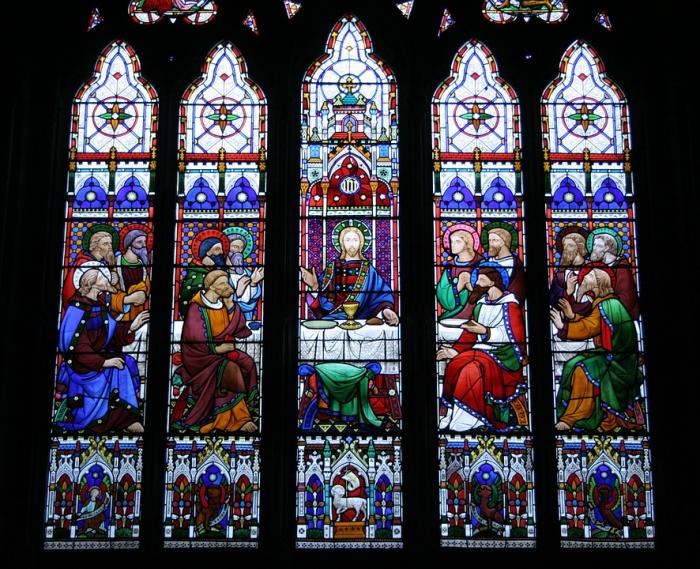
Courtesy of Pixabay
“If all are saved, then why follow Jesus?” has to be one of my least favorite inquiries, and for a litany of reasons. But primarily, it is because this question seems to assume that if there is no eternal hell awaiting us should we fail to choose Jesus as “personal lord and savior” in this life, then Jesus is not worth following. As if our primary concern as Christians should be the afterlife, rather than ushering in the at-hand kingdom of heaven. Ugh! Not for nothing, but my personal experiences strongly suggest that this assumption carries little weight. And pardon me, but I have yet to figure out how to remove myself from my subjective experiences. Let me know if you figure that one out, will you?
Now, that being said, in spite of the annoyance this question causes me, let’s explore a few answers, shall we?
Answer 1: The Gospel Brings Peace
“As shoes for your feet put on whatever will make you ready to proclaim the gospel of peace.” ~ Eph 6:15
“And the peace of God, which transcends all understanding, will guard your hearts and your minds in Christ Jesus.” ~ Phil 4:7
In case you haven’t noticed, our world is shrouded in violence. Syria is a mess. Palestine is in shambles—so too is Afghanistan, Iraq, Turkey, Yemen, Libya, Somalia, Ethiopia, Honduras, Brazil, Mexico, and on and on the list goes. This list also includes my country, the United States of America. Even as I write this, the United States—by the way, a “Christian” nation, as I’m often told—just chose for its President a “Christian” man whose solution to defeat terrorism is, in part, to “take out their families,”[1] over a “Christian” woman notorious for her pro-war voting record and dubious political dealings.
Some Christian nation!
On top of this precarious political situation we find ourselves in, our city streets are also witnessing increased aggression, both from and toward police, and random acts of violence are becoming more commonplace as of late. It is overwhelmingly apparent, then, that violence is quickly getting out of control and at some point we will have to face a reaping of what we are currently sowing. The worst case scenario, of course, is that we may just one day find ourselves booted the hell off our tiny blue dot, either because of nuclear destruction, a piling up of ecological disasters, and/or for any number of other reasons too numerous to list.
I do not say these things to sound like an alarmist. Ultimately, I remain an optimist. But I also realize the reality of our plight. It’s not beyond the realm of possibilities for humanity to enter into an all out nuclear war at some point, not when we have something to the tune of 15,500 total nukes (as of August, 2016[2]), with Russia just unveiling a warhead aptly called “the satan.” And if any of the nine nations that posses these weapons start going all red button on our asses, then it’s probably game over—unless you want to live underground for the rest of your life. I don’t.
So, given what could be considered some pretty gloomy prognostications, do we not need “saving” from a very real “something?” And is that something not violence? Is the Gospel not relevant when thinking about the real crisis humanity finds herself in, and in fact, has seemingly always found herself in?
You bet it is.
This is what the Gospel has been about from the start: a breaking into our time and space by God to show humanity what true humanness, as well as perfect theology, is all about—namely, divine shalom. Only now, sadly, this beautifully good news has been hijacked and seems more about securing for ourselves some blissful afterlife, rather than ushering in the peaceful kingdom of heaven in the here and now. But the latter is exactly what we need to get back to because at its core, the Gospel has never so much been about posthumous rewards, but about liberation from our enslavement to the violent mechanisms we structure our out-of-shape world with. And one of these mechanisms is called scapegoating.
We see this mechanism on full display in the Passion narrative, especially when former rivals—Pilate and Herod—unite around the death of Jesus. Luke 23:12 teaches: “That same day Herod and Pilate became friends with each other; before this they had been enemies.” That is just how we keep peace in society, by coming together at the expense of an “other.” Indeed, it’s how the world was founded even. Gen 4:17 tells us that after Cain slew Abel, he “knew his wife,” then immediately built a city—from a murder directly to civilization, human culture founded on blood.
The Passion exposes this, though, and then offers a way out. That Way is the Way of forgiveness, even in the face of the violent mechanisms that make up human culture. Luke 23:34 testifies to this when Jesus, naked from the cross, cries out “Father, forgive them; for they do not know what they are doing.” Jesus speaks to the non-conscious nature of this structuring mechanism—they do not know what they are doing—and then models, for all to see, how these powers and principalities shall fall. It will be through forgiveness, and it will be out in the open—“outside the city gate in order to sanctify the people by his own blood” (Heb 13:12)—rather than in the Temple, behind the veil where sacrifices were generally made.
This is how “thy kingdom come” manifests on earth “as it is in heaven” (Matt 6:10). Whereas human kingdoms are structured with retributive violence, to the extent of even seventy-sevenfold—such as when Lamech boasts of murdering a child in Gen 4:24—the kingdom of God is established by forgiveness offered to one another seventy-sevenfold, as taught by Jesus Christ in Matt 18:22, and then as modeled by him on the cross and after the Resurrection. You see, the Resurrection just picks up where the Passion leaves off. It unveils the slain yet forgiving victim, who offers the same peace and forgiveness (John 20:19–23) he offered during his life (Luke 23:34). This is what the writer of Hebrews is getting at when he teaches that the blood of Jesus speaks a better word than the blood of Abel (Heb 12:24). In Gen 4:10, Abel’s blood cries for vengeance. But Jesus, both from the cross and then after, forgivingly cries for shalom, or in other words, peace.
Answer 2: Death Looms—Watching, Waiting
“So that through death he might destroy the one who has the power of death, that is, the devil, and free those who all their lives were held in slavery by the fear of death.” ~ Heb 2:14b–15
All of us, in one way or another, are destined to die, whether by some horrific event early on in life or simply from a wearing down of the bodies we are currently riding around in. Frankly, this scares the living crap out of us. Pulitzer Prize winning anthropologist Ernest Becker even posited that it is the primary driving force behind humanity’s gruesome violence.[3] Whether that is entirely true or not, death anxiety certainly enslaves our minds and causes us to behave in such a way that is not at all becoming of the heavenly life. In fact, our fear of death can cause quite a living hell.
One of the major points being driven home by the Apostle Paul in Romans 5 is this very thing. In v.12, we are told that Adam’s sin leads to death for all people. Then in v.14 he writes how death even exercises dominion over us. That is to say, death and the fear it causes holds humanity in bondage, making it completely juxtaposed against the life-giving gift Christ then offers (Rom 5:17–18, 21). And that is the point here. What Adam did, Christ undid—Adam’s sin undone by Christ’s free gift of grace, death undone by Christ raised from the dead.
You see, Christ’s Resurrection shatters our fear of death, so much so in fact, that Paul, in his first letter to the Corinthians, describes death as being “swallowed up in victory” (1 Cor 15:54). Paul is so utterly confident in this that he would even mock death itself: “Where, O death, is your victory? Where, O death, is your sting?” (1 Cor 15:55)
A bold proclamation indeed, don’t ya think!
But the early Christians, Paul included, were bold people. They took all sorts of unjust punishment. They were accused of cannibalism (Eucharist), accused of atheism (they would not bow to the Romans gods), scapegoated for a tragic fire that tore through first century Rome, and then butchered by the thousands. Their burning bodies were even used to light up the night sky during Caesar Nero’s wild and noxious orgies. Yet they remained true to Christ, their Master. They forgave; they opened their homes to one another, living wholly for the “other,” in fact. They lived as if they had already died with Christ (Col 3:3). And because Christ had been raised, so were they. That is what living in the post-baptized reality is all about.
O, death, where is thy sting? Indeed!
That being said, what I want to emphasize to those who suggest that without an eternal hell there is no reason for Jesus is this: death and our fear of death is enough of a hell to be saved from. Eternal torment is indeed a manmade thing, but death is the true plight facing humanity. In fact, we are going to have to die twice. Not only will our bodies die, but so too will our egos, or in other words, our false selves. Ideally, the death of the ego will occur prior to the death of the body, but for some, it will no doubt happen in reverse. And because of this, perhaps there will be some burning going on down in Sheol (the Hebrew word for “the grave”)—a burning away of the “wood, hay, and stubble” that is the fruit of the ego (1 Cor 3:12). Perhaps, even, this will cause torment after death, as the burning away of filth and grim from a gem is not a pain-free process. But all this is speculative, and should not detract us from focusing on Christ’s corporate undoing of the death caused by the sin of Adam. That is where we find life in the most abundant of ways, starting here and now, and then on into the forever.
Answer 3: Jesus Asks Us To
This is the most “duh-worthy” answer of the three. No matter what we believe about eschatology, soteriology, or any of the other “-ologies,” does Jesus not simply ask us to follow him, period? The Bible is fairly clear about this: (All emphasis mine)
- Matt 4:19: “And he said to them, ‘Follow me, and I will make you fish for people.’”
- Matt 16:24: “Then Jesus said to his disciples, ‘Whoever wants to be my disciple must deny themselves and take up their cross and follow me.’”
- Matt 19:28: “Jesus said to them, ‘Truly I tell you, at the renewal of all things, when the Son of Man sits on his glorious throne, you who have followed me will also sit on the twelve thrones, judging the twelve tribes of Israel.’”
- Mark 10:21: “Jesus, looking at him, loved him and said, ‘You lack one thing; go, sell what you own, and give the money to the poor, and you will have treasure in heaven; then come, follow me.’”
- John 8:12: “Again Jesus spoke to them, saying, ‘I am the light of the world. Whoever follows me will never walk in darkness but will have the light of life.’”
- John 21:18–19: “‘Very truly, I tell you, when you were younger you used to fasten your own belt and to go wherever you wished. But when you grow old, you will stretch out your hands, and someone else will fasten a belt around you and take you where you do not wish to go.’ (He said this to indicate the kind of death by which he would glorify God.) After this he said to him, ‘Follow me.’”
You see, this “following” that Jesus calls us for is crucial. Given our mimetic (imitative) nature, we are going to follow someone, and generally non-consciously. And the fact of the matter is that this will generally lead to rivalries and violence, for you see, because we all want what the other has, and because we all cannot have it, it becomes simple mathematics. Think of the opening scene from Lord of the Rings: The Return of the King. Two brothers, Smeagol and Deagol, are fishing in a river, when Deagol gets dragged down by a real lunker of a catch. While under the water, he discovers the infamous ring. Once at the surface, Smeagol arrives and then picks up on Deagol’s deep desire for the ring. Sure enough, the two then get into a knock-down-drag-out fight where in which Smeagol slays Deagol. And that, ladies and gentlemen, is basically what we humans do to each other any time something shiny comes our way. We just cannot help ourselves. Our desires become so twisted, that we often lose our humanity and will stop at nothing to acquire them. We’ll even slay our own brother or sister if we have to.
So Tolkien absolutely nails it!
But the Hebrew Bible also speaks to this in its founding murder myth. Cain slays Abel because he desires what he believes Abel has, namely God’s blessing (Gen 4:3–5). The mimetic rivalry that is fueled by the brothers’ shared desires brings a lurking of sin to Cain’s door (Gen 4:7).[4] Cain then lets sin enter one verse later, when brother rises up against brother, spilling the first human blood. The Bible speaks truth to power here, soberly yet accurately depicting how all of human culture is founded on blood.
So, thinking again about Jesus.
Jesus refuses to enter into mimetic rivalries with others. Now, he does not do this because he is God, or has superhuman abilities (Docetism), but because he knows the Father’s heart. Remember, he was able to “defeat” his dark side while in the wilderness (Luke 4:1–13), thus denouncing anything from within himself that would potentially contradict the will of the Father. On numerous occasions, the writer of John’s Gospel then gives an account of the bond between the Son and the Father:
- John 5:19–20: “Jesus said to them, ‘Very truly, I tell you, the Son can do nothing on his own, but only what he sees the Father doing; for whatever the Father does, the Son does likewise. The Father loves the Son and shows him all that he himself is doing; and he will show him greater works than these, so that you will be astonished.’”
- John 6:38: “For I have come down from heaven, not to do my own will, but the will of him who sent me.”
- John 8:28: “So Jesus said, ‘When you have lifted up the Son of Man, then you will realize that I am he, and that I do nothing on my own, but I speak these things as the Father instructed me.’”
- John 10:29: “What my Father has given me is greater than all else, and no one can snatch it out of the Father’s hand.”
- John 12:49: “For I have not spoken on my own, but the Father who sent me has himself given me a commandment about what to say and what to speak.”
Now, what Jesus reveals about the divine is that divinity possesses no violence. God is a life-giver—only. God’s perfection is described primarily by his love and mercy (Matt 5:38 and Luke 6:36). In fact, God is love itself (1 John 4:18). He is also light and in him there is no darkness (1 John 1:5). This includes the darkness of mimetic rivalry, the very darkness that plagues humanity and drives us to such retributive violence.
This darkness is purely a human thing.
We witness it quite clearly in the back and forth between Jesus and Peter from Matt 16:21–23. Notice how, after Jesus foretells of his own death, Peter attempts to persuade Jesus to do contrary to what the Father was having him do. It is as if Peter is saying “no” to following Jesus and instead, desires Jesus to follow him. René Girard offers great insight into how a rivalry could have been born during this event:
Instead of imitating Jesus, Peter wants Jesus to imitate him. If two friends imitate each other’s desires, they both desire the same object. And if they cannot share this object, they will compete for it, each becoming simultaneously a model and an obstacle to each other. The competing desires intensify as model and obstacle reinforce each other, and an escalation of mimetic rivalry follows; admiration gives way to indignation, jealousy, envy, hatred, and, at last, violence and vengeance. Had Jesus imitated Peter’s ambition, the two thereby would have begun competing for the leadership of some politicized “Jesus movement.” Sensing the danger, Jesus vehemently interrupts Peter: “Get behind me, Satan, you are a skandalon to me.[5]
Jesus understands the temptation of taking on a model other than the Father (Luke 4:1–11). He understands how enticing the satan can be and recognizes it as skandalon, or a stumbling block. In this case, it is Peter’s desire to have Jesus follow him that is the skandalon personified—Satan! If Jesus would have followed Peter, the nonviolent Christ-mission would have failed and the two would have entered into a rivalrous situation, one that would have potentially escalated toward overt violence, either among Jesus and Peter and the disciples, or with those in Jerusalem where Jesus would soon be going, or both.
This is why following Jesus is so important. Because we cannot turn off our mimetic desires, we instead must imitate the desires of a figure that only does the will of the non-rivalrous Father. That figure is Christ Jesus. It is he who can lead us, en masse, into the kingdom of heaven. It is he who can expose humanity’s negative mimesis, and then he who models how to replace that with positive imitation—non-consciousness replaced by a higher consciousness.
It may not be a simple task, but it is the Christian calling—or “election,” if you will. And because this Way of life is not an easy one, crosses must be carried daily (Luke 9:23), as it remains a daily struggle for most people, including myself. But since Jesus asked this of us, and then showed us exactly how to do it, it is exactly what we should do.
For further study, I recommend:
Engaging the Powers: Discernment and Resistance in a World of Domination by Walter Wink
I See Satan Fall like Lightning by René Girard
The Denial of Death by Ernest Becker
The Jesus Driven Life: Reconnecting Humanity with Jesus by Michael Hardin
The Slavery of Death by Richard Beck
[1] Ross, “Donald Trump,” para. 1–2.
[2] See https://www.armscontrol.org/factsheets/Nuclearweaponswhohaswhat.
[3] See The Denial of Death (1973).
[4] This is the very first time the word “sin” is mentioned in the Hebrew Bible.
[5] Girard, “Are the Gospels Mythical?,” para. 10.
Previous Post

November 22, 2016
Crying out in the Wilderness: A Lamentation
Next Post

December 11, 2016 To Whomever Can Help
Browse Our Archives
Select a Category Atonement Book Review Early Church Eschatology eternal torment Hell Hermeneutics LGBTQ+ Mimetic Theory Mysticism News Old Testament Podcast Poetry Politics Prayer Religion Sacrifice Satire Soteriology Theology Uncategorized Violence
Select a Month October 2026 September 2026 August 2026 July 2026 June 2026 May 2026 April 2026 March 2026 February 2026 June 2025 December 2024 November 2024 October 2024 September 2024 August 2024 July 2024 June 2024 May 2024 April 2024 February 2024 January 2024 December 2023 November 2023 October 2023 September 2023 August 2023 June 2023 April 2023 March 2023 February 2023 January 2023 December 2022 November 2022 October 2022 September 2022 August 2022 July 2022 June 2022 May 2022 April 2022 March 2022 February 2022 January 2022 December 2021 November 2021 October 2021 September 2021 August 2021 July 2021 June 2021 May 2021 April 2021 March 2021 February 2021 January 2021 December 2020 November 2020 June 2019 May 2019 April 2019 March 2019 January 2019 December 2018 November 2018 October 2018 September 2018 August 2018 July 2018 June 2018 May 2018 April 2018 March 2018 February 2018 January 2018 December 2017 November 2017 October 2017 July 2017 June 2017 May 2017 April 2017 March 2017 February 2017 January 2017 December 2016 November 2016 October 2016 September 2016 July 2016 June 2016 May 2016 April 2016 March 2016 February 2016 January 2016 December 2015 November 2015 October 2015 September 2015 August 2015 July 2015 June 2015
Follow Us!
TAKE THE
Religious Wisdom Quiz
Who fell out of a window and was restored to life by Paul?
Select your answer to see how you score.
Eutychus Barnabas Silas Timothy
Books by This Author Books by All Set Free
Related posts from All Set Free

Addressing the Recent Heretic Happy Hour Podcast Episode
Yes, Max Miller, She Would Have Made You...


I Debated Andrew Wilson, Here's What I Learned
TRENDING AT PATHEOS Progressive Christian

57th Dove Awards Honor Dolly Parton, Crown New...
On gospel music’s biggest night, the 57th annual GMA Dove Awards honored...

The First Eucharistic Controversy: Christ’s Real Presence
For Catholics, the Eucharist is the source and summit of the Christian...

What a Stop Sign Can Teach Us About...
How to Make a Decision When You Can't Hear God Main point:...

Archdiocese Hosts Military Marriage Retreat in Germany
RASTATT, Germany — The transient military lifestyle, with its frequent deployments and...

Nearly every morning, I make the drive to Detroit with my high-school-age...

The Real AI Story Is Adoption Without Trust
Artificial intelligence has crossed a political threshold. It is no longer a...
view all Progressive Christian blogs
Ad-Free & Subscriber Log-In Subscription Support
- About Us
- 2026 Calendar
- Videos
- Podcasts
- Library of World Religions
- Faith In Media Tracker
- Advertise With Us
- Write for Us
- Privacy Policy
- Terms of Service
- Do Not Sell My Data
- Contact Us
- Radiant Digital
- Manage Newsletter Subscriptions
- Unsubscribe From Notifications
- Sitemap
Copyright 2008-2026, Patheos. All rights reserved.
Subscription Support Ad-Free & Subscriber Log-In
Follow Patheos