
BuddhistCatholicContemplativeEvangelicalGeneral ChristianHinduJewishLatter-day SaintMuslimNew VisionsProgressive Christian
Beliefs
- Buddhist
- Catholic
- Contemplative
- Evangelical
- General Christian
- Hindu
- Jewish
- Latter-day Saint
- More Voices
- Muslim
- New Visions
- Pagan
- Progressive Christian
Topics
- Religion News
- Food and Religion
- Sports and Religion
- Religious Art
- Religious Music and Entertainment
- Religious Events
- History and Religion
- Style and Religion
- Politics and Religion
- Women in Religion
- Recreation Outdoors and Religion
- Business Finance and Religion
- Careers Workplace and Religion
- Education and Religion
- Family Parenting and Religion
- Health Fitness and Religion
- Home and Religion
- Relationships and Religion
- Technology and Religion
- Travel and Religion
Columnists
- Buddhist Columnists
- Business Finance and Religion Columnists
- Careers Workplace and Religion Columnists
- Catholic Columnists
- Contemplative Columnists
- Education and Religion Columnists
- Evangelists Columnists
- Family Parenting and Religion Columnists
- General Christian Columnists
- Health Fitness and Religion Columnists
- Hindu Columnists
- History and Religion Columnists
- Home and Religion Columnists
- Jewish Columnists
- More Voices Columnists
- Latter Day Columnists
- Muslim Columnists
- New Visions Columnists
- Nonreligious Columnists
- Pagan Columnists
- Politics and Religion Columnists
- Progressive Columnists
- Recreation Outdoors and Religion Columnists
- Relationships and Religion Columnists
- Religion News Columnists
- Religious Art Columnists
- Religious Events Columnists
- Religious Music and Entertainment Columnists
- Sports and Religion Columnists
- Style and Religion Columnists
- Technology and Religion Columnists
- Travel and Religion Columnists
- Women in Religion Columnists
Resource Library
- 2026 Calendar
- Library of World Religions
- The 100 Most Holy Places on Earth
- Patheos Answers
- Podcasts
- Videos
- Faith Leaders Database
- Anglican Episcopalian
- Bahai
- Baptist
- Buddhism
- Christianity
- Confucianism
- Eastern Orthodoxy
- Hinduism
- Holiness and Pentecostal
- ISKCON
- Islam
- Judaism
- Lutheran
- Methodist
- The Church of Jesus Christ of Latter-day Saints
- New Age
- Paganism
- Presbytarian and Reformed
- Protestantism
- Religion Behind the Scenes
- Roman Catholic
- Scientology
- Shia Islam
- Sikhism
- Sufism
- Sunni Islam
- Taoism
- Zen
- See all religions
Research Tools
 Ad-Free & Subscriber Log-In Subscription Support
Ad-Free & Subscriber Log-In Subscription Support
Follow Patheos 

- Trending:
- Forgiveness
- |
- Marriage
- |
- Consciousness
- |
- Death Penalty
- |
- Election
- |
- Halloween

- Home
- Progressive Christian
- Religion News
- Introduction for my next book: “From the Blood of Abel.”
Introduction for my next book: “From the Blood of Abel.”
Last updated on: November 18, 2017 at 7:16 pm by Matthew Distefano
Introduction for my next book: “From the Blood of Abel.” 2017-11-18T19:16:50-06:00 Matthew Distefano
Patheos Explore the world's faith through different perspectives on religion and spirituality! Patheos has the views of the prevalent religions and spiritualities of the world.
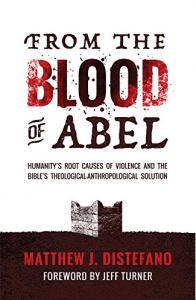 The Bible is a bloody book and I do not mean that in the way the British use “bloody” . . . as a noun intensifier that is. Rather, what I mean is that if it were a movie, it would be rated R for the incessant use of violence contained therein. Thematically, conquest and power is front and center as warring clans are constantly wiping each other off the face of the earth. From the great and mighty Pharaohs of Egypt and Caesars of Rome, all the way down to the smallest tribes of Judah, war is king and, to quote the poet Bob Dylan, we wage it “with God on our side.”[1] And these gods, such as the more well known Ba’al and Molech, are so blood-thirsty that they are believed to demand the murder—ahem, sacrifice—of innocent children in order to be propitiated. There is even a story in 2 Kings 3 where the king of Moab, during a great battle with Israel, sacrifices his firstborn son to his god Chemosh[2] in order to secure victory over the Israelites. And shockingly, it appears to work! 2 Kings 3:27 tells us that after the sacrifice of the heir to the Moabite throne, a “great wrath came upon Israel” and the Israelites withdrew from battle. This shows just how the belief in the power of sacrifice is a great power in and of itself. We now know Chemosh does not exist so would never believe that the sacrifice of a Moabite prince would actually lead to victory in war, but the writer of 2 Kings sure did. There was power in blood . . . and still is! I will get to that later.
But the Bible is also a book about hope and restoration. It testifies to a once enslaved people, who are delivered from bondage by a God who is for the downtrodden, for the poor, for the oppressed, and for the least of society.[3] It is also a book that is not afraid to testify against itself and its tradition, a book that includes the voice of the prophets who boldly critique their own faith tradition to the point of death.[4] Then, unlike any other event in history, it testifies about Christ Jesus, the one whom the Jewish prophets prophetically declared would “command peace to the nations” and whose “dominion shall be from sea to sea.” (Zechariah 9:9—emphasis mine) Furthermore, as violent the imagery is in the final book of the Bible, the Book of Revelation, hope in fact crescendos when it is said that from the slain lamb (Revelation 5:6), eternal life-giving water flows, sustaining the “tree of life” that is for the “healing of the nations” (Revelation 22:1–2—emphasis mine). In the midst of war and chaos and death and mayhem, there is a blessed optimism for all people as the writer of Revelation also explicitly states that the gates of heaven never close (Revelation 21:25) and that the Holy Spirit and bride of Christ (the church) perpetually invite others in (Revelation 22:17). Thus, there always remains hope—enough for that writer to envision a time when “he will wipe every tear from their eyes.” (Revelation 21:4)
So, then, what do we, as Christians, do with the Bible? Do we do as many in the Protestant tradition do and simply open it up and see what God is “speaking to us?” Do we read the book with a flat-hermeneutic (literal interpretation), and attempt to coalesce seemingly contradictory characteristics about God as the more fundamentalist-inclined do? Or, do we do a “one-eighty” and chuck out the whole Old Testament as Marcion of Sinope suggested or even more dramatic yet; toss out the entire Bible—New Testament included—as post-enlightenment atheists strongly advise?
Well, I do not believe any of these options or any similar are satisfactory and over the course of this book, will attempt to offer a better way to engage the Bible. I will argue that, rather than one unequivocal voice (God’s) in Scripture, there are multiple voices present (religion vs. revelation) and that the lens from which we discern what is what is that of Jesus hanging on the cross. It is this Christocentric lens, I will assert, that has the power to save us from ourselves and our fundamental human problem, namely that of violence (which I will introduce in chapter one). It has the power to save us from our propensity to create victims in the name of God, and, to use Pauline language, from the powers and principalities that structure our fallen world (Ephesians 6:12). It is the love Christ has for us that places him in the center of our death-dealing systems but it is also the love the Father has for him and for all of humanity that resurrects him three days later. This is the Good News and it is within this book called “The Bible” where we find hope; hope of a future where violence is no more, where the nations are indeed healed by the tree of life, and where the peace of God reigns forevermore. At least, that will be the case I am attempting to make in this book.
So let us journey together and discover how the Bible and more specifically the Gospel can be used to help heal humanity of her root causes of conflict. Let us discover the God who truly, in the end, desires mercy for all of his children. Let us discover a God who also desires for all his children to come home. Let us discover true peace for all.
Matthew J. Distefano
Paradise, CA
December 21, 2015
[1] The quoted section is the title of the third track from Bob Dylan’s 1964 album The Times They Are A-Changin’.
[2] Chemosh is depicted as the god of Moab in the Mesha Stele (c. 840 BC), or “Moabite Stone,” lines 3, 4, 8, 12, etc.
[3] This is traced back to the story of the Exodus, where Moses delivers the Hebrew people from bondage at the hands of the Egyptians.
[4] The attempted murder of the prophet Jeremiah can be found in Jeremiah 38:1 – 6, while the murder of Zechariah is found in 2 Chronicles 24:20–25.
Previous Post
December 19, 2015
Review of "All Set Free" by Lindsey Paris-Lopez
Next Post

January 7, 2016 My Take on the Situation in Oregon
Browse Our Archives
Select a Category Atonement Book Review Early Church Eschatology eternal torment Hell Hermeneutics LGBTQ+ Mimetic Theory Mysticism News Old Testament Podcast Poetry Politics Prayer Religion Sacrifice Satire Soteriology Theology Uncategorized Violence
Select a Month October 2026 September 2026 August 2026 July 2026 June 2026 May 2026 April 2026 March 2026 February 2026 June 2025 December 2024 November 2024 October 2024 September 2024 August 2024 July 2024 June 2024 May 2024 April 2024 February 2024 January 2024 December 2023 November 2023 October 2023 September 2023 August 2023 June 2023 April 2023 March 2023 February 2023 January 2023 December 2022 November 2022 October 2022 September 2022 August 2022 July 2022 June 2022 May 2022 April 2022 March 2022 February 2022 January 2022 December 2021 November 2021 October 2021 September 2021 August 2021 July 2021 June 2021 May 2021 April 2021 March 2021 February 2021 January 2021 December 2020 November 2020 June 2019 May 2019 April 2019 March 2019 January 2019 December 2018 November 2018 October 2018 September 2018 August 2018 July 2018 June 2018 May 2018 April 2018 March 2018 February 2018 January 2018 December 2017 November 2017 October 2017 July 2017 June 2017 May 2017 April 2017 March 2017 February 2017 January 2017 December 2016 November 2016 October 2016 September 2016 July 2016 June 2016 May 2016 April 2016 March 2016 February 2016 January 2016 December 2015 November 2015 October 2015 September 2015 August 2015 July 2015 June 2015
Follow Us!
TAKE THE
Religious Wisdom Quiz
Who said: "Do not merely listen to the word, and so deceive yourselves. Do what it says"?
Select your answer to see how you score.
Paul Peter Jesus James
Books by This Author Books by All Set Free
Related posts from All Set Free

Addressing the Recent Heretic Happy Hour Podcast Episode
Yes, Max Miller, She Would Have Made You...


I Debated Andrew Wilson, Here's What I Learned
TRENDING AT PATHEOS Progressive Christian

Emotion in Early Christianity by Andrew Crislip
Andrew Crislip’s Emotion in Early Christianity examines an often overlooked dimension of...

16 Spiritual Touchstones for a More Grounded Life
After decades of spiritual study, here are 16 principles I try...

Catholic Evangelization: Sharing Your Faith Every Day
Welcome back to the Graceful Awakening mini-series called, “From Faith to Mission.” ...

The Pillar of the Boatmen: the Ancient Monument...
The Pillar of the Boatmen is a Romano-Gaulish sculpture that dates from...

In one sense walking into Westminster Abbey is like walking down the...

'Super Scam Me' Exposes AI Jon Bon Jovi...
Leslie Pickett believed she was in a relationship with Jon Bon Jovi....
view all Progressive Christian blogs
Ad-Free & Subscriber Log-In Subscription Support
- About Us
- 2026 Calendar
- Videos
- Podcasts
- Library of World Religions
- Faith In Media Tracker
- Advertise With Us
- Write for Us
- Privacy Policy
- Terms of Service
- Do Not Sell My Data
- Contact Us
- Radiant Digital
- Manage Newsletter Subscriptions
- Unsubscribe From Notifications
- Sitemap
Copyright 2008-2026, Patheos. All rights reserved.
Subscription Support Ad-Free & Subscriber Log-In
Follow Patheos