
BuddhistCatholicContemplativeEvangelicalGeneral ChristianHinduJewishLatter-day SaintMuslimNew VisionsProgressive Christian
Beliefs
- Buddhist
- Catholic
- Contemplative
- Evangelical
- General Christian
- Hindu
- Jewish
- Latter-day Saint
- More Voices
- Muslim
- New Visions
- Pagan
- Progressive Christian
Topics
- Religion News
- Food and Religion
- Sports and Religion
- Religious Art
- Religious Music and Entertainment
- Religious Events
- History and Religion
- Style and Religion
- Politics and Religion
- Women in Religion
- Recreation Outdoors and Religion
- Business Finance and Religion
- Careers Workplace and Religion
- Education and Religion
- Family Parenting and Religion
- Health Fitness and Religion
- Home and Religion
- Relationships and Religion
- Technology and Religion
- Travel and Religion
Columnists
- Buddhist Columnists
- Business Finance and Religion Columnists
- Careers Workplace and Religion Columnists
- Catholic Columnists
- Contemplative Columnists
- Education and Religion Columnists
- Evangelists Columnists
- Family Parenting and Religion Columnists
- General Christian Columnists
- Health Fitness and Religion Columnists
- Hindu Columnists
- History and Religion Columnists
- Home and Religion Columnists
- Jewish Columnists
- More Voices Columnists
- Latter Day Columnists
- Muslim Columnists
- New Visions Columnists
- Nonreligious Columnists
- Pagan Columnists
- Politics and Religion Columnists
- Progressive Columnists
- Recreation Outdoors and Religion Columnists
- Relationships and Religion Columnists
- Religion News Columnists
- Religious Art Columnists
- Religious Events Columnists
- Religious Music and Entertainment Columnists
- Sports and Religion Columnists
- Style and Religion Columnists
- Technology and Religion Columnists
- Travel and Religion Columnists
- Women in Religion Columnists
Resource Library
- 2026 Calendar
- Library of World Religions
- The 100 Most Holy Places on Earth
- Patheos Answers
- Podcasts
- Videos
- Faith Leaders Database
- Anglican Episcopalian
- Bahai
- Baptist
- Buddhism
- Christianity
- Confucianism
- Eastern Orthodoxy
- Hinduism
- Holiness and Pentecostal
- ISKCON
- Islam
- Judaism
- Lutheran
- Methodist
- The Church of Jesus Christ of Latter-day Saints
- New Age
- Paganism
- Presbytarian and Reformed
- Protestantism
- Religion Behind the Scenes
- Roman Catholic
- Scientology
- Shia Islam
- Sikhism
- Sufism
- Sunni Islam
- Taoism
- Zen
- See all religions
Research Tools
 Ad-Free & Subscriber Log-In Subscription Support
Ad-Free & Subscriber Log-In Subscription Support
Follow Patheos 

- Trending:
- Forgiveness
- |
- Marriage
- |
- Consciousness
- |
- Death Penalty
- |
- Election
- |
- Halloween
 The Allergic Pagan
- Home
- Pagan
- Can “God” be Castrated?
Can “God” be Castrated?
Last updated on: August 25, 2016 at 8:43 am by John Halstead
Can “God” be Castrated? 2016-08-25T08:43:09-05:00 John Halstead
Patheos Explore the world's faith through different perspectives on religion and spirituality! Patheos has the views of the prevalent religions and spiritualities of the world.
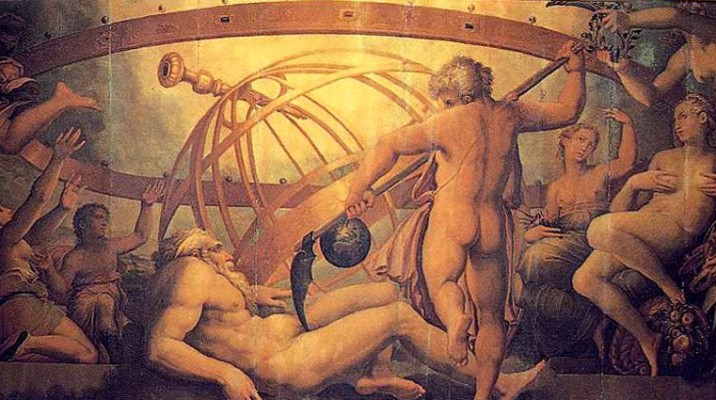 I recently wrote an essay entitled, “Is There A Place for God in Paganism?”, in which I tried to make the case for Pagans reclaiming the word “God” — not “God” the Abrahamic masculine creator God, and not “God” the masculine counterpart to the Goddess, and not “god” one of a plurality of gods, but rather a non-gendered, singular pantheistic “God”:
“Choosing to say ‘God’ instead of ‘Goddess’ allows us to speak about divinity separately from gender, while also allowing us to tap into all the power and possibility that has been associated with that word for centuries. It also allows us to challenge the Abrahamic conceptions of God more directly. …
“I’m not suggesting a return to transcendental monotheism or a return of the Abrahamic patriarch. And I’m not suggesting we choose ‘God’ over ‘the gods’ or the ‘Goddess’. I’m suggesting we embrace all of these words … and more: ‘gods’, ‘goddesses’, ‘Goddess’, and even ‘God’, each of them with their unique potential and their unique limitations.’
The article provoked a strong response, especially on Facebook. The responses fell into several categories:
1. It’s too soon.
“I don’t think it’s time. Let Christianity get down under 50% of the population, maybe it will be safe. Until then I hate encouraging monotheism.”
“I hope we get to the place with deity where the term “God” is not gendered. We are not there yet.”
“Repost in 500 years, we’ll reconsider then.”
2. The gods are many.
“Doesn’t work from a polytheist point of view . We see our gods as individuals.”
“No God for me. And I reject Goddess monotheism equally. Divinity is plural.”
“I think it’s hard to defend ‘God’ as gender neutral in a community that has promoted with vigor the concept of ‘God and Goddess’ for the last 70+ years.“
3. It feels wrong.
“I too use ‘the divine’ to represent both the female and male aspects, ‘God’ feels wrong in my mouth and smacks too much of monothiestic paths.”
“Sorry, the experiences of my formative years have blocked this word for me. It indeed ‘invokes images and qualities associated with the monotheistic god of the Abrahamic faiths, including transcendence, hierarchy, masculinity, dominance, power-over, etc.’ I have no desire to claim/reclaim that term.”
“My upbringing in a Christian home left me with a great deal of mental baggage regarding the word and even now, 30 years on a pagan path, I sometimes have to juggle with this a bit to put it back to bed. “
4. The One is too impersonal.
“There may be a brahman, or all-whatever-the-fewk, but to me it can’t have much to do with my Pagan religion of offering and blessing. When I think about the One, I like to think of One Big Process, or One Big Dance – a pattern made by the actions of countless individuals. The pattern itself has neither will nor work, it just whirls on, by the combined wills of all beings. But I don’t bother worshiping the pattern, because it can’t respond.”
“I do think the Gods are within Cosmos with us, and thus part of Nature. Cosmos is more like the dance Ian described. Too impersonal, too remote to bother with me, much less me bothering with it.”
“I do worship the pattern. And of course it responds. It responds to every minute thing we do. But not in a human, quid pro quo, fashion, of course.”
I can’t argue with any of these objections. Mostly, they boil down to personal preference. If you are a hard polytheist or if your personal history with monotheism is an obstacle, then the word “God” isn’t going to work for you.
But there was a fifth objection, which I struggled the most with:
5. “God” is gendered male.
“But culturally, now, it is pretty gendered.”
“we can’t go back to a time when ‘man was gender neutral”
“At this point gender has been baked into the word for so long that claiming it is not gendered is wishful speaking. As long as the majority of English speakers use the word the way it has always been used I see no reason to pretend that the word is not gendered. ”
“I don’t think at this point in time (maybe someday) God is reclaimable as a non-gendered term, anymore than Goddess is. “
Some people who took this position assumed that “God” is etymologically masculine:
“Goddess includes God. Look at the word. Like Women includes men. Like Female includes male. Yet, we’re rarely given those as the option for neutral.”
“Let’s just go back to “man” meaning everyone. Yes, it’s the same issue.“
The History of “God”
Other commenters responded to this argument by pointing out that “God” is not etymologically male in the way that “man” is. “God” has become gendered over time thanks to Christianity, but it was not originally a gendered term. According to the online etymological dictionary, “god” comes from the Proto-Indo-European roots ghut-, “that which is invoked”, or gheu- “to pour, pour a libation”.
“Originally a neuter noun in Germanic, the gender shifted to masculine after the coming of Christianity.”– Online Etymological Dictionary
I didn’t know that. Interestingly, according to the same source, “goddess” did not appear until the mid-14th century. If “God” predates Christianity, and “Goddess” post-dates advent of Christianity, then a reconstructionist argument could be made for returning to the gender-neutral meaning of “God”. In fact, we have already done that when we speak of the gods in the plural. Even contemporary Pagans speak of “the gods” (plural) in a way that refers to both male gods and female gods (goddesses).
“The word ‘God’ in its origins was not a gendered term. Only through Christianity did it become gendered. This is one of those places where etymology is your friend. I refer to the deities I work with as ‘gods’ despite the fact that the vast majority of them are female and/or genderqueer.”
Regardless of the etymological history, language changes, and I think it should change again — in recognition, not just of the the Feminine Divine (“Goddess”), but also of a divinity that transcends gender (“God”?).
Challenging Norms
I understand the challenge: When we say that a historically male-gendered term is genderless, there is the risk that all we are really doing is normatizing masculinity, i.e., reinforcing maleness as the standard by which all other genders are judged. I recognize that “God” is gendered most in Abrahamic discourse today, but I think that can change … and I think Pagans can help it change.
The word “God” doesn’t have to be gendered, and certainly doesn’t have to be male-gendered. For example, consider the phrase “God Herself/Hirself” or memes like “I met God. She’s Black.” or “God is coming. And She is pissed.”
I don’t think the fact that the majority of people understand a word one way is an argument for accepting the status quo. After all, Pagans reclaimed the word “witch”, which is a word that has been used for centuries to shame, condemn, torture, and burn women’s bodies. In fact, I think the fact that something is harmful is a very good reason to reclaim it and transform it into something healing. Why not reclaim “God” too?
Some of the commenters observed “God” is already understood as transcending gender in Hindu discourse:
“I used to live next to a family from India. I mentioned Kali one day and the older lady stilled, widened her eyes, and said “Kali-ma is God.” The gender wasn’t separated. Deity is spirit, and spirit has no gender. The only thing gender is for is procreation. Spirit has no need to procreate. I even heard a rabbi say that about God. Call God by the feminine, if you want, he said. He was very progressive.”
“Hindus use the word ‘God’ to cover everyone from Kali and Lakshmi to Vishnu and Shiva. When the British brought their language over, the Indian people took the concept of ‘God’ as a divine being, encompassing all genders, and it is still used this way today. ‘God’ has already been reclaimed by one polytheistic faith (although calling Hinduism polytheistic is a debate in itself), so I don’t see why one more faith with gods and goddesses can’t reclaim it.”
“God” By Any Other Name …
Other commenters responded that we already have good words for non-gendered divinity, i.e., “divinity” or “deity”. My only problem with those words is that they lack the cultural power of the word “God”. (The continued use of “God” in profanity, even among Pagans, is testament to its persistent power.) That’s a power I want to appropriate and invest with new meaning.
“Goddess” is a really powerful word too, at least for me. But I think it’s a word that is too easily ignored by Abrahamics. They can dismiss talk about “Goddess” more easily talk about “God”. Limiting ourselves to “Goddess”-talk limits our power to transform the dominant narrative. I think that if we don’t work to transform patriarchal language, then we may be left speaking a language that only those who already agree with us understand. Consider, by way of illustration, how Women’s Studies programs can become ghettoized, thereby insulating the rest of academia from feminist critique. In the same way, the Abrahamic religions are insulated from critiques of their patriarchialism from Pagans and Goddess worshipers, ironically by the very language which Pagans and Goddess worshipers choose to use.
Now, another suggestion in the comments was to use the homophone “Godde”, which is a kind of a mash of “God” and “Goddess”. I like this idea a lot. In its written form, I think it carries most of the cultural “oomph” of “God”, and it avoids conflation with the Abrahamic male-gendered “God”. However, in the spoken form, it’s pronounced the same, so it doesn’t avoid the criticisms above.
What do you think? Can “God” be castrated? Can we reclaim the word “God” from centuries of Christian patriarchal interpretation? Should we bother?
Previous Post

August 24, 2016
Neither Capitalism Nor Socialism: A Third Alternative
Next Post

August 29, 2016 5 Reasons You Should NOT Sign the Pagan Environmental Statement
Browse Our Archives
Select a Category Ritual Scripts Theology Uncategorized
Select a Month January 2017 December 2016 November 2016 October 2016 September 2016 August 2016 July 2016 June 2016 May 2016 April 2016 March 2016 February 2016 January 2016 December 2015 November 2015 October 2015 September 2015 August 2015 July 2015 June 2015 May 2015 April 2015 March 2015 February 2015 January 2015 December 2014 November 2014 October 2014 September 2014 August 2014 July 2014 June 2014 May 2014 April 2014 March 2014 February 2014 January 2014 December 2013 November 2013 October 2013 September 2013 August 2013 July 2013 June 2013 May 2013 April 2013 March 2013 February 2013 January 2013 December 2012 November 2012 October 2012 September 2012 August 2012 July 2012 June 2012 May 2012 April 2012 March 2012 February 2012 January 2012 December 2011 November 2011 October 2011 September 2011 August 2011
TAKE THE
Religious Wisdom Quiz
What Christian group uses "Meeting Houses" instead of traditional churches?
Select your answer to see how you score.
Baptists Lutherans Quakers Methodists
Related posts from The Allergic Pagan

A Guide to Politics at Patheos Pagan

Call to Chicago Area Pagans: Come to Hammond...

Autumn Equinox: God is Climate Change
Four "Godless Pagan" Authors on Pagan Musing Podcast...
TRENDING AT PATHEOS Pagan

I was recently chatting with someone on Instagram. She asked me what...

While there are many people who share their results, the end of...

On July 23, I saw Christopher Nolan's The Odyssey which is Homer’s...

As I write this two big events have just finished up. One...

Restoring the Watershed of Divine Love
Perhaps cooperation is not something we manufacture through legislation, ideology, or moral...

Many UUs don’t pray because of bad experiences in a previous religion,...
view all Pagan blogs
Ad-Free & Subscriber Log-In Subscription Support
- About Us
- 2026 Calendar
- Videos
- Podcasts
- Library of World Religions
- Faith In Media Tracker
- Advertise With Us
- Write for Us
- Privacy Policy
- Terms of Service
- Do Not Sell My Data
- Contact Us
- Radiant Digital
- Manage Newsletter Subscriptions
- Unsubscribe From Notifications
- Sitemap
Copyright 2008-2026, Patheos. All rights reserved.
Subscription Support Ad-Free & Subscriber Log-In
Follow Patheos