
BuddhistCatholicContemplativeEvangelicalGeneral ChristianHinduJewishLatter-day SaintMuslimNew VisionsProgressive Christian
Beliefs
- Buddhist
- Catholic
- Contemplative
- Evangelical
- General Christian
- Hindu
- Jewish
- Latter-day Saint
- More Voices
- Muslim
- New Visions
- Pagan
- Progressive Christian
Topics
- Religion News
- Food and Religion
- Sports and Religion
- Religious Art
- Religious Music and Entertainment
- Religious Events
- History and Religion
- Style and Religion
- Politics and Religion
- Women in Religion
- Recreation Outdoors and Religion
- Business Finance and Religion
- Careers Workplace and Religion
- Education and Religion
- Family Parenting and Religion
- Health Fitness and Religion
- Home and Religion
- Relationships and Religion
- Technology and Religion
- Travel and Religion
Columnists
- Buddhist Columnists
- Business Finance and Religion Columnists
- Careers Workplace and Religion Columnists
- Catholic Columnists
- Contemplative Columnists
- Education and Religion Columnists
- Evangelists Columnists
- Family Parenting and Religion Columnists
- General Christian Columnists
- Health Fitness and Religion Columnists
- Hindu Columnists
- History and Religion Columnists
- Home and Religion Columnists
- Jewish Columnists
- More Voices Columnists
- Latter Day Columnists
- Muslim Columnists
- New Visions Columnists
- Nonreligious Columnists
- Pagan Columnists
- Politics and Religion Columnists
- Progressive Columnists
- Recreation Outdoors and Religion Columnists
- Relationships and Religion Columnists
- Religion News Columnists
- Religious Art Columnists
- Religious Events Columnists
- Religious Music and Entertainment Columnists
- Sports and Religion Columnists
- Style and Religion Columnists
- Technology and Religion Columnists
- Travel and Religion Columnists
- Women in Religion Columnists
Resource Library
- 2026 Calendar
- Library of World Religions
- The 100 Most Holy Places on Earth
- Patheos Answers
- Podcasts
- Videos
- Faith Leaders Database
- Anglican Episcopalian
- Bahai
- Baptist
- Buddhism
- Christianity
- Confucianism
- Eastern Orthodoxy
- Hinduism
- Holiness and Pentecostal
- ISKCON
- Islam
- Judaism
- Lutheran
- Methodist
- The Church of Jesus Christ of Latter-day Saints
- New Age
- Paganism
- Presbytarian and Reformed
- Protestantism
- Religion Behind the Scenes
- Roman Catholic
- Scientology
- Shia Islam
- Sikhism
- Sufism
- Sunni Islam
- Taoism
- Zen
- See all religions
Research Tools
 Ad-Free & Subscriber Log-In Subscription Support
Ad-Free & Subscriber Log-In Subscription Support
Follow Patheos 

- Trending:
- Forgiveness
- |
- Marriage
- |
- Consciousness
- |
- Death Penalty
- |
- Election
- |
- Halloween
 The Allergic Pagan
- Home
- Pagan
- Is There a Place for God in Paganism?
Is There a Place for God in Paganism?
Last updated on: June 29, 2016 at 9:35 am by John Halstead
Is There a Place for God in Paganism? 2016-06-29T09:35:34-05:00 John Halstead
Patheos Explore the world's faith through different perspectives on religion and spirituality! Patheos has the views of the prevalent religions and spiritualities of the world.

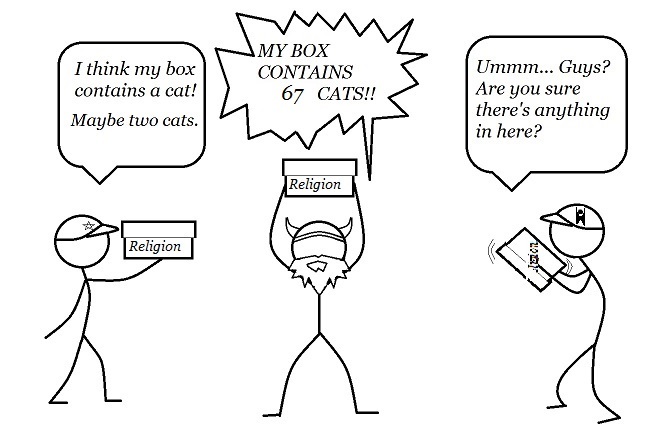
What’s in your God box?
Where Art Thou “God”?
“God” is not a word we hear a lot of in Paganism. We hear about:
gods (plural),
Goddess (feminine),
the god (accompanied by the definite article and often lower case “g”), who is the consort of the Goddess,
and a god (accompanied by the indefinite article and referring to one of many),
but nothing really about “God” (capitalized and singular).
The reason is that much of Neo-Pagan and Polytheists theology represents an intentional challenge to or critique of the traditional Western conception of divinity. But is it time for Pagans to reclaim God?
God vs. the Goddess
For many people who have been raised in Western civilization, whether or not they belong to an Abrahamic faith, the word “God” invokes images and qualities associated with the monotheistic god of the Abrahamic faiths, including transcendence, hierarchy, masculinity, dominance, power-over, etc. The Neo-Pagan Goddess, in contrast, is associated with embodiment, relationality, cyclicity, the chthonic, and the antinomian. The many gods of contemporary Paganism add the qualities of plurality and diversity to the Pagan conception of the divine. As such, both the Neo-Pagan Goddess and the many gods of contemporary Paganism are a needed corrective to an imbalanced image of the divine offered by the Abrahamic faiths.
But in spite of their having left the Abrahamic God behind, the word “God” remains an emotionally and psychologically charged word for many Pagans. Far from being devoid of content, the word is filled with meaning — usually a negative meaning — derived from the Abrahamic faiths. For a long time after I left my faith of origin (Mormonism), the word “God” itself had such strong negative emotional associations that I avoided its use, unless it was prefaced by a definite or indefinite article (“the” or “a”). Even in Pagan contexts, I preferred to use words like the “divine” or “deity”.
It was precisely the negative connotations of the word “God” that made just saying the word “Goddess” such a powerful and healing experience for me. It opened up realms of theological possibility previously unexplored by me, possibilities that I later came to realize in experience. “Goddess” represented for me the possibility of a deity that cared nothing about traditional notions of purity and obedience, a deity that could be experienced immanently, in the material world around me and in my own body.
Refilling My “God Box”
Courtesy: Alexander Folmer
But after many years of avoiding “God”, I gradually began to experience the word being emptied of its negative associations. Eventually, I regained the ability to talk about “God” again — not the God of my Christian upbringing and not a masculine counterpart to the Goddess either. “God” became for me, rather, a linguistic container or “box”. For the most part, I kept this box empty, intentionally, a container for my longing for that which cannot be articulated.
But sometimes, I put different things in my “God box”, trying on different conceptions of the divine, but only for a while. I kept in mind Ann Ulanov’s observation about both the potential and the limitations of theistic imagery: “It is very much a human impulse to try to picture God and God does come to find us in those very pictures as well as in the smashing of them.”
You might wonder why I would want to keep my “God box” at all. As B. T. Newberg has explained, the word “God” retains power, even when it is emptied of its content. As proof of this, consider how many anti-theistic atheists still experience the word as emotionally provocative. Newberg writes:
“The word “god” is embedded in a complex web of associations. Considering its proven ability to inspire powerful emotions and myriad creative interpretations over the centuries, we might say that it is particularly rich in this regard. It is critical to note that among its associations are a sense of heightened importance (sacredness), ultimate questions (e.g., why are we here), and a relation to moral values (how we live our lives). These grant it a unique power to evoke experiences of profound importance and moral relevance.” — B. T. Newberg, “In Defense of Gods” in Godless Paganism (2016).
Reclaiming God

Dylan Chenfeld, a self-described Jewish atheist, helps challenge the traditional image of God
I wonder whether Pagans should reclaim the word “God” from the Abrahamic faiths. Reclaiming is, in my opinion, a quintessentially (Neo-)Pagan activity. We’ve reclaimed ancient gods (like Ba’al), goddesses (like Asherah), and demons (like Lilith). We’ve reclaimed witchcraft and magic. Some of us have even reclaimed Satan. So why not reclaim “God”?
I belong to two religious communities, both of which are ambivalent, if not downright antagonistic, about the word “God”. The first is religious naturalism, which includes Unitarian Universalists and Humansitic Paganism. B. T. Newberg explains why it is important that religious naturalists not surrender the word “God” to the monotheistic literalists.
“It has been shown to have powerful advantages, and relinquishing the term to literalists hands over exclusive control of a potentially destructive weapon. Instead, naturalists can continue the age-old tradition of contested meanings by affirming naturalistic definitions alongside supernatural ones. Naturalist usage of the word “god” subverts literalist dominance, reclaims the word, and evolves it in directions compatible with modern scientific discovery.” — B. T. Newberg, “In Defense of Gods” in Godless Paganism (2016).
The other community I belong to is Paganism. Even those Pagans who are no longer triggered by the word “God” may not see the point of reclaiming it. After all, we’ve got gods (plural) and the Goddess (a feminine monistic deity), what do we need with God?
All these words we use to describe the divine (even “the divine”) are linguistic tools. Each of them says something different about divinity. Speaking of the gods in their plurality reminds us of the multiplicity of the divine, the uniqueness of each of its parts. Speaking of the Goddess in the singular reminds us of the unifying ground of Being which transcends multiplicity without denying its reality, the unity which connects the diverse parts of nature. And She and reminds us to look for the divine in the flesh, in our relationships, in the cycles of nature, in the earthy, and in the chaotic. Both of these — the gods and the Goddess — are personifications which enable us to relate to the divine in a way that we cannot to impersonal metaphors like “the divine”. But we need not see these expressions of divinity — singular and plural, personal and impersonal — as mutually exclusive. We can take a page from the ancient Greeks who, going all the way back to Homer, spoke interchangeably about the gods (theoi) and God (theos).
But there are still more possibilities than the many gods and the one Goddess. The tricky thing about language is that it both opens up horizons of possibility, while it also delimiting or foreclosing other possibilities. When we choose a word to describe something, we are simultaneously choosing not to use other words. Saying “Goddess” allows us to say certain things about divinity, but it doesn’t allow us to say all things. And there is always more to be said. “Goddess” is first and foremost a gendered way of speaking about divinity. “God”, while historically gendered male, is not universally understood in that way, not be Christians or other monotheists. Consider that many Pagans speak of the “gods” inclusively as referring to both male gods and female goddesses.
Choosing to say “God” instead of “Goddess” allows us to speak about divinity separately from gender, while also allowing us to tap into all the power and possibility that has been associated with that word for centuries. It also allows us to challenge the Abrahamic conceptions of God more directly. In some ways, memes like “I met God. She’s Black.” or “God is coming. And She is pissed.” are even more provocative than saying “Goddess”. Talk about “Goddess” can be ignored by Abrahamics as something distinct from “God” (“They’re not talking about our God.”), while talk about “God” (i.e., as She or as Black) is not so easy to ignore. This is another reason why we Pagans need to reclaim “God”.
I’m not suggesting a return to transcendental monotheism or a return of the Abrahamic patriarch. And I’m not suggesting we choose God over the gods or the Goddess. I’m suggesting we embrace all of these words … and more: “gods”, “goddesses”, “Goddess”, and even “God”, each of them with their unique potential and their unique limitations. We Pagans know something about the infinite diversity of the divine, and we need all of the linguistic resources at our disposal to express it. So let’s reclaim “God” from the monotheists and the patriarchs. Let’s make “God” Pagan again!
Previous Post

June 28, 2016
Don't Call Me A "Generic Pagan"
Next Post

July 14, 2016 Why We Need A God/dess Who Does Not Look Like Us
Browse Our Archives
Select a Category Ritual Scripts Theology Uncategorized
Select a Month January 2017 December 2016 November 2016 October 2016 September 2016 August 2016 July 2016 June 2016 May 2016 April 2016 March 2016 February 2016 January 2016 December 2015 November 2015 October 2015 September 2015 August 2015 July 2015 June 2015 May 2015 April 2015 March 2015 February 2015 January 2015 December 2014 November 2014 October 2014 September 2014 August 2014 July 2014 June 2014 May 2014 April 2014 March 2014 February 2014 January 2014 December 2013 November 2013 October 2013 September 2013 August 2013 July 2013 June 2013 May 2013 April 2013 March 2013 February 2013 January 2013 December 2012 November 2012 October 2012 September 2012 August 2012 July 2012 June 2012 May 2012 April 2012 March 2012 February 2012 January 2012 December 2011 November 2011 October 2011 September 2011 August 2011
TAKE THE
Religious Wisdom Quiz
Who saw a burning bush that was not consumed?
Select your answer to see how you score.
Noah Moses Elijah Isaiah
Related posts from The Allergic Pagan

A Guide to Politics at Patheos Pagan

Call to Chicago Area Pagans: Come to Hammond...

Autumn Equinox: God is Climate Change
Four "Godless Pagan" Authors on Pagan Musing Podcast...
TRENDING AT PATHEOS Pagan

I was recently chatting with someone on Instagram. She asked me what...

While there are many people who share their results, the end of...

On July 23, I saw Christopher Nolan's The Odyssey which is Homer’s...

As I write this two big events have just finished up. One...

Restoring the Watershed of Divine Love
Perhaps cooperation is not something we manufacture through legislation, ideology, or moral...

Many UUs don’t pray because of bad experiences in a previous religion,...
view all Pagan blogs
Ad-Free & Subscriber Log-In Subscription Support
- About Us
- 2026 Calendar
- Videos
- Podcasts
- Library of World Religions
- Faith In Media Tracker
- Advertise With Us
- Write for Us
- Privacy Policy
- Terms of Service
- Do Not Sell My Data
- Contact Us
- Radiant Digital
- Manage Newsletter Subscriptions
- Unsubscribe From Notifications
- Sitemap
Copyright 2008-2026, Patheos. All rights reserved.
Subscription Support Ad-Free & Subscriber Log-In
Follow Patheos