
BuddhistCatholicContemplativeEvangelicalGeneral ChristianHinduJewishLatter-day SaintMuslimNew VisionsProgressive Christian
Beliefs
- Buddhist
- Catholic
- Contemplative
- Evangelical
- General Christian
- Hindu
- Jewish
- Latter-day Saint
- More Voices
- Muslim
- New Visions
- Pagan
- Progressive Christian
Topics
- Religion News
- Food and Religion
- Sports and Religion
- Religious Art
- Religious Music and Entertainment
- Religious Events
- History and Religion
- Style and Religion
- Politics and Religion
- Women in Religion
- Recreation Outdoors and Religion
- Business Finance and Religion
- Careers Workplace and Religion
- Education and Religion
- Family Parenting and Religion
- Health Fitness and Religion
- Home and Religion
- Relationships and Religion
- Technology and Religion
- Travel and Religion
Columnists
- Buddhist Columnists
- Business Finance and Religion Columnists
- Careers Workplace and Religion Columnists
- Catholic Columnists
- Contemplative Columnists
- Education and Religion Columnists
- Evangelists Columnists
- Family Parenting and Religion Columnists
- General Christian Columnists
- Health Fitness and Religion Columnists
- Hindu Columnists
- History and Religion Columnists
- Home and Religion Columnists
- Jewish Columnists
- More Voices Columnists
- Latter Day Columnists
- Muslim Columnists
- New Visions Columnists
- Nonreligious Columnists
- Pagan Columnists
- Politics and Religion Columnists
- Progressive Columnists
- Recreation Outdoors and Religion Columnists
- Relationships and Religion Columnists
- Religion News Columnists
- Religious Art Columnists
- Religious Events Columnists
- Religious Music and Entertainment Columnists
- Sports and Religion Columnists
- Style and Religion Columnists
- Technology and Religion Columnists
- Travel and Religion Columnists
- Women in Religion Columnists
Resource Library
- 2026 Calendar
- Library of World Religions
- The 100 Most Holy Places on Earth
- Patheos Answers
- Podcasts
- Videos
- Faith Leaders Database
- Anglican Episcopalian
- Bahai
- Baptist
- Buddhism
- Christianity
- Confucianism
- Eastern Orthodoxy
- Hinduism
- Holiness and Pentecostal
- ISKCON
- Islam
- Judaism
- Lutheran
- Methodist
- The Church of Jesus Christ of Latter-day Saints
- New Age
- Paganism
- Presbytarian and Reformed
- Protestantism
- Religion Behind the Scenes
- Roman Catholic
- Scientology
- Shia Islam
- Sikhism
- Sufism
- Sunni Islam
- Taoism
- Zen
- See all religions
Research Tools
 Ad-Free & Subscriber Log-In Subscription Support
Ad-Free & Subscriber Log-In Subscription Support
Follow Patheos 

- Trending:
- Forgiveness
- |
- Marriage
- |
- Consciousness
- |
- Death Penalty
- |
- Election
- |
- Halloween
 The Allergic Pagan
- Home
- Pagan
- An Eclectic Mid-Winter Ritual
An Eclectic Mid-Winter Ritual
Last updated on: February 1, 2016 at 7:11 pm by John Halstead
An Eclectic Mid-Winter Ritual 2016-02-01T19:11:50-05:00 John Halstead
Patheos Explore the world's faith through different perspectives on religion and spirituality! Patheos has the views of the prevalent religions and spiritualities of the world.
Mid-Winter, or “Imbolc”, as many Neo-Pagans call it, tends to sneak up on me every year — probably because I don’t belong to any Pagan ritual group and there is no closely corresponding secular holiday of significance (unless you live in Punxsutawney).
I celebrate Mid-Winter a few days later than most Pagans, since the mid-point between the winter solstice and the spring equinox (Mid-Winter) actually falls a few days after February 2. This year it falls on February 4. Since I don’t celebrate with a Pagan group, there’s no conflict with the traditional Neo-Pagan celebration of Imbolc. And since Groundhog’s Day isn’t widely celebrated, there’s no conflict there either. If I’m being completely honest, celebrating a few days later than is traditional also works for me, because as I’ve said, the date usually sneaks up on me. So when I start seeing Imbolc articles in the Pagan online world, it reminds me I need to start planning my Mid-Winter ritual and having a couple of extra days is nice.
Here in the Midwest, February is the coldest time of the year on average. There might be snow on the ground still, or it might have melted, but it’s likely we still have more snow to come. But since it’s the peak (or should I say the trough) of cold temperatures, I can look forward to the beginning of warming (or at least less freezing) temperatures. So, for me, Mid-Winter is the end of the Great Freezing and the beginning of the Great Melting.
Mythologically, I relate this to the triumph of the Bright Youth over the Darkness, which releases of the waters that have been frozen. The flowing of these waters begins the transformation of the Goddess from the Crone back to the Maiden, looking forward to the renewal of the spring equinox. At the same time, the Goddess begins her journey from the underworld, to which she descended after the Autumn Equinox in search of her dead Lover, and where she has stayed since All Hallows, and from which she will emerge at the spring equinox. At the same time, I feel myself beginning the slow climb out of my state of emotional hibernation that I enter into every winter.
My personal eclectic ritual draws on Vedic, Celtic, and Sumer-Babylonian sources — with a good deal of modern Neo-Pagan revisionism. The ritual has three parts, corresponding to each of the sources.
Part 1: Katharsis, the Release of the Waters
In this part of the ritual, the Bright Youth who was born at Midwinter battles and triumphs over the Darkness, releasing the previously frozen waters in a great catharsis. In preparation, I will gather some snow in a container. Usually, I will do this weeks in advance and keep it frozen in the freezer, in case the snow has already melted on the date of the celebration. In a pinch, I will use ice from the freezer. The night before the ritual, I will set the snow out to allow it to melt.
Before dawn, I will take the snow-turned-water outside in a vessel and bring a second, smaller vessel. I set the smaller vessel on the ground and put some coarse salt in it. I will then read the text below, revised from the Rig Veda, about the triumph of Indra over the monster Indra and the release of the imprisoned waters.
“Phaeton” by Gustave Moreau
Indra, great is his might, the first high exploits were his own:
There the darkness stood, the vault that restrained the waters’ flow, the belly of Vritra.
Huge in length extended, Vritra stretched against the seven rivers, waxing in the gloom which no sun lightened.Impetuous as a bull, Indra forged the thunderbolt of overpowering might for the battle, golden, with a thousand edges, and ascended his car, scaling heaven to smite Vritra.
Chariot-borne, sun-bright, and truly potent, he poured forth, bursting the clouds, giving life to Sun and Dawn.
His wrath thundered, splendor encompassed him, and forth shone his warrior might.
His bellow shook the foundation of the earth as the wind stirs the water with its fury.In a wild joy, Indra fought the flood-obstructing serpent, vast, coiling Vritra, whom darkness compassed round.
He grasped thunder for his weapon and smote death to the firstborn of the dragons.
With the speed of thought, he cast his bolt down upon the jaws of Vritra, rending her joints, as of a boar.
Heaven itself, at the dragon’s roar, reeled back in terror when Indra hurled Vritra down, breaking the strongholds as she fell.
Thunder-armed, he cleft through the serpent, like a new-made pitcher, and the belly of Vritra burst asunder, setting the imprisoned waters in motion, as from a streaming udder.Eager for their course, forth flowed the life-fostering rivers; along steep slopes their course tumbled, inundating the deserts.
Roaring Indra, the fairest courser of them all, drove on the flood; the torrent made a roaring sound like rushing rivers, and the mountains trembled at the birth of his effulgence.
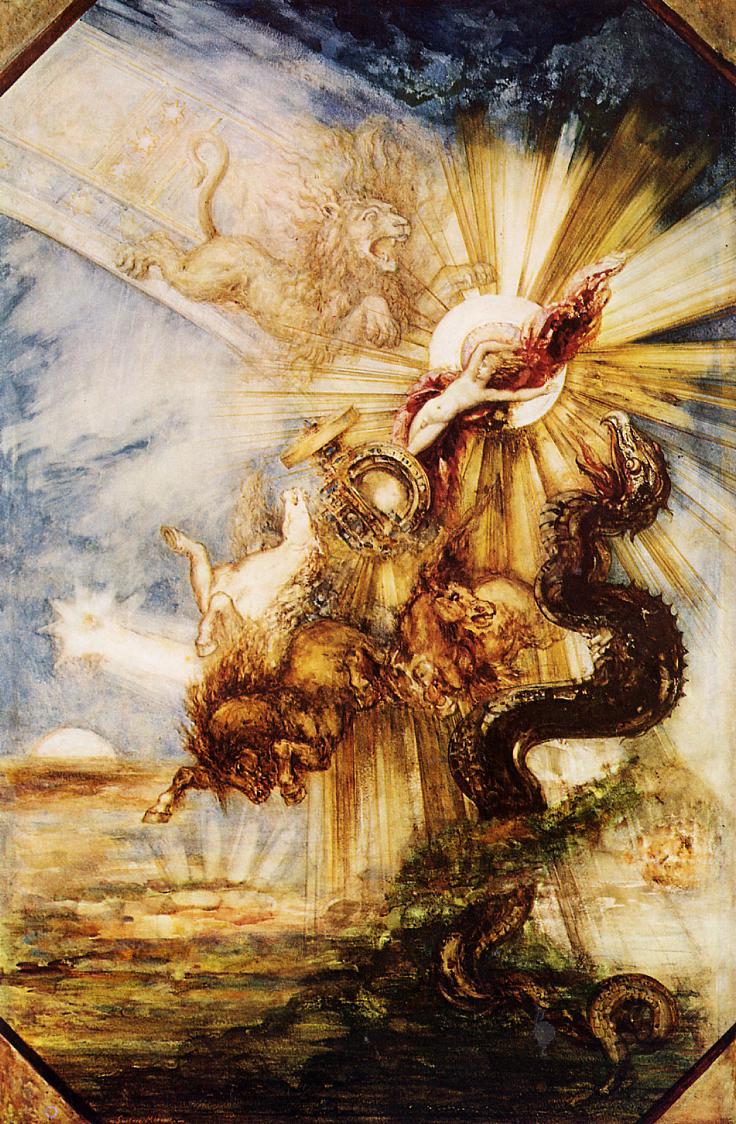
Now I pour the melted snow/ice water from the larger vessel into the smaller one, so that it overflows onto the ground.
Part 2: Lavatio, the Purification
In this part, the Goddess washes in the melted waters, which initiates her transformation from a Crone back into a Goddess. The text below, which is revised from the Celtic Lament of the Old Woman of Beare, is a despairing one — but it ends on a hint of hope. This expresses well how I feel during the cold and grey time of the year.
by Michael Kaluta
Ebb tide has come to me as the sea.
The sea crawls from the shore, leaving weeds like a corpse’s hair.
The sea slouches away from me, leaving me with salt on my lips.Time was the sea brought kings as slaves to me.
Now the sea brings only images of the drifting dead.
Women love only riches now.
But when we lived, we loved men,
young men whose horses galloped in the open plain,
beating lighting from the ground.
I loved such men.I feasted by the light of many bright candles.
Now I pray in the darkness of the oratory.
I drank my fill of wine and mead with kings,
their eyes lingering on my hair.
Now I drink the bitter dregs with shriveled hags and my hair is gray.
My skin, where glorious kings once pressed their lips, is now tight and thin.
My arms that once practiced the pleasant craft,
caressing the bodies of comely youths, are now bony and thin.
Then I wore garments of every hue and a cloak of green.
Now the veil that covers my hair is black and mean.The wine thrilled me to my fingertips.
And I stretched at the side of him who would take me briefly for his bride.
The storms have long since reached the stone chair of the kings.
Their tombs are old and crumbling.
The maidens rejoice when May Day comes to them.
But I have spent the summer of my youth.
I hold no sweet converse.
No gelded rams are killed for my wedding feast.What the flood-tide brings, the ebb-tide takes away.
I have known the flood and I have known the ebb.
The sun does not touch me.
In me I feel the cold.
But still a seed burns there.
The time is at hand that shall renew me.
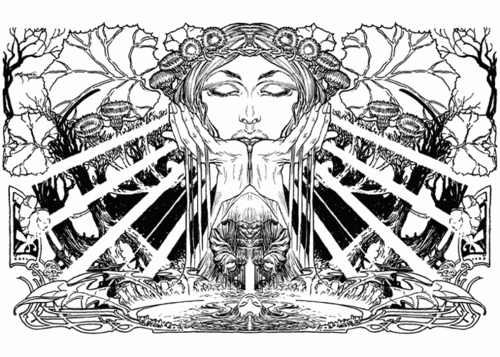
I then wash my face and hands in the water, allowing the water to fall onto my lips and tongue, savoring the bitterness of the salt and feeling the longing for fresh water.
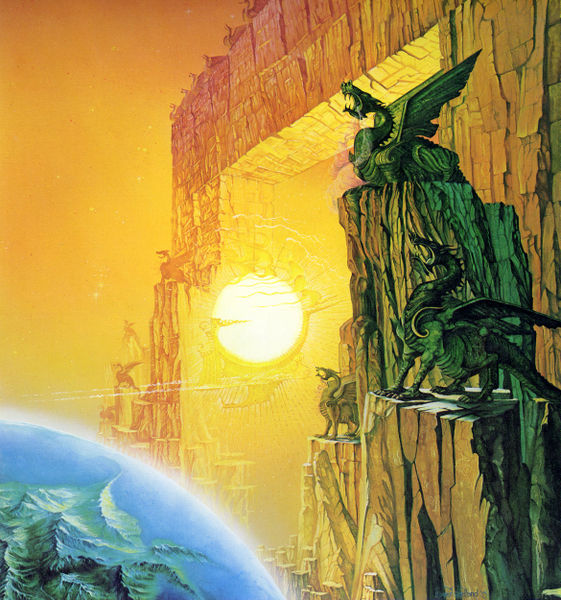
“The Gate of Morn” by Roger Garland
Part 3: Janua Coeli, the Gate of Heaven
The last part of the ritual recalls the ascent of Inanna/Ishtar from the underworld, passing through the seven gates of the underworld.
I will light one candle on my seven candle candelabra, representing the seven gates through which the Goddess passed on her way to the underworld, and through which she must travel as she returns. I will then carry the candelabra inside and place it on my altar. Over the next six weeks, until the spring equinox, I will light one additional candle each week, symbolizing the Goddess’s return to the land of light and life.
I have yet to find a text for this part of the ritual. The text of the ascent of Inanna/Ishtar just doesn’t seem poetic enough. So instead of a text, I will play John Murphy’s Sunshine/Adagio in D Minor.
Click here to listen to John Murphy – Sunshine (Adagio In D Minor)
Before the ritual is over, I will blindly choose a card from a Tarot or Oracle deck, as kind of divination. I don’t really believe in divination, per se. But I use tarot cards as I kind of imaginative/meditative practice. I will place the card on my altar and keep it there until the spring equinox.
Previous Post

January 22, 2016
How to Construct a Morning Ritual
Next Post
February 4, 2016 Become a Shaper of Earthseed
Browse Our Archives
Select a Category Ritual Scripts Theology Uncategorized
Select a Month January 2017 December 2016 November 2016 October 2016 September 2016 August 2016 July 2016 June 2016 May 2016 April 2016 March 2016 February 2016 January 2016 December 2015 November 2015 October 2015 September 2015 August 2015 July 2015 June 2015 May 2015 April 2015 March 2015 February 2015 January 2015 December 2014 November 2014 October 2014 September 2014 August 2014 July 2014 June 2014 May 2014 April 2014 March 2014 February 2014 January 2014 December 2013 November 2013 October 2013 September 2013 August 2013 July 2013 June 2013 May 2013 April 2013 March 2013 February 2013 January 2013 December 2012 November 2012 October 2012 September 2012 August 2012 July 2012 June 2012 May 2012 April 2012 March 2012 February 2012 January 2012 December 2011 November 2011 October 2011 September 2011 August 2011
TAKE THE
Religious Wisdom Quiz
What city is home to the Vatican?
Select your answer to see how you score.
Bethlehem Jerusalem Rome Florence
Related posts from The Allergic Pagan
Lowered Expectations Is Not the Answer to Bad...

Gods Save Us from Bad Pagan Rituals: 10...
Don't Call Me A "Generic Pagan"

An Earthseed Solstice: Festival of the Teacher
TRENDING AT PATHEOS Pagan

I was recently chatting with someone on Instagram. She asked me what...

While there are many people who share their results, the end of...

On July 23, I saw Christopher Nolan's The Odyssey which is Homer’s...

As I write this two big events have just finished up. One...

Restoring the Watershed of Divine Love
Perhaps cooperation is not something we manufacture through legislation, ideology, or moral...

Many UUs don’t pray because of bad experiences in a previous religion,...
view all Pagan blogs
Ad-Free & Subscriber Log-In Subscription Support
- About Us
- 2026 Calendar
- Videos
- Podcasts
- Library of World Religions
- Faith In Media Tracker
- Advertise With Us
- Write for Us
- Privacy Policy
- Terms of Service
- Do Not Sell My Data
- Contact Us
- Radiant Digital
- Manage Newsletter Subscriptions
- Unsubscribe From Notifications
- Sitemap
Copyright 2008-2026, Patheos. All rights reserved.
Subscription Support Ad-Free & Subscriber Log-In
Follow Patheos