
BuddhistCatholicContemplativeEvangelicalGeneral ChristianHinduJewishLatter-day SaintMuslimNew VisionsProgressive Christian
Beliefs
- Buddhist
- Catholic
- Contemplative
- Evangelical
- General Christian
- Hindu
- Jewish
- Latter-day Saint
- More Voices
- Muslim
- New Visions
- Pagan
- Progressive Christian
Topics
- Religion News
- Food and Religion
- Sports and Religion
- Religious Art
- Religious Music and Entertainment
- Religious Events
- History and Religion
- Style and Religion
- Politics and Religion
- Women in Religion
- Recreation Outdoors and Religion
- Business Finance and Religion
- Careers Workplace and Religion
- Education and Religion
- Family Parenting and Religion
- Health Fitness and Religion
- Home and Religion
- Relationships and Religion
- Technology and Religion
- Travel and Religion
Columnists
- Buddhist Columnists
- Business Finance and Religion Columnists
- Careers Workplace and Religion Columnists
- Catholic Columnists
- Contemplative Columnists
- Education and Religion Columnists
- Evangelists Columnists
- Family Parenting and Religion Columnists
- General Christian Columnists
- Health Fitness and Religion Columnists
- Hindu Columnists
- History and Religion Columnists
- Home and Religion Columnists
- Jewish Columnists
- More Voices Columnists
- Latter Day Columnists
- Muslim Columnists
- New Visions Columnists
- Nonreligious Columnists
- Pagan Columnists
- Politics and Religion Columnists
- Progressive Columnists
- Recreation Outdoors and Religion Columnists
- Relationships and Religion Columnists
- Religion News Columnists
- Religious Art Columnists
- Religious Events Columnists
- Religious Music and Entertainment Columnists
- Sports and Religion Columnists
- Style and Religion Columnists
- Technology and Religion Columnists
- Travel and Religion Columnists
- Women in Religion Columnists
Resource Library
- 2026 Calendar
- Library of World Religions
- The 100 Most Holy Places on Earth
- Patheos Answers
- Podcasts
- Videos
- Faith Leaders Database
- Anglican Episcopalian
- Bahai
- Baptist
- Buddhism
- Christianity
- Confucianism
- Eastern Orthodoxy
- Hinduism
- Holiness and Pentecostal
- ISKCON
- Islam
- Judaism
- Lutheran
- Methodist
- The Church of Jesus Christ of Latter-day Saints
- New Age
- Paganism
- Presbytarian and Reformed
- Protestantism
- Religion Behind the Scenes
- Roman Catholic
- Scientology
- Shia Islam
- Sikhism
- Sufism
- Sunni Islam
- Taoism
- Zen
- See all religions
Research Tools
 Ad-Free & Subscriber Log-In Subscription Support
Ad-Free & Subscriber Log-In Subscription Support
Follow Patheos 

- Trending:
- Forgiveness
- |
- Marriage
- |
- Consciousness
- |
- Death Penalty
- |
- Election
- |
- Halloween
 The Allergic Pagan
- Home
- Pagan
- “Less Christian Than Thou”: Neo-Paganism and Polytheism Beyond the Christian Divide
“Less Christian Than Thou”: Neo-Paganism and Polytheism Beyond the Christian Divide
Last updated on: January 14, 2016 at 11:41 am by John Halstead
“Less Christian Than Thou”: Neo-Paganism and Polytheism Beyond the Christian Divide 2016-01-14T11:41:24-05:00 John Halstead
Patheos Explore the world's faith through different perspectives on religion and spirituality! Patheos has the views of the prevalent religions and spiritualities of the world.
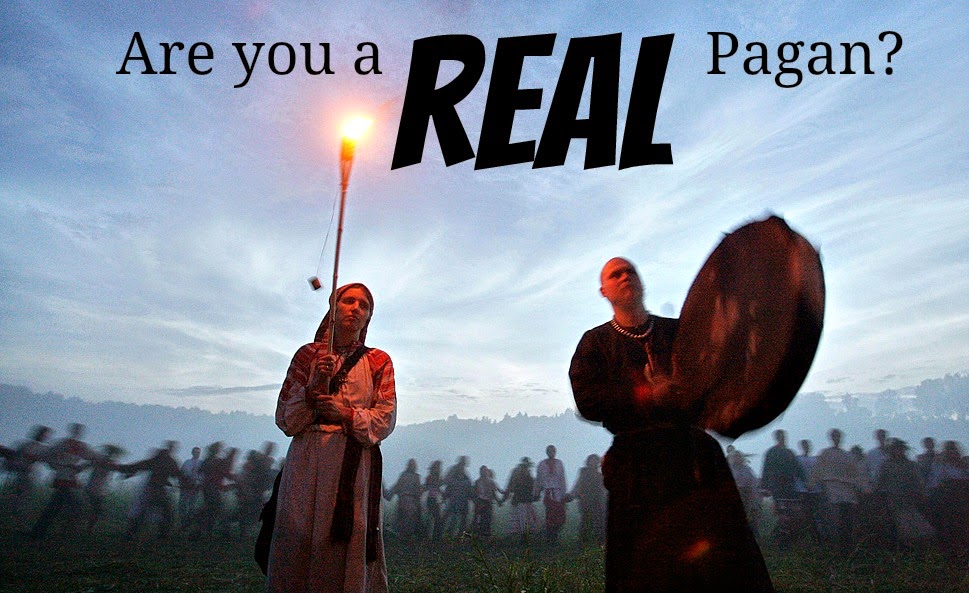
Over the Yuletide holiday, I attended an Episcopalian mass with my father, afterwhich he asked me if I was aware of how the word “Pagan” is understood by Christians. I think he was wondering why don’t I call myself something less provocative. I realize that, for some Christians, a self-described “Pagan” is as odd as a self-described “villain”. The truth is that I call myself “Pagan” because it is provocative. As I have written previously, “Part of the reason I identify as (Neo-)Pagan is actually because the term is synonymous with irrelegion and hedonism for many Christians …” The notion that the “maypole-dancing, idol-worshiping, and fornicating-in-the-forest non-Christian” is religious — indeed that dancing and fornicating can be part of a religion — is radical all by itself.
In the same way, some witches choose to call themselves because of the counter-cultural connotation. As Cynthia Eller explains in Living in the Lap of the Goddess: The Feminist Spirituality Movement in America: “For spiritual feminists, being a witch, saying one is a witch, is most often a feminist statement, the symbolic encapsulation of a feminist political program. The witch is the powerful outsider, the despised and excluded person who is threatening the established order.”
Words have power, and calling oneself “Pagan” in our culture is a challenge to the Christian hegemony. That someone would willingly call themselves “Pagan” flies in the face of a Christianity which presumes to ascribe to itself the whole meaning of goodness and morality.
Thinking about how Christians understand the word “Pagan” naturally got me thinking about how Pagans understand the word “Christian”, and specifically how “Christian” has become a term of opprobrium in Pagan culture, so that calling another person’s Paganism “Christian” is understood as an insult. “Pagan” may be a a dirty word in the Christian overculture, but in the Pagan subculture, calling someone “Christian” is a low blow.
As Jonathan Woolley recently observed in his essay, “The Matter of the Gods”, “Paganism is diverging.” On the one hand there are the Neo-Pagans, among whom we may include those Woolley labels “Gaia-theorists, duotheist Wiccans, archetype-channelers, and feminist Mono-theaists”, and on the other hand, there are the Polytheists, those who believe, in Woolley’s words, that “the gods are real, and distinctly so–each a person in their own right, just as we [humans] are, and that believing in them as Actually Extant Beings is, really, okay.” (For more on this divide, see Tess Dawson’s essay, “Two Winding Rivers: The Changing Face of the Pagan Movement”. The reason I bring this up is because it’s not uncommon to see folks in these two groups — Neo-Pagan and Polytheist — accusing those in the other group of being “Christian”.
Sometimes this is done with ill intent, and other times not, like when Woolley, a Polytheist, suggests that Neo-Pagan theology is too close to Christian for his comfort:
“If we consider the old theological consensus, what becomes readily apparent is that in many respects, it really isn’t too far removed from the spiritual conventions of the Western world’s established religious orthodoxy. Pantheism and Panentheism have a vibrant life outside of Paganism, and the Goddess has her anchorites even within Christianity and Judaism. Even the duotheism of Wicca arguably puts very little clear water between itself and the distributed godhead of Christianity; instead of a Holy Trinity, we have a Holy Tryst. In short, from a theological standpoint, the first generations of Pagan writing owe far more to lay Catholicism and the New England Transcendentalists, than to anything recognisably pre-Christian.”
I had a knee jerk reaction when I read this, but in all honesty I can’t really disagree with Woolley. In fact, I’ve written about the influence of Christianity on Neo-Paganism before myself. (See my posts “My Yule Sounded Alot Like Christmas” and “Waiter! There’s some Christianity in my Pagan soup!”) Take for example the Neo-Pagan Dying-and-Rising/Horned God and the Triple Goddess, who are all wound up with Jesus and Mary and the Christian Devil. Pagans are comfortable with the idea that Christian gods were derived from pagan ones, but a good argument could be made for influences flowing in the opposite direction as well. Michael York has argued in his essay, “New Age and Paganism”, that “contemporary expressions of Neo- paganismare to me more of an updating and rectification perhaps of an essentially Christian attitude which is different from the free-ranging and loosely defined multiplicity of personalities and forces and deities which collectively constitute the [ancient] pagan godhead.”
I know a lot of Polytheists would agree with this and point to this as evidence of Neo-Paganism’s failure to escape the orbit of Christianity. But I’m not convinced that Polytheism is any different. While Polytheists look at Neo-Paganism and see similarities to monotheistic Christianity, because of the former’s embrace of monism, so do Neo-Pagans look at Polytheism and see similarities to monotheistic Christianity, because of the former’s embrace of theism. The literalism, emphasis on orthodoxy, and belief in personal deities which characterizes some forms of Polytheism too closely resembles Christianity in the minds of some Neo-Pagans. It all depends on what bothers you most about monotheism: the mono- or the -theism. If it’s the former, you’re probably a Polytheist. If it’s the latter, you’re more likely a Neo-Pagan.
I remember, some years ago, hesitantly raising the subject with a Polytheist acquaintance of what I perceived as Polytheism’s resemblance to evangelical Christianity, only to be surprised by the person’s unabashed agreement. “Why would anyone admit to that?” I wondered to myself. Only now do I realize that while both Polytheists and Neo-Pagans want to distance themselves from Christianity, we have different reasons for doing so. If the relationship Polytheists have with their gods resembles the relationship of some evangelicals Christians to Jesus, that’s not necessarily something they are embarrassed about. Similarly, if Neo-Pagan theology tends toward a monism that resembles some forms of Christian theology, that’s not something that necessarily bothers them either.
The truth is that both Neo-Pagans and Polytheists are probably more “Christian” than we’d like to admit — whether we are embracing it or rebelling against it, we are all products of our environment — and that environment is thoroughly Christianized. This is true on an individual level for many of us who left behind Christianity as our religion-of-origin, but it’s also on a collective level. As Linda Woodhead has argued (as reported in Jone Salomonsen’s Enchanted Feminism: The Reclaiming Witches of San Francisco), “the ‘new spirituality’ that today flourishes in contemporary western societies [which includes both Neo-Paganism and Polytheism] … is deeply rooted in European Protestantism and has arisen as a response to an increasing dissatisfaction with Christianity …”
At the same time, while both Neo-Paganism and Polytheism are influenced by the Christian milieu out of which they arise, neither can fairly be called “Christian”. Seriously, would any actual Christian recognize either Neo-Pagan or Polytheist religion as their own? I doubt it. There’s probably not a Christian denomination in the world that would be willing to claim any of us. So what are we doing calling each other “Christian”?
What’s happening, I think, is that both Neo-Paganism and Polytheism are reactions to Christianity, but they are reactions in different directions. Neo-Paganism is a reaction to Christianity’s transcendental theism, hierarchical metaphysics, dogmatism, textual literalism, patriarchalism, and guilt culture — all interrelated issues. Polytheism is a reaction to Christianity’s monism and all that it implies — theologically, anthropologically, historically, politically, sexually, etc. And when Neo-Pagans and Polytheists look back at each other along our different trajectories, it is difficult to appreciate how the other has diverged from Christianity. Consider the diagram below:
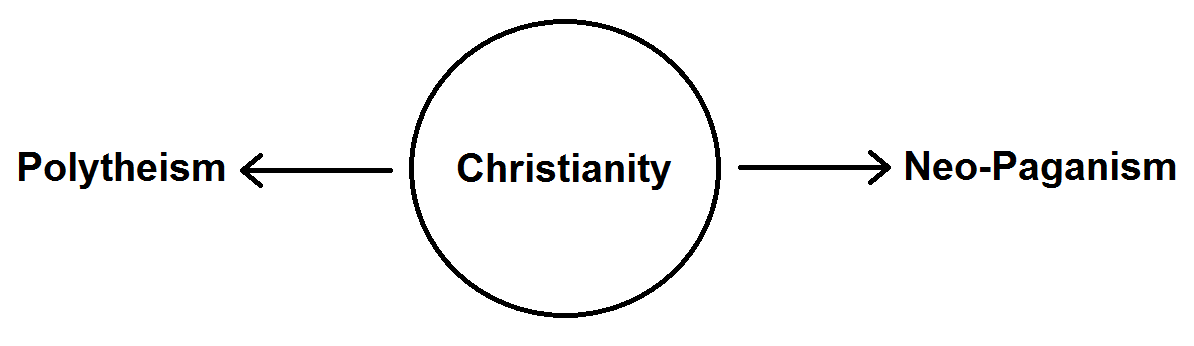 Both Polytheism and Neo-Paganism are, in a sense, *post-*Christian. But when we look at one another, all we tend to see is the Christianity we are reacting against. Christianity looms so large in our collective consciousness, it is hard to see anything else.
So, what does all of this mean? Well, for one thing, I think Neo-Pagans and Polytheists need to stop comparing one another to Christianity. It’s just not helpful. It raises everyone’s defenses and is not conducive to genuine communication.
For another, we need to recognize that these two groups — Neo-Pagans and Polytheists — have fundamentally different issues. For many Polytheists, monism is a big problem. While for many Neo-Pagans, literalistic theism or an emphasis on belief are what they find most problematic. Polytheism and Neo-Paganism don’t just represent different answers to the same question, they represent different answers to different questions. I think much of the conflict between our two communities might arise from the failure to appreciate that each group is trying to be the answer to a different question.
And to the extent that we are asking different questions, not just offering different answers, I think it is fair to say that Neo-Paganism and Polytheism are different religions, not just different sects or “paths” within the same religion. This is often obscured by the fact that both groups share an interest in ancient pagan religions (albeit for different reasons) and people in both groups lay claim to the word “Pagan” (albeit for different reasons). I wonder how many Neo-Pagan/Polytheist arguments might be avoided if we realized that Neo-Paganism has about as much in common with Polytheism as either of them have in common with Christianity.
In many ways, we are living in a Kafkaesque world, where formulating the right question has become more difficult than finding an answer. As the authors of “Moral Responsibility in the Age of Bureaucracy” write, “The comprehension that we stand at a moral crossroads is not given, but acquired through considerable effort, courage, and even luck. Obtaining that knowledge is a moral challenge coequal to, or perhaps greater than, the challenge of responding to it.” It’s become platitudinous to say that none of us have all the answers. But it is equally true that none of us have all the questions. If we can’t appreciate one another’s answers, perhaps we should begin by trying to appreciate each other’s questions.
Previous Post

January 1, 2016
I've forgotten why I cared: The irrelevance of (un)belief in the gods
Next Post
January 15, 2016 Simple Answers Have to Be Earned
Browse Our Archives
Select a Category Ritual Scripts Theology Uncategorized
Select a Month January 2017 December 2016 November 2016 October 2016 September 2016 August 2016 July 2016 June 2016 May 2016 April 2016 March 2016 February 2016 January 2016 December 2015 November 2015 October 2015 September 2015 August 2015 July 2015 June 2015 May 2015 April 2015 March 2015 February 2015 January 2015 December 2014 November 2014 October 2014 September 2014 August 2014 July 2014 June 2014 May 2014 April 2014 March 2014 February 2014 January 2014 December 2013 November 2013 October 2013 September 2013 August 2013 July 2013 June 2013 May 2013 April 2013 March 2013 February 2013 January 2013 December 2012 November 2012 October 2012 September 2012 August 2012 July 2012 June 2012 May 2012 April 2012 March 2012 February 2012 January 2012 December 2011 November 2011 October 2011 September 2011 August 2011
TAKE THE
Religious Wisdom Quiz
What does "Tetragrammaton" refer to in biblical studies?
Select your answer to see how you score.
The four Gospels The four-letter name of God The first four books of the Bible The first four commandments
Related posts from The Allergic Pagan

A Guide to Politics at Patheos Pagan

Call to Chicago Area Pagans: Come to Hammond...

Size Doesn't Matter: 5 Pieces of Advice for...

What’s A Nice Atheist Like Me Doing At...
TRENDING AT PATHEOS Pagan

When we talk about Greek religion, we often begin with the dodekatheion—the...

I was recently chatting with someone on Instagram. She asked me what...

While there are many people who share their results, the end of...

On July 23, I saw Christopher Nolan's The Odyssey which is Homer’s...

As I write this two big events have just finished up. One...

Restoring the Watershed of Divine Love
Perhaps cooperation is not something we manufacture through legislation, ideology, or moral...
view all Pagan blogs
Ad-Free & Subscriber Log-In Subscription Support
- About Us
- 2026 Calendar
- Videos
- Podcasts
- Library of World Religions
- Faith In Media Tracker
- Advertise With Us
- Write for Us
- Privacy Policy
- Terms of Service
- Do Not Sell My Data
- Contact Us
- Radiant Digital
- Manage Newsletter Subscriptions
- Unsubscribe From Notifications
- Sitemap
Copyright 2008-2026, Patheos. All rights reserved.
Subscription Support Ad-Free & Subscriber Log-In
Follow Patheos