
BuddhistCatholicContemplativeEvangelicalGeneral ChristianHinduJewishLatter-day SaintMuslimNew VisionsProgressive Christian
Beliefs
- Buddhist
- Catholic
- Contemplative
- Evangelical
- General Christian
- Hindu
- Jewish
- Latter-day Saint
- More Voices
- Muslim
- New Visions
- Pagan
- Progressive Christian
Topics
- Religion News
- Food and Religion
- Sports and Religion
- Religious Art
- Religious Music and Entertainment
- Religious Events
- History and Religion
- Style and Religion
- Politics and Religion
- Women in Religion
- Recreation Outdoors and Religion
- Business Finance and Religion
- Careers Workplace and Religion
- Education and Religion
- Family Parenting and Religion
- Health Fitness and Religion
- Home and Religion
- Relationships and Religion
- Technology and Religion
- Travel and Religion
Columnists
- Buddhist Columnists
- Business Finance and Religion Columnists
- Careers Workplace and Religion Columnists
- Catholic Columnists
- Contemplative Columnists
- Education and Religion Columnists
- Evangelists Columnists
- Family Parenting and Religion Columnists
- General Christian Columnists
- Health Fitness and Religion Columnists
- Hindu Columnists
- History and Religion Columnists
- Home and Religion Columnists
- Jewish Columnists
- More Voices Columnists
- Latter Day Columnists
- Muslim Columnists
- New Visions Columnists
- Nonreligious Columnists
- Pagan Columnists
- Politics and Religion Columnists
- Progressive Columnists
- Recreation Outdoors and Religion Columnists
- Relationships and Religion Columnists
- Religion News Columnists
- Religious Art Columnists
- Religious Events Columnists
- Religious Music and Entertainment Columnists
- Sports and Religion Columnists
- Style and Religion Columnists
- Technology and Religion Columnists
- Travel and Religion Columnists
- Women in Religion Columnists
Resource Library
- 2026 Calendar
- Library of World Religions
- The 100 Most Holy Places on Earth
- Patheos Answers
- Podcasts
- Videos
- Faith Leaders Database
- Anglican Episcopalian
- Bahai
- Baptist
- Buddhism
- Christianity
- Confucianism
- Eastern Orthodoxy
- Hinduism
- Holiness and Pentecostal
- ISKCON
- Islam
- Judaism
- Lutheran
- Methodist
- The Church of Jesus Christ of Latter-day Saints
- New Age
- Paganism
- Presbytarian and Reformed
- Protestantism
- Religion Behind the Scenes
- Roman Catholic
- Scientology
- Shia Islam
- Sikhism
- Sufism
- Sunni Islam
- Taoism
- Zen
- See all religions
Research Tools
 Ad-Free & Subscriber Log-In Subscription Support
Ad-Free & Subscriber Log-In Subscription Support
Follow Patheos 

- Trending:
- Forgiveness
- |
- Marriage
- |
- Consciousness
- |
- Death Penalty
- |
- Election
- |
- Halloween
 The Allergic Pagan
- Home
- Pagan
- A Unitarian Wheel of the Year
A Unitarian Wheel of the Year
Last updated on: December 13, 2015 at 11:50 pm by John Halstead
A Unitarian Wheel of the Year 2015-12-13T23:50:26-05:00 John Halstead
Patheos Explore the world's faith through different perspectives on religion and spirituality! Patheos has the views of the prevalent religions and spiritualities of the world.
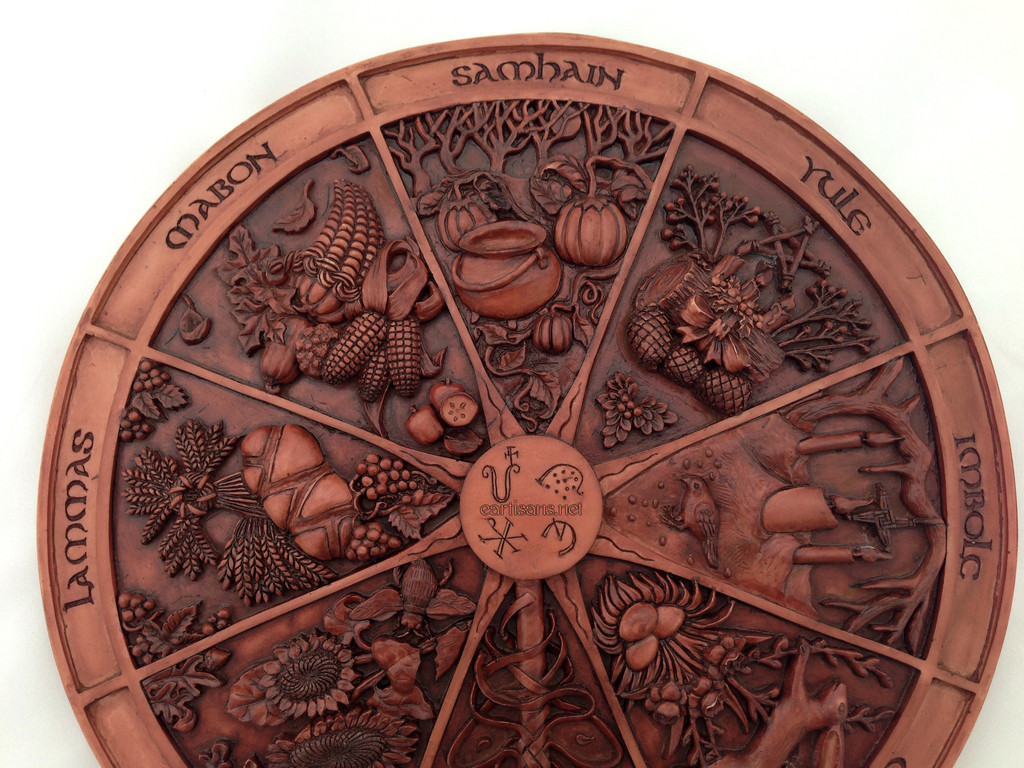
Wheel of the Year
Recently, my Unitarian minister led a Sunday morning discussion about what holidays we should celebrate as Unitarians. He asked each of us to list the three holidays — or “holy days” — we felt the congregation should celebrate. Most people listed holidays which we do not already celebrate — Juneteenth, Festivus, Purim, and others. We then discussed the challenges of choosing which holidays to celebrate as a congregation. How do we decide? There are more holidays to choose from than there are days of the year — and many more times than there are Sundays. Should the holidays we choose relate in some way to the 7 Unitarian Principles? Should we try to incorporate holidays from diverse religious traditions? What about concerns of cultural appropriation? Won’t someone always feel like they or their culture has been left out?
When I was asked what three holidays we should celebrate, I chose three which we already do celebrate:
Vespers
Flower Communion
Ingathering / Water Communion
I chose these because they are the three times of the year when I have felt the strongest sense of community in our congregation. They also correspond to three of the four seasons: Vespers in the winter, the Flower Communion in the spring, and the Ingathering in the autumn. Together with Pride Day in the summer, it seemed to me that these events constitute a kind of liturgical year or Wheel of the Year for our Unitarian congregation. I don’t know that anyone else in my congregation thinks about our annual celebrations in this way, but I thought it was a neat correspondence between our UU traditions and the Pagan Wheel of the Year.
Vespers: Winter
The word “vespers” means “evening” and refers to the sunset evening prayer in many of the more orthodox Christian denominations. Our congregation has a “Vespers” service on Christmas Eve. It corresponds roughly to the “evening” of the year, the winter solstice, the longest night of the year (which is celebrated by many humanists in lieu of Christmas). It’s an unusual celebration for our congregation, because we do not usually have Christian-themed services. We don’t usually do anything to observe Easter, for example. And many of the traditional Christian hymns in our hymnal are edited to remove references to Christ. But at the Vespers service, our congregation, which consists of many humanists and atheists (many of whom are suspicious of any kind of ritual), will pack the sanctuary every Christmas Eve, and all sing unadulterated Christmas hymns about baby Jesus. We then we process into a darkened parish hall holding candles and singing “Silent Night.”
Our Vespers service corresponds to the Pagan Yule for the same reason that Christmas corresponds to the Pagan Yule. The birth of the Christ child is a symbol of the rebirth of the sun at the darkest time of the year, and the human hope manifest in the universal experience of the dawn following even the darkest night.
How short the daylight hours have now become.
How grey the skies, how barren seem the trees.
A damp and chilling wind has gripped my mind and made me gloomy, too.
But there is that in me which reaches up toward the light and laughter, bells, and carolers,
And knows that my religious myth and dream of reborn joy and goodness must be true,
Because it speaks the truths of older myths;
That light returns to balance darkness, life surges in the evergreen – and us,
As babes are hope, and saviors of the world, as miracles abound in common things.— “Reflections on the Resurgence of Joy” by Dori Jeanine Somers (UU Reading 653)
Flower Communion: Spring
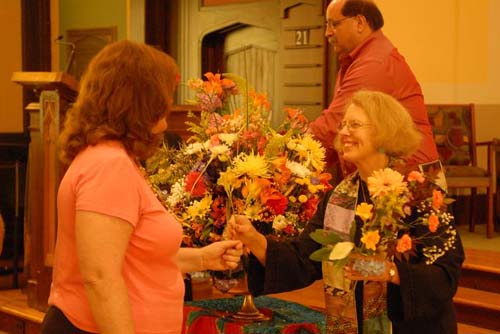 The Flower Communion is observed by many Unitarian Universalist congregations. It dates back to 1923 and was created by Unitarian minister in Czechoslovakia, Norbert Capek. It later spread to the U.S. Capek was killed by Nazis in Dachau because his gospel of diversity was considered dangerous by the Third Reich.
The Flower Communion is usually held in the spring. During the ritual, congregants contribute flowers to a centrally located vase, and later the flowers are distributed among the congregation. Participants commonly contribute one kind of flower and take away a different kind. The offering of flowers symbolizes the diverse gifts that we each bring to our Unitarian congregations, while the taking of flowers, the “communion,” symbolizes the different gifts that we take away from our experience of Unitarian Universalism. Not only do we bring different things to Unitarianism, but we each take away different things. This is an appropriate symbolism for a non-dogmatic religion like Unitarian Universalism.
The use of flowers obviously corresponds to the springtime and the vernal equinox which is celebrated by Pagans. The diversity of life bursting forth in the springtime corresponds to the diversity (of belief) of our congregations, as well as the new energy which we bring to the unique missions of each of our Unitarian congregations. I also like the idea of flowers as a kind of “communion” — enjoying picked flowers requires the sacrifice of the flower and reminds us that death is part of life.
Pride Day: Summer
After I came up with my three Unitarian holidays and noticed the correspondence with three of the four seasons, the absence of a summer holiday was conspicuous to me. Then someone in the discussion mentioned Pride Day, which happens in June. I recalled marching with my Unitarian congregation shortly after Pride Day in the community’s Fourth of July parade this past year, when I had the honor of holding the “Standing on the Side of Love” banner. In that march, I felt we were celebrating our pride as a nation, obviously, but also our pride as Unitarians and our pride in the diversity of our sexual orientations. It occurred to me that Pride Day might fill the summer holiday gap in my imagined Unitarian Wheel of the Year. The experience of pride — national, religious, sexual — I think, corresponds to the summer solstice celebrated by Pagans, which celebrates the apex of the year and the peak of growth of vegetation.
Ingathering / Water Communion: Autumn
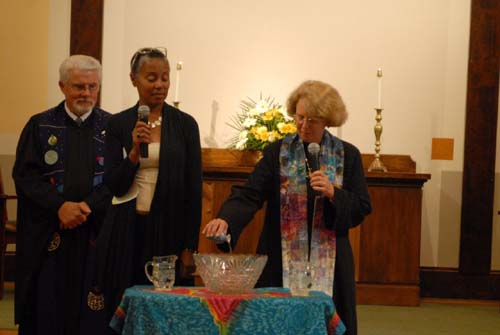 The first Water Communion was created by Carolyn McDade and Lucile Schuck Longview for the 1980 Women and Religion Continental Convocation of Unitarian Universalists as a way to honor the journeys of women and the way women both contribute to and draw from each other’s strength. (McDade is also the author of what has become the unofficial Unitarian anthem, “Spirit of Life.”) It later came to be used as an ingathering/homecoming ritual by many UU congregations.
Throughout the year, members of the congregation collect small amounts of water that have meaning for them, either from a special location (e.g., from the family home, the ocean or a river, or a memento of a trip) or a special occasion (the first rain after a dry spell). We tend to bring our water from places we have visited as a family, like Muir Woods in California, LaTourell Falls in Portland, Fish Lake (home of Pando, a grove of aspens in Utah that may be the largest living organism).
At the Ingathering service, the waters are poured together in a single bowl, symbolizing our merging as a community. After the service, some of the water is often saved and used for ceremonial purposes at other times of the year. In our congregation, a small amount of the water is saved until the following year — to symbolize the continuity with our past — and the rest is offered to the memory garden beside the church. For many, the ritual symbolizes the the rejoining of the congregation after summer travels. (Many UU congregations recess in the summer.)
For Pagans, the use of water corresponds to the Platonic element of Water, which is sometimes associated with autumn. In addition, the gathering of waters might be seen as corresponding to the gathering of the autumn harvest, which is celebrated by many Pagans at the fall equinox.
All together, these four “holy days” might be seen as a kind of Unitarian liturgical year or a Unitarian Wheel of the Year: a pregnant pause and time for quite contemplation at the winter Vespers service, a flowering of enthusiasm and celebration of diversity at the spring Flower Communion, the culmination of our activities in summer Pride celebrations, and a regrouping at the autumn Ingathering. As a Pagan, I am of course drawn to celebrations with seasonal correspondences. And thinking about some of our Unitarian celebrations in this way satisfies my need for a sense of symbolic unity. It relates the individual celebrations to one another as part of a greater whole, which deepens their meaning for me.


Browse Our Archives
Select a Category Ritual Scripts Theology Uncategorized
Select a Month January 2017 December 2016 November 2016 October 2016 September 2016 August 2016 July 2016 June 2016 May 2016 April 2016 March 2016 February 2016 January 2016 December 2015 November 2015 October 2015 September 2015 August 2015 July 2015 June 2015 May 2015 April 2015 March 2015 February 2015 January 2015 December 2014 November 2014 October 2014 September 2014 August 2014 July 2014 June 2014 May 2014 April 2014 March 2014 February 2014 January 2014 December 2013 November 2013 October 2013 September 2013 August 2013 July 2013 June 2013 May 2013 April 2013 March 2013 February 2013 January 2013 December 2012 November 2012 October 2012 September 2012 August 2012 July 2012 June 2012 May 2012 April 2012 March 2012 February 2012 January 2012 December 2011 November 2011 October 2011 September 2011 August 2011
TAKE THE
Religious Wisdom Quiz
Who prayed in the lions' den every day?
Select your answer to see how you score.
Daniel David Solomon Paul
Related posts from The Allergic Pagan

A Guide to Politics at Patheos Pagan

Call to Chicago Area Pagans: Come to Hammond...
Four "Godless Pagan" Authors on Pagan Musing Podcast...
Lowered Expectations Is Not the Answer to Bad...
TRENDING AT PATHEOS Pagan

I was recently chatting with someone on Instagram. She asked me what...

While there are many people who share their results, the end of...

On July 23, I saw Christopher Nolan's The Odyssey which is Homer’s...

As I write this two big events have just finished up. One...

Restoring the Watershed of Divine Love
Perhaps cooperation is not something we manufacture through legislation, ideology, or moral...

Many UUs don’t pray because of bad experiences in a previous religion,...
view all Pagan blogs
Ad-Free & Subscriber Log-In Subscription Support
- About Us
- 2026 Calendar
- Videos
- Podcasts
- Library of World Religions
- Faith In Media Tracker
- Advertise With Us
- Write for Us
- Privacy Policy
- Terms of Service
- Do Not Sell My Data
- Contact Us
- Radiant Digital
- Manage Newsletter Subscriptions
- Unsubscribe From Notifications
- Sitemap
Copyright 2008-2026, Patheos. All rights reserved.
Subscription Support Ad-Free & Subscriber Log-In
Follow Patheos