
BuddhistCatholicContemplativeEvangelicalGeneral ChristianHinduJewishLatter-day SaintMuslimNew VisionsProgressive Christian
Beliefs
- Buddhist
- Catholic
- Contemplative
- Evangelical
- General Christian
- Hindu
- Jewish
- Latter-day Saint
- More Voices
- Muslim
- New Visions
- Pagan
- Progressive Christian
Topics
- Religion News
- Food and Religion
- Sports and Religion
- Religious Art
- Religious Music and Entertainment
- Religious Events
- History and Religion
- Style and Religion
- Politics and Religion
- Women in Religion
- Recreation Outdoors and Religion
- Business Finance and Religion
- Careers Workplace and Religion
- Education and Religion
- Family Parenting and Religion
- Health Fitness and Religion
- Home and Religion
- Relationships and Religion
- Technology and Religion
- Travel and Religion
Columnists
- Buddhist Columnists
- Business Finance and Religion Columnists
- Careers Workplace and Religion Columnists
- Catholic Columnists
- Contemplative Columnists
- Education and Religion Columnists
- Evangelists Columnists
- Family Parenting and Religion Columnists
- General Christian Columnists
- Health Fitness and Religion Columnists
- Hindu Columnists
- History and Religion Columnists
- Home and Religion Columnists
- Jewish Columnists
- More Voices Columnists
- Latter Day Columnists
- Muslim Columnists
- New Visions Columnists
- Nonreligious Columnists
- Pagan Columnists
- Politics and Religion Columnists
- Progressive Columnists
- Recreation Outdoors and Religion Columnists
- Relationships and Religion Columnists
- Religion News Columnists
- Religious Art Columnists
- Religious Events Columnists
- Religious Music and Entertainment Columnists
- Sports and Religion Columnists
- Style and Religion Columnists
- Technology and Religion Columnists
- Travel and Religion Columnists
- Women in Religion Columnists
Resource Library
- 2026 Calendar
- Library of World Religions
- The 100 Most Holy Places on Earth
- Patheos Answers
- Podcasts
- Videos
- Faith Leaders Database
- Anglican Episcopalian
- Bahai
- Baptist
- Buddhism
- Christianity
- Confucianism
- Eastern Orthodoxy
- Hinduism
- Holiness and Pentecostal
- ISKCON
- Islam
- Judaism
- Lutheran
- Methodist
- The Church of Jesus Christ of Latter-day Saints
- New Age
- Paganism
- Presbytarian and Reformed
- Protestantism
- Religion Behind the Scenes
- Roman Catholic
- Scientology
- Shia Islam
- Sikhism
- Sufism
- Sunni Islam
- Taoism
- Zen
- See all religions
Research Tools
 Ad-Free & Subscriber Log-In Subscription Support
Ad-Free & Subscriber Log-In Subscription Support
Follow Patheos 

- Trending:
- Forgiveness
- |
- Marriage
- |
- Consciousness
- |
- Death Penalty
- |
- Election
- |
- Halloween
 The Allergic Pagan
- Home
- Pagan
- Raiding of Intellectual Cattle: A Guest Post by Steven Posch
Raiding of Intellectual Cattle: A Guest Post by Steven Posch
Last updated on: November 6, 2015 at 8:37 am by John Halstead
Raiding of Intellectual Cattle: A Guest Post by Steven Posch 2015-11-06T08:37:21-05:00 John Halstead
Patheos Explore the world's faith through different perspectives on religion and spirituality! Patheos has the views of the prevalent religions and spiritualities of the world.
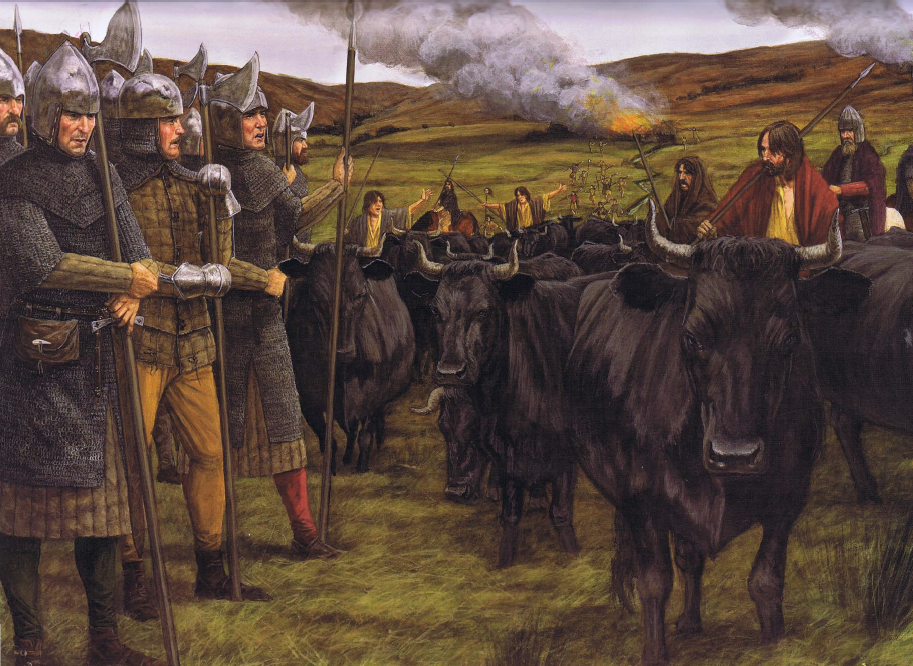
Today I am honored to host my guest, storyteller Steven Posch, who shares his unique take on the Pagan cultural appropriation controversy.
Cattle-Raid: A Legend of the Dobunni
In the beginning of days, the Great Mother called all the peoples to her, her children, and to each people she gave its own proper food.
To the Cornovii she gave the deer to be their food, and indeed they are great hunters to this day. To the Brigantes, she gave oats to be their food, to the Iceni barley, to the Silures sheep, and so it was. To each people, its own proper food.
But to our people, to the Dobunni, to us she gave cattle to be our food, and their milk and their meat are indeed the best of foods.
Of all the peoples, it is to us that she gave cattle, and so it is that our young men will try their boldness and cunning by raiding the herds of others.
For since the Great Mother in her wisdom gave cattle to us, to the Dobunni, in the beginning of days, when others have cattle in their keeping—the Cornovii, the Brigantes, the Iceni, the Silures—it can only be that these cattle have been stolen from their rightful owners, which is to say from us, from the Dobunni.
So let no one be so foolish as to say that Dobunni steal cattle.
For everyone knows that no man can steal what is already his.
The Dobunni were that same people which in later days came to be known as the Hwicce. Some would say that from them and their ways come those we call witches and witchcraft.
And some would say otherwise.
Cattle Raids and Cultural Appropriation
As a storyteller, I tend to do much of my thinking through stories. In the much-vexed ongoing discussion of cultural appropriation it seemed to me that abstract theorizing may well benefit from the wisdom of narrative. So I began casting around for a story that treated with the topic.
Theorist Cei Serith always says, “When confronted with a new situation, first consult ancestral precedent.” The Received Tradition (or at least those portions of it with which I am personally conversant), has little to say on the topic of cultural appropriation directly, but in fact the practice has a surprising number of parallels with the grand old Keltic pastime (one could almost call it a sport) of the táin, the cattle-raid. The Kelts came by cattle-rustling honestly (so to speak): it would seem, in fact, to have been an ancient tradition of many Indo-European peoples (and, indeed, of pastoral cultures in general: compare the current problems with the self-same practice in South Sudan).
We have, to the best of our knowledge, no surviving mythology from the Dobunni, the Keltic tribe that inhabited the Severn basin and Cotswolds in what is now the south-west Midlands of England. (The “creation myth” that Stephen Yeates “recreates” in A Dreaming for the Witches cannot truly be called a story.) There seems to be good genetic and archaeological evidence to indicate that Dobunni population and culture survived into Anglo-Saxon times as the tribe known as the Hwicce. Maverick archaeologist Stephen Yeates would contend that the tribal religion of the Hwicce, with its strong continuities with the preceding Dobunni religion, is in fact what would become historic Witchcraft (and later, Wicca). Historical or not, it’s a powerful story, for which I will admit to a certain personal fondness, perhaps because some of my own ancestors hail from this same region.
So I’ve cast my putative origin-myth (to use the term loosely) for cattle-raiding in a Dobunni cultural setting. It is as authentic to both period and culture as I can make it.
The fact that I lifted the story directly from Masai mythology only adds savor to the stew. (I hope that I’ve managed to successfully recast and “naturalize” the story. Did I fool you?) As the Big Man (alias “Tombstone”) says: “This, my dear Spider Man, is what grown-ups call ‘irony.’”
Call it a “raiding of intellectual cattle,” if you like. The culture with the best stories always wins in the end.
References
For more on the Tribe of Witches, the early medieval Kingdom of the Hwicce, and Hwiccan mythology and religion:
Stephen J. Yeates, The Tribe of Witches: The Religion of the Dobunni and Hwicce (2008). Oxbow Books.
Stephen J. Yeates, A Dreaming for the Witches: A Recreation of the Dobunni Primal Myth (2009). Oxbow Books.
For more on Indo-European cattle-raids:
M. L. West, Indo-European Poetry and Myth (2007). Oxford.
For more on African and Indo-European pastoral societies and their parallels:
Bruce Lincoln, Priests, Warriors, and Cattle: A Study in the Ecology of Religion (2008). University of California.
Steven Posch blogs at http://witchesandpagans.com/pagan-culture-blogs/paganistan.html
Previous Post

November 3, 2015
I Got Played By A Troll

Browse Our Archives
Select a Category Ritual Scripts Theology Uncategorized
Select a Month January 2017 December 2016 November 2016 October 2016 September 2016 August 2016 July 2016 June 2016 May 2016 April 2016 March 2016 February 2016 January 2016 December 2015 November 2015 October 2015 September 2015 August 2015 July 2015 June 2015 May 2015 April 2015 March 2015 February 2015 January 2015 December 2014 November 2014 October 2014 September 2014 August 2014 July 2014 June 2014 May 2014 April 2014 March 2014 February 2014 January 2014 December 2013 November 2013 October 2013 September 2013 August 2013 July 2013 June 2013 May 2013 April 2013 March 2013 February 2013 January 2013 December 2012 November 2012 October 2012 September 2012 August 2012 July 2012 June 2012 May 2012 April 2012 March 2012 February 2012 January 2012 December 2011 November 2011 October 2011 September 2011 August 2011
TAKE THE
Religious Wisdom Quiz
Multitudes, multitudes in the valley of decision! What is this valley also called?
Select your answer to see how you score.
The valley of Kidron The valley of Megiddo The valley of judgment The valley of Jehoshaphat
Related posts from The Allergic Pagan

A Guide to Politics at Patheos Pagan

Call to Chicago Area Pagans: Come to Hammond...

Size Doesn't Matter: 5 Pieces of Advice for...

What’s A Nice Atheist Like Me Doing At...
TRENDING AT PATHEOS Pagan

When we talk about Greek religion, we often begin with the dodekatheion—the...

I was recently chatting with someone on Instagram. She asked me what...

While there are many people who share their results, the end of...

On July 23, I saw Christopher Nolan's The Odyssey which is Homer’s...

As I write this two big events have just finished up. One...

Restoring the Watershed of Divine Love
Perhaps cooperation is not something we manufacture through legislation, ideology, or moral...
view all Pagan blogs
Ad-Free & Subscriber Log-In Subscription Support
- About Us
- 2026 Calendar
- Videos
- Podcasts
- Library of World Religions
- Faith In Media Tracker
- Advertise With Us
- Write for Us
- Privacy Policy
- Terms of Service
- Do Not Sell My Data
- Contact Us
- Radiant Digital
- Manage Newsletter Subscriptions
- Unsubscribe From Notifications
- Sitemap
Copyright 2008-2026, Patheos. All rights reserved.
Subscription Support Ad-Free & Subscriber Log-In
Follow Patheos