
BuddhistCatholicContemplativeEvangelicalGeneral ChristianHinduJewishLatter-day SaintMuslimNew VisionsProgressive Christian
Beliefs
- Buddhist
- Catholic
- Contemplative
- Evangelical
- General Christian
- Hindu
- Jewish
- Latter-day Saint
- More Voices
- Muslim
- New Visions
- Pagan
- Progressive Christian
Topics
- Religion News
- Food and Religion
- Sports and Religion
- Religious Art
- Religious Music and Entertainment
- Religious Events
- History and Religion
- Style and Religion
- Politics and Religion
- Women in Religion
- Recreation Outdoors and Religion
- Business Finance and Religion
- Careers Workplace and Religion
- Education and Religion
- Family Parenting and Religion
- Health Fitness and Religion
- Home and Religion
- Relationships and Religion
- Technology and Religion
- Travel and Religion
Columnists
- Buddhist Columnists
- Business Finance and Religion Columnists
- Careers Workplace and Religion Columnists
- Catholic Columnists
- Contemplative Columnists
- Education and Religion Columnists
- Evangelists Columnists
- Family Parenting and Religion Columnists
- General Christian Columnists
- Health Fitness and Religion Columnists
- Hindu Columnists
- History and Religion Columnists
- Home and Religion Columnists
- Jewish Columnists
- More Voices Columnists
- Latter Day Columnists
- Muslim Columnists
- New Visions Columnists
- Nonreligious Columnists
- Pagan Columnists
- Politics and Religion Columnists
- Progressive Columnists
- Recreation Outdoors and Religion Columnists
- Relationships and Religion Columnists
- Religion News Columnists
- Religious Art Columnists
- Religious Events Columnists
- Religious Music and Entertainment Columnists
- Sports and Religion Columnists
- Style and Religion Columnists
- Technology and Religion Columnists
- Travel and Religion Columnists
- Women in Religion Columnists
Resource Library
- 2026 Calendar
- Library of World Religions
- The 100 Most Holy Places on Earth
- Patheos Answers
- Podcasts
- Videos
- Faith Leaders Database
- Anglican Episcopalian
- Bahai
- Baptist
- Buddhism
- Christianity
- Confucianism
- Eastern Orthodoxy
- Hinduism
- Holiness and Pentecostal
- ISKCON
- Islam
- Judaism
- Lutheran
- Methodist
- The Church of Jesus Christ of Latter-day Saints
- New Age
- Paganism
- Presbytarian and Reformed
- Protestantism
- Religion Behind the Scenes
- Roman Catholic
- Scientology
- Shia Islam
- Sikhism
- Sufism
- Sunni Islam
- Taoism
- Zen
- See all religions
Research Tools
 Ad-Free & Subscriber Log-In Subscription Support
Ad-Free & Subscriber Log-In Subscription Support
Follow Patheos 

- Trending:
- Forgiveness
- |
- Marriage
- |
- Consciousness
- |
- Death Penalty
- |
- Election
- |
- Halloween
 The Allergic Pagan
- Home
- Pagan
- We’re All Appropriating Dead Pagan Cultures
We’re All Appropriating Dead Pagan Cultures
Last updated on: October 10, 2015 at 1:57 pm by John Halstead
We’re All Appropriating Dead Pagan Cultures 2015-10-10T13:57:14-05:00 John Halstead
Patheos Explore the world's faith through different perspectives on religion and spirituality! Patheos has the views of the prevalent religions and spiritualities of the world.
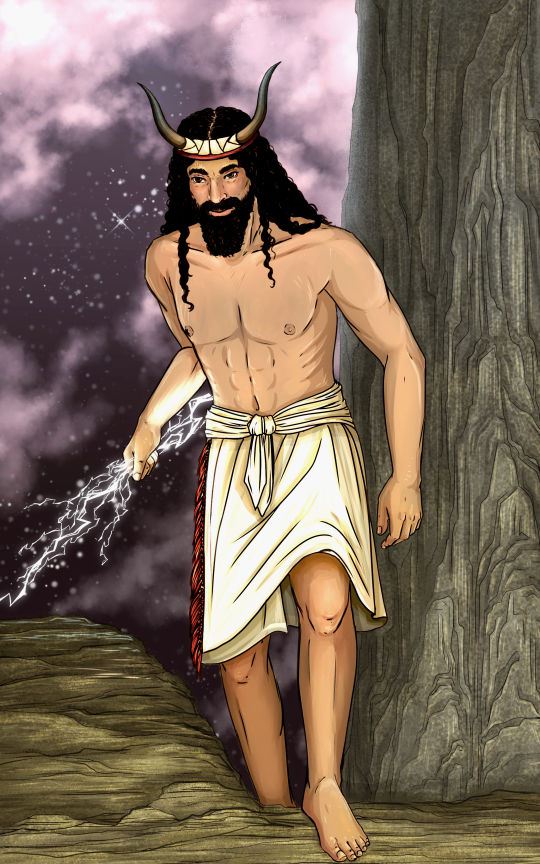
Ba’al Hadad prayer card by G. Palmer for sale on Galina Krasskova’s website
I swore I was not going to get involved in the Cultural Appropriation Controversy here at Patheos Pagan. But yesterday, I got dragged into it when I was accused of cultural appropriation myself. Specifically, I was accused by Galina Krasskova of “appropriating” the images of gods for the banner for this blog (above). (The image in question is of Egyptian-Canaanite gods.) Now, I had been previously accused by Tess Dawson of “defacing sacred images for fun and profit”, and I responded to that accusation here in my last post. But Dawson didn’t use the word “appropriation”. Her concern was with how I used the image, not the fact that I used it. Krasskova took this to the next level. According to her, because I am an “outsider” — meaning I do not believe in the literal existence of the gods depicted — then my use of polytheistic iconography is a form of cultural “appropriation”.
Krasskova’s post raises some interesting questions which have barely been touched on in the discussions about cultural appropriation on Patheos. Most of the discussion at Patheos has focused on living cultures, like those of indigenous peoples. But how does that discussion apply to a culture that has been dead for millennia, i.e., the Canaanites? Of course, Krasskova (and presumably Dawson) would argue that the Canaanite culture is not dead, because it has been recently revived (i.e., by Dawson). But that causes me to wonder, who can claim the right to revive a dead culture? And do the modern individuals who revive a dead culture automatically inherit the injuries and the victimhood of those who died millennia ago?
It is important to point out that it is only an aspect of the Canaanite culture Dawson is attempting to revive. As far as I know, she is not attempting to live like the the ancient Canaanites. She’s not learning Canaanite basket weaving and living in a mud hut. Does her worship of polytheistic gods entitle her to feel victimized by events that happened thousands of years before she was born? Does reviving the worship of Canaanite gods make her a Canaanite? Does it matter whether she is descended from Canaanites? Does it matter whether she lives in the place where the ancient Canaanites lived? Does it matter that, whatever we do religiously, we still immersed in contemporary Western culture in nearly every other way? Does it matter that culturally all of us are much closer to the perpetrators than to the victims of the cultural crimes that we are claiming to be vicarious victims of?
Do those who are attempting to revive a dead culture have the right to claim vicarious victimhood? That is exactly what Dawson and Krasskova are doing. Both of them analogized the header on the banner of this blog to the physical destruction of the holy sites of ancient polytheists by Daesh/ISIL which is going on in the present. According to Krasskova, her religion is under attack — both by Islamic fundamentalists in the Middle East and by atheist Pagans in the West. For her, the “co-optation” of “her” religious termination and the “watering down” of “her” traditions are somehow equivalent to the physical destruction of archeological monument by Daesh/ISIL in the Middle East. This is obviously hyperbole, whether Krasskova recognizes it or not. (Matty James does a good job of highlighting Krasskova’s persecution complex in the comments.) But what I find curious is how Krasskova identifies with the victims of the violence of Daesh/ISIL — not as a fellow human being, but as a polytheist. For her, the destruction of the holy sites of long dead polytheists is the destruction of her holy sites. And this causes me to wonder — who is really doing the appropriation here? Me or her?
And as strange as it is that Krasskova and Dawson can claim to be inheritors of the victimhood of the ancient Canaanites, it is even more strange that I — and all eclectic Neo-Pagans by extension — have been somehow identified by them with the perpetrators of cultural destruction which occurred millennia ago. Krasskova manages to conflate the disappearance of the Canaanite culture in the Iron Age with the destruction of polytheist cultures by Christians in the first century C.E. and the contemporary destruction of polytheistic archeological sites by Islamic extremists. First of all, the Canaanites were not destroyed by monotheists. Canaan was conquered by the Assyrians, then the Babylonians, then the Persians, Greeks, and Romans — all polytheists. Second, Krasskova has no more right to identify with the victims of the Christianization of the ancient world than I do — and I don’t think I do at all.
Recently, Sable Aradia has described what I think is a common sentiment among contemporary Pagans toward Christian syncretization of ancient paganism:
“Does it make you angry to listen to some Christians waxing rhetoric about “the reason for the season” when you know perfectly well that the reason that Christmas is on the 25th of December is because early Christians wanted to compete with the rival faith of the Sun God Mithras? Does it infuriate you when they go on and on about the life of Jesus Christ like it was completely original, utterly ignoring how the details were cribbed out right from Horus, Dionysus, Persephone, Osiris, Zoroaster, Krishna, the Buddha and Mithras? And on top of everything else, you know that pretty much every single modern Western Christmas custom was stolen from the Norse and the Saxons? (If it wasn’t invented by the Victorians). Does a lump of resentment stick in your craw when you consider how dismissive some Christians are to Pagans, and how they call us “evil” and “Satanic,” when you know for a fact that about 90% of their ethics originated in the writings of the great Greek Pagan philosophers? Do you get angry at how the secular world is commercializing and trivializing Samhain? And now the Day of the Dead as well?”
All of what Sable says about the pagan origins of Christianity is true. But it is one thing to be frustrated with the ignorance of Christians who think their religious culture is some pure artifact descended directly from heaven and untouched by human hands. And it is another thing altogether to act like we, personally, are the victims of crimes which were committed by Christians against pagans in a time and place so far removed from us.
The truth is that we contemporary Pagans — including myself, as well as Dawson and Krasskova — are culturally much closer to the Christians than to the pagans in this scenario. If we’re going to identify with anyone, it should probably be the perpetrators, not the victims. Yes, ancient Christians appropriated ancient Pagan imagery and customs and ethics. But we contemporary Pagans are no better. We cannot claim the moral high ground in this area simply because we choose to worship multiple gods instead of one. We have no more or less right to ancient pagan imagery and customs than contemporary Christians do. As Alexander Folmer recently acknowledged in his contribution to the cultural appropriation discussion:
“Many of us are also fairly far removed from the birthplace of the traditions we practice. I’m a 21stcentury English speaking American, living in the Sonoran Desert. Despite my ancestral origins, I’m about as far from the frozen northern landscape of my seafaring ancestors as it gets. I’ve never even been out of sight of land in my life. I may be descended from Viking stock, but the landscape and language of the lore is foreign enough to me that it might as well be Mars.”
In the course of the Cultural Appropriations Controversy, several people, including Yvonne Aburrow and Crystal Blanton, have observed that the defining characteristic of cultural appropriation is an imbalance of power. Perhaps you could make the case that I, as a living person, have more power than those who belonged to the dead culture and who — with the exception of a handful of self-appointed defenders — have no living representatives. (This is an interesting intersection of politics and metaphysics.) But, what you cannot say is that I have more power in this situation than Dawson or Krasskova. Being an eclectic Neo-Pagan does not give me any privileges which are denied to polytheist reconstructionists. Whether they want to see it or not, we’re all in the same boat. Neither of us owns these images. Krasskova and Dawson have no more right to them than I do. Perhaps I am “appropriating” ancient Canaanite religious culture — but if am, so are Dawson and Krasskova.
And if we are all all appropriating dead pagan culture, then the real question simply becomes whether the appropriation is respectful. I get that Dawson and Krasskova feel that my appropriation of the Canaanite image is not respectful. I have explained in my last post, I feel that it is:
“This is where I write about my spirituality. This is where I write about holy things. And this image is holy to me — both the original image and the “adulterated” image (as Tess calls it). Now maybe Tess can’t appreciate the connections I’ve drawn above. I don’t expect her to. But I do expect her to respect the fact that the connection exists for me. It is as real and as holy to me as her relationship to her gods is to her.”
This is not “commercialization” or “commodification”, and to describe my spirituality in those terms is insulting.
Let me give you another example from Steven Posch, “Pagan Culture Builder”:
“The way they tell it around here, two brothers fell in love with the same woman. She favored the younger, and in a fit of rage the elder brother killed him, hacked his body into pieces, and threw them into the river. It so happens that this woman was a witch, so she paddled up and down the Mississippi singing her spells, and in the end she managed to find his whole body. Well, not quite the whole body, since his dick got eaten by a catfish. (If you’ve ever wondered why people eat catfish at Beltane, that’s why.) So she carved him a new dick from a cottonwood root, and then she put all the pieces back together. She breathed the life back into him long enough for one last loving. Then she buried him. But out of that one last loving she got a child and they say that’s where this whole line of river-witches comes from.”
This tale was obviously inspired by the Egyptian myth of Isis and Osiris. Is this cultural appropriation? I don’t know. But real question, I think, is whether it is respectful. And I think it is. In fact, I think the ancient Egyptians — master syncretists as they were — would really appreciate it.
Living in a pluralistic society, we have to get used to the idea that others will use our images and our words in ways that are sacred to them, but alien to us. I remember an instance when I was a Mormon missionary and I met a lady who told me she too believed the founder of the Mormon church, Joseph Smith, was a prophet — but the lady was not Mormon. (I think she may have been Baha’i.) I insisted that a belief in Joseph Smith’s prophetic calling logically compelled her to become Mormon. She just responded that she had incorporated my beliefs into her own. Frankly, I was offended. (Mormons don’t worship Joseph Smith, but they honor him like a prophet, like Jews do Moses.) Emotionally, I felt like she was “stealing” Joseph Smith from me. But looking back, I realize now, she wasn’t taking anything away from me. Her Joseph Smith wasn’t my Joseph Smith. And for that matter, my Joseph Smith wasn’t the Joseph Smith anyway.
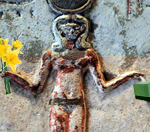
The same is true for the image of the gods in the header above. The figure on the right in the header is the Canaanite god Resheph. My Resheph is not Tess Dawson’s Resheph. And neither of our Resheph’s are the Resheph. My Odin is not Krasskova’s Odin. And neither of our Odins are the Odin. Krasskova sees herself “guarding carefully every metaphorical stone that we have again unearthed and set in place as we restore these sacred containers of our mysteries and mystery”. I agree with Krasskova that we need to guard the “sacred containers of our mysteries” … from “commercialization” and “commodification”. But we do not need to guard them from each other. Your holy may not be my holy, but what matters is that we both are trying to see the holy.
Previous Post
October 2, 2015
The Image on this Header is Holy to Me
Next Post
October 13, 2015 On My Way to the Parliament of World Religions
Browse Our Archives
Select a Category Ritual Scripts Theology Uncategorized
Select a Month January 2017 December 2016 November 2016 October 2016 September 2016 August 2016 July 2016 June 2016 May 2016 April 2016 March 2016 February 2016 January 2016 December 2015 November 2015 October 2015 September 2015 August 2015 July 2015 June 2015 May 2015 April 2015 March 2015 February 2015 January 2015 December 2014 November 2014 October 2014 September 2014 August 2014 July 2014 June 2014 May 2014 April 2014 March 2014 February 2014 January 2014 December 2013 November 2013 October 2013 September 2013 August 2013 July 2013 June 2013 May 2013 April 2013 March 2013 February 2013 January 2013 December 2012 November 2012 October 2012 September 2012 August 2012 July 2012 June 2012 May 2012 April 2012 March 2012 February 2012 January 2012 December 2011 November 2011 October 2011 September 2011 August 2011
TAKE THE
Religious Wisdom Quiz
True or False: The Ten Commandments were written on three stone tablets.
Select your answer to see how you score.
TRUE FALSE
Related posts from The Allergic Pagan

A Guide to Politics at Patheos Pagan

Call to Chicago Area Pagans: Come to Hammond...


Size Doesn't Matter: 5 Pieces of Advice for...
TRENDING AT PATHEOS Pagan

I was recently chatting with someone on Instagram. She asked me what...

While there are many people who share their results, the end of...

On July 23, I saw Christopher Nolan's The Odyssey which is Homer’s...

As I write this two big events have just finished up. One...

Restoring the Watershed of Divine Love
Perhaps cooperation is not something we manufacture through legislation, ideology, or moral...

Many UUs don’t pray because of bad experiences in a previous religion,...
view all Pagan blogs
Ad-Free & Subscriber Log-In Subscription Support
- About Us
- 2026 Calendar
- Videos
- Podcasts
- Library of World Religions
- Faith In Media Tracker
- Advertise With Us
- Write for Us
- Privacy Policy
- Terms of Service
- Do Not Sell My Data
- Contact Us
- Radiant Digital
- Manage Newsletter Subscriptions
- Unsubscribe From Notifications
- Sitemap
Copyright 2008-2026, Patheos. All rights reserved.
Subscription Support Ad-Free & Subscriber Log-In
Follow Patheos