
BuddhistCatholicContemplativeEvangelicalGeneral ChristianHinduJewishLatter-day SaintMuslimNew VisionsProgressive Christian
Beliefs
- Buddhist
- Catholic
- Contemplative
- Evangelical
- General Christian
- Hindu
- Jewish
- Latter-day Saint
- More Voices
- Muslim
- New Visions
- Pagan
- Progressive Christian
Topics
- Religion News
- Food and Religion
- Sports and Religion
- Religious Art
- Religious Music and Entertainment
- Religious Events
- History and Religion
- Style and Religion
- Politics and Religion
- Women in Religion
- Recreation Outdoors and Religion
- Business Finance and Religion
- Careers Workplace and Religion
- Education and Religion
- Family Parenting and Religion
- Health Fitness and Religion
- Home and Religion
- Relationships and Religion
- Technology and Religion
- Travel and Religion
Columnists
- Buddhist Columnists
- Business Finance and Religion Columnists
- Careers Workplace and Religion Columnists
- Catholic Columnists
- Contemplative Columnists
- Education and Religion Columnists
- Evangelists Columnists
- Family Parenting and Religion Columnists
- General Christian Columnists
- Health Fitness and Religion Columnists
- Hindu Columnists
- History and Religion Columnists
- Home and Religion Columnists
- Jewish Columnists
- More Voices Columnists
- Latter Day Columnists
- Muslim Columnists
- New Visions Columnists
- Nonreligious Columnists
- Pagan Columnists
- Politics and Religion Columnists
- Progressive Columnists
- Recreation Outdoors and Religion Columnists
- Relationships and Religion Columnists
- Religion News Columnists
- Religious Art Columnists
- Religious Events Columnists
- Religious Music and Entertainment Columnists
- Sports and Religion Columnists
- Style and Religion Columnists
- Technology and Religion Columnists
- Travel and Religion Columnists
- Women in Religion Columnists
Resource Library
- 2026 Calendar
- Library of World Religions
- The 100 Most Holy Places on Earth
- Patheos Answers
- Podcasts
- Videos
- Faith Leaders Database
- Anglican Episcopalian
- Bahai
- Baptist
- Buddhism
- Christianity
- Confucianism
- Eastern Orthodoxy
- Hinduism
- Holiness and Pentecostal
- ISKCON
- Islam
- Judaism
- Lutheran
- Methodist
- The Church of Jesus Christ of Latter-day Saints
- New Age
- Paganism
- Presbytarian and Reformed
- Protestantism
- Religion Behind the Scenes
- Roman Catholic
- Scientology
- Shia Islam
- Sikhism
- Sufism
- Sunni Islam
- Taoism
- Zen
- See all religions
Research Tools
 Ad-Free & Subscriber Log-In Subscription Support
Ad-Free & Subscriber Log-In Subscription Support
Follow Patheos 

- Trending:
- Forgiveness
- |
- Marriage
- |
- Consciousness
- |
- Death Penalty
- |
- Election
- |
- Halloween
 The Allergic Pagan
- Home
- Pagan
- Why This Pagan Won’t Be Honoring His Ancestors on Halloween
Why This Pagan Won’t Be Honoring His Ancestors on Halloween
Last updated on: October 1, 2015 at 7:08 pm by John Halstead
Why This Pagan Won’t Be Honoring His Ancestors on Halloween 2015-10-01T19:08:02-05:00 John Halstead
Patheos Explore the world's faith through different perspectives on religion and spirituality! Patheos has the views of the prevalent religions and spiritualities of the world.
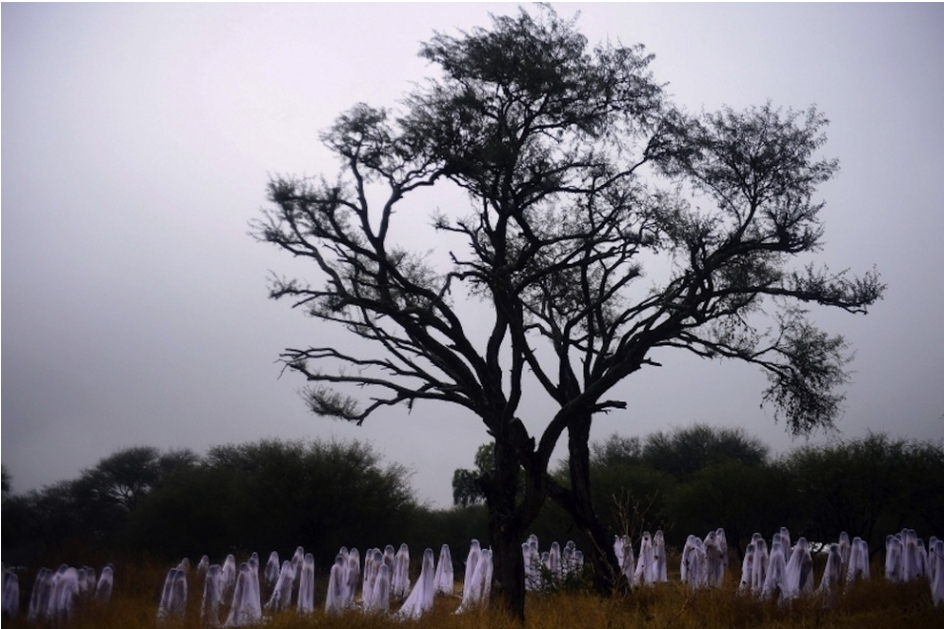
Day of the Dead in Los Senderos, Mexico organized by Spencer Tunick (Getty Images)
If you follow my blog, you’ll know I’m a bit of an iconoclast when it comes to the Wheel of the Year. I’m a big advocate of customizing our celebration of the Pagan High Holy Days to the local geography and climate one lives in. So, because I live in the midwest, I don’t celebrate the beginning of spring on Imbolc when there’s still snow on the ground. And when I invoke the element of water, I face north, because that’s were the nearest large body of water (Lake Michigan) is in relation to me.
But I also believe it makes sense to synchronize our High Days with the culture in which we live, at least to a certain extent. Jason Mankey has written previously about what he calls the “Eight Great American Sabbats” — basically the high “holy” days of secular American culture. There is a certain (very rough) correspondence between these American holidays and the Neo-Pagan Wheel of the Year:
Winter Solstice (Yule) ~ Christmas/New Year’s
Winter Cross-Quarter (Imbolc) ~ Groundhog’s Day
Spring Equinox (Ostara) ~ Easter/Passover
Spring Cross-Quarter (Beltane) ~ Memorial Day (unofficial start of summer)
Summer Solstice (Litha) ~ Independence Day
Summer Cross-Quarter (Lughnasadh) ~ ?
Fall Equinox (Mabon/Herfest) – Labor Day (unofficial start of fall)
Fall Cross-Quarter (Samhain) ~ Halloween
Some of these Pagan High Days correspond better to their secular mates than others. So it’s easier to ignore the coincidence of Beltane and Memorial Day or Mabon and Labor Day (since the dates don’t match up closely) than it is to ignore the coincidence of Yule and Christmas or — what I want to talk about today — Samhain and Halloween.
I’ve always liked Halloween. Next to Christmas, it is my favorite American holiday. For one thing, Halloween is the only time of the year a straight guy can be flamboyant without apology in our homophobic American culture. I love the costumes, the trick-or-treating, and the whole scary-but-fun atmosphere. So when I became Pagan, I was ready to embrace Halloween as a Pagan High Holy Day. And I’ve got to say I was disappointed when I found out that most Neo-Pagans celebrate Samhain as a kind of Pagan “Day of the Dead” or All Souls Day, with little to no connection to the secular celebration of Halloween.
But Halloween is ready-made for Pagan appropriation. Sure, it’s completely secularized — just like much of Christmas is — but despite its secular origins, Halloween just begs to be Pagan-ized. For one thing, it’s the only time of the year when we can do weird things around a bonfire at night in our backyard and not draw too much attention to ourselves. And it’s a great example of what Jason Mankey calls “Rustic Paganism” — like Morris Dancing, it isn’t historically pagan, but it feels pagan.
I understand that many Neo-Pagans associate the day with their ancestors because of the idea that the “veil between the worlds” is thinnest on this day. But that’s true of Beltane too, and Beltane falls close to Memorial Day — a day on which many Americans honor, not just those who died in war, but all their ancestors. For some Americans, it is the only time they visit the graves of family. I do think it is important to have a Pagan holy day honoring our ancestors. But we could do that at Beltane or Memorial Day. Or we could do something like the Catholic All Hallows Tridium and celebrate All Hallows on October 31st and then do a Pagan “All Souls” Day later, like on November 2.
There’s just nothing about Halloween makes me think of my grandparents or great-grandparents. To me, the high-spirited, festive nature of Halloween stands in sharp contrast with the somber feeling of visiting graves on Memorial Day. I find it hard to maintain the an attitude appropriate to honoring my ancestors when everyone else around me is having a kind of second Mardi Gras.
Nor do I associate Halloween/Samhain with the New Year, like some Neo-Pagans do. I have my doubts about whether Samhain really was the New Year for ancient Celts, but in any case, it was much more common for ancient pagans around the world to observe the New Year on the winter solstice or the spring equinox. Yule just makes more sense to me as the Pagan New Year.
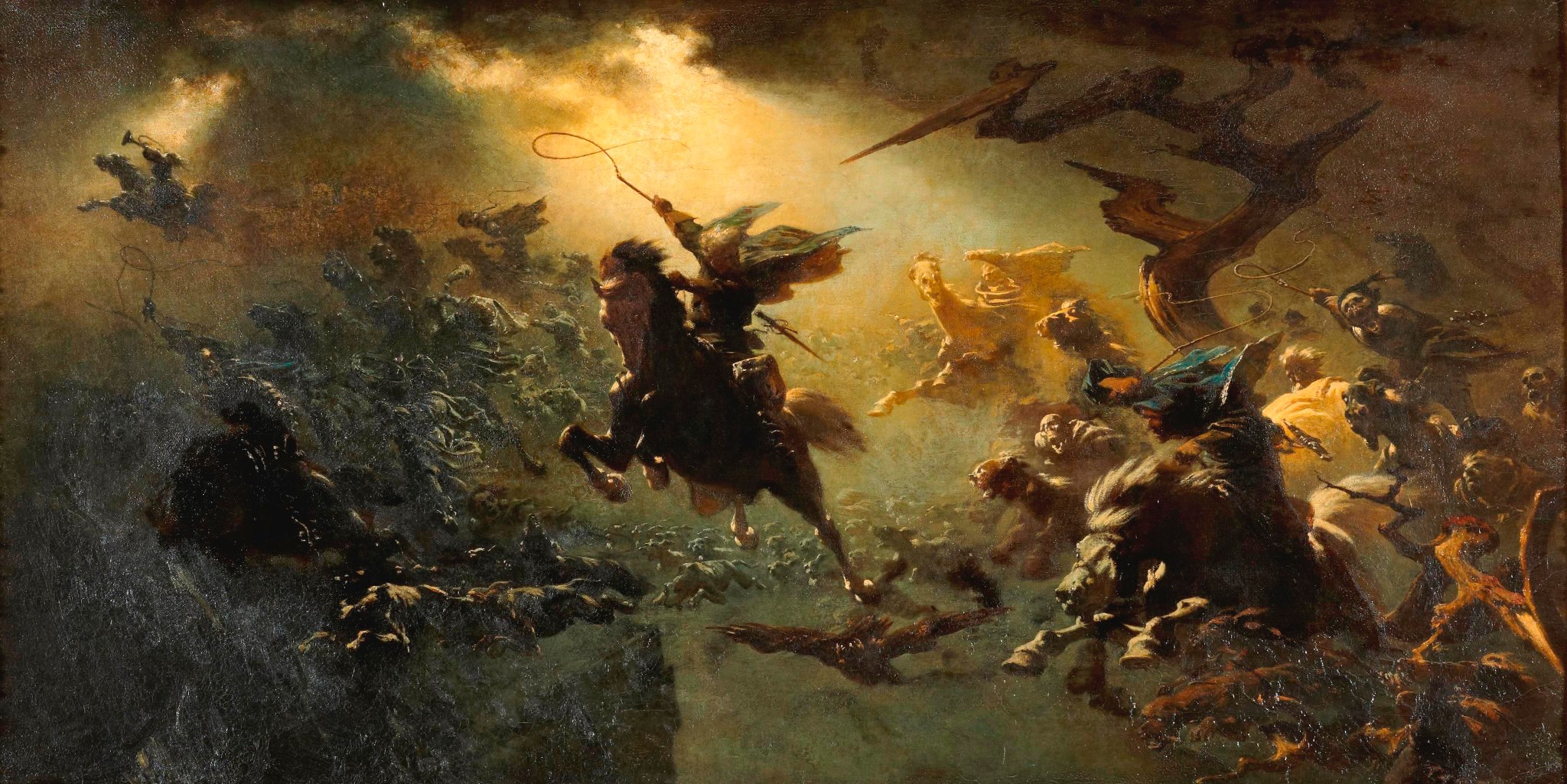
“The Wild Hunt” by Johann Wilhelm Cordes (Wikimedia Commons)
Rather than the ancestors, Halloween calls to my mind another Pagan motif: the Wild Hunt. For me, Halloween marks the time on the Wheel of the Year when the Dark God is crowned as the Holly King and leads the Wild Hunt as it emerges from Underworld to roam the winter countryside, with the Dark Queen riding beside him in her devouring aspect as the Huntress. I explain the connection to my kids this way:
“The legend of the Wild Hunt is behind many of the traditions of Halloween. According to legend, people wear masks to scare the ghosts and goblins that come out of the underworld at this time of the year. Because, if the Wild Hunt catches a person walking alone at night during this time of the year, it will carry them off to the underworld and they will become a part of the Wild Hunt themselves. But if you are wearing a scary mask, the Wild Hunt will think you are one of them, and will pass you by.”
Of course, this is not the true history behind trick-or-treating, but I I think the symbolism fits nicely. The correspondence is so strong for me that I break my general rule about celebrating the cross-quarters on their actual celestial date. (The Autumn Cross-Quarter falls on November 7 this year.)
I even like the name “Hallow’een” or “All Hallow’s Eve” — much better than Samhain, which no one can pronounce anyway. “Hallow” means “holy”, so All Hallows means “All Holy”, and to me that fits with the meaning of the day as a time for remembering the dark gods, because to Pagans they are holy too. The name “Hallow’een” says to me, “It’s all ‘hallow’ or sacred, even our ‘dark’ side.” It’s the perfect time for letting our Shadow side out for a ride.
Tell me what you think. Is Halloween a holy day for you? Do you experience any dissonance with honoring the ancestors while others are trick-or-treating?
Previous Post

September 24, 2015
On Gods and Stained Glass Windows: A Response to Morpheus Ravenna
Next Post

October 2, 2015 Help Us Publish "Godless Paganism: Voices of Non-Theistic Pagans"
Browse Our Archives
Select a Category Ritual Scripts Theology Uncategorized
Select a Month January 2017 December 2016 November 2016 October 2016 September 2016 August 2016 July 2016 June 2016 May 2016 April 2016 March 2016 February 2016 January 2016 December 2015 November 2015 October 2015 September 2015 August 2015 July 2015 June 2015 May 2015 April 2015 March 2015 February 2015 January 2015 December 2014 November 2014 October 2014 September 2014 August 2014 July 2014 June 2014 May 2014 April 2014 March 2014 February 2014 January 2014 December 2013 November 2013 October 2013 September 2013 August 2013 July 2013 June 2013 May 2013 April 2013 March 2013 February 2013 January 2013 December 2012 November 2012 October 2012 September 2012 August 2012 July 2012 June 2012 May 2012 April 2012 March 2012 February 2012 January 2012 December 2011 November 2011 October 2011 September 2011 August 2011
TAKE THE
Religious Wisdom Quiz
True or False: In Revelation, the New Jerusalem has ten gates, each made of a single pearl.
Select your answer to see how you score.
TRUE FALSE
Related posts from The Allergic Pagan

Lowered Expectations Is Not the Answer to Bad...
What's On Your Pagan Calendar for 2016?
7 Reasons Why Christmas is Part of My...
TRENDING AT PATHEOS Pagan

When we talk about Greek religion, we often begin with the dodekatheion—the...

I was recently chatting with someone on Instagram. She asked me what...

While there are many people who share their results, the end of...

On July 23, I saw Christopher Nolan's The Odyssey which is Homer’s...

As I write this two big events have just finished up. One...

Restoring the Watershed of Divine Love
Perhaps cooperation is not something we manufacture through legislation, ideology, or moral...
view all Pagan blogs
Ad-Free & Subscriber Log-In Subscription Support
- About Us
- 2026 Calendar
- Videos
- Podcasts
- Library of World Religions
- Faith In Media Tracker
- Advertise With Us
- Write for Us
- Privacy Policy
- Terms of Service
- Do Not Sell My Data
- Contact Us
- Radiant Digital
- Manage Newsletter Subscriptions
- Unsubscribe From Notifications
- Sitemap
Copyright 2008-2026, Patheos. All rights reserved.
Subscription Support Ad-Free & Subscriber Log-In
Follow Patheos