
BuddhistCatholicContemplativeEvangelicalGeneral ChristianHinduJewishLatter-day SaintMuslimNew VisionsProgressive Christian
Beliefs
- Buddhist
- Catholic
- Contemplative
- Evangelical
- General Christian
- Hindu
- Jewish
- Latter-day Saint
- More Voices
- Muslim
- New Visions
- Pagan
- Progressive Christian
Topics
- Religion News
- Food and Religion
- Sports and Religion
- Religious Art
- Religious Music and Entertainment
- Religious Events
- History and Religion
- Style and Religion
- Politics and Religion
- Women in Religion
- Recreation Outdoors and Religion
- Business Finance and Religion
- Careers Workplace and Religion
- Education and Religion
- Family Parenting and Religion
- Health Fitness and Religion
- Home and Religion
- Relationships and Religion
- Technology and Religion
- Travel and Religion
Columnists
- Buddhist Columnists
- Business Finance and Religion Columnists
- Careers Workplace and Religion Columnists
- Catholic Columnists
- Contemplative Columnists
- Education and Religion Columnists
- Evangelists Columnists
- Family Parenting and Religion Columnists
- General Christian Columnists
- Health Fitness and Religion Columnists
- Hindu Columnists
- History and Religion Columnists
- Home and Religion Columnists
- Jewish Columnists
- More Voices Columnists
- Latter Day Columnists
- Muslim Columnists
- New Visions Columnists
- Nonreligious Columnists
- Pagan Columnists
- Politics and Religion Columnists
- Progressive Columnists
- Recreation Outdoors and Religion Columnists
- Relationships and Religion Columnists
- Religion News Columnists
- Religious Art Columnists
- Religious Events Columnists
- Religious Music and Entertainment Columnists
- Sports and Religion Columnists
- Style and Religion Columnists
- Technology and Religion Columnists
- Travel and Religion Columnists
- Women in Religion Columnists
Resource Library
- 2026 Calendar
- Library of World Religions
- The 100 Most Holy Places on Earth
- Patheos Answers
- Podcasts
- Videos
- Faith Leaders Database
- Anglican Episcopalian
- Bahai
- Baptist
- Buddhism
- Christianity
- Confucianism
- Eastern Orthodoxy
- Hinduism
- Holiness and Pentecostal
- ISKCON
- Islam
- Judaism
- Lutheran
- Methodist
- The Church of Jesus Christ of Latter-day Saints
- New Age
- Paganism
- Presbytarian and Reformed
- Protestantism
- Religion Behind the Scenes
- Roman Catholic
- Scientology
- Shia Islam
- Sikhism
- Sufism
- Sunni Islam
- Taoism
- Zen
- See all religions
Research Tools
 Ad-Free & Subscriber Log-In Subscription Support
Ad-Free & Subscriber Log-In Subscription Support
Follow Patheos 

- Trending:
- Forgiveness
- |
- Marriage
- |
- Consciousness
- |
- Death Penalty
- |
- Election
- |
- Halloween
 The Allergic Pagan
- Home
- Pagan
- Pagans Around the World Call for Environmental Action on Earth Day
Pagans Around the World Call for Environmental Action on Earth Day
Last updated on: April 23, 2015 at 6:42 pm by John Halstead
Pagans Around the World Call for Environmental Action on Earth Day 2015-04-23T18:42:53-05:00 John Halstead
Patheos Explore the world's faith through different perspectives on religion and spirituality! Patheos has the views of the prevalent religions and spiritualities of the world.
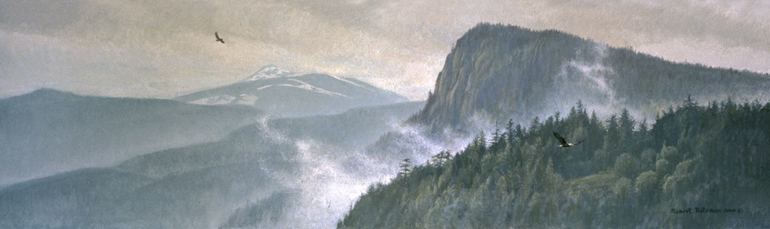
“Thinking Like a Mountain” by Robert Bateman
In this time of accelerating environmental change, many of us feel a sense of urgency to help transform humanity’s relationship with the Earth. This sense of urgency is what drew together a large group of diverse Pagans, including Pagan leaders, authors, artists, and bloggers from the United States, Canada, the United Kingdom, and Australia to draft “A Pagan Community Statement on the Environment.” In honor of Earth Day, the statement has been published at ecopagan.com where you can add your signature. The statement represents the beginning of a conversation, not the final word. Join us in our call to all people to rise to this historic moment in order to protect all life on Earth by signing the statement. You can sign on your own behalf or on behalf of a group or organization.
A Pagan Community Statement on the Environment
Who we are
Paganism is a family of spiritual paths rooted in ancestral religions throughout the world and predating recorded history. As explained by the Pagan Federation, Paganism includes polytheistic and pantheistic nature-worshipping religions, and often includes deities of all genders, ancestor veneration, and celebrations in tune with our Earth. A full discussion of the many varieties of Paganism is beyond the scope of this statement, but we, the signatories, value life and the natural world as sacred. Thus, Pagan thought leads us to live in harmony with the rhythms of our great Earth.
Nature is sacred
We receive, acknowledge and embrace the sacred in and as nature, though our individual relationships with the natural world are diverse. We recognize that nature encompasses humanity and the planet, and that we are neither above nor separate from the rest of nature. We recognize the ancient wisdom that closeness to nature brings closeness among humanity and all living beings; and when we live as if we are separate from nature, we diminish our compassion for ourselves and for others. Therefore, we affirm the necessity of living sustainably as part of nature.
We are part of the web of life
In recent decades, many contemporary Pagan religious traditions have stressed humanity’s interconnectivity with the rest of the natural world. Many of our ancestors realized what has now been supported by the scientific method and our expanding knowledge of the universe — that Earth’s biosphere may be understood as a single ecosystem and that all life on Earth is interconnected.
The very atoms of which we are composed connect us to the entire universe. Our hydrogen was produced in the Big Bang, and the other atoms essential for life were forged in the scorching furnaces of ancient stars. Beyond atoms, the molecules of life connect us to Earth, showing that we don’t live “on Earth” like some alien visitor, but rather that we are part of Earth, just as a volcano or river is part of Earth and its cycles.
We are earth, with carbon, nitrogen and phosphorus making up our bodies one day, and incorporated into mountains the next. We are air, giving food to the trees and grasses when we exhale, and breathing in their gift of free oxygen with each breath. We are fire, burning the energy of the Sun, captured and given to us by plants. We are water, with the oceans flowing in our veins and the same water that nourished the dinosaurs within our cells.
We are connected to our families, through links of love, to their relatives, and so on to the entire human species. Our family tree goes back further than the rise of humans, including all mammals, all animals, and all life on Earth. The entire Earth is our immense and joyous family reunion.
We feel these connections in a spiritual way. The web of life includes strands that tug on our hearts, thread through our essential nature, and weave us into a spiritual whole. As part of the body of life on Earth, we care about the health of all parts of the body. Many human activities destroy parts of the body, and we recoil at them. Cutting down a rainforest is no different from cutting off a healthy leg or arm. In fact, these are even more vital than our arms and legs, because these forests are part of our planetary lungs. Similarly, we care about our waters, our land, our air, and our diverse biosphere. We do so out of respect for our ancestors, out of care for all life today, and out of love for future generations. Anything that harms the body of life on Earth, including global warming, pollution and extinction, is thus a spiritual and moral issue.
We are part of Earth, and Earth is part of us.
How we are damaging the ecosystem
Humanity’s actions are radically altering the web of life of which we are a component, threatening the lives of many species, Homo sapiens included. This harm takes many forms. Habitat loss continues as consumption increases. Deforestation alone destroys some 150 thousand square kilometers each year, the size of Japan — equivalent to 24 football fields every minute.
Global warming caused by our emission of greenhouse gases has already contributed to sea level rise, ocean acidification, and increased floods and droughts, with more severe effects expected within this century. Additional damage can be seen from ozone depletion. Our actions also have resulted in an ongoing and unsustainable depletion of resources, including minerals, food sources and usable water, generating increasing amounts of pollution. Other harm in addition to these is likely to be found in the future as we continue to learn about the impact of human activities on our world.
What we can do
Since Earth is able to heal itself, we need to stop doing harm, and let the healing begin. However, this is not as simple as it sounds. Our global systems of exploitation are not easily dismantled.
There are certain actions we can take now. It is important for each individual, community, and nation to take stock of what that means for the betterment of the whole. Technical solutions can never move forward without political will, and the necessary political will requires a shift in our most deeply held values, in our very definitions of what it means to be human, and in how humanity relates to the world. We recognize this shift as a spiritual imperative.
It is a collective challenge, and individual actions are necessary but not sufficient. Therefore we must build a culture of true sustainability. This does not mean trying to find ways to “sustain” our current levels of consumption or trying to “sustain” economic and political systems which have failed us. Rather, building a truly sustainable culture means transforming the systems of domination and exploitation that threaten our future into systems of symbiotic partnership that support our ecosystem. We must be clear about our agenda, which includes promoting sustainable, local economies, reforming our food systems, distributing resources in a more just and humane fashion, and ensuring that our human populations are below the carrying capacity of our planet through access to voluntary birth control, and equal access to education and work for women.
Any economic or political system which encourages the exploitation of Earth and people must be dismantled or substantially reformed. This includes any system based on endless growth. We should be operating in a closed loop system, not a linear one. This means moving away from disposable development and culture, and moving toward renewable development and culture wherein all products are intended for longevity, repairability, and easy recycling or composting at the end of their use. The sustainable economy of the future will be one with the shortest distances between production, consumption and recycling of byproducts.
In addition, there is a deeper and more profound change that is needed. Fundamentally, we believe that a change in spirit is required, one that fosters a new relationship between humanity and other species and Earth as a whole. As Pagans, we believe we are well situated to help imagine and create a future in which humanity lives in greater harmony with the rest of our planet. We strive in our worship, work, play, and daily lives to connect to this greater harmony. We believe that recognizing our connection as part of Earth itself is a unique facet of what defines us. Pagans can aid in the repair of our environment by teaching how we are part of life on Earth, sharing rituals and ceremonies that foster bonds between ourselves and the rest of the web of life, and instilling a sense of responsibility for how we interact with the ecosystem — all this creating cultures that can sustain our human society today and for generations to come.
As signatories, we commit to use our abilities and resources to promote policies and practices that foster the changes that our world so urgently needs. We will continue to educate members of our community to foster intelligent and focused sustainable living, and help the world recognize that everyone, whether Pagan or not, is part of our precious Earth. We hold that living a fulfilling and meaningful life, and allowing the same for future generations, is only possible if the entire Earth is healthy. We will therefore strive as individuals, as groups, and as members of a global society to promote the current and future health of our entire Earth, including the water, air, land, and the web of life.
Earth Day 2015
Click here to sign the statement.

Next Post
April 24, 2015 Arbor Day: Earth Day for Procrastinators
Browse Our Archives
Select a Category Ritual Scripts Theology Uncategorized
Select a Month January 2017 December 2016 November 2016 October 2016 September 2016 August 2016 July 2016 June 2016 May 2016 April 2016 March 2016 February 2016 January 2016 December 2015 November 2015 October 2015 September 2015 August 2015 July 2015 June 2015 May 2015 April 2015 March 2015 February 2015 January 2015 December 2014 November 2014 October 2014 September 2014 August 2014 July 2014 June 2014 May 2014 April 2014 March 2014 February 2014 January 2014 December 2013 November 2013 October 2013 September 2013 August 2013 July 2013 June 2013 May 2013 April 2013 March 2013 February 2013 January 2013 December 2012 November 2012 October 2012 September 2012 August 2012 July 2012 June 2012 May 2012 April 2012 March 2012 February 2012 January 2012 December 2011 November 2011 October 2011 September 2011 August 2011
TAKE THE
Religious Wisdom Quiz
What does Paul say in Philemon he would have liked to keep Onesimus to do?
Select your answer to see how you score.
Preach the word Help him while he is in chains for the gospel Serve in the church Care for the poor
Related posts from The Allergic Pagan

A Guide to Politics at Patheos Pagan

A Pagan Dad Goes to Washington: 10 Things...

Call to Chicago Area Pagans: Come to Hammond...

TRENDING AT PATHEOS Pagan

I was recently chatting with someone on Instagram. She asked me what...

While there are many people who share their results, the end of...

On July 23, I saw Christopher Nolan's The Odyssey which is Homer’s...

As I write this two big events have just finished up. One...

Restoring the Watershed of Divine Love
Perhaps cooperation is not something we manufacture through legislation, ideology, or moral...

Many UUs don’t pray because of bad experiences in a previous religion,...
view all Pagan blogs
Ad-Free & Subscriber Log-In Subscription Support
- About Us
- 2026 Calendar
- Videos
- Podcasts
- Library of World Religions
- Faith In Media Tracker
- Advertise With Us
- Write for Us
- Privacy Policy
- Terms of Service
- Do Not Sell My Data
- Contact Us
- Radiant Digital
- Manage Newsletter Subscriptions
- Unsubscribe From Notifications
- Sitemap
Copyright 2008-2026, Patheos. All rights reserved.
Subscription Support Ad-Free & Subscriber Log-In
Follow Patheos