
BuddhistCatholicContemplativeEvangelicalGeneral ChristianHinduJewishLatter-day SaintMuslimNew VisionsProgressive Christian
Beliefs
- Buddhist
- Catholic
- Contemplative
- Evangelical
- General Christian
- Hindu
- Jewish
- Latter-day Saint
- More Voices
- Muslim
- New Visions
- Pagan
- Progressive Christian
Topics
- Religion News
- Food and Religion
- Sports and Religion
- Religious Art
- Religious Music and Entertainment
- Religious Events
- History and Religion
- Style and Religion
- Politics and Religion
- Women in Religion
- Recreation Outdoors and Religion
- Business Finance and Religion
- Careers Workplace and Religion
- Education and Religion
- Family Parenting and Religion
- Health Fitness and Religion
- Home and Religion
- Relationships and Religion
- Technology and Religion
- Travel and Religion
Columnists
- Buddhist Columnists
- Business Finance and Religion Columnists
- Careers Workplace and Religion Columnists
- Catholic Columnists
- Contemplative Columnists
- Education and Religion Columnists
- Evangelists Columnists
- Family Parenting and Religion Columnists
- General Christian Columnists
- Health Fitness and Religion Columnists
- Hindu Columnists
- History and Religion Columnists
- Home and Religion Columnists
- Jewish Columnists
- More Voices Columnists
- Latter Day Columnists
- Muslim Columnists
- New Visions Columnists
- Nonreligious Columnists
- Pagan Columnists
- Politics and Religion Columnists
- Progressive Columnists
- Recreation Outdoors and Religion Columnists
- Relationships and Religion Columnists
- Religion News Columnists
- Religious Art Columnists
- Religious Events Columnists
- Religious Music and Entertainment Columnists
- Sports and Religion Columnists
- Style and Religion Columnists
- Technology and Religion Columnists
- Travel and Religion Columnists
- Women in Religion Columnists
Resource Library
- 2026 Calendar
- Library of World Religions
- The 100 Most Holy Places on Earth
- Patheos Answers
- Podcasts
- Videos
- Faith Leaders Database
- Anglican Episcopalian
- Bahai
- Baptist
- Buddhism
- Christianity
- Confucianism
- Eastern Orthodoxy
- Hinduism
- Holiness and Pentecostal
- ISKCON
- Islam
- Judaism
- Lutheran
- Methodist
- The Church of Jesus Christ of Latter-day Saints
- New Age
- Paganism
- Presbytarian and Reformed
- Protestantism
- Religion Behind the Scenes
- Roman Catholic
- Scientology
- Shia Islam
- Sikhism
- Sufism
- Sunni Islam
- Taoism
- Zen
- See all religions
Research Tools
 Ad-Free & Subscriber Log-In Subscription Support
Ad-Free & Subscriber Log-In Subscription Support
Follow Patheos 

- Trending:
- Forgiveness
- |
- Marriage
- |
- Consciousness
- |
- Death Penalty
- |
- Election
- |
- Halloween
 The Allergic Pagan
- Home
- Pagan
- Non-Violent Writing: Selma and the “Pagan” question
Non-Violent Writing: Selma and the “Pagan” question
Last updated on: January 15, 2015 at 12:21 am by John Halstead
Non-Violent Writing: Selma and the “Pagan” question 2015-01-15T00:21:16-05:00 John Halstead
Patheos Explore the world's faith through different perspectives on religion and spirituality! Patheos has the views of the prevalent religions and spiritualities of the world.
[Note from the author: Since writing this, I have come to realize (through the comments of patient friends) the degree of the inappropriateness of comparing rhetorical combativeness within the online Pagan community to the racism in the Civil Rights era south. In these online discussion, no matter how toxic, there exists little of the power or privilege which made and continue to make racism so insidious and virulent. Especially in light of recent events, this comparison by a white author such as myself has the effect, albeit unintended, of trivializing the ongoing struggle for racial equality, and no amount of qualification can entirely eliminate this effect. I apologize for the offense and pain this post created for some of my readers. I have chosen to leave the post up as an object lesson, and in the hope that my main point about de-escalating our rhetoric will still be helpful to others. -John]
I had a professor in undergrad who told us that the way to make a name for yourself as a writer was to make a bold statement and let others fuss about the details. It was not his only piece of bad advice. Making unequivocal declarations may a draw attention, but it does not garner respect. Life is far too nuanced for monochromatic thinking and writing.
What’s more, I’ve come to see that there is a kind of violence in writing which makes declarative statements about other people, especially writing which presumes to categorize others, to put them in their place, so to speak. Lately, I have seen this in debates over what it means to be “Pagan” and “polytheist”. This often takes the form of declarations which try to appropriate the whole meaning of “Pagan” or “polytheist” for oneself and exclude others who want to be included (or even include others who want to be excluded). At the heart of these discussions is the very human and sympathetic need for self-definition. It is natural to create linguistic categories as a kind of psychological “house” for our egos to reside. Because we are social creatures, it is also natural for us to define our identity in relation to those around us. But as with racism, sexism, and discriminatory -isms, the problem arises when we cease to talk about specific individuals, and start making generalizations about large groups of people.
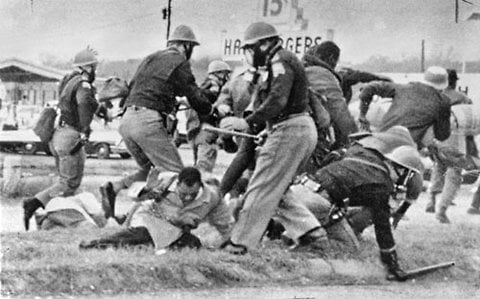
Civil rights marchers in Selma being beaten by Alabama.
Spiritual bigotry?
This weekend, I went with some UU friends to see Selma (which was a great film, by the way), about the civil rights march from Selma to Montgomery, Alabama, led by Martin Luther King Jr. There was considerable physical violence displayed against the protesters in the movie — mostly by police officers. But there was also a kind of psychological violence at work.
The struggle for uninhibited access to the ballot boxes was at its root, I think, a struggle for the right of self-definition. What the white southerners in the film seemed to fear, even more than the political consequences of allowing blacks to vote, was that blacks would refuse to remain in their designated place at the bottom of the social hierarchy. As Dr. King explained on the steps of the Montgomery capitol building at the end of the Selma march, the white rural poor of the south feared what it would mean for them if blacks no longer accepted the inferior role that had been assigned to them by white society:
“.. it may be said of the Reconstruction era that the southern aristocracy took the world and gave the poor white man Jim Crow. He gave him Jim Crow. And when his wrinkled stomach cried out for the food that his empty pockets could not provide,he ate Jim Crow, a psychological bird that told him that no matter how bad off he was, at least he was a white man, better than the black man. And he ate Jim Crow. And when his undernourished children cried out for the necessities that his low wages could not provide, he showed them the Jim Crow signs on the buses and in the stores, on the streets and in the public buildings. And his children, too, learned to feed upon Jim Crow, their last outpost of psychological oblivion.” (“Our God is Marching On!”, March 25, 1965)
The Civil Rights Movement challenged not only the inferior status of blacks, but also the superior status of whites.
While a direct comparison is not appropriate, I see some of the same dynamics going on in our struggle as a community to define what it means to be “Pagan” or what it means to be “polytheist”. Of course, there many forms rhetorical violence. They include ad hominem attacks, name calling, and other inflammatory language. But I want to talk about one form of rhetorical violence in particular: over-generalization. This happens when one person or group of people tries to define for themselves what “Pagan” or “polytheist” means for them, but ends up telling another person or group of people that they are not Pagan or polytheist because they do not fit one particular definition. There is often an element of a “holier-than-thou” mentality in such statements, which parallels the superiority complex which operated behind the supposedly “separate but equal” culture.
I think it is natural for us to attempt to define our ourselves and our spirituality, and even to compare and contrast with one another. There is nothing inherently wrong with categorizing, but our categories should be tools, not weapons. When we start forcing large groups of people, many of whom we have no first-hand interaction with, into categories of our own devising, then we have the makings of a kind of spiritual bigotry. Since we have no Pagan pope, these attempts to define one another, either in or out of the Pagan umbrella, are nowhere near as oppressive as the Jim Crow laws were to blacks — but some people experience this as a kind of violence, if only of a linguistic variety.
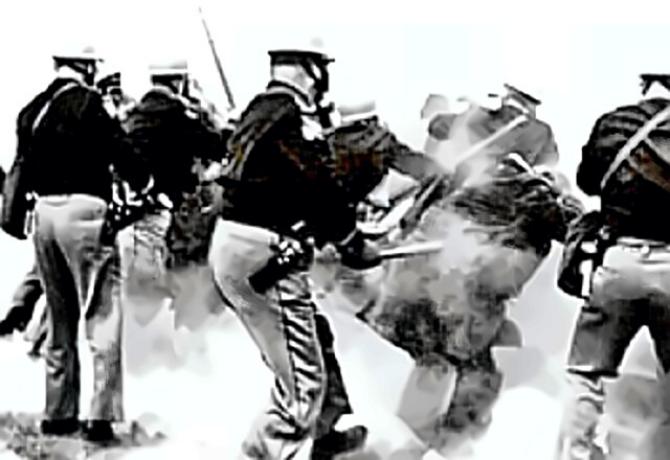
Alabama State troopers attack civil-rights demonstrators outside Selma, Alabama, on Bloody Sunday, March 7, 1965
De-escalating rhetorical violence
I am an attorney by profession. Several years ago, I took the deposition of an off-duty police officer who had been accused, in a civil suit, of using excessive force while employed as a security guard. The officer testified about how he had been trained to deal with aggressive or violent suspects, and he had applied this training to his work as a private contractor. He was taught what is called the “use of force continuum”, which matches different levels of suspect resistance to different levels of police force. The five levels of force can be found below:
The Use of Force Continuum
5. Lethal force
4. Intermediate Weapons (e.g. baton, pepper spray, Taser, beanbag rounds, Mace (spray), etc.)
3. Empty-hand submission techniques, Pressure Point Control Tactics
2. Verbal commands
1. Physical presence
What was interesting was that the officer explained that he was trained to respond to Level 1 resistance by asserting Level 2 force. Level 2 resistance was to be met with Level 3 force, and so on. While the model makes sense from one perspective, it is easy to see how people could easily get shot where the police officers are being trained to escalate, rather than de-escalate, the level of violence in every encounter.
Watching the movie Selma this weekend got me thinking about non-violence. If we accept that attempting to define another person or their spirituality can be an act of violence, then we must look for ways to de-escalate this violence in our writing. (I am indebted to Del Tashlin, the author of the Sex, Drugs, and Rock Stars blog for some of the ideas here.) What I propose is a 5-step continuum of over-generalization that parallels the “use of force continuum” used by police officers. Here it is:
The Over-Generalization Continuum
5. “All”
4. “Most”
3. “Many”
2. “Some”
1. “I”
The idea is that whenever you are tempted to use one of the words above in your writing, you de-escalate the level of potential rhetorical violence by considering using the word below it instead. The word “I” should be the default position, because it is our own experience that we know the most about. Many of us had the use of the first person singular trained out of us by well-intentioned grade school teachers, who taught us to write in the authoritative voice of the third-person omniscient. But I have found that the writing in the first person it is a very powerful way to write, especially about spiritual and religious matters. It keeps me more honest and it forces me to introspect. Of course, we don’t always want to write autobiographically. In such cases, we can consider moving up to using “some”.
The word “some” can be used when we know something exists, but really don’t have any idea how common it is. “Some Pagans have engaged in some form of environmental protest” would be a good example. I would like to say that “many” Pagans have engaged in some form of environmental protest, but I really don’t know, so “some” is more appropriate.
“Many” can be used when we believe from our experience that something is commonplace, but know there are exceptions. “Many” is good when we are tempted to use “most”, but really don’t have the statistics to back it up. For example, I might say “Many Pagans practice an earth-centered spirituality.” Especially if you are an earth-centered Pagan, it can be tempting to go one step further and use “most”, but since I really don’t have the experience to back that up, I default to “many”.
“Most” can be used when we believe something is universal or nearly-universal, and are tempted to use “all”. For example, “Most Pagans respect the earth as sacred.” Saying a person respects the earth as sacred is more general than saying they are “earth-centered”, and therefore “most” can probably be used here. But to say “all” is to invite challenge and risk loosing your original point in the subsequent battle for self-definition. Many bloggers will have had the experience of making generalizations about something that they thought was universal, only to have one outlier speak up and demand their existence be acknowledged.
“All” should be used rarely, when we know there to be no exceptions. “All Pagans are human beings” would be a safe statement, but there are probably not many others.
But the real challenge is to remember the implied “all”. The word “all” is implied in all declarative statements about a group of people that is not otherwise qualified by “most”, “many”, or “some”. For example, the statement “Pagans worship many gods” implies that “all” Pagans worship many gods. Such a statement should be downgraded to “most” or even “many” to be safe. These same rules applies when we talk about “Paganism” or “polytheism”. Just like any statement about “Pagans” or “polytheists” must be qualified by one of the words above, so too any statement about “Paganism” and “polytheism” needs to be similarly qualified, i.e., “Some forms of Paganism …”, “Many forms of polytheism …”, etc.
Now, I am as bad about this as anyone, as some of my prior posts here are evidence of. In fact, I’ve had to go back an make changes to my use of “many”, “most”, etc. in this very essay. Moving forward, I am going to make an effort to de-escalate the violence in my own writing. I’m sure I will be less than perfect at this, especially at first. In the meantime, I welcome you, my readers, to point out when you think I might need to de-escalate my over-generalizations or other forms of rhetorical violence. For example, perhaps the comparison I made above to Selma is too inflammatory in this context? What do you think?
 Oppressing the oppressors?
There is one final point that needs to be made, and that has to do with the claim by people who over-generalize that it is they who are the victims of rhetorical violence. For those who want appropriate the whole meaning of words like “Pagan” or “polytheist” for themselves, challenges to their definitions can feel like cultural theft and an assault on their very identity. For example …
“Mr. Halstead, his army of sock puppets and minions are doing a great job of sidestepping the primary issue, I have no problem with them existing, what they believe. My sole issue is cultural appropriation of the term Pagan which has been defined by no less an authority than the last Pagan Emperor of Rome. That is every bit as offensive as the Washington Redskins is to Native Americans …” (Rev. Cathryn Platine, Jan. 11, 2015)
This explains why such challenges are often met with other forms of rhetorical violence, like ad hominem attacks, name calling, and even physical threats … all of which I have witnessed. Like some of the white southerners who responded to the civil rights protests violently, these individuals attack because they feel they are under attack. They may feel that entire edifice of human communication is teetering in the balance, as the frequent retort, “Words have meaning!”, attests. Thus, they feel the need to assume the role of “language police”. Some have developed a siege mentality, feeling they are fighting a war of linguistic attrition, having “surrendered” the name “Pagan” and retreated to “polytheism”, only to find that even that word is contested by archetypal “polytheists” and naturalistic “polytheists”. Even the modifier “devotional” might apply to some earth-centered forms of Paganism.
Ultimately, like the white southerners who had to learn to share their privileges, these individuals will have to learn to share their words with other people who they perceive as “other”. We’ve all had that awkward “I’m Pagan, but not that kind of Pagan” conversation. It’s part of being Pagan … or polytheist, or Christian, or Muslim, or anything. There is no escaping it. There is no dictionary that can protect us, no linguistic ghetto we can hide in. We have to learn to share.
In the meantime, how are we to respond when other claim the exclusive right to use certain words? I think, at the very least, we must avoid making the same mistake. We must avoid returning rhetorical violence for rhetorical violence. We must at least try to practice non-violence writing and speaking.
Next Post

January 17, 2015 The Neo-Pagan Mysteries, Part 1: Introduction
Browse Our Archives
Select a Category Ritual Scripts Theology Uncategorized
Select a Month January 2017 December 2016 November 2016 October 2016 September 2016 August 2016 July 2016 June 2016 May 2016 April 2016 March 2016 February 2016 January 2016 December 2015 November 2015 October 2015 September 2015 August 2015 July 2015 June 2015 May 2015 April 2015 March 2015 February 2015 January 2015 December 2014 November 2014 October 2014 September 2014 August 2014 July 2014 June 2014 May 2014 April 2014 March 2014 February 2014 January 2014 December 2013 November 2013 October 2013 September 2013 August 2013 July 2013 June 2013 May 2013 April 2013 March 2013 February 2013 January 2013 December 2012 November 2012 October 2012 September 2012 August 2012 July 2012 June 2012 May 2012 April 2012 March 2012 February 2012 January 2012 December 2011 November 2011 October 2011 September 2011 August 2011
TAKE THE
Religious Wisdom Quiz
Who danced with all his might before the LORD as the Ark was brought to Jerusalem?
Select your answer to see how you score.
Jonathan Samuel Nathan David
Related posts from The Allergic Pagan

A Guide to Politics at Patheos Pagan

Call to Chicago Area Pagans: Come to Hammond...
Four "Godless Pagan" Authors on Pagan Musing Podcast...

Size Doesn't Matter: 5 Pieces of Advice for...
TRENDING AT PATHEOS Pagan

I was recently chatting with someone on Instagram. She asked me what...

While there are many people who share their results, the end of...

On July 23, I saw Christopher Nolan's The Odyssey which is Homer’s...

As I write this two big events have just finished up. One...

Restoring the Watershed of Divine Love
Perhaps cooperation is not something we manufacture through legislation, ideology, or moral...

Many UUs don’t pray because of bad experiences in a previous religion,...
view all Pagan blogs
Ad-Free & Subscriber Log-In Subscription Support
- About Us
- 2026 Calendar
- Videos
- Podcasts
- Library of World Religions
- Faith In Media Tracker
- Advertise With Us
- Write for Us
- Privacy Policy
- Terms of Service
- Do Not Sell My Data
- Contact Us
- Radiant Digital
- Manage Newsletter Subscriptions
- Unsubscribe From Notifications
- Sitemap
Copyright 2008-2026, Patheos. All rights reserved.
Subscription Support Ad-Free & Subscriber Log-In
Follow Patheos