
BuddhistCatholicContemplativeEvangelicalGeneral ChristianHinduJewishLatter-day SaintMuslimNew VisionsProgressive Christian
Beliefs
- Buddhist
- Catholic
- Contemplative
- Evangelical
- General Christian
- Hindu
- Jewish
- Latter-day Saint
- More Voices
- Muslim
- New Visions
- Pagan
- Progressive Christian
Topics
- Religion News
- Food and Religion
- Sports and Religion
- Religious Art
- Religious Music and Entertainment
- Religious Events
- History and Religion
- Style and Religion
- Politics and Religion
- Women in Religion
- Recreation Outdoors and Religion
- Business Finance and Religion
- Careers Workplace and Religion
- Education and Religion
- Family Parenting and Religion
- Health Fitness and Religion
- Home and Religion
- Relationships and Religion
- Technology and Religion
- Travel and Religion
Columnists
- Buddhist Columnists
- Business Finance and Religion Columnists
- Careers Workplace and Religion Columnists
- Catholic Columnists
- Contemplative Columnists
- Education and Religion Columnists
- Evangelists Columnists
- Family Parenting and Religion Columnists
- General Christian Columnists
- Health Fitness and Religion Columnists
- Hindu Columnists
- History and Religion Columnists
- Home and Religion Columnists
- Jewish Columnists
- More Voices Columnists
- Latter Day Columnists
- Muslim Columnists
- New Visions Columnists
- Nonreligious Columnists
- Pagan Columnists
- Politics and Religion Columnists
- Progressive Columnists
- Recreation Outdoors and Religion Columnists
- Relationships and Religion Columnists
- Religion News Columnists
- Religious Art Columnists
- Religious Events Columnists
- Religious Music and Entertainment Columnists
- Sports and Religion Columnists
- Style and Religion Columnists
- Technology and Religion Columnists
- Travel and Religion Columnists
- Women in Religion Columnists
Resource Library
- 2026 Calendar
- Library of World Religions
- The 100 Most Holy Places on Earth
- Patheos Answers
- Podcasts
- Videos
- Faith Leaders Database
- Anglican Episcopalian
- Bahai
- Baptist
- Buddhism
- Christianity
- Confucianism
- Eastern Orthodoxy
- Hinduism
- Holiness and Pentecostal
- ISKCON
- Islam
- Judaism
- Lutheran
- Methodist
- The Church of Jesus Christ of Latter-day Saints
- New Age
- Paganism
- Presbytarian and Reformed
- Protestantism
- Religion Behind the Scenes
- Roman Catholic
- Scientology
- Shia Islam
- Sikhism
- Sufism
- Sunni Islam
- Taoism
- Zen
- See all religions
Research Tools
 Ad-Free & Subscriber Log-In Subscription Support
Ad-Free & Subscriber Log-In Subscription Support
Follow Patheos 

- Trending:
- Forgiveness
- |
- Marriage
- |
- Consciousness
- |
- Death Penalty
- |
- Election
- |
- Halloween
 The Allergic Pagan
- Home
- Pagan
- “In With the New, Out With the Old”: Generational Conflict Within Paganism
“In With the New, Out With the Old”: Generational Conflict Within Paganism
Last updated on: January 11, 2015 at 8:51 pm by John Halstead
“In With the New, Out With the Old”: Generational Conflict Within Paganism 2015-01-11T20:51:26-05:00 John Halstead
Patheos Explore the world's faith through different perspectives on religion and spirituality! Patheos has the views of the prevalent religions and spiritualities of the world.

Pagan mother and child during Russian Solstice. Credit: European Free Radio and Press
To be honest, I’ve always had a problem with authority. As I teenager, I was insistent that respect must be earned, not taken for granted; and boy did I make earning my respect hard back then. (My belated apologies to all parents, teachers, youth leader, and so on.)
Since moving out of my adolescent phase, though, I have tried to grant everyone respect by default. It is discourtesy and contempt that should have to be earned, not respect. But respect does not equate with deference. I may respect your opinion, I may cherish you as an elder, but that does not mean I will defer to your judgment. While I try to express my respect for the experience of those who are older than me, I have little patience for those who invoke their age in an attempt to claim deference to their judgment.
It seems I have this problem most with people who are around my parents’ age. As I get older, the age of the people I have this problem with moves up as well. When I was in my 20s, it was people in their 40s and 50s that most grated on my nerves. Now that I’m almost 40, it’s people (mostly men) in their 60s and 70s. It’s possible that there’s something about the Boomer Generation’s attitude toward authority, or I have unresolved parental issues, or both.
In any case, I remain deaf to appeals to the authority of one’s chronological age. One reason is because I don’t see much of a correlation between chronological age and wisdom. I know some people in their 20s and 30s whose inherent wisdom and life experience make me feel as naive as an infant. And I know people twice my age that act like infants — especially when their ideas are challenged. In addition, it seems to me that people, of any age, who are wise, have no need to claim the authority of years. Their wisdom speaks for itself, through their words, their acts, and their demeanor. While people who invoke their chronological age to compel compliance often have little else to recommend them. Sometimes the people who claim ageism are guilty of a kind of reverse ageism themselves, displaying disrespect for all those younger than them. Ageism — discrimination against the aged — is a real phenomena , which I do not intend to downplay by my comments here. But it does everyone a disservice to conflate ageism with the mere refusal to kowtow to every word that comes out of the mouth of an elder.
Those, of every generation, who invoke the authority of their age and cry “ageism” when no one listens seem to be cut from a common mold. They are comfortable with the status quo, and they fear that the times they are a changin’. These would-be elders claim to define our future by appeals to the past. No doubt, there is a critical role for tradition, for structure and institutions. They act as a bulwark against chaos, both social and personal. And our elders are the guardians of that bulwark. But bulwarks can become obstacles. And unless the structures of the old generation are vivified by the energies of the new, then they stagnate. I think it is the job of the older generation to act as a kind of governor on the throttle, against the lead-foot pressure of younger generation. But the older generation does not gradually lessen — and ultimately remove — that restraining force, then the whole thing stalls.
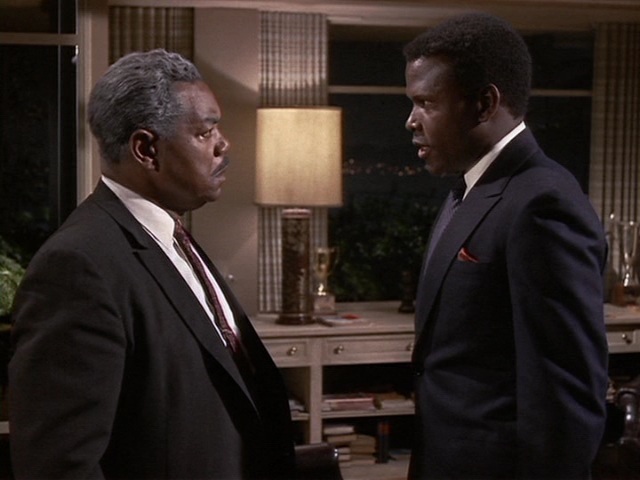
Syndey Poitier in Guess Who’s Coming to Dinner (1967)
I’ll be turning 40 this year, and I feel caught between these two forces — both despising and clinging to the ideas of the first generations of Neo-Pagans, while both fearing and thirsting for the ideas of the newest generation of Pagans. How to relate to these two generations is the question. I’m reminded of a scene from the 1967 film, Guess Who’s Coming to Dinner, starring Sidney Poitier, Katharine Hepburn, and Spencer Tracy. Poitier plays a young black doctor, John Prentice, whose white fiancee brings him home to meet her white parents. The meeting is later joined by the black parents of Poitier’s character, John. There is a scene where John’s father, a retired mailman, pulls him aside and tries to dissuade him from marrying a white girl. When John refuses to listen, his father appeals to his age and John’s obligations to his parents. While John’s response is unnecessarily disrespectful, I think, something he says about the obligations of one generation to the next has stuck with me.
Mr. Prentice: Son, you’ve got to listen to me. I’m not trying to tell you how to live your life, but you’ve never made a mistake like this before. … Y’know, for a man who all his life never put a wrong foot anywhere, you’re way out of line, boy!
John: That’s for me to decide, man. So just shut up and let me—
Mr. Prentice: You don’t say that to me! You haven’t got the right to ever say a thing like that to me. Not after what I’ve been to you! And you know that, and I know that. Yeah, I know what you are and what you’ve made of yourself. But I worked my ass off to get the money to buy you all the chances you had! You know how far I carried that bag in 30 years? 75,000 miles. And mowin’ lawns in the dark so you wouldn’t have to be stokin’ furnaces and could bear down on the books. I’ll tell you, there were things your mother should have had that she insisted go for you. And I don’t mean fancy things. I mean a decent coat. A lousy coat! And you’re gonna tell me that means nothin’ to you. And you could break your mother’s heart?
[…]
John: You’ve said what you had to say. You listen to me. You say you don’t want to tell me how to live my life? What do you think you’ve been doing? You tell me what rights I’ve got or haven’t got and what I owe to you for what you’ve done for me. Let me tell you something. I owe you nothing. If you carried that bag a million miles, you did what you were supposed to do. Because you brought me into this world and from that day you owed me everything you could ever do for me, like I will owe my son, if I ever have another. But you don’t own me. You can’t tell me when or where I’m out of line or try to get me to live my life according to your rules. You don’t even know what I am, Dad. You don’t know who l am, how I feel, what I think. And if I tried to explain it the rest of your life, you would never understand. You are years older than I am. You and your whole lousy generation believes the way it was for you is the way it’s got to be! And not until your whole generation has Iain down and died will the deadweight of you be off our backs! You understand? You’ve got to get off my back. Dad. You’re my father. I’m your son. I love you. I always have and I always will. But you think of yourself as a colored man. I think of myself as a man. …
This idea, that generational obligations flow downward, has stuck with me as I have had children and watched them grow into teenagers, watched them grow beyond the limited scope of my vision for them. I think it must be this way, each generation wearing itself out in service to the next, each new generation climbing over the last to reach new vistas. We fathers and mother, leaders and elders, have to do this, have to sacrifice ourselves, knowing that we likely will not see the gratitude or appreciation that we deserve. We have to do this knowing that our joy must be found in seeing the next generation thrive, even as we decline. Watching the ideas of the new generation surpass our comprehension, even as the institutions we cherished crumble. It must be this way, or else we as a people get stuck. This is perhaps the enduring legacy of the Enlightenment, which despite its limitations and failures, showed the human race the way out of the perpetual cycle of the slavish worship of tradition. And we Pagans are children of the Enlightenment, as surely as we are children of the Romantics.
I am a Neo-Pagan, which means that I honor and cherish the past. But it also means that I recognize that Change is the one ever-present reality. As surely as one season follows the next, as surely as the King of the Old Year is sacrificed at the height of his power by the Child of the New Year — sacrificed by his own son — just as surely, we must each, when our own time is come, bow our heads to the succeeding generation, in honor of that Life which encompasses all, even death.
So the next time some Pagan elder is demanding I defer to their judgment about my Paganism, I think I will just turn away, turn to someone younger than me, and ask myself what I have done to help the next generation of Pagans thrive.
Next Post

January 13, 2015 Non-Violent Writing: Selma and the "Pagan" question
Browse Our Archives
Select a Category Ritual Scripts Theology Uncategorized
Select a Month January 2017 December 2016 November 2016 October 2016 September 2016 August 2016 July 2016 June 2016 May 2016 April 2016 March 2016 February 2016 January 2016 December 2015 November 2015 October 2015 September 2015 August 2015 July 2015 June 2015 May 2015 April 2015 March 2015 February 2015 January 2015 December 2014 November 2014 October 2014 September 2014 August 2014 July 2014 June 2014 May 2014 April 2014 March 2014 February 2014 January 2014 December 2013 November 2013 October 2013 September 2013 August 2013 July 2013 June 2013 May 2013 April 2013 March 2013 February 2013 January 2013 December 2012 November 2012 October 2012 September 2012 August 2012 July 2012 June 2012 May 2012 April 2012 March 2012 February 2012 January 2012 December 2011 November 2011 October 2011 September 2011 August 2011
TAKE THE
Religious Wisdom Quiz
Who said: "Dear friends, do not be surprised at the fiery ordeal that has come on you to test you"?
Select your answer to see how you score.
Paul Peter John James
Related posts from The Allergic Pagan

A Guide to Politics at Patheos Pagan

Call to Chicago Area Pagans: Come to Hammond...


Size Doesn't Matter: 5 Pieces of Advice for...
TRENDING AT PATHEOS Pagan

I was recently chatting with someone on Instagram. She asked me what...

While there are many people who share their results, the end of...

On July 23, I saw Christopher Nolan's The Odyssey which is Homer’s...

As I write this two big events have just finished up. One...

Restoring the Watershed of Divine Love
Perhaps cooperation is not something we manufacture through legislation, ideology, or moral...

Many UUs don’t pray because of bad experiences in a previous religion,...
view all Pagan blogs
Ad-Free & Subscriber Log-In Subscription Support
- About Us
- 2026 Calendar
- Videos
- Podcasts
- Library of World Religions
- Faith In Media Tracker
- Advertise With Us
- Write for Us
- Privacy Policy
- Terms of Service
- Do Not Sell My Data
- Contact Us
- Radiant Digital
- Manage Newsletter Subscriptions
- Unsubscribe From Notifications
- Sitemap
Copyright 2008-2026, Patheos. All rights reserved.
Subscription Support Ad-Free & Subscriber Log-In
Follow Patheos