
BuddhistCatholicContemplativeEvangelicalGeneral ChristianHinduJewishLatter-day SaintMuslimNew VisionsProgressive Christian
Beliefs
- Buddhist
- Catholic
- Contemplative
- Evangelical
- General Christian
- Hindu
- Jewish
- Latter-day Saint
- More Voices
- Muslim
- New Visions
- Pagan
- Progressive Christian
Topics
- Religion News
- Food and Religion
- Sports and Religion
- Religious Art
- Religious Music and Entertainment
- Religious Events
- History and Religion
- Style and Religion
- Politics and Religion
- Women in Religion
- Recreation Outdoors and Religion
- Business Finance and Religion
- Careers Workplace and Religion
- Education and Religion
- Family Parenting and Religion
- Health Fitness and Religion
- Home and Religion
- Relationships and Religion
- Technology and Religion
- Travel and Religion
Columnists
- Buddhist Columnists
- Business Finance and Religion Columnists
- Careers Workplace and Religion Columnists
- Catholic Columnists
- Contemplative Columnists
- Education and Religion Columnists
- Evangelists Columnists
- Family Parenting and Religion Columnists
- General Christian Columnists
- Health Fitness and Religion Columnists
- Hindu Columnists
- History and Religion Columnists
- Home and Religion Columnists
- Jewish Columnists
- More Voices Columnists
- Latter Day Columnists
- Muslim Columnists
- New Visions Columnists
- Nonreligious Columnists
- Pagan Columnists
- Politics and Religion Columnists
- Progressive Columnists
- Recreation Outdoors and Religion Columnists
- Relationships and Religion Columnists
- Religion News Columnists
- Religious Art Columnists
- Religious Events Columnists
- Religious Music and Entertainment Columnists
- Sports and Religion Columnists
- Style and Religion Columnists
- Technology and Religion Columnists
- Travel and Religion Columnists
- Women in Religion Columnists
Resource Library
- 2026 Calendar
- Library of World Religions
- The 100 Most Holy Places on Earth
- Patheos Answers
- Podcasts
- Videos
- Faith Leaders Database
- Anglican Episcopalian
- Bahai
- Baptist
- Buddhism
- Christianity
- Confucianism
- Eastern Orthodoxy
- Hinduism
- Holiness and Pentecostal
- ISKCON
- Islam
- Judaism
- Lutheran
- Methodist
- The Church of Jesus Christ of Latter-day Saints
- New Age
- Paganism
- Presbytarian and Reformed
- Protestantism
- Religion Behind the Scenes
- Roman Catholic
- Scientology
- Shia Islam
- Sikhism
- Sufism
- Sunni Islam
- Taoism
- Zen
- See all religions
Research Tools
 Ad-Free & Subscriber Log-In Subscription Support
Follow Patheos 

- Trending:
- Advent
- |
- Forgiveness
- |
- Thanksgiving
- |
- Election
- |
- Seasonal Holidays
- |
- Marriage
 The Allergic Pagan
- Home
- Pagan
- What the heck is Jungian polytheism?
What the heck is Jungian polytheism?
Last updated on: January 31, 2014 at 9:03 am by John Halstead
What the heck is Jungian polytheism? 2014-01-31T09:03:02-05:00 John Halstead
Patheos Explore the world's faith through different perspectives on religion and spirituality! Patheos has the views of the prevalent religions and spiritualities of the world.
Conor O’Bryan Warren asked me during our Pagan Tea Time chat what “Jungian polytheism” is. I found myself stumbling over how to answer, primarily because Conor is a devotional polytheist, and I know how some polytheists feel about my Jung-talk. But Conor was genuinely wondering what the heck I was talking about. So I gave it a shot. Here’s what I said, less eloquently and more succinctly, to Conor.
First of all, as I explained in a previous post, I don’t really call myself a Jungian polytheist or any kind of polytheist, because “polytheism” (note the quotes) is just one element of my belief system, and not one that I would place right in the center. But let’s set that issue aside and explain what a “Jungian polytheism” looks like. I’ve written about this before on this blog at my Jungian Neo-Paganism blog, Dreaming the Myth Forward. I usually quote a lot of Carl Jung, because I love how he says things, and I try to make it sound erudite. But in this post, I want to try to explain it as simply as I can using my own words. As an experiment, I’m going to resist the urge to quote Jung or anyone else. (If you want to read some of what Jung said, you can check out my other blog, click on some of the links below, or just type “Jung” into the search engine to the right.)
For me, being Pagan means that I find the divine (1) in myself and (2) in the world around me. These are two aspects of my Paganism that I struggle to bring together: the Self-centric Paganism and the earth-centric Paganism. Anyway, “Jungian polytheism” is (mostly) part of the former, the part of my religion that locates the divine in myself.
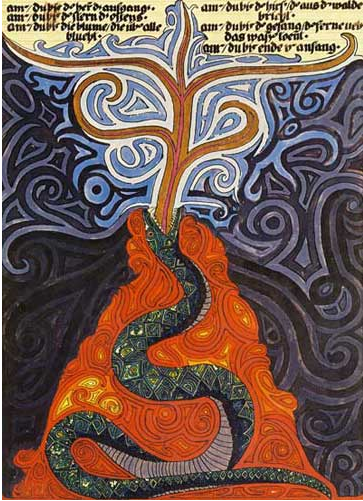 Now, when I say I locate the divine in myself, I don’t mean I am divinizing my conscious ego-self — that would be delusional. For me, what I am calling “myself” or “my Self” is much larger than my conscious mind — which is just the tip of the iceberg, so to speak. My “Self” includes an unconscious that is much “larger” than what I ordinarily think of as “me”. In fact, that larger Self may very well expand out into the world in some way, and that is where my Self-centric and earth-centric Paganism begin to overlap. (But that’s a discussion for another day.) This all comes from the psychologist, Carl Jung. So that’s where the Jungian part of “Jungian polytheism” comes from.
What’s important for this discussion is to understand that this unconscious Self is not unitary. It is made up of myriad partial personalities running around in the background of my conscious mind. These partial selves are not invented; they are discovered — through meditation, dreams, analysis of neurosis and so on. They often have certain resemblances or correspondences to the gods and heroes of myth. (I think there’s a reason for that, but again that’s a discussion for another day.) So that’s where the poly- part of the “Jungian polytheism” comes from: There are “many” of these partial selves.
If these partial selves are left to their own devices, they will drive us to ruin, because they are all battling for dominance. At any given moment, we can be kind of “possessed” by one of these mini-personalities that drive us or “ride” us. By making room in my conscious life for each of these selves, a sacred time and a sacred place to honor each of them in their own right, I bring order to the chaos that is my “self”. This can be done through therapy or many other ways. I do it through ritual. The goal of ritual, for me, is not mastery of these other selves, but wholeness. Through ritual, I seek to integrate these partial selves with my conscious self. Personal power (power-with, not power-over), I believe comes from bringing these disparate personal forces into some kind of harmony.
But why call them gods? That’s a question I really didn’t get to when talking to Conor. The reason I call them “gods” is because I can’t think of any other word that adequately describes the overwhelming influence that these powers have over our lives. In a very real sense, they are living us. They determine our fate, the way a literal god would. We might also call them demons (or, better, what the Greeks called daimones), but the goal to to sacralize them, not to demonize them — to honor them, and treat each of them as holy. (What are demons anyway, but the repressed gods of a conquered people?) And that’s the other reason why I call them “gods” — because I respond to them the way I would to a god, by honoring them in sacred ritual. And invoking these “gods” can have the same effect within me that many people experience by praying to traditional gods, such as emotional healing and personal transformation. Can they help me get a job or a lover? Of course they can: by helping me to change, so I can change my circumstances. So that’s where the –theism part of the “Jungian polytheism” comes from.
That’s about as non-jargony and succinct as I can do at this point. (I know, I have a way to go. Wow, I really wanted to include some quotes from Jung.)
It’s obvious this is a very different understanding of the gods than many devotional polytheists have. And I admit that when I talk to devotional polytheists, I am hearing them describe their relationships with the gods through my own paradigm. I don’t understand the metaphysical nature of the gods in the same way as Conor, for example. But I do respect and honor the relationship he has with his gods. I respect and honor the rituals he uses to create and maintain those relationships. And I respect and honor the good that those relationships bring into his life. And I have no problem calling his gods “gods”, because that’s what they are to me as well. The same goes for my Christian wife and her God. I honor her experience and I can use her language. Does it matter that we don’t mean exactly the same things by those words? It would sadden me if my wife, or Conor, or any other theist found me impious or disrespectful because the words we use mean something different to me. I think that while we are starting out in very different places, with different understandings about the nature of the gods, we do end up, if not in the exact same place, then at least in the same neighborhood — the place where we all honor the holiness of the encounter with the divine Other, however we conceive that.
In a future post, I hope to introduce you to my gods so you can see what I am talking about in practice.
Previous Post

January 27, 2014
Pagan Tea Time with Conor O'Bryan Warren
Next Post
January 30, 2014 Gods I have known, Part 1: Microcosm
Browse Our Archives
Select a Category Ritual Scripts Theology Uncategorized
Select a Month January 2017 December 2016 November 2016 October 2016 September 2016 August 2016 July 2016 June 2016 May 2016 April 2016 March 2016 February 2016 January 2016 December 2015 November 2015 October 2015 September 2015 August 2015 July 2015 June 2015 May 2015 April 2015 March 2015 February 2015 January 2015 December 2014 November 2014 October 2014 September 2014 August 2014 July 2014 June 2014 May 2014 April 2014 March 2014 February 2014 January 2014 December 2013 November 2013 October 2013 September 2013 August 2013 July 2013 June 2013 May 2013 April 2013 March 2013 February 2013 January 2013 December 2012 November 2012 October 2012 September 2012 August 2012 July 2012 June 2012 May 2012 April 2012 March 2012 February 2012 January 2012 December 2011 November 2011 October 2011 September 2011 August 2011
TAKE THE
Religious Wisdom Quiz
Which Psalm begins, "The Lord is my light and my salvation; whom shall I fear?"
Select your answer to see how you score.
Psalm 27 Psalm 14 Psalm 139 Psalm 91
Related posts from The Allergic Pagan
How "Gods Before Politics" Perpetuates Privilege

Fiddling With The Gods While Rome Burns

The gods are "like warm apple pie": The...
TRENDING AT PATHEOS Pagan

10 years of the Power Sigil & Moving...
Last week while reorganizing my studio space, I found the sketchbook that...

Here comes a rant (and TLDR: if you're a US citizen eligible...

Why are younger seekers drawn to Paganism and...
One of the things I've noticed the most is that I'm far...

When we talk about Greek religion, we often begin with the dodekatheion—the...

I was recently chatting with someone on Instagram. She asked me what...

On July 23, I saw Christopher Nolan's The Odyssey which is Homer’s...
view all Pagan blogs
Ad-Free & Subscriber Log-In Subscription Support
- About Us
- 2026 Calendar
- Videos
- Podcasts
- Library of World Religions
- Faith In Media Tracker
- Advertise With Us
- Write for Us
- Privacy Policy
- Terms of Service
- Do Not Sell My Data
- Contact Us
- Radiant Digital
- Manage Newsletter Subscriptions
- Unsubscribe From Notifications
- Sitemap
Copyright 2008-2026, Patheos. All rights reserved.
Subscription Support Ad-Free & Subscriber Log-In
Follow Patheos