
BuddhistCatholicContemplativeEvangelicalGeneral ChristianHinduJewishLatter-day SaintMuslimNew VisionsProgressive Christian
Beliefs
- Buddhist
- Catholic
- Contemplative
- Evangelical
- General Christian
- Hindu
- Jewish
- Latter-day Saint
- More Voices
- Muslim
- New Visions
- Pagan
- Progressive Christian
Topics
- Religion News
- Food and Religion
- Sports and Religion
- Religious Art
- Religious Music and Entertainment
- Religious Events
- History and Religion
- Style and Religion
- Politics and Religion
- Women in Religion
- Recreation Outdoors and Religion
- Business Finance and Religion
- Careers Workplace and Religion
- Education and Religion
- Family Parenting and Religion
- Health Fitness and Religion
- Home and Religion
- Relationships and Religion
- Technology and Religion
- Travel and Religion
Columnists
- Buddhist Columnists
- Business Finance and Religion Columnists
- Careers Workplace and Religion Columnists
- Catholic Columnists
- Contemplative Columnists
- Education and Religion Columnists
- Evangelists Columnists
- Family Parenting and Religion Columnists
- General Christian Columnists
- Health Fitness and Religion Columnists
- Hindu Columnists
- History and Religion Columnists
- Home and Religion Columnists
- Jewish Columnists
- More Voices Columnists
- Latter Day Columnists
- Muslim Columnists
- New Visions Columnists
- Nonreligious Columnists
- Pagan Columnists
- Politics and Religion Columnists
- Progressive Columnists
- Recreation Outdoors and Religion Columnists
- Relationships and Religion Columnists
- Religion News Columnists
- Religious Art Columnists
- Religious Events Columnists
- Religious Music and Entertainment Columnists
- Sports and Religion Columnists
- Style and Religion Columnists
- Technology and Religion Columnists
- Travel and Religion Columnists
- Women in Religion Columnists
Resource Library
- 2026 Calendar
- Library of World Religions
- The 100 Most Holy Places on Earth
- Patheos Answers
- Podcasts
- Videos
- Faith Leaders Database
- Anglican Episcopalian
- Bahai
- Baptist
- Buddhism
- Christianity
- Confucianism
- Eastern Orthodoxy
- Hinduism
- Holiness and Pentecostal
- ISKCON
- Islam
- Judaism
- Lutheran
- Methodist
- The Church of Jesus Christ of Latter-day Saints
- New Age
- Paganism
- Presbytarian and Reformed
- Protestantism
- Religion Behind the Scenes
- Roman Catholic
- Scientology
- Shia Islam
- Sikhism
- Sufism
- Sunni Islam
- Taoism
- Zen
- See all religions
Research Tools
 Ad-Free & Subscriber Log-In Subscription Support
Follow Patheos 

- Trending:
- Advent
- |
- Forgiveness
- |
- Thanksgiving
- |
- Election
- |
- Seasonal Holidays
- |
- Marriage
 The Allergic Pagan
- Home
- Pagan
- My Goddess is gross
My Goddess is gross
Last updated on: December 3, 2013 at 8:29 pm by John Halstead
My Goddess is gross 2013-12-03T20:29:05-05:00 John Halstead
Patheos Explore the world's faith through different perspectives on religion and spirituality! Patheos has the views of the prevalent religions and spiritualities of the world.
We spent this past week in Florida with family. We went to the beach, which I always love. My wife and kids always pull the most interesting things out of the ocean. But this trip was a little unusual in that everything they pulled out was … disgusting. It looked like a collection of props from the movie Aliens, all tentacles and slime. I wish I knew more about aquatic flora and fauna, because words fail to describe some of the things they discovered, both living and dead. A spiney purple sea urchin, its three horned beak still opening and closing slowly. Some kind of grey slimy tubular thing, plant or animal I could not say. A small, overturned insect-like crab, its legs still stretching in the air. A blood-red sea weed that reminded me of something from Speilberg’s remake of War of the Worlds. (We returned everything we found to the ocean.)

Behold, this is your Goddess!
My wife pulled this (still living) giant clam out of the water. It was covered in a profusion of the remnants of various life forms. It was both repulsive and beautiful.
“That’s disgusting,” I told her.
My wife held it up to me and said, “This is your Goddess.”
“It’s the slimy side of her,” I responded, making a moue.
I was thinking of what Camile Paglia wrote in Sexual Personae about the way we deceive ourselves about nature’s beauty:
“We say that nature is beautiful. But this aesthetic judgment, which not all peoples have shared, is another defense formation, woefully inadequate for encompassing nature’s totality. What is pretty in nature is confined to the thin skin of the globe on which we huddle. Scratch that sin, and nature’s daemonic ugliness will erupt.
“Our focus on the pretty is an Apollonian strategy. The leaves and flowers, the birds, the hills are a patchwork pattern by which we map the known. What the West represses in its view of nature is the chthonian, which means ‘of the earth’–but earth’s bowels, not its surface. […] The Dionysian is no picnic. It is the chthonian realities which Apollo evades, the blind grinding of subterranean force, the long slow suck, the muck and ooze. It is the dehumanizing brutality of biology and geology, the Darwinian waste and bloodshed, the squalor and rot we must block from our consciousness to retain our Apollonion integrity as persons.”
“This is your Goddess,” my wife said to me smiling.
“It’s the slimy side of her,” I responded.
“This is life,” she replied.
It’s strange when a seemingly mundane moment is transformed into a sacred one. I looked at my Mormon wife standing in the ocean, holding a shell, and I heard her speak the words of a true priestess: “This is your Goddess. This is life.”
I looked out at the ocean, and for the first time it really hit me how much life there is there. While we crawl along the surface of the dry earth, imagining ourselves kings of the planet, the real action is going on under the surface. I imagined if aliens came to our planet, seeing it for the first time, they would likely consider the ocean, not the land, the locus of life, and we humans and all our mighty creations would seem to be a virulent strain of skin cancer in relation to the rest of the life on the planet.
To give you an idea, there are over 57 million square miles of land on earth, which is less than a third of the surface area of the earth. Every schoolchild knows that water covers two-thirds of the earth’s surface. But that’s just the surface. The volume of the ocean is over 300 million cubic miles. Imagine how much life we can pack into a square mile, and that’s mostly two dimensional. (Skyscrapers do give us some vertical space, but the tallest skyscrapers are only about a half mile and they are very rare.) The ocean fills 6 times that in every direction. And even a drop of ocean water is teeming with life. By some estimates there are a million marine species. The idea is enough to make one feel what Teilhard de Chardin called “the distress which makes human wills founder daily under the crushing number of living things and stars.”

A drop of water under a microscope
Looking at all the slimy things my wife and kids pulled from the sea that day, I realized what an illusion my nice, neat world is. And that includes my neat and pretty spirituality. There is a tendency in Pagan discourse (my own included) to associate the one face of the Goddess with everything pleasant — light, beauty, and life — while everything unpleasant — darkness, ugliness, and death — is the other face. But standing there on the beach, I realized that life and (what I call) ugliness are really the same face.
Camile Paglia writes that repugnance is the “Apollonian” response to the “Dionysian” “grossness of procreative nature.” We recoil from the “chthonian matrix from which we arose. We have an evolutionary revulsion from slime, our site of biologic origins.” She goes on to explain this response in Nietzschean terms:
“Reason and logic are the anxiety-inspired domain of Apollo, premiere god of the sky-cult. The Apollonian is harsh and phobic, coldly cutting itself off from nature by its superhuman purity. […W]estern personality and western achievements are, for better or worse, largely Apollonian. Apollo’s great opponent Dionysus is the ruler of the chthonian whose law is procreative femaleness. As we shall see, the Dionysian is liquid nature, a miasmic swamp whose prototype is the still pond of the womb. […]
“Dionysus was identified with liquids–blood, sap, milk, wine. The Dionysian is nature’s chthonian fluidity. Apollo, on the other hand, gives form and shape, marking of one being from another.”
When Paglia writes about the Dionysian, she is describing the realm of the Goddess. As Edward Whitmont explains in Return of the Goddess, “The disregard of Dionysus is associated also with a disregard and repression of femininity in its archetypal dimension” because Dionysus “is the male expression of visible manifest life which arises from and again returns to its maternal origin.”
The grossness and the vitality of the Goddess are one and the same. This is my Goddess: fecund and fluid, oozing blood, sap, milk … and sea water. All the pretty pictures of goddesses from Bottcelli’s Birth of Venus to the kitchy depictions of goddesses on the internet … these are Apollonian evasions. My Goddess, if she took human form, would be more like a feminine version of one of the tentacled and barnacle-covered pirates from the Flying Dutchman in the Pirates of the Caribbean sequel — perhaps a cross between the repulsive captain Davy Jones and the beautiful sea-witch Calypso. This is my Goddess! Behold her grossness! She is life.
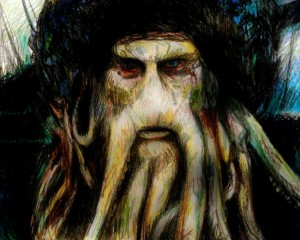
Davy Jones

Calypso
Previous Post

November 22, 2013
Our happily remarried ex's: Teo Bishop and Pagan spite
Next Post
December 5, 2013 Where the sidewalk ends: Suburban enchantment
Browse Our Archives
Select a Category Ritual Scripts Theology Uncategorized
Select a Month January 2017 December 2016 November 2016 October 2016 September 2016 August 2016 July 2016 June 2016 May 2016 April 2016 March 2016 February 2016 January 2016 December 2015 November 2015 October 2015 September 2015 August 2015 July 2015 June 2015 May 2015 April 2015 March 2015 February 2015 January 2015 December 2014 November 2014 October 2014 September 2014 August 2014 July 2014 June 2014 May 2014 April 2014 March 2014 February 2014 January 2014 December 2013 November 2013 October 2013 September 2013 August 2013 July 2013 June 2013 May 2013 April 2013 March 2013 February 2013 January 2013 December 2012 November 2012 October 2012 September 2012 August 2012 July 2012 June 2012 May 2012 April 2012 March 2012 February 2012 January 2012 December 2011 November 2011 October 2011 September 2011 August 2011
TAKE THE
Religious Wisdom Quiz
Who said, "Before I formed you in the womb I knew you"?
Select your answer to see how you score.
God Paul David Isaiah
Related posts from The Allergic Pagan

Why We Need A God/dess Who Does Not...

Is There a Place for God in Paganism?

12 Reasons You Can't (only) Call God "Father"
TRENDING AT PATHEOS Pagan

To help with the upcoming holiday season, I'm introducing the Holiday Helper...

10 years of the Power Sigil & Moving...
Last week while reorganizing my studio space, I found the sketchbook that...

Why are younger seekers drawn to Paganism and...
One of the things I've noticed the most is that I'm far...

When we talk about Greek religion, we often begin with the dodekatheion—the...

I was recently chatting with someone on Instagram. She asked me what...

On July 23, I saw Christopher Nolan's The Odyssey which is Homer’s...
view all Pagan blogs
Ad-Free & Subscriber Log-In Subscription Support
- About Us
- 2026 Calendar
- Videos
- Podcasts
- Library of World Religions
- Faith In Media Tracker
- Advertise With Us
- Write for Us
- Privacy Policy
- Terms of Service
- Do Not Sell My Data
- Contact Us
- Radiant Digital
- Manage Newsletter Subscriptions
- Unsubscribe From Notifications
- Sitemap
Copyright 2008-2026, Patheos, part of the Radiant Digital network of media brands. All rights reserved.
Subscription Support Ad-Free & Subscriber Log-In
Follow Patheos