
BuddhistCatholicContemplativeEvangelicalGeneral ChristianHinduJewishLatter-day SaintMuslimNew VisionsProgressive Christian
Beliefs
- Buddhist
- Catholic
- Contemplative
- Evangelical
- General Christian
- Hindu
- Jewish
- Latter-day Saint
- More Voices
- Muslim
- New Visions
- Pagan
- Progressive Christian
Topics
- Religion News
- Food and Religion
- Sports and Religion
- Religious Art
- Religious Music and Entertainment
- Religious Events
- History and Religion
- Style and Religion
- Politics and Religion
- Women in Religion
- Recreation Outdoors and Religion
- Business Finance and Religion
- Careers Workplace and Religion
- Education and Religion
- Family Parenting and Religion
- Health Fitness and Religion
- Home and Religion
- Relationships and Religion
- Technology and Religion
- Travel and Religion
Columnists
- Buddhist Columnists
- Business Finance and Religion Columnists
- Careers Workplace and Religion Columnists
- Catholic Columnists
- Contemplative Columnists
- Education and Religion Columnists
- Evangelists Columnists
- Family Parenting and Religion Columnists
- General Christian Columnists
- Health Fitness and Religion Columnists
- Hindu Columnists
- History and Religion Columnists
- Home and Religion Columnists
- Jewish Columnists
- More Voices Columnists
- Latter Day Columnists
- Muslim Columnists
- New Visions Columnists
- Nonreligious Columnists
- Pagan Columnists
- Politics and Religion Columnists
- Progressive Columnists
- Recreation Outdoors and Religion Columnists
- Relationships and Religion Columnists
- Religion News Columnists
- Religious Art Columnists
- Religious Events Columnists
- Religious Music and Entertainment Columnists
- Sports and Religion Columnists
- Style and Religion Columnists
- Technology and Religion Columnists
- Travel and Religion Columnists
- Women in Religion Columnists
Resource Library
- 2026 Calendar
- Library of World Religions
- The 100 Most Holy Places on Earth
- Patheos Answers
- Podcasts
- Videos
- Faith Leaders Database
- Anglican Episcopalian
- Bahai
- Baptist
- Buddhism
- Christianity
- Confucianism
- Eastern Orthodoxy
- Hinduism
- Holiness and Pentecostal
- ISKCON
- Islam
- Judaism
- Lutheran
- Methodist
- The Church of Jesus Christ of Latter-day Saints
- New Age
- Paganism
- Presbytarian and Reformed
- Protestantism
- Religion Behind the Scenes
- Roman Catholic
- Scientology
- Shia Islam
- Sikhism
- Sufism
- Sunni Islam
- Taoism
- Zen
- See all religions
Research Tools
 Ad-Free & Subscriber Log-In Subscription Support
Follow Patheos 

- Trending:
- Advent
- |
- Forgiveness
- |
- Thanksgiving
- |
- Election
- |
- Seasonal Holidays
- |
- Marriage
 The Allergic Pagan
- Home
- Pagan
- What in Sam Hain?
What in Sam Hain?
Last updated on: October 21, 2013 at 10:08 am by John Halstead
What in Sam Hain? 2013-10-21T10:08:48-05:00 John Halstead
Patheos Explore the world's faith through different perspectives on religion and spirituality! Patheos has the views of the prevalent religions and spiritualities of the world.
Let me begin by saying, I love Halloween. I’ve always loved Halloween. For one thing, it is the only time of the year a straight guy can be flamboyant without apology in this homophobic American culture. I come by my love for Halloween naturally. It’s my mother’s favorite holiday. She used to make our costumes herself — and not just one but usually three, for each of us — one for school, one for church, and one for trick-or-treating. And we almost always won the costume contests. I love the costumes, the trick-or-treating, the whole scary-but-fun atmosphere.
So when I became Pagan, I was ready to embrace Halloween as a Pagan holy day. I was very disappointed to learn that most Neo-Wiccans/Neo-Pagans celebrate Samhain a kind of Pagan Day of the Dead or All Souls Day, with little to no connection to the secular celebration of Halloween. This explains the befuddled look I got from the Neo-Wiccan leader of my local CUUPS group years ago, when I, new to the group, asked her if we should wear costumes to the Samhain celebration.
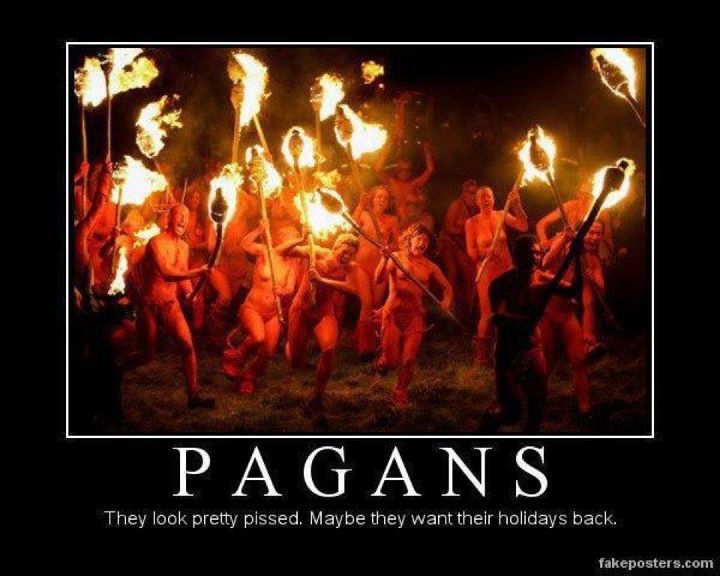
First of all, there is only one major American holiday that corresponds directly with a Neo-Pagan holiday, and it’s Halloween. Christmas/Yule is a close second, with the moveable Easter feast coming in third, since it sometimes falls on or near the spring equinox. (Memorial Day and Labor Day are loosely related to Beltane and Mabon in that they mark the beginning and end of the American cultural summer.) But Halloween is ready-made for Pagan appropriation. Sure, it’s completely secularized (just like much of Christmas is). Jason Mankey has given a great history of the secular origins of Halloween here. But despite its modern and secular origins, Halloween just begs to be Pagan. I actually think those Christians who freak out about the (small-p) pagan-ness of Halloween are on to something. I mean, lots of us Pagans are real witches for gods’ sake!
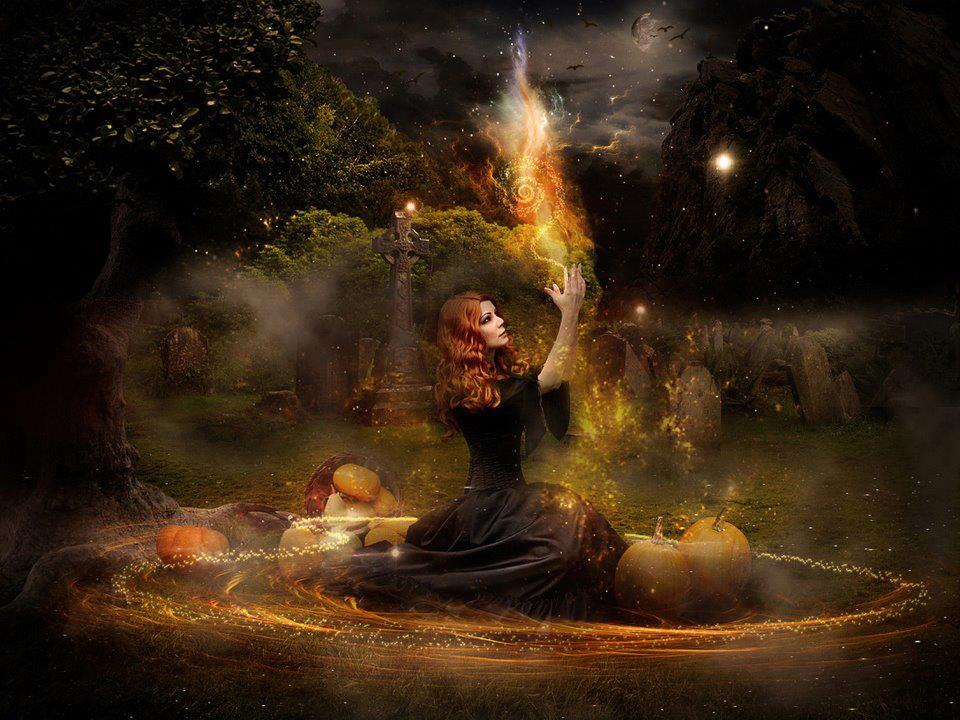
Halloween was made for us! For one thing, it’s the only time of the year when we can do weird things around a bonfire at night in our backyard and not draw too much attention to ourselves. And while its origins are not ancient, it is a great example of what Jason Mankey calls “Rustic Paganism”. Like Morris Dancing, it isn’t an ancient pagan practice, but it’s a practice that feels pagan.
I undertand that many Neo-Pagans associate the day with their ancestors because the Celts supposedly believed that the “veil between the worlds” is thinnest on this day. And I respect that. But for me, nothing about Halloween makes me think of my great-grand parents. And then there is the high-spirited nature of Halloween. While I suppose a Day of the Dead could be a festive day, like it is in Mexico, visiting graves on Memorial Day is always a somber event for me. And it’s just hard to maintain the an attitude appropriate for one’s ancestors when everyone else around you is having an American Mardi Gras.
Rather than the ancestors, Halloween and this time of the year in general call to my mind another Pagan motif entirely: the Wild Hunt. For me, Halloween marks the time on the Wheel of the Year when the Dark God is crowned as the Holly King and leads the Wild Hunt as it emerges from Underworld to roam the winter countryside, with the Dark Queen riding beside him in her devouring aspect as the Huntress. I explain the connection to my kids this way:
“The legend of the Wild Hunt is behind many of the traditions of Halloween. According to legend, people wear masks to scare the ghosts and goblins that come out of the underworld at this time of the year. Because, if the Wild Hunt catches a person walking alone at night during this time of the year, it will carry them off to the underworld and they will become a part of the Wild Hunt themselves. But if you are wearing a scary mask, the Wild Hunt will think you are one of them, and will pass you by.”
Of course, this is not the true history behind the tradition of trick-or-treating, but it fits nicely, at least to my mind.
I like Halloween as a holy day so much that I break my general rule about celebrating the cross-quarters on their actual celestial date, which fall about from about a couple of days to a week after their traditional dates. The autumn cross-quarter this year falls on November 7.
I even like the name “Hallow’een” or “All Hallow’s Eve”. Hallows means “holy”, so All Hallows means “All Holy”, and to me that fits with the meaning of the day as a time for remembering the dark gods, because to Pagans they are holy too. The name “Hallow’een” says to me, “It’s all ‘hallow’ or sacred, even the dark and the frightening.”
I know lots of Pagans are attached by now to the name Samhain (pron. sah-win). In general, I dislike naming our holidays unphonetically, but at least there is some pagan precedent for the name, unlike Mabon. (The name originates in the Tochmarc Emire, and its use is consistent with the choice of other Irish names for the cross-quarter days.) It does bug me though when some people call it the Pagan New Year. For one thing, Pagans don’t treat it like the New Year, in spite of calling it that. For another, I have my doubts about whether it really was the Celtic New Year. According to Ronald Hutton, it is true that Samhain was the most important of the four Celtic festivals, but this does not necessarily mean it was considered the New Year’s Day. The Ulster tale of Echtra Nerai or Tain Bo Aingen, the “Adventures of Nera or the Cattle Raid of Angen”, refers to Samhain as “the end of the year”. It is possible, however, that it was meant that Samhain was the “[beginning of the] end of the year”, i.e., winter, without also representing the beginning of the new year, i.e., spring. Generally, it was much more common for ancient pagan peoples throughout the world to observe the New Year on or around the winter solstice or the spring equinox. Yule makes much more sense as the Pagan New Year to me.
I do think it is very important to have a Pagan holy day honoring our ancestors though; I just think it should be separate. For that reason, it makes sense to me to do something like the Catholic All Hallows Tridium and celebrate All Hallows on October 31st and then do a Pagan “All Souls” Day later, like on November 2. We could call it Pagan Remembrance Day or Ancestor Day or something like that. I’m sure this would bug some formerly-Catholic Pagans, but I love (re-)Paganizing Christian motifs, so it doesn’t both me.
Tell me what you think. Is Halloween a holy day for you? Do you experience any dissonance with honoring the ancestors while others are trick-or-treating?
Previous Post

October 11, 2013
Prayers I Can Pray
Next Post
October 25, 2013 The Power of Simple Gestures
Browse Our Archives
Select a Category Ritual Scripts Theology Uncategorized
Select a Month January 2017 December 2016 November 2016 October 2016 September 2016 August 2016 July 2016 June 2016 May 2016 April 2016 March 2016 February 2016 January 2016 December 2015 November 2015 October 2015 September 2015 August 2015 July 2015 June 2015 May 2015 April 2015 March 2015 February 2015 January 2015 December 2014 November 2014 October 2014 September 2014 August 2014 July 2014 June 2014 May 2014 April 2014 March 2014 February 2014 January 2014 December 2013 November 2013 October 2013 September 2013 August 2013 July 2013 June 2013 May 2013 April 2013 March 2013 February 2013 January 2013 December 2012 November 2012 October 2012 September 2012 August 2012 July 2012 June 2012 May 2012 April 2012 March 2012 February 2012 January 2012 December 2011 November 2011 October 2011 September 2011 August 2011
TAKE THE
Religious Wisdom Quiz
Who asked Jesus, "What is truth?"
Select your answer to see how you score.
Caiaphas Pilate Peter Judas
Related posts from The Allergic Pagan
Why This Pagan Won't Be Honoring His Ancestors...
All Hallows: candy and pomegranates, gravestones and red...
TRENDING AT PATHEOS Pagan

10 years of the Power Sigil & Moving...
Last week while reorganizing my studio space, I found the sketchbook that...
Here comes a rant (and TLDR: if you're a US citizen eligible...

Why are younger seekers drawn to Paganism and...
One of the things I've noticed the most is that I'm far...

When we talk about Greek religion, we often begin with the dodekatheion—the...

I was recently chatting with someone on Instagram. She asked me what...

On July 23, I saw Christopher Nolan's The Odyssey which is Homer’s...
view all Pagan blogs
Ad-Free & Subscriber Log-In Subscription Support
- About Us
- 2026 Calendar
- Videos
- Podcasts
- Library of World Religions
- Faith In Media Tracker
- Advertise With Us
- Write for Us
- Privacy Policy
- Terms of Service
- Do Not Sell My Data
- Contact Us
- Radiant Digital
- Manage Newsletter Subscriptions
- Unsubscribe From Notifications
- Sitemap
Copyright 2008-2026, Patheos. All rights reserved.
Subscription Support Ad-Free & Subscriber Log-In
Follow Patheos