
BuddhistCatholicContemplativeEvangelicalGeneral ChristianHinduJewishLatter-day SaintMuslimNew VisionsProgressive Christian
Beliefs
- Buddhist
- Catholic
- Contemplative
- Evangelical
- General Christian
- Hindu
- Jewish
- Latter-day Saint
- More Voices
- Muslim
- New Visions
- Pagan
- Progressive Christian
Topics
- Religion News
- Food and Religion
- Sports and Religion
- Religious Art
- Religious Music and Entertainment
- Religious Events
- History and Religion
- Style and Religion
- Politics and Religion
- Women in Religion
- Recreation Outdoors and Religion
- Business Finance and Religion
- Careers Workplace and Religion
- Education and Religion
- Family Parenting and Religion
- Health Fitness and Religion
- Home and Religion
- Relationships and Religion
- Technology and Religion
- Travel and Religion
Columnists
- Buddhist Columnists
- Business Finance and Religion Columnists
- Careers Workplace and Religion Columnists
- Catholic Columnists
- Contemplative Columnists
- Education and Religion Columnists
- Evangelists Columnists
- Family Parenting and Religion Columnists
- General Christian Columnists
- Health Fitness and Religion Columnists
- Hindu Columnists
- History and Religion Columnists
- Home and Religion Columnists
- Jewish Columnists
- More Voices Columnists
- Latter Day Columnists
- Muslim Columnists
- New Visions Columnists
- Nonreligious Columnists
- Pagan Columnists
- Politics and Religion Columnists
- Progressive Columnists
- Recreation Outdoors and Religion Columnists
- Relationships and Religion Columnists
- Religion News Columnists
- Religious Art Columnists
- Religious Events Columnists
- Religious Music and Entertainment Columnists
- Sports and Religion Columnists
- Style and Religion Columnists
- Technology and Religion Columnists
- Travel and Religion Columnists
- Women in Religion Columnists
Resource Library
- 2026 Calendar
- Library of World Religions
- The 100 Most Holy Places on Earth
- Patheos Answers
- Podcasts
- Videos
- Faith Leaders Database
- Anglican Episcopalian
- Bahai
- Baptist
- Buddhism
- Christianity
- Confucianism
- Eastern Orthodoxy
- Hinduism
- Holiness and Pentecostal
- ISKCON
- Islam
- Judaism
- Lutheran
- Methodist
- The Church of Jesus Christ of Latter-day Saints
- New Age
- Paganism
- Presbytarian and Reformed
- Protestantism
- Religion Behind the Scenes
- Roman Catholic
- Scientology
- Shia Islam
- Sikhism
- Sufism
- Sunni Islam
- Taoism
- Zen
- See all religions
Research Tools
 Ad-Free & Subscriber Log-In Subscription Support
Ad-Free & Subscriber Log-In Subscription Support
Follow Patheos 

- Trending:
- Forgiveness
- |
- Marriage
- |
- Consciousness
- |
- Death Penalty
- |
- Election
- |
- Halloween
 The Allergic Pagan
- Home
- Pagan
- Mabon, Mabon-Not
Mabon, Mabon-Not
Last updated on: September 20, 2013 at 12:00 pm by John Halstead
Mabon, Mabon-Not 2013-09-18T19:52:06-05:00 John Halstead
Patheos Explore the world's faith through different perspectives on religion and spirituality! Patheos has the views of the prevalent religions and spiritualities of the world.
This is Part 2 of my continuing rant about the Pagan holy days. The only real issue I have with Mabon is the name. Aside from the fact that no one seems certain how to pronounce it, the name itself is a poor choice. As with “Lughnasadh”, which I wrote about last time, “Mabon” is only tenuously related to the season or the Neopagan mythos relating to the season. I would say, of all eight holidays, Mabon has the worst name of all of them.
The name originates with a Pagan-Craft Calendar which was published in 1970 by Aidan Kelly. The name was picked up by the Green Egg newsletter and, consequently, became standard. I have always found it curious that Kelly’s own tradition, NROOGD, did not adopt this name and instead called the fall equinox the “Rites of Eleusis”. Kelly (who also blogs here at Patheos) has earned his place as an elder in the Pagan community, so I mean no disrespect to him. Nor do I mean in any way to diminish the significance of his contribution to the development of Neopaganism. However, Kelly himself was never one to favor adherence to tradition over religious innovation. So I think we honor him by questioning this choice of name for the fall equinox.
“Mabon” is a poor choice for a number of reasons. First, it is a Welsh name, in contrast to the other equinox and the two solstices, which have Anglo-Saxon names. Part of the challenge in naming the equinoxes is that there is little to no evidence that the Anglo-Saxons (or the Welsh for that matter) celebrated the equinoxes. Second, the story of abduction of Mabon in the Mabinogion is a relatively obscure tale, not at all central to the Neopagan mythos (compare the Descent of Ishtar or the myth of Demeter and Persephone for example), and only tangentially related to the Neopagan celebration it so names. The autumn equinox has no real historical connection to the mythical Welsh figure, Mabon, son of Modron. Some Neopagans have suggested that the name is appropriate due to the grieving of Modron for her lost son. But there are many more myths involving grief and lamentation which would be more familiar to Neopagans: Demeter, Isis, and Ishtar are examples of deities who are associated with lamentation motifs.

In my previous discussion on Lughnasadh, I suggested 3 steps for choosing an appropriate name for a Neopagan celebration: (1) Look to the season; (2) Work out what the day means mythologically in relation to the season; and (3) Choose a name for the day that fits the season and the myth.
Let’s start with the season: It’s the equinox, so (in the northern hemisphere) the days will just start becoming shorter than the days. It’s the official beginning of fall in the U.S. Actual harvesting is going on, unlike 6 1/2 weeks earlier during Lughnasadh, the so-called “first harvest”. All those harvest associations we drew on precipitously in August now make sense. Here in the Midwest, we’re just starting to notice cooler weather. Canadian geese will be flying south soon, and the first dabs of color will soon appear on the leaves of the trees.
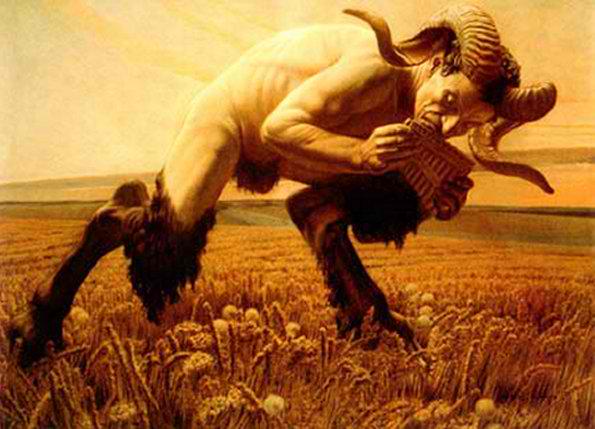
“The Faun” by Carlos Schwabe
Mythologically, the Sun King/Oak King is dismembered, eaten, and/or interred, following his sacrifice at First Fruits/Mid-Summer 6 1/2 weeks ago. The Goddess laments the loss of her Consort and descends to the Underworld in search of him. The death, eating, and lamentation motifs correspond to the harvest time as well as the triumph of darkness over light manifest in the equinox.
So, we need to find a name that corresponds to the season, the myth, or ideally both. If we’re going to use a Welsh name, then “Llew” would be a better choice than “Mabon”. According to Mike Nichols, the autumn equinox is the day when, in the Mabonogion, the character of Goronwy, symbolizing the darkness, defeats the hero Llew, symbolizing the light, signaling the beginning of winter and the shortening of days. Nichols’ essay, “The Death of Llew: A Seasonal Interpretation”, is great and, if you haven’t read you should check it out. The only problem with “Llew” as a name for the season is that the myth is just as obscure as “Mabon”. If we are going to pick a dying god to name the day after, Osiris would be a choice that would be more familiar to Neopagans. Even Baal, Adonis, and Tammuz would all probably be more familiar to Neopagans than Llew or Mabon.
Or we could go with an Anglo-Saxon name, which would be consistent with the use of other Anglo-Saxon names for the other Quarter Days. In that case, an appropriate name for the day might be “Herfest”, which is the Anglo-Saxon name for “autumn” and a cognate with “harvest”. I’ve seen some Pagans using this name already. If we’re going with Harvest themes, another good name is “Ingathering” or “Cornucopia”, both of which I have seen used by Pagans. Probably the most popular alternative for “Mabon” I have seen is “Harvest Home”. I like it best. The name has nice alliteration. Both “harvest” and “home-coming” are appropriate for the season. And it is an appropriate appellation for the Neopagan version of Thanksgiving.
So, my vote is for “Herfest” or “Harvest Home”. What do you think? What names do you like?
Previous Post

September 1, 2013
A Neopagan Celebrity Tarot (Part 2)
Browse Our Archives
Select a Category Ritual Scripts Theology Uncategorized
Select a Month January 2017 December 2016 November 2016 October 2016 September 2016 August 2016 July 2016 June 2016 May 2016 April 2016 March 2016 February 2016 January 2016 December 2015 November 2015 October 2015 September 2015 August 2015 July 2015 June 2015 May 2015 April 2015 March 2015 February 2015 January 2015 December 2014 November 2014 October 2014 September 2014 August 2014 July 2014 June 2014 May 2014 April 2014 March 2014 February 2014 January 2014 December 2013 November 2013 October 2013 September 2013 August 2013 July 2013 June 2013 May 2013 April 2013 March 2013 February 2013 January 2013 December 2012 November 2012 October 2012 September 2012 August 2012 July 2012 June 2012 May 2012 April 2012 March 2012 February 2012 January 2012 December 2011 November 2011 October 2011 September 2011 August 2011
TAKE THE
Religious Wisdom Quiz
In Jude, what did the Lord do to the people he saved from Egypt who did not believe?
Select your answer to see how you score.
Destroyed them Let them wander forty years Cast them into the wilderness Punished them
Related posts from The Allergic Pagan

Gods Save Us from Bad Pagan Rituals: 10...


The Neo-Pagan Mysteries, Part 5: The Dying God
TRENDING AT PATHEOS Pagan

I was recently chatting with someone on Instagram. She asked me what...

While there are many people who share their results, the end of...

On July 23, I saw Christopher Nolan's The Odyssey which is Homer’s...

As I write this two big events have just finished up. One...

Restoring the Watershed of Divine Love
Perhaps cooperation is not something we manufacture through legislation, ideology, or moral...

Many UUs don’t pray because of bad experiences in a previous religion,...
view all Pagan blogs
Ad-Free & Subscriber Log-In Subscription Support
- About Us
- 2026 Calendar
- Videos
- Podcasts
- Library of World Religions
- Faith In Media Tracker
- Advertise With Us
- Write for Us
- Privacy Policy
- Terms of Service
- Do Not Sell My Data
- Contact Us
- Radiant Digital
- Manage Newsletter Subscriptions
- Unsubscribe From Notifications
- Sitemap
Copyright 2008-2026, Patheos. All rights reserved.
Subscription Support Ad-Free & Subscriber Log-In
Follow Patheos