
BuddhistCatholicContemplativeEvangelicalGeneral ChristianHinduJewishLatter-day SaintMuslimNew VisionsProgressive Christian
Beliefs
- Buddhist
- Catholic
- Contemplative
- Evangelical
- General Christian
- Hindu
- Jewish
- Latter-day Saint
- More Voices
- Muslim
- New Visions
- Pagan
- Progressive Christian
Topics
- Religion News
- Food and Religion
- Sports and Religion
- Religious Art
- Religious Music and Entertainment
- Religious Events
- History and Religion
- Style and Religion
- Politics and Religion
- Women in Religion
- Recreation Outdoors and Religion
- Business Finance and Religion
- Careers Workplace and Religion
- Education and Religion
- Family Parenting and Religion
- Health Fitness and Religion
- Home and Religion
- Relationships and Religion
- Technology and Religion
- Travel and Religion
Columnists
- Buddhist Columnists
- Business Finance and Religion Columnists
- Careers Workplace and Religion Columnists
- Catholic Columnists
- Contemplative Columnists
- Education and Religion Columnists
- Evangelists Columnists
- Family Parenting and Religion Columnists
- General Christian Columnists
- Health Fitness and Religion Columnists
- Hindu Columnists
- History and Religion Columnists
- Home and Religion Columnists
- Jewish Columnists
- More Voices Columnists
- Latter Day Columnists
- Muslim Columnists
- New Visions Columnists
- Nonreligious Columnists
- Pagan Columnists
- Politics and Religion Columnists
- Progressive Columnists
- Recreation Outdoors and Religion Columnists
- Relationships and Religion Columnists
- Religion News Columnists
- Religious Art Columnists
- Religious Events Columnists
- Religious Music and Entertainment Columnists
- Sports and Religion Columnists
- Style and Religion Columnists
- Technology and Religion Columnists
- Travel and Religion Columnists
- Women in Religion Columnists
Resource Library
- 2026 Calendar
- Library of World Religions
- The 100 Most Holy Places on Earth
- Patheos Answers
- Podcasts
- Videos
- Faith Leaders Database
- Anglican Episcopalian
- Bahai
- Baptist
- Buddhism
- Christianity
- Confucianism
- Eastern Orthodoxy
- Hinduism
- Holiness and Pentecostal
- ISKCON
- Islam
- Judaism
- Lutheran
- Methodist
- The Church of Jesus Christ of Latter-day Saints
- New Age
- Paganism
- Presbytarian and Reformed
- Protestantism
- Religion Behind the Scenes
- Roman Catholic
- Scientology
- Shia Islam
- Sikhism
- Sufism
- Sunni Islam
- Taoism
- Zen
- See all religions
Research Tools
 Ad-Free & Subscriber Log-In Subscription Support
Ad-Free & Subscriber Log-In Subscription Support
Follow Patheos 

- Trending:
- Forgiveness
- |
- Marriage
- |
- Consciousness
- |
- Death Penalty
- |
- Election
- |
- Halloween
 The Allergic Pagan
- Home
- Pagan
- Wonder and Death: Why only adults can really appreciate nature
Wonder and Death: Why only adults can really appreciate nature
Last updated on: July 10, 2013 at 9:52 pm by John Halstead
Wonder and Death: Why only adults can really appreciate nature 2013-07-10T21:52:54-05:00 John Halstead
Patheos Explore the world's faith through different perspectives on religion and spirituality! Patheos has the views of the prevalent religions and spiritualities of the world.
“To recognize death and mortality and to live fully with that awareness is to know the only true idea of the holy available to man in this or any other century.”
— John Vickery, The Literary impact of The Golden Bough
We’ve just come back from our family vacation to Utah — which means I’m back from my blogging vacation as well.
We drove out from Indiana, which is a two day trek across Illinois, Iowa, Missouri, Kansas, Colorado, and Utah. I believe I-70 west of Denver offers one of the most beautiful stretches of scenery available from an Interstate in the U.S. For someone raised east of the Mississippi, driving through the Rockies can be a religious experience in itself. (Unfortunately, you’re driving at 65+ mph and the driver has to negotiate both the speeding traffic and the tight turns, which makes appreciating the view nearly impossible.)
When we arrived in Utah, my father-in-law took us to the top of the mountain range in the Manti-La Sal National Forest, which my wife’s hometown lies at the foot of. There were still patches of snow on the ground. And there were several small lakes reflecting the summer sky, which seemed much closer standing on the top of the mountain than when we were in the valley.
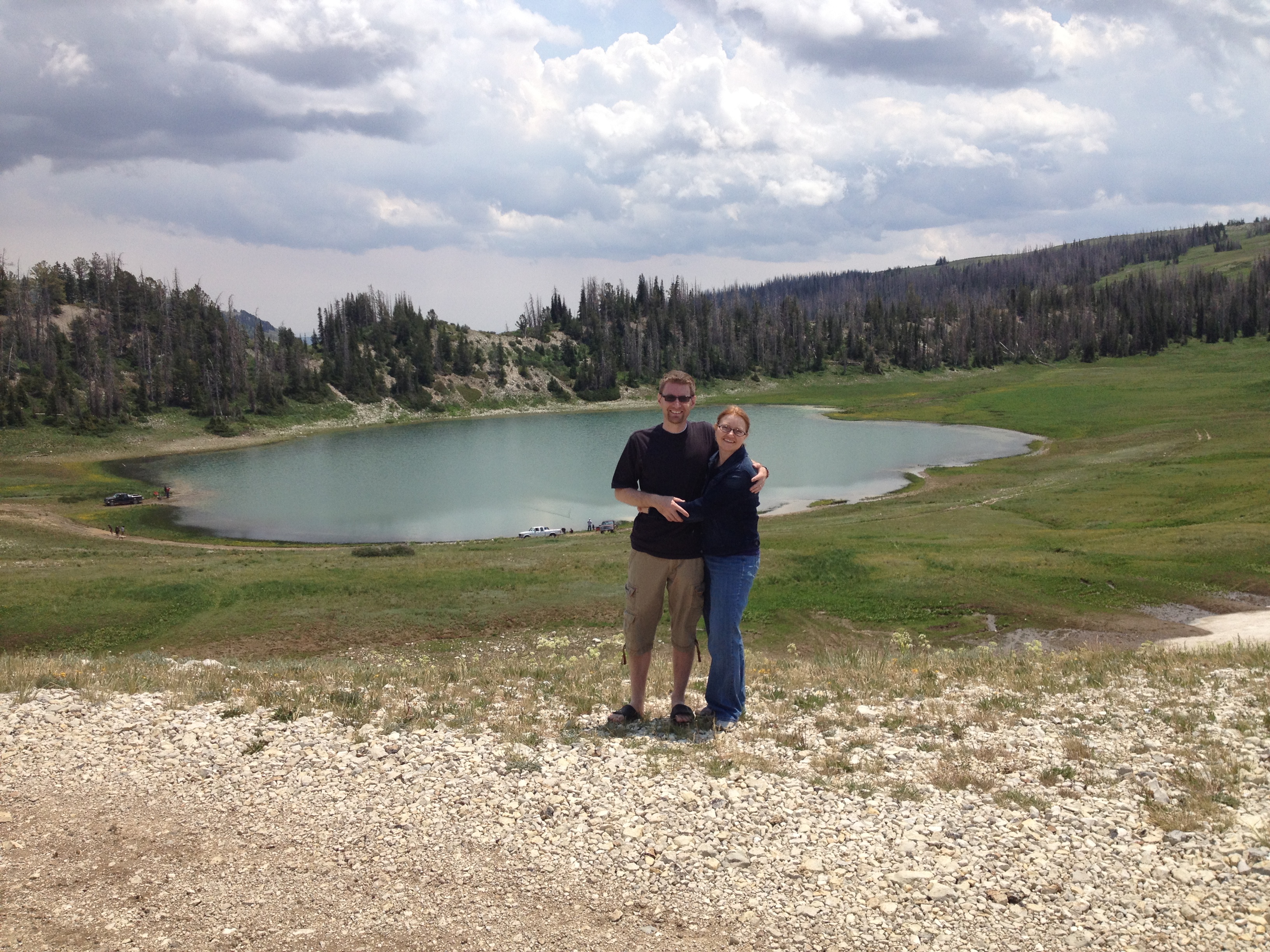
My wife and I at Snow Lake
I was surprised to find that, even in a drought year, the land was bright green, unlike in the valley. Like Hildegaard of Bingen, I associate my experience of God with greenness (Hildegaard called it “veriditas”). I grew up in Kentucky, West Virginia, and southern Indiana, all very green places. I’ve never resonated with the desert, despite the best efforts of my BYU geology professor. But there are pockets of greenness in Utah. And as I climbed the densely forested mountain slopes, I felt like I had come home. I had a strong sense that I was my truest self in that place. I felt that same feeling very strongly not too long ago among the redwoods in Muir Woods in California. No experience that I have ever had in a formal religious context has ever compared to the feeling of rightness that I consistently feel when hiking in a forest.
But it wasn’t just Utah that I enjoyed. The drive out was special too. I even enjoyed the long stretches of green pastures and fields in Kansas. In fact, I especially enjoyed Kansas this time. I used to hate driving through farm country. As a child, the hour drive from one grandmother’s home in Indianapolis to another grandmother’s home in Lafayette, Indiana felt like the Bataan Death March. Being strapped into the backseat, unable to see over the rows of corn on both sides was a special torture. But I now find myself enjoying that same stretch of highway and the many others like it. My spirit soars whenever I am able to get out of my office and into “nature”, even if that nature is a cultivated field, and even if I am witnessing it from inside a motor vehicle. It’s not as powerful as when I am hiking in a forest, but it is something nonetheless.
I find myself wondering what has changed between my childhood and now that I enjoy these drives. The contrast is all the more acute since I have children of my own. This past weekend, I hiked with my family up a mountainside to show them a beautiful meadow and a vista I had happened upon. My kids, now 11 and 14, enjoyed the view for all of 10 seconds before becoming distracted. The same thing happened on the drive through Glenwood Canyon west of Denver. It was a struggle to tear them away from their electronic devices to appreciate the magnificence all around them. I could blame it on the technology, but I know it is more than that. Parents have been dealing with this phenomenon long before there were iPads (although I’m sure the technology exacerbates the situation). How many parents have driven their children across the country to see the Grand Canyon, only to hear them say, “Wow! … Can we go home now?”
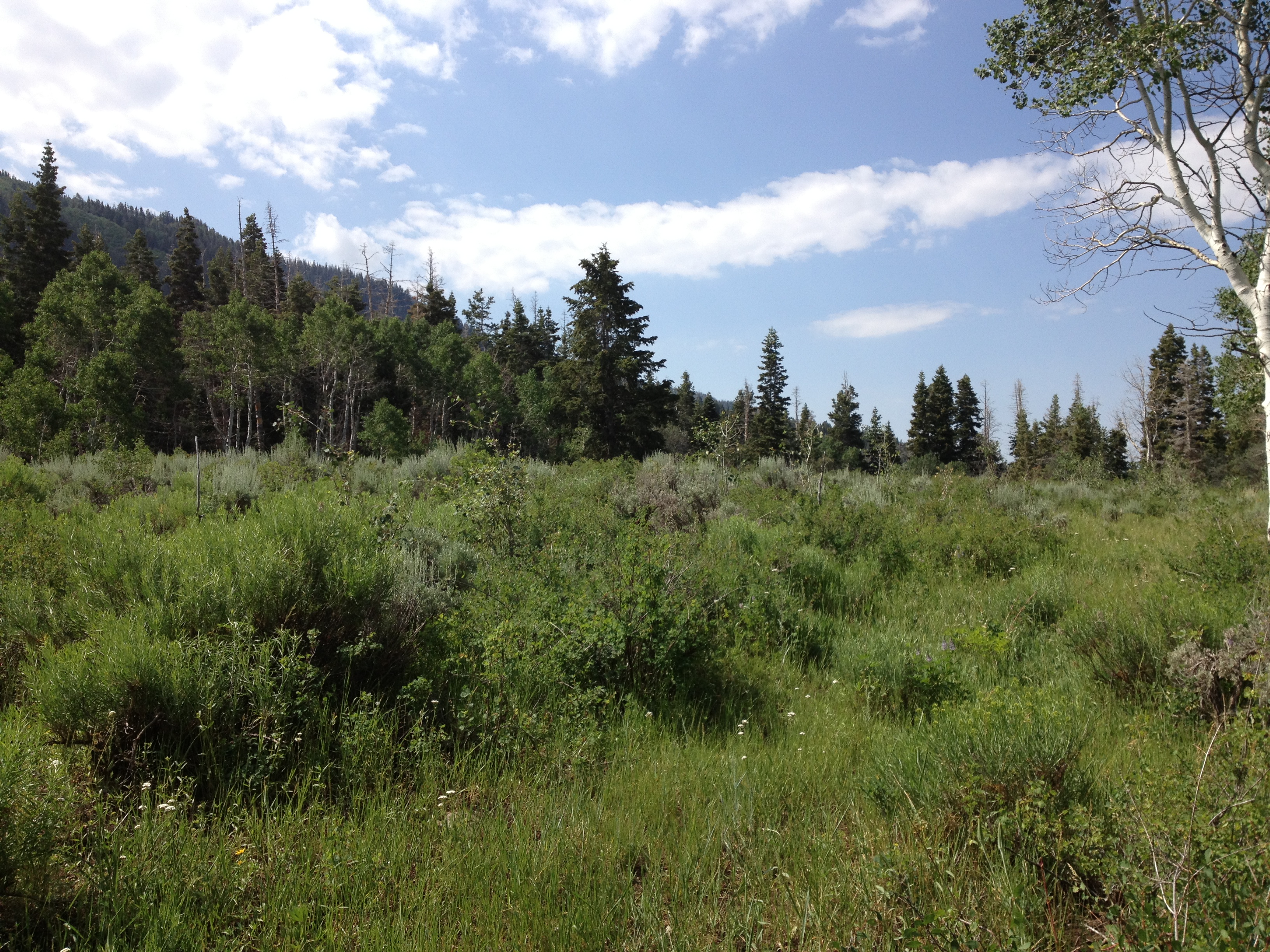
Manti-La Sal National Forest
Recently my son expressed delight at seeing a sunset by exclaiming that it looked like a picture. Shouldn’t it be the other way around? For me, and I think for most adults, there is a significant qualitative difference between experiencing a sunset first hand and seeing a picture of one. But I don’t think my kids really appreciate the difference. Again, I could blame it on the new technology, but I don’t think I was all that different as a child. I have often heard people speak about the innate sense of wonder that children experience at the world around them. Two nature writers in particular come to mind: Rachel Carson and Annie Dillard. Rachel Carson writes in Silent Spring:
“A child’s world is fresh and new and beautiful, full or wonder and excitement. It is our misfortune that for most of us that clear-eyed vision, that true instinct for what is beautiful and awe-inspiring, is dimmed and even lost before we reach adulthood. If I had influence with the good fairy who is supposed to preside over the christening of all children I should ask that her gift to each child in the world be a sense of wonder so indestructible that it would last throughout life, as an unfailing antidote against the boredom and disenchantments of later years, the sterile preoccupation with things artificial, the alienation from the sources of our strength.”
And Annie Dillard writes in Pilgrim at Tinker Creek:
“An infant who has just learned to hold his head up has a frank and forthright way of gazing about him in bewilderment. He hasn’t the faintest clue where he is, and he aims to learn. In a couple of years, what he will have learned instead is how to fake it: he’ll have the cocksure air of a squatter who has come to feel he owns the place. Some unwonted, taught pride diverts us from out original intent, which is to explore the neighborhood, view the landscape, to discover at least where it is that we have been so startlingly set down, if we can’t learn why.”
I love these quotes, but I am skeptical about their facticity. I don’t think either Carson or Dillard actually had children at the time they wrote these words. Carson and Dillard had this sense of wonder, as adults, and it is evident in their writing. But I think it is dubious whether they had the same sense when they were themselves children. I have seen my children fascinated by the natural world on occasion, but not consistently so. In my experience, adults are more able to experience awe and wonder of nature than children, and I wonder why.
I asked my wife about it, and she said she thinks it takes a kind of contemplative aptitude to appreciate nature. I also asked my 10 year-old daughter about it, and she said she thinks that it requires patience, which adults have and children lack. I think the two answers are related and close to the mark.
I also think that the experience of wonder requires a certain knowledge. The scale (temporal and spacial) and complexity of nature which science reveals to us can bring adults to their knees (figuratively and literally), but is often lost on children. One geology class turned my wife into a lifelong lover of rocks. A little bit of amateur astronomy and my experience of the night sky is transformed. One night in Utah this past week was particularly clear, and it was spectacular. I’ve lived most of my life in the Midwest, where the humidity acts as a film which blocks the light of all but the brightest stars. I remember the first time I went out into the desert in Utah at night. It was like I had never seen the night sky before. Of course, one need not know anything about biology, botany, geology, etc. in order to marvel at the magnificence of the universe. But it helps.
I do think, though, there may be one item of knowledge which may explain the difference between how adults and children experience the natural world. It is something that children really do not know and that only slowly comes into the awareness of adults as we age. It is the knowledge that we are going to die. Standing under the night sky, staring up to stars so thick I feel like a could scoop them up into my hands, my awareness of my own mortality transforms my experience from a purely aesthetic one to a spiritual one. I am no longer just seeing something beautiful; I am changed, humbled by the vastness of the universe manifest before me. Hiking up a mountain trail and cresting the peak to look down into the valley, I am not just exercising my limbs. I am throwing myself up against the mountain, straining against the limits of physicality, limits which foreshadow the Limit which is placed on every life. Driving through Glenwood Canyon along the Colorado River, knowing that this beauty existed long before me and will continue to be long after I am gone, fosters in me a sense of gratitude for the brief but magnificent opportunity that is my life.
These are experiences that are lost on my children. They are lost on them because they do not yet know how fleeting life is. They do not really know yet that they will someday die. As we move from childhood into adulthood, we don’t leave an Edenic garden where there is no death. Rather, we come to see the death that we were previously blind to. But this “fall” is a felix culpa or “fortunate fall”, for in coming to the awareness of our mortality, we gain the beauty of the world. In the movie Troy, Achilles tells his lover:
The Gods envy us. They envy us because we’re mortal,
because any moment might be our last.
Everything is more beautiful because we’re doomed.
You will never be lovelier than you are now.
We will never be here again.
So I rest content with my children’s distractedness, knowing that their innocence is what stands between them and them beauty of the earth, and also knowing that one day they will come to know it as I have.
Previous Post

June 26, 2013
10 reasons I care about the same sex marriage rulings
Next Post
July 15, 2013 Losing My Religion: The illusion of choice in religious leave-taking
Browse Our Archives
Select a Category Ritual Scripts Theology Uncategorized
Select a Month January 2017 December 2016 November 2016 October 2016 September 2016 August 2016 July 2016 June 2016 May 2016 April 2016 March 2016 February 2016 January 2016 December 2015 November 2015 October 2015 September 2015 August 2015 July 2015 June 2015 May 2015 April 2015 March 2015 February 2015 January 2015 December 2014 November 2014 October 2014 September 2014 August 2014 July 2014 June 2014 May 2014 April 2014 March 2014 February 2014 January 2014 December 2013 November 2013 October 2013 September 2013 August 2013 July 2013 June 2013 May 2013 April 2013 March 2013 February 2013 January 2013 December 2012 November 2012 October 2012 September 2012 August 2012 July 2012 June 2012 May 2012 April 2012 March 2012 February 2012 January 2012 December 2011 November 2011 October 2011 September 2011 August 2011
TAKE THE
Religious Wisdom Quiz
Which apostle was known as the "apostle to the Gentiles"?
Select your answer to see how you score.
Paul Peter John James
Related posts from The Allergic Pagan

Call to Chicago Area Pagans: Come to Hammond...

Why I Chose to Get Arrested (with photos):...

Paganism’s Promise: My Winding Path to Environmental Activism...
We’re Already Living in a Tree: My Winding...
TRENDING AT PATHEOS Pagan

When we talk about Greek religion, we often begin with the dodekatheion—the...

I was recently chatting with someone on Instagram. She asked me what...

While there are many people who share their results, the end of...

On July 23, I saw Christopher Nolan's The Odyssey which is Homer’s...

As I write this two big events have just finished up. One...

Restoring the Watershed of Divine Love
Perhaps cooperation is not something we manufacture through legislation, ideology, or moral...
view all Pagan blogs
Ad-Free & Subscriber Log-In Subscription Support
- About Us
- 2026 Calendar
- Videos
- Podcasts
- Library of World Religions
- Faith In Media Tracker
- Advertise With Us
- Write for Us
- Privacy Policy
- Terms of Service
- Do Not Sell My Data
- Contact Us
- Radiant Digital
- Manage Newsletter Subscriptions
- Unsubscribe From Notifications
- Sitemap
Copyright 2008-2026, Patheos. All rights reserved.
Subscription Support Ad-Free & Subscriber Log-In
Follow Patheos