
BuddhistCatholicContemplativeEvangelicalGeneral ChristianHinduJewishLatter-day SaintMuslimNew VisionsProgressive Christian
Beliefs
- Buddhist
- Catholic
- Contemplative
- Evangelical
- General Christian
- Hindu
- Jewish
- Latter-day Saint
- More Voices
- Muslim
- New Visions
- Pagan
- Progressive Christian
Topics
- Religion News
- Food and Religion
- Sports and Religion
- Religious Art
- Religious Music and Entertainment
- Religious Events
- History and Religion
- Style and Religion
- Politics and Religion
- Women in Religion
- Recreation Outdoors and Religion
- Business Finance and Religion
- Careers Workplace and Religion
- Education and Religion
- Family Parenting and Religion
- Health Fitness and Religion
- Home and Religion
- Relationships and Religion
- Technology and Religion
- Travel and Religion
Columnists
- Buddhist Columnists
- Business Finance and Religion Columnists
- Careers Workplace and Religion Columnists
- Catholic Columnists
- Contemplative Columnists
- Education and Religion Columnists
- Evangelists Columnists
- Family Parenting and Religion Columnists
- General Christian Columnists
- Health Fitness and Religion Columnists
- Hindu Columnists
- History and Religion Columnists
- Home and Religion Columnists
- Jewish Columnists
- More Voices Columnists
- Latter Day Columnists
- Muslim Columnists
- New Visions Columnists
- Nonreligious Columnists
- Pagan Columnists
- Politics and Religion Columnists
- Progressive Columnists
- Recreation Outdoors and Religion Columnists
- Relationships and Religion Columnists
- Religion News Columnists
- Religious Art Columnists
- Religious Events Columnists
- Religious Music and Entertainment Columnists
- Sports and Religion Columnists
- Style and Religion Columnists
- Technology and Religion Columnists
- Travel and Religion Columnists
- Women in Religion Columnists
Resource Library
- 2026 Calendar
- Library of World Religions
- The 100 Most Holy Places on Earth
- Patheos Answers
- Podcasts
- Videos
- Faith Leaders Database
- Anglican Episcopalian
- Bahai
- Baptist
- Buddhism
- Christianity
- Confucianism
- Eastern Orthodoxy
- Hinduism
- Holiness and Pentecostal
- ISKCON
- Islam
- Judaism
- Lutheran
- Methodist
- The Church of Jesus Christ of Latter-day Saints
- New Age
- Paganism
- Presbytarian and Reformed
- Protestantism
- Religion Behind the Scenes
- Roman Catholic
- Scientology
- Shia Islam
- Sikhism
- Sufism
- Sunni Islam
- Taoism
- Zen
- See all religions
Research Tools
 Ad-Free & Subscriber Log-In Subscription Support
Ad-Free & Subscriber Log-In Subscription Support
Follow Patheos 

- Trending:
- Forgiveness
- |
- Marriage
- |
- Consciousness
- |
- Death Penalty
- |
- Election
- |
- Halloween
 The Allergic Pagan
- Home
- Pagan
- “We have met the enemy and he is us.” — Pogo (Revised)
“We have met the enemy and he is us.” — Pogo (Revised)
Last updated on: January 26, 2017 at 6:10 pm by John Halstead
“We have met the enemy and he is us.” — Pogo (Revised) 2017-01-26T18:10:29-05:00 John Halstead
Patheos Explore the world's faith through different perspectives on religion and spirituality! Patheos has the views of the prevalent religions and spiritualities of the world.
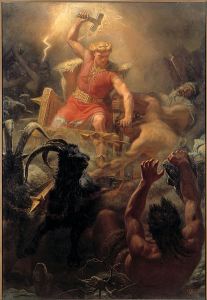
I’d hammer out danger
I’d hammer out a warning
I’d hammer out love between my brothers and my sisters
All over this land
— “If I Had a Hammer (The Hammer Song)”
by Lee Hays and Pete Seeger
Two things that I have learned in the latest Pagan-polytheist brouhaha over “pop culture Paganism” are:
1. Polytheism (like Paganism) is not a single or clearly defined entity.
2. I share common ground as a Self-centric and earth-centered Pagan with many polytheists.
Regarding the first point, I had previously (and erroneously) equated polytheism with reconstructionism. The variety of responses to the “pop culture Paganism” debate helped me to realize that there are polytheistic reconstructionists, non-reconstructionist polytheists, magickal polytheists, archetypal polytheists, naturalistic polytheists … and probably every conceivable variation on those categories as well.
Regarding the second point, I’ve been pleased to learn that, while I still disagree with hard polytheists about the nature of the gods, I myself have something to learn from them about devotion and worship (which I believe are not inconsistent with humanistic, naturalist, and archetypal Paganism). I am grateful to hard polytheists like P. Sufenas Virius Lupus and Dver for this. I am also grateful to polytheists like Sunweaver who don’t use the word “archetype” as a slur. And I am grateful to the many polytheists who have been willing in the last couple of years to take the time and exercise the patience it requires to explain your beliefs and practice to someone who is genuinely interested.
Unfortunately, I have also encountered what I think is (at least what I hope is) the extreme, fringe side of reconstructionist polytheism, in the person of Galina Krasskova.
A little bit of background. Galina Krasskova comes to Paganism via Heathenry, which, in the past, she has taken pains to distinguish from Paganism(s). As she explains in her Master’s thesis, “Race, Gender, and the Problem of ‘Ergi’ in Modern American Heathenry”, Heathenry developed in the United States in 1968 (the same year that Neo-Paganism appeared). But, as Krasskova explains, Heathenry grew not out of the counter-culture, but as a conservative response to the social changes of the 1960s (i.e., the sexual revolution, civil rights, and women’s liberation): “Unlike Wicca and eclectic Paganisms, which also began to come of age in the 1960s and 1970s, Asatru is a counter-counter cultural reaction, in other words a reaction to the reaction.”
Margot Adler, writing in 1979, consciously elected not to include Heathenry in her survey of contemporary Paganism, Drawing Down the Moon. Since that time, people like Diana Paxson have worked to bridge the gulf between Heathenry and Paganism, and we now see a healthy blurring of the boundaries between these two communities.
Unfortunately, others, like Krasskova, have adopted a divide and conquer approach. According to Krasskova, anyone who calls themselves a polytheist or Pagan (they are the same thing to her) who does not conform to her definition of those words is the enemy. Setting aside the outright contempt that Krasskova shows for non-deity-centered forms of Paganism (which she calls “humanistic, reductionist poison” and “garbage”), she also believes that the rest of us are out to destroy her religion. And this fear breeds a dangerous hostility, even militancy, in her writing. She explicitly identifies her enemies as monists, humanists, archetypalists, and atheist Pagans, but she also has little patience for other polytheists who do not meet her narrow definition of that word.
In a recent exchange in the comments to The Anomalous Thracian’s post, “God’s of Consequence”, I asked Galina and Anomalous:
“Also, how do you account for those self-described polytheists who believe that the gods *do* come from within us, but then take on a life of their own outside of us, thus becoming “real”, i.e., thought-forms or egregores? This is not a humanist, or even necessarily an archetypal, perspective. I think polytheism is more diverse than you suggest.”
Galina’s response?
“i would say they’re not polytheists.”
And just to be clear, if you are not polytheist, according to Krasskova, you are not Pagan either. She writes:
“I would go so far as to say Paganism that isn’t Deity centric isn’t Pagan.”
The “indigenous roots” Krasskova refers to is literalist, hard polytheism. Not egregores, not thought-forms, not archetypes, not metaphors — only a very literal belief in the gods as as “real, independent, sentient beings” which “exist [and always have] outside of the limitations of the human mind” qualifies as polytheism or Paganism in Krasskova’s opinion.
Of course, Krasskova is entitled to her belief in her gods, however she conceives them. My issue with her arises with her claim that, if you don’t share her belief, then you don’t deserve to call yourself polytheist or even Pagan. It is not just archetypists, monists, “pop culture pagans”, humanists, and atheist Pagans that Krasskova would exclude from the Pagan umbrella. She also seeks to exclude those polytheists who aren’t, to her mind, polytheist enough. In short, she seeks to exclude the vast majority of Pagans.
Why should anyone care what Krasskova thinks? Because of the militant and provocative language she uses in her recent post, “Deity Centered Polytheism”:
“The recent debate about pop culture paganism brought home a few facts to me. This is a struggle. We are engaged in a potentially divisive struggle. It’s a necessary one, but it’s a struggle, a call to arms nonetheless. We are fighting to establish and build our traditions, restore our lineages, and renew veneration for the Powers in a way that will outlast us and our descendants. Secular Paganism, humanist paganism, atheist paganism, pop culture paganism, archetypism, and all of these various ideologies that put just about anything but actual Gods central to the spiritual experience (combined with the expectations that we as polytheists will give these ideologies equal legitimacy and weight to our own within our own traditions) are attacks on the integrity polytheism as a whole. Our traditions were destroyed once. It will not happen again. I believe that every devoted polytheist today has a responsibility not only to honor their Gods and ancestors consistently and well, but to stand up and draw a line in the sand with the greater mishmash of ‘Pagan’ communities, a line that says ‘you take your horse shit this far and no farther.’
“Because regardless of what people on the non-Deity centric side of the fence say, there is a concerted attempt to define devotion out of Paganism, out of polytheism, and out of Heathenry. It’s an attempt to finish the assault upon our traditions that our ancestors faced. This time it’s made with words and verbal strategies, with writing and blog posts. But it’s an attack nonetheless. Calling those of us who put our Gods first ‘fundamentalists’ in an effort to seize the moral high ground of this argument will not change the fact that this is a battle for the very soul of our traditions. Our ancestors, despite what monotheistic rhetoric would tell us, resisted and fought back and I for one believe it’s incumbent on us today to do at least that much.” (emphasis added)
(Note the quotes around “Pagan”.)
Krasskova thinks she is “holding the line” against a second Burning Times. She sees all other forms of Paganism as attacks on her own form of reconstructionist polytheism. She sees non-theistic forms of Paganism as “an outright attack on our Gods, our traditions, our lineage, and our ancestors. That happened once,” she says, “it will NOT happen again.” This is not rhetorical flourish. It is not hyperbole. Krasskova is insistent that she means exactly what she says. And if you disagree with her, then the value of your life to her is nil: “Outside of my partner, my dearest friends, and my House, outsiders have value to me only insofar as they are serving their Gods rightly”.
This is dangerous talk. It is destructive talk. Krasskova sees herself as a victim. But she adopts the oppressive language of her imaginary oppressors. She is an ideologue who is seeking to transform a diverse Pagan community into her own homogenous form of deity-centered polytheism. Even Heathenry was not sufficiently deity-centered for her, as she explains in her thesis:
“The overwhelming majority of modern Heathens choose, therefore, to make not the sacred world of Gods and spirits the ‘axis around which the human world revolves,’ but rather choose instead to make the human world the axis around which the worlds of the Gods revolve, utilizing carefully structured public rituals to keep the sacred at bay.”
No one is exempt from Krasskova’s condemnation and wrath: not Pagans, not polytheists, and not Heathens.
And Krasskova is not alone. At this moment, less a day after she published her post, 171 people have “liked” her post. And then there’s The Anomalous Thracian, whose blog is where Krasskova practiced what would become her “Deity Centered Polytheism” post in the comments section. Anomalous takes his literalism so far that he believes that his gods can “literally” (his word) rip the arms off people and beat them to death with them: “… yes, literally ripping arms off. Gods. Tangible consequences. Like bears in the woods.” (See his post and his comments following his post.) Not only does he believe this — which of course he’s entitled to — but if you question it, then you reap only contempt and charges of cultural imperialism. This is who Krasskova keeps company with. And the violence that Anomalous describes in his gods lends a new disturbing dimension to the implied violence of Krasskova’s “call to arms”. This, combined with an unshakeable conviction that you know what the gods want, is dangerous.
I do not doubt the genuineness of Krasskova’s encounters with what she calls her gods (although I can’t help but doubt the reality of what Anomalous describes). But I do take issue with where she goes with those experiences. Krasskova’s “call to arms” is an extreme example of the mistake made by so many religious ideologues who take their personal religious experiences as support for the exclusive authority of their tradition over all others, and then seek to defend that claim violently against all enemies, real or perceived. Krasskova has not explicitly incited physical violence, but she comes close, and her post does leave open that possibility. At the very least, she calls for verbal forms of violence against Pagans and polytheists who do not toe the line she has drawn, verbal violence which she models in her comments and her posts.
Previous Post

June 4, 2013
Time out for a Big Thank You!
Next Post
June 10, 2013 Mea Culpa
Browse Our Archives
Select a Category Ritual Scripts Theology Uncategorized
Select a Month January 2017 December 2016 November 2016 October 2016 September 2016 August 2016 July 2016 June 2016 May 2016 April 2016 March 2016 February 2016 January 2016 December 2015 November 2015 October 2015 September 2015 August 2015 July 2015 June 2015 May 2015 April 2015 March 2015 February 2015 January 2015 December 2014 November 2014 October 2014 September 2014 August 2014 July 2014 June 2014 May 2014 April 2014 March 2014 February 2014 January 2014 December 2013 November 2013 October 2013 September 2013 August 2013 July 2013 June 2013 May 2013 April 2013 March 2013 February 2013 January 2013 December 2012 November 2012 October 2012 September 2012 August 2012 July 2012 June 2012 May 2012 April 2012 March 2012 February 2012 January 2012 December 2011 November 2011 October 2011 September 2011 August 2011
TAKE THE
Religious Wisdom Quiz
What is the Christian teaching about temptation?
Select your answer to see how you score.
Deny it exists Resist and pray for strength Give in quickly Ignore it
Related posts from The Allergic Pagan

A Guide to Politics at Patheos Pagan

Call to Chicago Area Pagans: Come to Hammond...

Size Doesn't Matter: 5 Pieces of Advice for...

What’s A Nice Atheist Like Me Doing At...
TRENDING AT PATHEOS Pagan

I was recently chatting with someone on Instagram. She asked me what...

While there are many people who share their results, the end of...

On July 23, I saw Christopher Nolan's The Odyssey which is Homer’s...

As I write this two big events have just finished up. One...

Restoring the Watershed of Divine Love
Perhaps cooperation is not something we manufacture through legislation, ideology, or moral...

Many UUs don’t pray because of bad experiences in a previous religion,...
view all Pagan blogs
Ad-Free & Subscriber Log-In Subscription Support
- About Us
- 2026 Calendar
- Videos
- Podcasts
- Library of World Religions
- Faith In Media Tracker
- Advertise With Us
- Write for Us
- Privacy Policy
- Terms of Service
- Do Not Sell My Data
- Contact Us
- Radiant Digital
- Manage Newsletter Subscriptions
- Unsubscribe From Notifications
- Sitemap
Copyright 2008-2026, Patheos. All rights reserved.
Subscription Support Ad-Free & Subscriber Log-In
Follow Patheos