
BuddhistCatholicContemplativeEvangelicalGeneral ChristianHinduJewishLatter-day SaintMuslimNew VisionsProgressive Christian
Beliefs
- Buddhist
- Catholic
- Contemplative
- Evangelical
- General Christian
- Hindu
- Jewish
- Latter-day Saint
- More Voices
- Muslim
- New Visions
- Pagan
- Progressive Christian
Topics
- Religion News
- Food and Religion
- Sports and Religion
- Religious Art
- Religious Music and Entertainment
- Religious Events
- History and Religion
- Style and Religion
- Politics and Religion
- Women in Religion
- Recreation Outdoors and Religion
- Business Finance and Religion
- Careers Workplace and Religion
- Education and Religion
- Family Parenting and Religion
- Health Fitness and Religion
- Home and Religion
- Relationships and Religion
- Technology and Religion
- Travel and Religion
Columnists
- Buddhist Columnists
- Business Finance and Religion Columnists
- Careers Workplace and Religion Columnists
- Catholic Columnists
- Contemplative Columnists
- Education and Religion Columnists
- Evangelists Columnists
- Family Parenting and Religion Columnists
- General Christian Columnists
- Health Fitness and Religion Columnists
- Hindu Columnists
- History and Religion Columnists
- Home and Religion Columnists
- Jewish Columnists
- More Voices Columnists
- Latter Day Columnists
- Muslim Columnists
- New Visions Columnists
- Nonreligious Columnists
- Pagan Columnists
- Politics and Religion Columnists
- Progressive Columnists
- Recreation Outdoors and Religion Columnists
- Relationships and Religion Columnists
- Religion News Columnists
- Religious Art Columnists
- Religious Events Columnists
- Religious Music and Entertainment Columnists
- Sports and Religion Columnists
- Style and Religion Columnists
- Technology and Religion Columnists
- Travel and Religion Columnists
- Women in Religion Columnists
Resource Library
- 2026 Calendar
- Library of World Religions
- The 100 Most Holy Places on Earth
- Patheos Answers
- Podcasts
- Videos
- Faith Leaders Database
- Anglican Episcopalian
- Bahai
- Baptist
- Buddhism
- Christianity
- Confucianism
- Eastern Orthodoxy
- Hinduism
- Holiness and Pentecostal
- ISKCON
- Islam
- Judaism
- Lutheran
- Methodist
- The Church of Jesus Christ of Latter-day Saints
- New Age
- Paganism
- Presbytarian and Reformed
- Protestantism
- Religion Behind the Scenes
- Roman Catholic
- Scientology
- Shia Islam
- Sikhism
- Sufism
- Sunni Islam
- Taoism
- Zen
- See all religions
Research Tools
 Ad-Free & Subscriber Log-In Subscription Support
Ad-Free & Subscriber Log-In Subscription Support
Follow Patheos 

- Trending:
- Forgiveness
- |
- Marriage
- |
- Consciousness
- |
- Death Penalty
- |
- Election
- |
- Halloween
 The Allergic Pagan
- Home
- Pagan
- Longing and Grace in Lev Grossman’s The Magician King
Longing and Grace in Lev Grossman’s The Magician King
Last updated on: June 19, 2015 at 3:36 pm by John Halstead
Longing and Grace in Lev Grossman’s The Magician King 2015-06-19T15:36:42-05:00 John Halstead
Patheos Explore the world's faith through different perspectives on religion and spirituality! Patheos has the views of the prevalent religions and spiritualities of the world.
God speaks to each of us as he makes us,
then walks with us silently out of the night.
These are the words we dimly hear:
You, sent out beyond your recall,
go to the limits of your longing. …
— Rilke
You, the great homesickness I could never shake off …
— Rilke
I know I promised a follow-up to my post about Lev Grossman’s book The Magicians. I had a lot of thoughts for a follow-up, but then I picked up Grossman’s sequel, The Magician King, and I was lost.
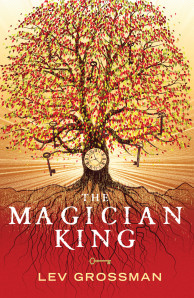
(Warning: while I will not give the whole book away, there may be some spoilers in what follows.)
Quentin and the Hero’s Quest
The Magician King is a worthy sequel to The Magicians. In it, the protagonist, Quentin, finally learns the lesson that he did not learn in the first book: that the sense of meaning that he longs for is not to be found in magic or in other magical worlds, but in an inner transformation for himself. At the end of the book, Quentin is standing literally on the precipice of yet another (even more) magical world, when he realizes the truth of the statement made by Ember, the god of the magical world of Fillory: the hero is not the one who wins the prize; the hero is the one who “pays the price”.
The scene reminded me of the trailer for the just-released Iron Man 3 movie, in which the Mandadrin tells Tony Stark: “I’m going to give you a choice: Do you want an empty life, or a meaningful death?” Being the hero means dying. (This may be a literal or symbolic death, and the hero may return, but he must first die.) As Hemingway said: If the hero has not died, the author just has not finished the story. (For more on Quentin and his quest for meaning, see my previous post on The Magicians.)
Julia’s Story
But The Magician King is at least as much about Julia, as it is about Quentin, and its Julia that I want to focus on. Julia is a character that only makes three appearances in the first book: first as Quentin’s teenage friend and unrequited love, second as a tortured emo-type begging Quentin for the magic he has, and finally as a mysterious and powerful “hedge witch” (a magician who has gained magic power outside the official structure of magic training academies like Brakebills). The Magician King shifts back and forth between the main drama of Quentin and Julia’s quest to save Fillory and flashbacks to Julia’s past, where Grossman fills in the gaps between the three appearances she makes in The Magicians.
Julia is a different character than Quentin. While both are geniuses, Julia is much more the rationalist than the romantic Quentin. She excels at math and science and she prefers to know things than feel things. She is a sensing-thinking type on the Myers-Briggs scale. Julia, it turns out, was denied admission to Brakebills, the magical academy that Quentin attended. She gives up college, family, and any hope of a normal life as she sets out to find her own magic. Eventually, she discovers an underground magical community on her own. She quickly rises to the top of the community, gathering spells or “levels”.
The creme de la creme, she discovers, is a handful of Mensa-type geniuses like herself who live in villa in Provence calling themselves “Free Trader Beowulf” (an allusion to the Traveller role playing game of the 80s). When the group maxes out on the available magical knowledge (250 “levels”) and works out all the possible permutations, they then try to take their power to the next level — the level of the gods. And here, in the last quarter of the book, is where Grossman enters territory that will seem very familiar to the contemporary Pagan polytheist.
Julia and the Quest for Healing
Julia and her new friends theorize that the gods and monsters of the world’s mythology must be beings who were once magicians but who took a quantum leap in their knowledge and power, and that divine power is just another form of magical technology. So they set about to find one god in particular, a goddess related to Diana, Cybele, Isis, and the Black Madonna of Chartres. They call her “Our Lady Underground” or “O.L.U.” (Only a group as pedantic as the Free Traders would give a goddess an acronym for a name.) Pagans will recognize O.L.U. as the archetypal Mother Earth Goddess.
What I found most interesting, however, was how this group of super-intellectual, left-brained, atheistic, hedonistic, and power-seeking magicians, whose “intellectual gag reflex” is triggered by even the mention of religion, gradually becomes transformed by their search for Our Lady Underground. They first set out to “strip away all the reverence and the awe and the art” from their subject, and approach it coldly, intending to “study gods the way an entomologist studies insects”. In spite of this, the nature of their goal slowly transforms the Free Traders:
“A new atmosphere had settled over the house at Murs. It had always been a basic tenet thee that luxury and comfort were integral parts of the magical lifestyle. Not just for its own sake, but as a matter of principle. As magicians–Murs magicians!–they were the secret aristocracy of the world, and Goddamn it, they were going to live like it.
“Now that was changing. Nobody said anything. And certainly no edicts came down from Pouncy [the group’s leader], but the atmosphere became more spartan. The serious nature of their investigation was cooling and tempering their collective mood. Less wine came out with dinner, and sometimes none at all. The food became plainer. Conversations were conducted in hushed tones as they would be in the halls of a monastery. And an attitude of seriousness and austerity was taking root among them. Julia suspected some of the others of fasting. From a high energy magical research center, Murs was turning into something more like a religious retreat.”
One night Julia has a powerful dream of O.L.U.:
“She came in the form of a statue of herself. The one from the crypt at Chartres, stiff and cold. The statute gave Julia a wooden cup. Sitting up, Julia lifted it to her lips and drank like a ferverish child being given medicine in bed. The liquid was cool and sweet, and she thought of the Donne poem about the thirsty Earth. Then she lowered the cup, and the goddess leaned down and kissed her, with her hard, gilded icon’s face.
“Then the statute broke apart, its outside crumbling like an eggshell, and from inside it stepped the true goddess, clear at last. She was grave and unbearably lovely, and she held her attributes in either hand: a gnarled olive staff in her right, a birds nest with three eggs in it in her left. Half of her face was in shadow, for the half of the year she spent underground. Her eyes were full of love and forgiveness.
“‘You are my daughter,’ she said, ‘my true daughter. …’”
That same night, Pouncy finds himself actually praying, with spectacular results.
It is not initially clear what magic represents for Julia. For Quentin, magic represented meaning. But it seems to mean something else to Julia. Julia had been broken by her discovery of magic and her subsequent denial of access to it. This wounding sends her on a quest for magical power through the the magical underground. She intends to take, by sheer force of will, what had been denied to her. But, like Quentin, she is never satisfied. The search consumes her, and she cuts all ties with family and friends. Her behavior resembles that of an addict, and it takes its tole on her body and her mind.
Eventually though, she finds a home with the Free Traders. Like her, the Free Traders are all wounded individuals. (Something common among the Brakebills alumni actually.) One condition for entrance into the Free Traders is that one be clinically depressed or disturbed, a condition which one must prove by producing one’s prescriptions. One day, just before the group invokes Our Lady, Pouncy admits to Julia that what he hopes to gain from O.L.U. is not power, but healing: “I want her take me home with her,” he says. As it turns out, Julia desires the same thing.
Longing and Grace
In the end, I think the Grossman’s Magicians series is about longing, a longing that I think is very common, perhaps universal. It is a longing that we sometime project outward and experience as a sense that there is something “wrong” with the world. It is a longing which the both Quentin and Julia seek to satisfy with profane magic, only to discover that this kind of magic does not fill the hole in their soul.
This longing is, I think, a longing for William James’ “more” — more life — what C.S. Lewis calls “that other larger, stronger, quieter life” (Mere Christianity). “Not God, but life,” writes James Leuba, “more life, a larger, richer, more satisfying life, is, in the last analysis, the end of religion. The love of life, at any and every level of development, is the religious impulse.” (The Monist, vol. 11, p. 572, quoted in William James, The Varieties of Religious Experience). D.H. Lawrence describes this “one underlying religious idea” thusly:
“the conception of the vitality of the cosmos, the myriad vitalities in wild confusion, which still is held in some sort of array : and man, amid all the glowing welter, adventuring, struggling, striving for one thing, life, vitality, more vitality : to get into himself more and more of the gleaming vitality of the cosmos. That is the treasure. The active religious idea was that man, by vivid attention and subtlety and exerting all his strength, could draw more life into himself, more life, more and more glistening vitality, till he became shining like the morning, blazing like a god.”
(D.H. Lawrence, Etruscan Places). And that is precisely what Julia and the Free Traders each seem to be searching for — godhood, not as an expression of power, but of a “larger, richer, more satisfying life”.
But if there is one thing that the religious sages and mystics agree on, it is this: that this “more”, this “other”, has to meet us half way. As Heidegger famously said in his Der Spiegel interview:
“Philosophy is not able to effect a transformation of the world. This is not only true of philosophy, but of all human thought and endeavor. Only a god can save us. The sole possibility that is left for us is to prepare a readiness, through thought and poetic creation for the appearance of the god.”
And this, I think, is what separates religion from profane magic. Like technology, profane magic is a function of an isolated subject exerting his or her will on an objective, inert world. But religion, as the etymology of the word implies, is a relation between two subjects, Buber’s “I-Thou”. And this why the Free Traders’ search takes the religious turn. It is not more power that they want — it is more life.
I recently attended a lecture of the Central Indiana Friends of Jung society given by Donnamarie Flanagan entitled “Keep the Longing Alive and the Transcendent Function Will Come”. The transcendent function is Jung’s term for the transformative power of the autonomous psyche to unite opposites (a conscious thesis and an unconscious antithesis) through the creation of a new symbol (synthesis). It can be likened to the Christian Holy Ghost. It is through the transcendent function that the process of individuation (becoming a whole person) is effected. Flanagan writes in the handout she gave us:
“The longing that can be named is not the deep longing of the soul. It is often imagined as a profound homesickness, but where is home? No more than we can name the object of our longing, can we achieve it by effort. The best we can do its wait for the transcendent function’s work of grace to provide the linking symbol. Yet, the symbol itself points beyond itself toward mysterium.”
In Jungian terms, the sense of longing that we feel is the “religious function” of the psyche. It is a longing for reunification with the Self — Jung’s God-concept — which is often symbolized by the Mother archetype. She represents
“homecoming, shelter, and the long silence from which everything begins and in which everything ends. Intimately known and yet strange like Nature, lovingly tender and yet cruel like fate, joyous and untiring giver of life-mater dolorosa and mute implacable portal that closes upon the dead.”
(CW 9, P 172). She is Rilke’s “great homesickness” that we can never shake off. This is what the Free Traders (at least Julia and Pouncy) long for, and this is, I think, why their quest becomes a religious one.
We try to kill this longing in numerous ways, with food, alcohol, television, and myriad other distractions and obsessions. But, according to Flanagan, we must keep this sense of longing alive. While we cannot unilaterally effect the reunification that we desire, which can only happen by the mysterious grace of the autonomous psyche, we need to consciously create and hold a space where this transformation can happen. This is what I think Heidegger meant when he spoke (above) about “preparing a readiness”.
This can be one function of ritual, of prayer, and of a kind of sacred magic. The purpose of this kind of prayer would not be to satisfy our wants, but to actually draw out our most fundamental longing. “Give us this day our daily hunger,” should be our daily prayer, says Flanagan (quoting Gaston Bachlard). And this can also be the purpose of a different kind of magic from the profane magic that Quentin learns a Brakebills and Julia learns through the magical underground. It is not magic as technology, but magic as an encounter with that “other”, that “more”, which gives life its vitality and its sense of meaningfulness. It is a magic which cannot be forced. It is a magic which happens in the place where longing and grace intersect.
Previous Post

May 4, 2013
New post at Pagan Square: Jung's Shadow Trinity
Next Post
May 18, 2013 Religion vs. Therapy
Browse Our Archives
Select a Category Ritual Scripts Theology Uncategorized
Select a Month January 2017 December 2016 November 2016 October 2016 September 2016 August 2016 July 2016 June 2016 May 2016 April 2016 March 2016 February 2016 January 2016 December 2015 November 2015 October 2015 September 2015 August 2015 July 2015 June 2015 May 2015 April 2015 March 2015 February 2015 January 2015 December 2014 November 2014 October 2014 September 2014 August 2014 July 2014 June 2014 May 2014 April 2014 March 2014 February 2014 January 2014 December 2013 November 2013 October 2013 September 2013 August 2013 July 2013 June 2013 May 2013 April 2013 March 2013 February 2013 January 2013 December 2012 November 2012 October 2012 September 2012 August 2012 July 2012 June 2012 May 2012 April 2012 March 2012 February 2012 January 2012 December 2011 November 2011 October 2011 September 2011 August 2011
TAKE THE
Religious Wisdom Quiz
Who said, "Can anything good come from Nazareth?"
Select your answer to see how you score.
Peter John the Baptist Nathanael Pilate
Related posts from The Allergic Pagan
How "Gods Before Politics" Perpetuates Privilege

Why We Need A God/dess Who Does Not...
Is There a Place for God in Paganism?
TRENDING AT PATHEOS Pagan

When we talk about Greek religion, we often begin with the dodekatheion—the...

I was recently chatting with someone on Instagram. She asked me what...

While there are many people who share their results, the end of...

On July 23, I saw Christopher Nolan's The Odyssey which is Homer’s...

As I write this two big events have just finished up. One...

Restoring the Watershed of Divine Love
Perhaps cooperation is not something we manufacture through legislation, ideology, or moral...
view all Pagan blogs
Ad-Free & Subscriber Log-In Subscription Support
- About Us
- 2026 Calendar
- Videos
- Podcasts
- Library of World Religions
- Faith In Media Tracker
- Advertise With Us
- Write for Us
- Privacy Policy
- Terms of Service
- Do Not Sell My Data
- Contact Us
- Radiant Digital
- Manage Newsletter Subscriptions
- Unsubscribe From Notifications
- Sitemap
Copyright 2008-2026, Patheos. All rights reserved.
Subscription Support Ad-Free & Subscriber Log-In
Follow Patheos