
BuddhistCatholicContemplativeEvangelicalGeneral ChristianHinduJewishLatter-day SaintMuslimNew VisionsProgressive Christian
Beliefs
- Buddhist
- Catholic
- Contemplative
- Evangelical
- General Christian
- Hindu
- Jewish
- Latter-day Saint
- More Voices
- Muslim
- New Visions
- Pagan
- Progressive Christian
Topics
- Religion News
- Food and Religion
- Sports and Religion
- Religious Art
- Religious Music and Entertainment
- Religious Events
- History and Religion
- Style and Religion
- Politics and Religion
- Women in Religion
- Recreation Outdoors and Religion
- Business Finance and Religion
- Careers Workplace and Religion
- Education and Religion
- Family Parenting and Religion
- Health Fitness and Religion
- Home and Religion
- Relationships and Religion
- Technology and Religion
- Travel and Religion
Columnists
- Buddhist Columnists
- Business Finance and Religion Columnists
- Careers Workplace and Religion Columnists
- Catholic Columnists
- Contemplative Columnists
- Education and Religion Columnists
- Evangelists Columnists
- Family Parenting and Religion Columnists
- General Christian Columnists
- Health Fitness and Religion Columnists
- Hindu Columnists
- History and Religion Columnists
- Home and Religion Columnists
- Jewish Columnists
- More Voices Columnists
- Latter Day Columnists
- Muslim Columnists
- New Visions Columnists
- Nonreligious Columnists
- Pagan Columnists
- Politics and Religion Columnists
- Progressive Columnists
- Recreation Outdoors and Religion Columnists
- Relationships and Religion Columnists
- Religion News Columnists
- Religious Art Columnists
- Religious Events Columnists
- Religious Music and Entertainment Columnists
- Sports and Religion Columnists
- Style and Religion Columnists
- Technology and Religion Columnists
- Travel and Religion Columnists
- Women in Religion Columnists
Resource Library
- 2026 Calendar
- Library of World Religions
- The 100 Most Holy Places on Earth
- Patheos Answers
- Podcasts
- Videos
- Faith Leaders Database
- Anglican Episcopalian
- Bahai
- Baptist
- Buddhism
- Christianity
- Confucianism
- Eastern Orthodoxy
- Hinduism
- Holiness and Pentecostal
- ISKCON
- Islam
- Judaism
- Lutheran
- Methodist
- The Church of Jesus Christ of Latter-day Saints
- New Age
- Paganism
- Presbytarian and Reformed
- Protestantism
- Religion Behind the Scenes
- Roman Catholic
- Scientology
- Shia Islam
- Sikhism
- Sufism
- Sunni Islam
- Taoism
- Zen
- See all religions
Research Tools
 Ad-Free & Subscriber Log-In Subscription Support
Ad-Free & Subscriber Log-In Subscription Support
Follow Patheos 

- Trending:
- Forgiveness
- |
- Marriage
- |
- Consciousness
- |
- Death Penalty
- |
- Election
- |
- Halloween
 The Allergic Pagan
- Home
- Pagan
- Water and Stone: libations and altars
Water and Stone: libations and altars
Last updated on: October 18, 2012 at 9:13 pm by John Halstead
Water and Stone: libations and altars 2012-10-18T21:13:34-05:00 John Halstead
Patheos Explore the world's faith through different perspectives on religion and spirituality! Patheos has the views of the prevalent religions and spiritualities of the world.
Recently, I discovered a great blog at Witches and Pagans called Baring the Aegis: Hellenismos by Elani Temperance on Greek reconstructionist spirituality. Her full blog can be found here. Two posts in particular caught my attention, both on the practice of libations: “Sponde and khoe; the practice of liquid sacrifices” and “Khernips and libations; two videos on Hellenic ritual”. The videos which Elani made are both beautiful and instructive. I recommend watching them, especially the second one on libations (below).
One thing I like about Elani’s discussion of libations are the little details that help to sacralize the practice: like stepping away from the altar before “processing” back to it, and shifting the vessel from the right to the left hand before pouring the libation.
Libations are a practice that I discovered when I first started practicing Paganism. I like libations because, since they are liquid, they are absorbed by the ground, and you are not left with food lying about as with other offerings of foodstuffs. But more than that, there is something visceral about pouring a liquid; it evokes all the sensations that I associate with running water: rivers, waterfalls, showers, and long thirsty draughts of water.
On my recent visit to the University of Pennsylvania Museum of Anthropology and Archeology in Philadelphia, I saw an Egyptian offering table. The channel allows libations to run off the surface.
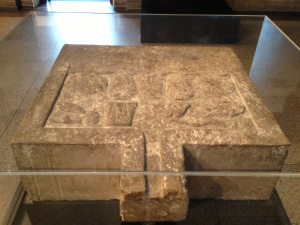
limestone offering table, 1800 BCE, Egypt
This table resembled a similar one I saw at the Rosicrucian Egyptian Museum several months ago in San Jose, California. This one came from the Ptolemaic period of Egypt. The items carved on the surface are “activated” by pouring liquid on the surface from special hs jars.
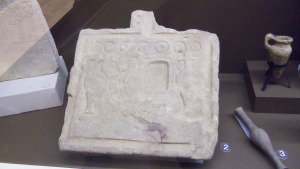
offering altar, Ptolemaic period, Egypt
When I saw this, I became fascinated with idea of making an altar with a prayer carved into stone over which water could poured to “activate” the prayer, similar in some ways to Tibetan prayer wheels.
I’ve been fantasizing about a libation stone of my own. I just need to figure out if I want to pay someone to make this (who?) or learn to carve stone myself. I’m actually considering learning to carve it myself. Lupa recently wrote at No Unsacred Place about the spiritual practice of “getting your hands dirty”, combining hard work and the outdoors, literally digging your hands into the environment. What’s that Buddhist saying? “Before enlightenment — chop wood, carry water. After Enlightenment — chop wood, carry water.” Carving stone seems like a great way to “get my hands dirty”.
I recently completed several biographies of Jung and was interested to learn that Jung carved stone as a spiritual practice. He wrote that through his writing he found a way to put the contents of his unconscious on a “solid footing”, but still he was unsatisfied. “Words and paper, however, did not seem real enough to me; something more was needed. I had to achieve a kind of representation in stone of my innermost thoughts …” And so, in 1922, he began building a stone house for himself on the lake at Bollingen. The building, or the “Tower”, went through several phases over the decades, a process that Jung associated with the evolution of his Self. Jung’s Self took the form of Philemon in his practice of active imagination. But in the material world, it took the form of the Tower at Bollingen.
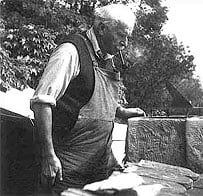
At Bollingen, there was no electricity and no running water. Jung would chop wood, pump and carry water, and cook for himself. (He is reported to have been an excellent cook.) “These simple acts make man simple,” Jung wrote, “and how difficult it is to be simple.” Chop wood, carry water.
In 1950, Jung ordered a triangular cornerstone, but the quarry sent a square block that was a perfect cube. When he saw it, Jung wanted it and decided to make a monument with it. In celebration of his 75th birthday, Jung carved the stone below as a “thanks offering” (as he called it) and as an “explanation” of the Tower.
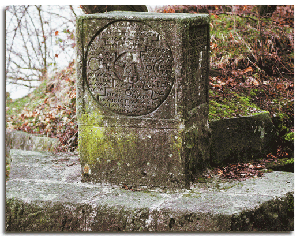
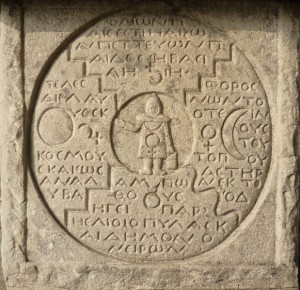
Jung carved on multiple sides of the stone, borrowing his text from alchemical writings, Heraclitus, the Mithras liturgy, and Homer. The inscription on the side depicted above is Greek and reads, in part:
“This is Telesphoros, who roams through the dark regions of this cosmos and glows like a star out of the depths. He points the way to the gates of the sun and to the land of dreams.”
(Telesphoros was the dwarf son of Aesclepius, the Greek god of healing.)
So Jung has inspired me. I don’t plan to build a tower. But I am seriously considering learning some basic stone carving. I have been designing my “libation altar” in my mind. On the surface of the stone, I want to have a raised text that is taken from the second chapter of the Book of Hosea:
Then the earth will answer
with the honey,
and the wine,
and the oil.
And on the front I would put the Hebrew word, Jezreel:
יִזְרְעֶֽאל׃
which is a play on words from Hosea which literally means “God sows”.
The Book of Hosea has always fascinated me, especially chapter 2. It is one of the oldest books of the Old Testament, dating perhaps to the 8th century BCE, and is a polemic against the fertility cult of Ba’al. What is interesting is that, in this chapter, Yahweh describes himself also as a fertility god. The story can be read on multiple levels, as a story about a prophet that marries a (sacred?) prostitute, a story about Yahweh and his metaphorical wife Israel, or a story about Yahweh and his mythical wife Asherah and her lover Ba’al. The text reads:
“In that day, I will answer,” says the LORD. “I will answer the heavens [as they plead for clouds]. And the heavens will answer the earth [with rain]. Then the earth will answer with grain, and the wine [grapevines], and the oil [olive trees]. And they in turn will answer, ‘Jezreel’—‘God sows!’
(Hosea 2:21-22).
On the back side, I would put this text from Genesis 28:
Jacob took the stone
and set it up as a pillar
and poured oil on top of it.
The text comes from the story of Jacob’s vision of the ladder:
“Then Jacob awoke from his sleep and said, “Surely the Lord is in this place, and I did not know it.” And he was afraid and said, “How awesome is this place! This is none other than the house of God, and this is the gate of heaven.” So early in the morning Jacob took the stone that he had put under his head and set it up for a pillar and poured oil on the top of it. He called the name of that place Bethel …”
The text is Biblical evidence of a practice of worship of standing stones (massboth) which was common in Palestine, but condemned in other parts of the Bible, and usually coincided with the worship of Asherah poles or trees (Hosea 3:4; Hosea 10:2; Ex. 34:13; Deut. 7:5; Deut. 12:3; 1 Kings 14:23; 2 Kings 10:17; 2 Kings 18:14; 2 Kings 23:14; 2 Chron. 14:13; Jer. 3:9; Micah 5:13).
Then on the right and left sides of the altar I would put this text taken from the Canaanite Ba’al cycle:
Word of stone
Whisper of tree
This is a typical example of my eclecticism: putting Biblical and Canaanite text on an Egyptian-style libation altar and borrowing libation forms from Greek practice. It may seem strange that I would use texts from the Bible, but for as long as I have been Pagan I have been fascinated with the all the references to paganism in the Tanakh. (More on that in a future post.)
Previous Post

October 13, 2012
My trip to Philadephia
Next Post
October 20, 2012 Symbols
Browse Our Archives
Select a Category Ritual Scripts Theology Uncategorized
Select a Month January 2017 December 2016 November 2016 October 2016 September 2016 August 2016 July 2016 June 2016 May 2016 April 2016 March 2016 February 2016 January 2016 December 2015 November 2015 October 2015 September 2015 August 2015 July 2015 June 2015 May 2015 April 2015 March 2015 February 2015 January 2015 December 2014 November 2014 October 2014 September 2014 August 2014 July 2014 June 2014 May 2014 April 2014 March 2014 February 2014 January 2014 December 2013 November 2013 October 2013 September 2013 August 2013 July 2013 June 2013 May 2013 April 2013 March 2013 February 2013 January 2013 December 2012 November 2012 October 2012 September 2012 August 2012 July 2012 June 2012 May 2012 April 2012 March 2012 February 2012 January 2012 December 2011 November 2011 October 2011 September 2011 August 2011
TAKE THE
Religious Wisdom Quiz
What is the main point of the Parable of the Persistent Widow?
Select your answer to see how you score.
Pray and don't give up Obey the law Give money generously Avoid judges
Related posts from The Allergic Pagan

A Guide to Politics at Patheos Pagan

Call to Chicago Area Pagans: Come to Hammond...


Size Doesn't Matter: 5 Pieces of Advice for...
TRENDING AT PATHEOS Pagan

I was recently chatting with someone on Instagram. She asked me what...

While there are many people who share their results, the end of...

On July 23, I saw Christopher Nolan's The Odyssey which is Homer’s...

As I write this two big events have just finished up. One...

Restoring the Watershed of Divine Love
Perhaps cooperation is not something we manufacture through legislation, ideology, or moral...

Many UUs don’t pray because of bad experiences in a previous religion,...
view all Pagan blogs
Ad-Free & Subscriber Log-In Subscription Support
- About Us
- 2026 Calendar
- Videos
- Podcasts
- Library of World Religions
- Faith In Media Tracker
- Advertise With Us
- Write for Us
- Privacy Policy
- Terms of Service
- Do Not Sell My Data
- Contact Us
- Radiant Digital
- Manage Newsletter Subscriptions
- Unsubscribe From Notifications
- Sitemap
Copyright 2008-2026, Patheos. All rights reserved.
Subscription Support Ad-Free & Subscriber Log-In
Follow Patheos