
BuddhistCatholicContemplativeEvangelicalGeneral ChristianHinduJewishLatter-day SaintMuslimNew VisionsProgressive Christian
Beliefs
- Buddhist
- Catholic
- Contemplative
- Evangelical
- General Christian
- Hindu
- Jewish
- Latter-day Saint
- More Voices
- Muslim
- New Visions
- Pagan
- Progressive Christian
Topics
- Religion News
- Food and Religion
- Sports and Religion
- Religious Art
- Religious Music and Entertainment
- Religious Events
- History and Religion
- Style and Religion
- Politics and Religion
- Women in Religion
- Recreation Outdoors and Religion
- Business Finance and Religion
- Careers Workplace and Religion
- Education and Religion
- Family Parenting and Religion
- Health Fitness and Religion
- Home and Religion
- Relationships and Religion
- Technology and Religion
- Travel and Religion
Columnists
- Buddhist Columnists
- Business Finance and Religion Columnists
- Careers Workplace and Religion Columnists
- Catholic Columnists
- Contemplative Columnists
- Education and Religion Columnists
- Evangelists Columnists
- Family Parenting and Religion Columnists
- General Christian Columnists
- Health Fitness and Religion Columnists
- Hindu Columnists
- History and Religion Columnists
- Home and Religion Columnists
- Jewish Columnists
- More Voices Columnists
- Latter Day Columnists
- Muslim Columnists
- New Visions Columnists
- Nonreligious Columnists
- Pagan Columnists
- Politics and Religion Columnists
- Progressive Columnists
- Recreation Outdoors and Religion Columnists
- Relationships and Religion Columnists
- Religion News Columnists
- Religious Art Columnists
- Religious Events Columnists
- Religious Music and Entertainment Columnists
- Sports and Religion Columnists
- Style and Religion Columnists
- Technology and Religion Columnists
- Travel and Religion Columnists
- Women in Religion Columnists
Resource Library
- 2026 Calendar
- Library of World Religions
- The 100 Most Holy Places on Earth
- Patheos Answers
- Podcasts
- Videos
- Faith Leaders Database
- Anglican Episcopalian
- Bahai
- Baptist
- Buddhism
- Christianity
- Confucianism
- Eastern Orthodoxy
- Hinduism
- Holiness and Pentecostal
- ISKCON
- Islam
- Judaism
- Lutheran
- Methodist
- The Church of Jesus Christ of Latter-day Saints
- New Age
- Paganism
- Presbytarian and Reformed
- Protestantism
- Religion Behind the Scenes
- Roman Catholic
- Scientology
- Shia Islam
- Sikhism
- Sufism
- Sunni Islam
- Taoism
- Zen
- See all religions
Research Tools
 Ad-Free & Subscriber Log-In Subscription Support
Ad-Free & Subscriber Log-In Subscription Support
Follow Patheos 

- Trending:
- Forgiveness
- |
- Marriage
- |
- Consciousness
- |
- Death Penalty
- |
- Election
- |
- Halloween
 The Allergic Pagan
- Home
- Pagan
- My trip to Philadephia
My trip to Philadephia
Last updated on: October 13, 2012 at 10:27 am by John Halstead
My trip to Philadephia 2012-10-13T10:27:47-05:00 John Halstead
Patheos Explore the world's faith through different perspectives on religion and spirituality! Patheos has the views of the prevalent religions and spiritualities of the world.
I just got back from a trip to Philadelphia for work. I was fortunate to be able to squeeze in a little me-time and I hit three different museums.
My first stop was the Franklin Institute, which I cannot recommend, but they had a temporary exhibit of the Dead Sea Scrolls. The exhibit ends tomorrow, so I was luck to catch it. Unfortunately we were not allowed to photograph the scrolls themselves. The two photos below came from the website:

The exhibit was pretty good. They did a good job of making the experience a sacred one, and you could tell that it was just that for many of the patrons.
They did have a very nice intact example of the female pillar figurines from Palestine. The lighting was dimmed to enhance the sense of sacredness, but unfortunately that meant the artifacts were hard to photograph.

8th c. BCE, Lachish
There were a lot of artifacts from Lachish, but I was disappointed that they did not have the Lachish ewer, which is probably my third favorite artifact from this region. (My favorites are the Taanach stand and a goddess figurine from Revadim.)
I then headed over to the University of Pennsylvania Museum of Anthropology and Archaeology. They have a temporary exhibit of Mayan artifacts. They included several large stela. Unfortunately most of the cooler artifacts were replicas. There was a page from the Dresden Codex, the finest surviving Mayan book, from 1300-1500 CE. The first page illustrates the destruction of the world at the end of the solar year followed by four pages showing the ceremonies to introduce the new year.

Dresden Codex, 14th-15th c. CE, Mexico
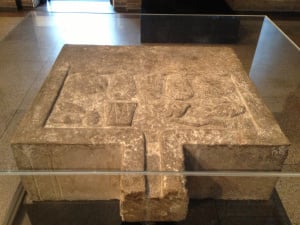
This altar was cool, but kind of creepy when I started to imagine what might have been sacrificed on it:

altar, 8th c. CE, Honduras
They also had permanent exhibits from around the world. The Canaanite exhibit was especially interesting to me. It had a small but fascinate collection of goddess plaques like this one:

14th-13th c. BCE, Beth Shemesh
Here is a particularly beautiful figurine of what appears to b a pregnant woman:

4th-5th c. BCE, Beth Shean
Below is the butt of a processional staff next to a (possibly female) figurine. But when I saw these together, I saw the Neopagan god and goddess.

butt of processional staff, 13th c. BCE, Beth Shemesh (left) and figurine, 13th c. BCE, Beth Shean (right)
Probably the best collection they had was the Greek/Roman section. They had several good examples of amphora and other vases, including the red figures style. This one was my favorite:

Attic Red Figure Amphora, 5th c. BCE, Capua.
This side depicts Dionysus and a maenad.

This side depicts Apollo and Artemis pouring libations.
Note that the picture above shows two gods pouring libations, something I have written about before here, “Who do the gods sacrifice to?”.
The Egyptian section was interesting too. They had a cool exhibit of columns covered in hieroglyphs.
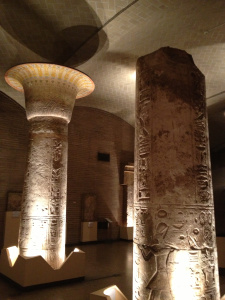
I thought this sarcophagus lid was interesting too. It shows the goddess Nut (who swallows the sun in the evening and gives birth to him in the morning) on the inside of the lid. (You have to zoom in and look close to see her arms and body, but her head is clearly visible.)

goddess Nut on the inside of sarcophagus lid

detail of inside of sarcophagus lid showing goddess Nut
For some reason I find what is on the inside of the lid even more interesting than what is on the outside.
Finally, I went to the Rodin Museum which has the largest collection of Rodin sculptures outside of Paris. I could have stood for an hour in front of the “Gates of Hell” which is on the entrance to the museum.

Rodin, “The Gates of Hell”
Below are some details of the left and right panels that give a better sense of the three-dimensionality of the work. Standing beneath it I have a vertiginous feeling combined with a strange desire to climb up the wall.
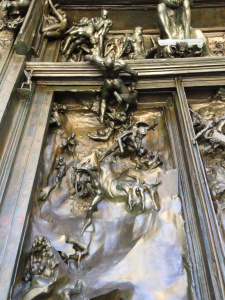
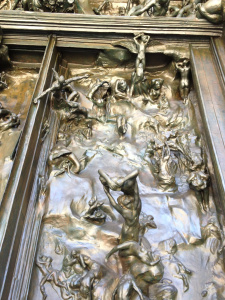
As I tried to take pictures, I realized that what is unique about Rodin is that most of his sculptures do not have a “front”. It is difficult, if not impossible, to capture the work in a single photograph. Even a panoramic series of photographs often does not do it justice. There is an interiority to many of Rodin’s works, especially those showing multiple figures, so you get the feeling that the real “event” being depicted is actually hidden between the figures.
This one is one of my favorites, which actually is two separate pieces from the “Gates of Hell” placed together by Rodin to create a new work.

Rodin, “I Am Beautiful”
This one was also interesting. It is of two figures (male and female?) in a (violent or erotic?) embrace. The closest figure appears to be a faun or demi-human and the other figure has oversized arms and hands.

Rodin, “Possession”
I was not at all impressed with the city of Philadelphia, but they did have some good museums.
Previous Post

October 11, 2012
Goddess as a Personal Presence
Next Post
October 18, 2012 Water and Stone: libations and altars
Browse Our Archives
Select a Category Ritual Scripts Theology Uncategorized
Select a Month January 2017 December 2016 November 2016 October 2016 September 2016 August 2016 July 2016 June 2016 May 2016 April 2016 March 2016 February 2016 January 2016 December 2015 November 2015 October 2015 September 2015 August 2015 July 2015 June 2015 May 2015 April 2015 March 2015 February 2015 January 2015 December 2014 November 2014 October 2014 September 2014 August 2014 July 2014 June 2014 May 2014 April 2014 March 2014 February 2014 January 2014 December 2013 November 2013 October 2013 September 2013 August 2013 July 2013 June 2013 May 2013 April 2013 March 2013 February 2013 January 2013 December 2012 November 2012 October 2012 September 2012 August 2012 July 2012 June 2012 May 2012 April 2012 March 2012 February 2012 January 2012 December 2011 November 2011 October 2011 September 2011 August 2011
TAKE THE
Religious Wisdom Quiz
How many commandments were written on stone tablets?
Select your answer to see how you score.
Twelve Ten Thirteen Seven
Related posts from The Allergic Pagan
All Hallows: candy and pomegranates, gravestones and red...
Water and Stone: libations and altars

A Guide to Politics at Patheos Pagan

A Pagan Dad Goes to Washington: 10 Things...
TRENDING AT PATHEOS Pagan

I was recently chatting with someone on Instagram. She asked me what...

While there are many people who share their results, the end of...

On July 23, I saw Christopher Nolan's The Odyssey which is Homer’s...

As I write this two big events have just finished up. One...

Restoring the Watershed of Divine Love
Perhaps cooperation is not something we manufacture through legislation, ideology, or moral...

Many UUs don’t pray because of bad experiences in a previous religion,...
view all Pagan blogs
Ad-Free & Subscriber Log-In Subscription Support
- About Us
- 2026 Calendar
- Videos
- Podcasts
- Library of World Religions
- Faith In Media Tracker
- Advertise With Us
- Write for Us
- Privacy Policy
- Terms of Service
- Do Not Sell My Data
- Contact Us
- Radiant Digital
- Manage Newsletter Subscriptions
- Unsubscribe From Notifications
- Sitemap
Copyright 2008-2026, Patheos. All rights reserved.
Subscription Support Ad-Free & Subscriber Log-In
Follow Patheos