
BuddhistCatholicContemplativeEvangelicalGeneral ChristianHinduJewishLatter-day SaintMuslimNew VisionsProgressive Christian
Beliefs
- Buddhist
- Catholic
- Contemplative
- Evangelical
- General Christian
- Hindu
- Jewish
- Latter-day Saint
- More Voices
- Muslim
- New Visions
- Pagan
- Progressive Christian
Topics
- Religion News
- Food and Religion
- Sports and Religion
- Religious Art
- Religious Music and Entertainment
- Religious Events
- History and Religion
- Style and Religion
- Politics and Religion
- Women in Religion
- Recreation Outdoors and Religion
- Business Finance and Religion
- Careers Workplace and Religion
- Education and Religion
- Family Parenting and Religion
- Health Fitness and Religion
- Home and Religion
- Relationships and Religion
- Technology and Religion
- Travel and Religion
Columnists
- Buddhist Columnists
- Business Finance and Religion Columnists
- Careers Workplace and Religion Columnists
- Catholic Columnists
- Contemplative Columnists
- Education and Religion Columnists
- Evangelists Columnists
- Family Parenting and Religion Columnists
- General Christian Columnists
- Health Fitness and Religion Columnists
- Hindu Columnists
- History and Religion Columnists
- Home and Religion Columnists
- Jewish Columnists
- More Voices Columnists
- Latter Day Columnists
- Muslim Columnists
- New Visions Columnists
- Nonreligious Columnists
- Pagan Columnists
- Politics and Religion Columnists
- Progressive Columnists
- Recreation Outdoors and Religion Columnists
- Relationships and Religion Columnists
- Religion News Columnists
- Religious Art Columnists
- Religious Events Columnists
- Religious Music and Entertainment Columnists
- Sports and Religion Columnists
- Style and Religion Columnists
- Technology and Religion Columnists
- Travel and Religion Columnists
- Women in Religion Columnists
Resource Library
- 2026 Calendar
- Library of World Religions
- The 100 Most Holy Places on Earth
- Patheos Answers
- Podcasts
- Videos
- Faith Leaders Database
- Anglican Episcopalian
- Bahai
- Baptist
- Buddhism
- Christianity
- Confucianism
- Eastern Orthodoxy
- Hinduism
- Holiness and Pentecostal
- ISKCON
- Islam
- Judaism
- Lutheran
- Methodist
- The Church of Jesus Christ of Latter-day Saints
- New Age
- Paganism
- Presbytarian and Reformed
- Protestantism
- Religion Behind the Scenes
- Roman Catholic
- Scientology
- Shia Islam
- Sikhism
- Sufism
- Sunni Islam
- Taoism
- Zen
- See all religions
Research Tools
 Ad-Free & Subscriber Log-In Subscription Support
Ad-Free & Subscriber Log-In Subscription Support
Follow Patheos 

- Trending:
- Forgiveness
- |
- Marriage
- |
- Consciousness
- |
- Death Penalty
- |
- Election
- |
- Halloween
 The Allergic Pagan
- Home
- Pagan
- Depression as a friend (updated)
Depression as a friend (updated)
Last updated on: July 18, 2012 at 3:55 pm by John Halstead
Depression as a friend (updated) 2012-07-18T15:55:42-05:00 John Halstead
Patheos Explore the world's faith through different perspectives on religion and spirituality! Patheos has the views of the prevalent religions and spiritualities of the world.
Hello darkness, my old friend
I’ve come to talk with you again
— “The Sound of Silence”, Simon and Garfunkel
Let me preface this by saying that I have never suffered from long term depression, depression that lasted years — unless you count the years of misery that preceded my leaving the religion of my birth. Okay, yeah, I should probably count that. Since then, I have experienced long periods of depression in the winter and shorter bouts of depression during the warmer months. Also, what I call “depression” is rarely debilitating. I still get out of bed, eat, go to work and so on, although the these activities are impacted when I am depressed. What helps me survive these periods is my Pagan and Jungian belief that depression, while unpleasant, is not bad.
Over at his blog, Teo Bishop has written a post about what we do when we are “stuck in the winter” of our lives. Teo’s post is worth reading — as much for what he says about daily personal spiritual practice as anything — as are the comments, many from people who suffer from long-term depression. One thing that I have learned from the pagan paradigm is that the “fallow tides” of life are unavoidable. In fact, not only is it not possible to avoid them, but we shouldn’t try to. The dark times in our lives are part of life. Our psychic lives are no more meant to be all “light and sweetness” than than any other part of the living world. This recognition helps me weather these fallow periods with a measure of grace. I suspect it also shortens their length, although it is difficult to say. I believe that, if I were to resist these periods, that I might be able to delay them, but not forever, and they would return with a vengeance.
My religion of origin, Mormonism, is what I call a “religion of light”. It eschews darkness in all forms, including depression and any form of unhappiness. Happiness, to Mormons, is a sign of grace. It means that you are living your life according to God’s plan and the Church’s rules. If you are unhappy, it means you are doing something wrong; it means you are sinning. It is no surprise then that Mormons eschew psychotherapy, which they see as a poor substitute for “living the gospel”. Going to therapy would be tantamount to an admission of guilt. This creates a Catch-22 for many Mormons because Mormon dogma encourages a kind of perfectionism which leads to depression. Just imagine Pleasantville and you wouldn’t be too far off. This is why Utah ranks number one in depression (also suicide) [see also this link] and why Utah Valley is sarcastically called “Happy Valley” — because so many people are taking Prozac.

Like Pagans, Jungians believe that depression is not something to be resisted. Jung wrote that all neurosis (in which we would include depression) has a meaning and a purpose. (CW 4.415). He writes:
“Only if we understand and accept the neurosis as our truest and most precious possession can we be sure of avoiding stagnation and of not succumbing to rigidity and neurotic subterfuge. In the neurosis is hidden one’s worst enemy and best friend.”
(CW 10.359)
“We should not try to ‘get rid’ of a neurosis, but rather to experience what it means, what it has to teach, what its purpose is. We should even learn to be thankful for it, otherwise we pass it by and miss the opportunity of getting to know ourselves as we really are. A neurosis is truly removed only when it has removed the false attitude of the ego. We do not cure it–it cures us. A man is ill, but the illness is nature’s attempt to heal him.”
(CW 10.361)
Post-Jungian, James Hillman, argues that therapeutic attempts to eliminate depression echo the Christian myth of resurrection, but have the unfortunate effect of demonizing soulful state of being:
“Depression is still the Great Enemy. More personal energy is expended in manic defenses against, diversions from, and denials of it than goes into other supposed psychopathological threats to society: psycho- pathic criminality, schizoid breakdown, addictions. As long as we are caught in cycles of hoping against despair, each productive of the other, as long as our actions in regard to depression are resurrective, implying that being down and staying down is sin, we remain Christian in psychology.
“Yet through depression we enter depths and in depths find soul. Depression is essential to the tragic sense of life. It moistens the dry soul and dries the wet. It brings refuge, limitation, focus, gravity, weight, and humble powerlessness. It reminds of death. The true revolution (in behalf of soul) begins in the individual who can be true to his or her depression. Neither jerking oneself out of it, caught in cycles of hope and despair, nor suffering it through till it turns, nor theologizing it – but discovering the consciousness and depths it wants. So begins the revolution on behalf of the soul.”
“Re-Visioning Psychology” (1975). I can’t think of a better example of the “theologizing” of depression than Mormonism.
David Miller compares depressive states to the “dark night of the soul” in the apophatic mystical tradition and concludes:
“Could it be that the epidemic psychological depression in North America may be a concealed wish for spirituality, but not spirituality in the sense of conventional positive, literalistic religion, nor in the sense of a New Age spiritual transcendence of darkness? Could it be that the malaise so many feel really wants not to be gotten rid of, not healed, but deepened and, like the neurosis, ‘accepted as our truest and most precious possession.’ (quoting Jung)”
“If this were so, then Prozac, New Age remedies, cocaine, martini lunches, counselling, meditation, therapy, religious practice, support and recovery groups, self-help literature–all, if they imagine themselves to be to the purpose of “curing” depression and low self- esteem, may well be not only ill advised, but even counter-productive …”
(“Nothing almost sees miracles! Self and no-self in psychology and religion”, lecture given as the fourth annual Jim Klee Forum lecture at West Georgia College on May 17, 1993. A print version of the essay appeared in The Journal of the Psychology of Religion, 4-5 (1995-1996): 1-26.)
Certainly, if one is truly “stuck in winter”, this is not a condition which anyone would want to prolong. However, as a Pagan and as a Jungian, I believe the question we should be asking ourselves is not, “How do I bring this condition to its most rapid end?”, but rather, “What is it that my soul is trying to tell me?” I am obviously not an expert in these matters. My own experience includes my own depression and watching many other people struggle with depression. From I experience, I believe that the way out is not through drugs (prescribed or otherwise) or right living or positive mental attitude or visualizing white light. Sometimes the only way out of the pit is, as Dante shows us, though the bottom.
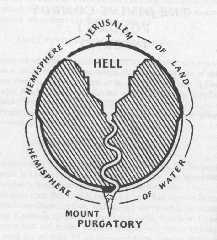
As they say, “When you’re falling, dive!”
Monika Wikman writes in her book, Pregnant Darkness: Alchemy and the Rebirth of Consciousness,
“Our deepest darknesses are pregnant with incredible life energy.
“Cultivating a living relationship with the mysteries of the psyche and psychoid depends on our ability to of into the darkness, dim the light of the ego, and attend to what appears. We descend into the darkness voluntarily when we meditate or engage in any kind of spiritual practice, dream work, active imagination, shamanic journeying, creative endeavor, and so on. We descend involuntarily through depression and crises, such as health problems, loss of love, loss of position, and so on. […]
“both of these paths, the active one where we court the soul, and the one in which crisis pulls us into the psyche, can lead us to the source of transformation and renewal.”
Is it possible then that depression can truly be our friend? our guide? and “source of transformation and renewal”?
Previous Post

July 13, 2012
Summer Solstice - Urban Style
Next Post
July 26, 2012 Who's in charge here? Grace, humility, and defiance of fate
Browse Our Archives
Select a Category Ritual Scripts Theology Uncategorized
Select a Month January 2017 December 2016 November 2016 October 2016 September 2016 August 2016 July 2016 June 2016 May 2016 April 2016 March 2016 February 2016 January 2016 December 2015 November 2015 October 2015 September 2015 August 2015 July 2015 June 2015 May 2015 April 2015 March 2015 February 2015 January 2015 December 2014 November 2014 October 2014 September 2014 August 2014 July 2014 June 2014 May 2014 April 2014 March 2014 February 2014 January 2014 December 2013 November 2013 October 2013 September 2013 August 2013 July 2013 June 2013 May 2013 April 2013 March 2013 February 2013 January 2013 December 2012 November 2012 October 2012 September 2012 August 2012 July 2012 June 2012 May 2012 April 2012 March 2012 February 2012 January 2012 December 2011 November 2011 October 2011 September 2011 August 2011
TAKE THE
Religious Wisdom Quiz
I am a journey from Moab back to Bethlehem, marked by bitterness turned to blessing. What am I?
Select your answer to see how you score.
A widow's path Ruth's journey Naomi's return A pilgrimage
Related posts from The Allergic Pagan

A Guide to Politics at Patheos Pagan

Call to Chicago Area Pagans: Come to Hammond...

Size Doesn't Matter: 5 Pieces of Advice for...

What’s A Nice Atheist Like Me Doing At...
TRENDING AT PATHEOS Pagan

I was recently chatting with someone on Instagram. She asked me what...

While there are many people who share their results, the end of...

On July 23, I saw Christopher Nolan's The Odyssey which is Homer’s...

As I write this two big events have just finished up. One...

Restoring the Watershed of Divine Love
Perhaps cooperation is not something we manufacture through legislation, ideology, or moral...

Many UUs don’t pray because of bad experiences in a previous religion,...
view all Pagan blogs
Ad-Free & Subscriber Log-In Subscription Support
- About Us
- 2026 Calendar
- Videos
- Podcasts
- Library of World Religions
- Faith In Media Tracker
- Advertise With Us
- Write for Us
- Privacy Policy
- Terms of Service
- Do Not Sell My Data
- Contact Us
- Radiant Digital
- Manage Newsletter Subscriptions
- Unsubscribe From Notifications
- Sitemap
Copyright 2008-2026, Patheos. All rights reserved.
Subscription Support Ad-Free & Subscriber Log-In
Follow Patheos