
BuddhistCatholicContemplativeEvangelicalGeneral ChristianHinduJewishLatter-day SaintMuslimNew VisionsProgressive Christian
Beliefs
- Buddhist
- Catholic
- Contemplative
- Evangelical
- General Christian
- Hindu
- Jewish
- Latter-day Saint
- More Voices
- Muslim
- New Visions
- Pagan
- Progressive Christian
Topics
- Religion News
- Food and Religion
- Sports and Religion
- Religious Art
- Religious Music and Entertainment
- Religious Events
- History and Religion
- Style and Religion
- Politics and Religion
- Women in Religion
- Recreation Outdoors and Religion
- Business Finance and Religion
- Careers Workplace and Religion
- Education and Religion
- Family Parenting and Religion
- Health Fitness and Religion
- Home and Religion
- Relationships and Religion
- Technology and Religion
- Travel and Religion
Columnists
- Buddhist Columnists
- Business Finance and Religion Columnists
- Careers Workplace and Religion Columnists
- Catholic Columnists
- Contemplative Columnists
- Education and Religion Columnists
- Evangelists Columnists
- Family Parenting and Religion Columnists
- General Christian Columnists
- Health Fitness and Religion Columnists
- Hindu Columnists
- History and Religion Columnists
- Home and Religion Columnists
- Jewish Columnists
- More Voices Columnists
- Latter Day Columnists
- Muslim Columnists
- New Visions Columnists
- Nonreligious Columnists
- Pagan Columnists
- Politics and Religion Columnists
- Progressive Columnists
- Recreation Outdoors and Religion Columnists
- Relationships and Religion Columnists
- Religion News Columnists
- Religious Art Columnists
- Religious Events Columnists
- Religious Music and Entertainment Columnists
- Sports and Religion Columnists
- Style and Religion Columnists
- Technology and Religion Columnists
- Travel and Religion Columnists
- Women in Religion Columnists
Resource Library
- 2026 Calendar
- Library of World Religions
- The 100 Most Holy Places on Earth
- Patheos Answers
- Podcasts
- Videos
- Faith Leaders Database
- Anglican Episcopalian
- Bahai
- Baptist
- Buddhism
- Christianity
- Confucianism
- Eastern Orthodoxy
- Hinduism
- Holiness and Pentecostal
- ISKCON
- Islam
- Judaism
- Lutheran
- Methodist
- The Church of Jesus Christ of Latter-day Saints
- New Age
- Paganism
- Presbytarian and Reformed
- Protestantism
- Religion Behind the Scenes
- Roman Catholic
- Scientology
- Shia Islam
- Sikhism
- Sufism
- Sunni Islam
- Taoism
- Zen
- See all religions
Research Tools
 Ad-Free & Subscriber Log-In Subscription Support
Ad-Free & Subscriber Log-In Subscription Support
Follow Patheos 

- Trending:
- Forgiveness
- |
- Marriage
- |
- Consciousness
- |
- Death Penalty
- |
- Election
- |
- Halloween
 The Allergic Pagan
- Home
- Pagan
- Family Summer Solstice Celebration
Family Summer Solstice Celebration
Last updated on: June 20, 2012 at 12:18 pm by John Halstead
Family Summer Solstice Celebration 2012-06-20T12:18:38-05:00 John Halstead
Patheos Explore the world's faith through different perspectives on religion and spirituality! Patheos has the views of the prevalent religions and spiritualities of the world.
Here’s my outline for my family summer solstice celebration:
Prelude
Introduction
I begin:
The Summer Solstice is the longest day of the year and the shortest night. The sun has grown to its full strength and summer begins. But it is also the day when the days begin to get shorter again.
This day is called “Litha” by many Pagans. Litha is the name given to the solstice by the Anglo-Saxons, who are our ancestors. They celebrated the summer solstice directly opposite to the winter solstice. Do you remember when we celebrated the winter solstice? Do you remember what Pagans call the winter solstice?
Paganism is all about balance. It is about bringing opposites together into harmony. Do you remember that we celebrated the birth of the Sun Child at the winter solstice from his mother, the Goddess Mother Night? So if we celebrated the birth of the sun child on the longest night, what do think we will celebrate tonight on the longest day?
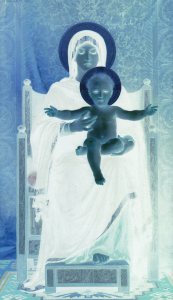
“Virgin and Child”, William Bouguereau (inverted)
We are celebrating the birth of the Dark Child from his mother, the Goddess of the Sun. In many ancient traditions, the Sun is a God, but in others she is a Goddess. For example, the ancient Japanese worshiped a goddess of the Sun called Amaterasu.
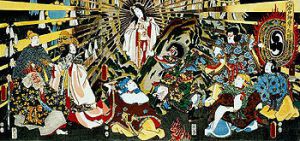
Amaterasu
The ancient Egyptians also worshiped a goddess of the Sun named “Sekhmet”, who had the head of a lion.
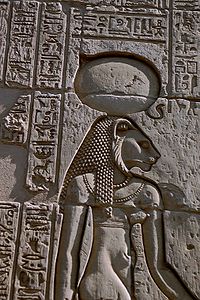
Sekhmet
So the Child of Light is born from the dark Goddess and the Child of Darkness is born from the light Goddess. What does this tell us about nature?
It teaches us that all things contain their opposites. Like the Chinese symbol of the yin-yang. To Pagans the light spot on the dark field may represent the Child of Light born from the womb of the Goddess of Night. And the dark spot in the light field represents the Child of Darkness born from the Day. What does this tell us about ourselves? We’re going to find out today.
This Dark Child who is born at Litha will eventually grow up to be what Pagans call the Holly King, the King of Winter. And he will battle the Oak King, the King of Summer, who was born on the opposite side of the year at Yule. In Celtic (ancient Irish) myth, the story is told of two kings, Gwyn and Gwythr, the white son of the night and the dark son of the day. In the Celtic story they battle for the love of a maiden who represents the Goddess. The story used to be reenacted every year in a kind of play.
In the Pagan myth the Child of Light and the Dark Child are twin brothers — not identical twins, but mirror twins. What are mirror twins? In fact, they are actually two parts of one God, the Pagan Horned God who has a light side and a dark side. Just like the Goddess of Summer and the Goddess of Winter are really different sides of the one Great Goddess. They are like two sides of one coin.
Paganism teaches us that the dark half is not evil or bad. And the light half is not good. They are both part of a whole and the whole is good. The separation is what is bad.
My wife reads:
“We begin by making new metaphors. Without negating the light, we reclaim the dark: the fertile earth where the hidden seed lies unfolding, the unseen power that rises within us, the dark of sacred human flesh, the depths of the ocean, the night — when our senses quicken; we reclaim all the lost parts of ourselves we have shoved down into the dark. Instead of enlightenment, we begin to speak of deepening.” — Starhawk
My daughter reads:
“It is the goal of Paganism to remind us that there is a darker side to all things and that this darker side is not necessarily harmful and negative. There is beauty in darkness for those who dare enter the shadows to embrace it. …
My son reads:
“But it is important to remember that focusing only on the darker side is just as dangerous as focusing on the lighter side. Balance is important, and even though some may relate to one aspect more than the other, we must always remain open to the other aspects. Life consists of the interplay of these opposites, which naturally complement each other. To discard one aspect is to sacrifice our wholeness and limit our potential.” — John J. Coughlin
I read:
The song you heard at the beginning of our celebration was in Greek. The song is called “Daemonos”. What does the word “Daemonos” sound like? The ancient Greeks worshiped two kinds of gods: the gods of sky and light and the gods of the earth and darkness. The gods of the sky and light were the Olympians. You may know their names: Zeus, Apollo, Hermes, Athena, Hera, Aphrodite. But the Greeks also worshiped gods of the earth and darkness which were called “daemonos”. They understood that you could not have one without the other.
When Christianity came around, the Christians borrowed the name “daemonos” and turned it into “demon”. The early Christian church taught people that everything to do with light and heaven was good, and everything to do with earth and darkness was bad. Today, Pagans understand that you the earth and darkness are not bad. And the sky and light is not good. They are both part of an endless cycle which the Chinese call the Tao (or the Way) and Pagans call the Wheel of the Year.
The darkness is not bad, it is just hidden. And people are afraid of what they do not know and that fear can make us do some very strange things. The darkness is not just outside of us. It is also inside of us. One of my favorite thinkers was a psychologist named Carl Jung. He called this darkness inside of all of us the “Shadow”. The Shadow is the part of ourselves that we hide from everyone. Sometimes we even hide it from ourselves without realizing it. And because it is hidden, it can make us do all kinds of strange things.
Do you remember the story of Peter Pan? Do you remember when he snuck into the children’s bedroom and his shadow got away from him and he chased it all over the room? Until Wendy sewed it back on for him?
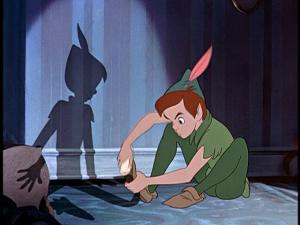
Peter Pan and his shadow
Well, our shadows can be like that sometimes. Sometimes they can feel like they are off doing their own thing, without our permission.
Carl Jung believed one of the most important things we can do as human beings is to find these shadows and sew them back on, metaphorically speaking. He believed that we cannot be whole persons until we reconnect with our lost dark twin. Tonight we are going to be doing a ritual that will help us connect with our Shadow.
Activity I
Trace and cut out outlines of each person on large roll of white paper. This is the persona. Then trace and cut out outlines of each person on black paper. This is the shadow.
Remind participants that shadow self is not bad, just hidden. Talk about why we show certain things to the world, and why we hide other things. Talk about how we sometimes show the bad and hide the good. Have each person write on the white cutout (persona): (1) something that they like about themselves that they let everyone see and (2) something that they don’t like about themselves that they let everyone see. Then each person writes on the shadow outline (in unreadable black ink): (1) something that they don’t like about themselves that they don’t let anyone see and (2) something that they do like about themselves that they don’t let anyone see. Apply glue and place the two parts together saying:
I am light leaping out of darkness, leaping out of you. I am darkness leaping out of fire, leaping out of you.
Activity II
I read:
[We made paper mache masks earlier.]
Jung taught that each of us wears a mask, which we call our “persona”. Our Persona is the face that we show the world. We use this mask to hide the parts of ourselves that we don’t want others to see. In order to speak with our Shadow, we have take off the mask of our Persona. But we can’t really take off our Persona like a mask. Instead, we are going to hide our Persona by making shadow masks. We have prepared masks and today you are going to decorate the mask in a way that reflects your shadow side.
The masks don’t have mouths because our Shadows don’t have mouths. Why do you think that is? They keep our secrets. But also, they can’t express themselves in words. Do you remember how frustrating it was not to be able to communicate when we were making the masks. That is how our shadow feels. In order to hear our shadows, we need to listen to our feelings, deep down inside.
Decorate pre-prepared masks with paint markers. Explain to participants that they are drawing what their shadow side looks like.
Explain that the masks do not have mouths, because our shadow sides do not know how to speak with words. They speak with emotion.
Activity III
Place each shadow on the ground with the mask for a face.
Have each participant lay on the ground on top of their shadow. Explain there will be no talking after the mask is placed except by the Guide (me) or in case of an emergency, until the mask is removed after the dance.
Have each participant repeat as follows before placing the mask:
I am the Dark Child,
the Dark Twin,
the Other.
I was known to the Greeks as the Minotaur.
I was known to the Britons as Mordred.
I was known to the Egyptians as Set.
I have been known by many names which are now forgotten.
I am the Midnight Sun,
darkness leaping out of light.
Born from the compulsion and malice of what is forbidden,
I am the seed of destruction at the heart of all life.
I am the Worm that eats the Season,
the serpent that gnaws at the roots of the World Tree.
I have no worship,
but I am present in all your deeds,
and all your thoughts,
and all your desires,
and all your dreams.
Seek me there.
Activity IV
Line the participants up at the door. Explain to the participants that we will be dancing around the fire. Explain they will be using their bodies to express the feelings that come from their Shadow that the Shadow cannot speak.
Rules:
1. No talking (except the Guide and except in an emergency).
2. Stay away from the fire.
3. Stand where I place you until I tap you on the shoulder. You can dance in place, but you have to wait until I tap you on the shoulder to begin the dance around the circle.
4. No touching other people and keep your distance from everyone else.
Prepare the space by lighting the fire and the torches. Guide each person outside to the fire circle. Start the music.
Dance to the following music by Shibaten:
“Sky Tower”
“Hunter”
“Noa”
Activity V
Return inside. Remove the masks. And place the yin-yang symbol around each participant’s neck, explaining that this symbolizes the union of the light and dark.
Explain that we will be winding down with a different kind of song: “Green and Grey” by Damh the Bard:
This song is about a priest who goes into the woods and he meets someone there, the Horned God of the Pagans. But he thinks the Horned God is the Christian Devil. And the Horned God explains that he is not black or white, but green and grey.
Sing the chorus together after the first stanza.
“Green and Grey” by Damh the Bard
Early one morning, around the first of May,
A man in black came walking, into a woodland glade,
Following the sounds of pipes on this beautiful Spring day,
High on the music that they made.
But what beheld him within that place?
A look of recognition fell across his face,
“Lucifer, oh Lucifer, why do you appear to me?
For I am a man of God, a priest.
(Chorus)
I’m no devil I’m Father to the land,
I have lived here since the Earth began,
Neither black nor white,
Priest hear what I say,
I’m green and grey.
The priest said, “Lucifer, Lucifer you lie so well,
I will pray unto my God, go back to the fires of Hell!
You fell from Heaven, and you fell from Grace.
You want dominion over this place.”
The Piper smiled, and to the priest he said,
“I was Lord of Animals, the Wild Hunt I led,
Until your God came here and with his jealous hand,
It was he who wanted dominion over this land.
The priest said, “All evil comes from your hand.”
The Piper said, “If evil is, it lies in the hearts of Man.”
“But you lead us, oh you tempt us, to rape, to steal, to kill!”
The Piper said, “Whatever happened to free will?”
Then the Grove lay empty, the priest told no one.
The blossom lay upon the thorn, the Piper’s tune was done.
And in the sunlit forest, the animals they bowed,
As the Piper lay his Goddess down.
Now talk about why the Horned God is not black or white. Talk about why he is grey (black + white). Talk about why he is green (balance = growth):
To symbolize this, we are going to draw a green tree or green plant on the white outlines of our selves, to symbolize the growth that comes from the union of the light and dark, our persona and our shadow.
After we have drawn the trees, say the following aloud (which will be our closing words):
“Gardeners of the spirit know that without darkness, nothing comes to birth, as without light, nothing flowers.” — May Sarton
Previous Post

June 19, 2012
"The Wind, Silence, and Love"
Next Post
June 21, 2012 The Challenges of Family Rituals
Browse Our Archives
Select a Category Ritual Scripts Theology Uncategorized
Select a Month January 2017 December 2016 November 2016 October 2016 September 2016 August 2016 July 2016 June 2016 May 2016 April 2016 March 2016 February 2016 January 2016 December 2015 November 2015 October 2015 September 2015 August 2015 July 2015 June 2015 May 2015 April 2015 March 2015 February 2015 January 2015 December 2014 November 2014 October 2014 September 2014 August 2014 July 2014 June 2014 May 2014 April 2014 March 2014 February 2014 January 2014 December 2013 November 2013 October 2013 September 2013 August 2013 July 2013 June 2013 May 2013 April 2013 March 2013 February 2013 January 2013 December 2012 November 2012 October 2012 September 2012 August 2012 July 2012 June 2012 May 2012 April 2012 March 2012 February 2012 January 2012 December 2011 November 2011 October 2011 September 2011 August 2011
TAKE THE
Religious Wisdom Quiz
What does Paul say in Philemon he would have liked to keep Onesimus to do?
Select your answer to see how you score.
Preach the word Help him while he is in chains for the gospel Serve in the church Care for the poor
Related posts from The Allergic Pagan

A Guide to Politics at Patheos Pagan

A Pagan Dad Goes to Washington: 10 Things...

Call to Chicago Area Pagans: Come to Hammond...

TRENDING AT PATHEOS Pagan

I was recently chatting with someone on Instagram. She asked me what...

While there are many people who share their results, the end of...

On July 23, I saw Christopher Nolan's The Odyssey which is Homer’s...

As I write this two big events have just finished up. One...

Restoring the Watershed of Divine Love
Perhaps cooperation is not something we manufacture through legislation, ideology, or moral...

Many UUs don’t pray because of bad experiences in a previous religion,...
view all Pagan blogs
Ad-Free & Subscriber Log-In Subscription Support
- About Us
- 2026 Calendar
- Videos
- Podcasts
- Library of World Religions
- Faith In Media Tracker
- Advertise With Us
- Write for Us
- Privacy Policy
- Terms of Service
- Do Not Sell My Data
- Contact Us
- Radiant Digital
- Manage Newsletter Subscriptions
- Unsubscribe From Notifications
- Sitemap
Copyright 2008-2026, Patheos. All rights reserved.
Subscription Support Ad-Free & Subscriber Log-In
Follow Patheos