
BuddhistCatholicContemplativeEvangelicalGeneral ChristianHinduJewishLatter-day SaintMuslimNew VisionsProgressive Christian
Beliefs
- Buddhist
- Catholic
- Contemplative
- Evangelical
- General Christian
- Hindu
- Jewish
- Latter-day Saint
- More Voices
- Muslim
- New Visions
- Pagan
- Progressive Christian
Topics
- Religion News
- Food and Religion
- Sports and Religion
- Religious Art
- Religious Music and Entertainment
- Religious Events
- History and Religion
- Style and Religion
- Politics and Religion
- Women in Religion
- Recreation Outdoors and Religion
- Business Finance and Religion
- Careers Workplace and Religion
- Education and Religion
- Family Parenting and Religion
- Health Fitness and Religion
- Home and Religion
- Relationships and Religion
- Technology and Religion
- Travel and Religion
Columnists
- Buddhist Columnists
- Business Finance and Religion Columnists
- Careers Workplace and Religion Columnists
- Catholic Columnists
- Contemplative Columnists
- Education and Religion Columnists
- Evangelists Columnists
- Family Parenting and Religion Columnists
- General Christian Columnists
- Health Fitness and Religion Columnists
- Hindu Columnists
- History and Religion Columnists
- Home and Religion Columnists
- Jewish Columnists
- More Voices Columnists
- Latter Day Columnists
- Muslim Columnists
- New Visions Columnists
- Nonreligious Columnists
- Pagan Columnists
- Politics and Religion Columnists
- Progressive Columnists
- Recreation Outdoors and Religion Columnists
- Relationships and Religion Columnists
- Religion News Columnists
- Religious Art Columnists
- Religious Events Columnists
- Religious Music and Entertainment Columnists
- Sports and Religion Columnists
- Style and Religion Columnists
- Technology and Religion Columnists
- Travel and Religion Columnists
- Women in Religion Columnists
Resource Library
- 2026 Calendar
- Library of World Religions
- The 100 Most Holy Places on Earth
- Patheos Answers
- Podcasts
- Videos
- Faith Leaders Database
- Anglican Episcopalian
- Bahai
- Baptist
- Buddhism
- Christianity
- Confucianism
- Eastern Orthodoxy
- Hinduism
- Holiness and Pentecostal
- ISKCON
- Islam
- Judaism
- Lutheran
- Methodist
- The Church of Jesus Christ of Latter-day Saints
- New Age
- Paganism
- Presbytarian and Reformed
- Protestantism
- Religion Behind the Scenes
- Roman Catholic
- Scientology
- Shia Islam
- Sikhism
- Sufism
- Sunni Islam
- Taoism
- Zen
- See all religions
Research Tools
 Ad-Free & Subscriber Log-In Subscription Support
Ad-Free & Subscriber Log-In Subscription Support
Follow Patheos 

- Trending:
- Forgiveness
- |
- Marriage
- |
- Consciousness
- |
- Death Penalty
- |
- Election
- |
- Halloween
 The Allergic Pagan
- Home
- Pagan
- Could it be…SATAN?
Could it be…SATAN?
Last updated on: January 31, 2012 at 7:50 am by John Halstead
Could it be…SATAN? 2012-01-31T07:50:53-05:00 John Halstead
Patheos Explore the world's faith through different perspectives on religion and spirituality! Patheos has the views of the prevalent religions and spiritualities of the world.
I went to the LDS Church again this past Sunday with my wife and kids. I didn’t really want to go this week, but I want to be supportive to my wife and son. This Sunday, I was struck by the number of references to Satan, or “the Adversary” as Mormons frequently say. Satan was discussed in each one of the three meetings. And “he” was not just mentioned; he was described in vivid detail as a real and active presence that is actively seeking to destroy those present. At one point, Satan was described as a linebacker hanging on to us (as quarterbacks) trying to drag us down. It was very vivid and personal imagery. The overall message I got is not just that Satan is real, but he knows your name and is out to get you.
I never noticed before how much Satan is discussed in Mormon religious meetings. I asked my wife about it and she assured me that it was me that had changed and not the meetings. In other words, I was noticing it more because I was moving even further from the Mormon discourse in my personal life. Whatever the case, I really felt like I was in a “Church Lady” skit from Saturday Night Live.

The Church Lady
I’ve recently been thinking about religious stereotypes/archetypes. I don’t mean archetypes in the Jungian sense, or stereotypes in the pejorative sense. Rather, I mean the kinds of symbolic persons that religious communities hold up as ideals and which structure the identity of the religious community. I’ve posted before about how the symbols or archetypes of the Druid, the Pagan, the Witch, the Magician and so on are the seeds of our Pagan identities, how these images of the Pagan, the Witch etc. may explain more than anything else why we choose to call ourselves one thing and not another.
I started to wonder what the quintessential Christian archetype would be. Jesus? Maybe. Which image of Jesus though? Certainly not Jesus calming the storm or walking on water. Maybe Christ on the cross. Or maybe it would be Mary, at least for Catholics. Perhaps they identify more with the mother kneeling at the cross than the crucified Christ. Or maybe the image of the adulterous woman, “Mary Magdalen”. What about Protestants, then? Perhaps the figure of Paul on the road to Damascus, actively fighting God, and then struck blind and instantly converted by a vision of the resurrected Jesus. I think that archetype may capture well the experience of being saved or born again which is at the heart of evangelical Christianity.
I already know what is the archetype for Mormons though: Joseph Smith, at the age of 14, kneeling down in a grove to ask God which of the churches is true. This is called “The First Vision” by Mormons, and it is the quintessential Mormon experience.
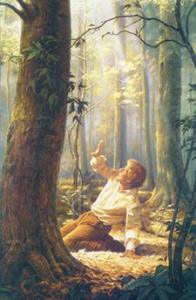
Joseph Smith and the “First Vision”
It is this image that Mormon missionaries offer to those who are “investigating” the Mormon church, with the hope that they will follow Joseph Smith’s example. This experience of asking God about the truthfulness of the Mormon Church’s doctrine and the legitimacy of its ecclesiastical authority and then having some kind of spiritual experience of affirmation is what Mormons call “gaining a testimony”. This experience is to Mormons what being saved is to evangelicals, at least in terms of its importance in the individual and communal religious life. (For anyone interested in the topic of Mormon “testimonies”, check out Douglas Davies’ The Mormon Culture of Salvation.)
In an article entitled “Joseph Smith and the Structure of Mormon Identity”, Steven Olsen discusses the function of the First Vision story in the formation of Mormon identity. (Olsen was a professor of mine at BYU.) There are various versions of the First Vision. The earliest account written by the hand of Joseph Smith in 1832 differs in several key regards from version which became the official version in 1838. (If your interested in this, check out this site.) Olsen writes of the official version:
“[N]o other Mormon document can serve so well the role of cultural charter or creation myth. […] By integrating fundamental aspects of Mormon historical, theological and ideological consciousness into a simple narrative form, the Joseph Smith story becomes the model of testimony among a people whose declarations of faith are often expressed in experiential terms. The text also establishes Joseph Smith as the model convert …”
(emphasis added). In other words, Joseph Smith is an archetype.
What I had forgotten about, until yesterday at church, was the role of Satan in the First Vision account. The simplified version of the First Vision is that Joseph Smith wanted to know which church was true, went into the woods and prayed, and God the Father and Jesus Christ appeared to him and told him to join none of the churches, as they were all false. (According to the story, he would later receive further instruction on organizing the “true” church of Jesus Christ.)
This simplified version, which is the one told by Mormon missionaries, leaves out the encounter with Satan, which is part of the official version. The official version reads:
After I had retired to the place where I had previously designed to go, having looked around me, and finding myself alone, I kneeled down and began to offer up the desires of my heart to God. I had scarcely done so, when immediately I was seized upon by some power which entirely overcame me, and had such an astonishing influence over me as to bind my tongue so that I could not speak. Thick darkness gathered around me, and it seemed to me for a time as if I were doomed to sudden destruction.
But, exerting all my powers to call upon God to deliver me out of the power of this enemy which had seized upon me, and at the very moment when I was ready to sink into despair and abandon myself to destruction÷not to an imaginary ruin, but to the power of some actual being from the unseen world, who had such marvelous power as I had never before felt in any being÷just at this moment of great alarm, I saw a pillar of light exactly over my head, above the brightness of the sun, which descended gradually until it fell upon me.
It no sooner appeared than I found myself delivered from the enemy which held me bound. When the light rested upon me I saw two Personages …
This is a moving and intimate account of an encounter with “an actual being” with overwhelming powers of darkness and stupification. It resembles closely in its structure and degree of intimacy the imagery which was still being used in the LDS Church that I visited this past Sunday. Olsen comments: “A more powerful contrast between light and dark could not be imagined”. According Olsen, it is precisely this dichotomy between light and darkness which provides the structure for the essential Mormon identity. No wonder then the there is so much talk about Satan/the Adversary in Mormon religious meetings. (Although I have not yet read it, another book on this topic is Douglas Davies’ Joseph Smith, Jesus, and Satanic Opposition.)
I’ve posted about the issue of evil and Satan before, but I want to look at it from a different angle in this post. One of the fundamental steps of my de-conversion from Mormonism and Christianity was the realization that the patriarchal, judgmental Father God that had terrorized me for years was really just a projection of my Inner Judge. In To Have to To Be, Eric Fromm writes:
“God, originally a symbol for the highest value that we can experience within us, becomes in the having mode, an idol. In the prophetic concept, an idol is a thing that we ourselves make and project our own powers into, thus impoverishing ourselves. We then submit to our creation and by our submission are in touch with ourselves in an alienated form.”
The same is true of Satan. In psychoanalytic theory, every devil is a projection of our inner repressions onto others. When we project our “gods” outward, not only do we impoverish ourselves, but our gods can become demonic. Conversely, when we project our demons outward, we loose the personal power that they can grant us through their integration.
Mormon identity is structured around an almost Manichean dichotomy between light and darkness, God and Satan. My Neopagan identity, in contrast, is structured around the integration of light and darkness, God and Satan. Jung believed that our conceptions of God, in order to be more representative of psychic wholeness, need to integrate not only the feminine, the earthly, and the bodily, but also the Satanic. To complement God the Father, there must be God the Mother (which might be suggested in the figure of Mary). To complement the Holy Spirit, there must be the Holy Body (which might be implicit in the doctrine of the incarnation). And to complement the figure of Jesus, Jung believes we need to assimilate the figure of Satan. In Jung’s mythos, Satan is God’s s unconscious. And it is in the human psyche that God is made whole, reconciled with his own Shadow.
Jung writes in his Red Book impressionistically of his own experience of this assimilation:
The devil is the sum of the darkness of human nature. He who lives in the light strives toward being the image of God; he who lives in the dark strives toward being the image of the devil. Because I wanted to live in the light, the sun went out for me when I touched the depths. It was dark and serpent-like.
I united myself with it and did not overpower it. I took my part of the humiliation and subjugation upon myself, in that I took on the nature of the serpent. If I had not become like the serpent, the devil, the quintessence of everything serpentile, would have held this bit of power over me. This would have given the devil a grip and he would have forced me to make a pact with him just as he also cunningly deceived Faust. But I forestalled him by uniting myself with the serpent, just as a man unites with a woman.
So I took away from the devil the possibility of influence, which only ever passes through one’s own serpenthood, which one commonly assigns to the devil instead of oneself …
Thus I built a firm structure. Through this I myself gained stability and duration and could withstand the fluctuations of the personal.
I wonder what symbols might express this experience of integration. Our culture is replete with imagery of light and dark diametrically opposed, but seems to have fewer images of reconciliation. One Hollywood example of the latter that came to mind is the Jim Henson movie, The Dark Crystal, which depicts two races, the wise Mystics and evil Skeksis. Over the course of the movie, we gradually realize that the two races are inexorably intertwined, and in the climatic conclusion, the two races are literally rejoined into one, when the broken shard of the Dark Crystal is returned.
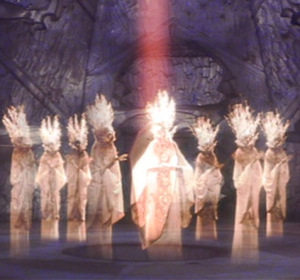
The Dark Crystal
A more ancient example might be the Descent of Inanna/Ishtar. Inanna descends into the underworld, in search of her lost lover (i.e., her animus) in some versions of the story. She passes through seven gates, at each of which she has to shed her clothing and jewels, the symbols of her power and personhood, until she stands naked before the Queen of the Underworld, Erishkigal, Inanna’s sister. Erishkigal hangs Inanna on a hook like a piece of meat.
Only when the god Enki sends two servants to the underworld is Inanna/Ishtar rescued. What is interesting is how this is accomplished. These servants, whose natures are ambiguous, convince Erishkigal to let Inanna go by gaining her goodwill by first sympathizing with her suffering, groaning with her pains.
They entered the throne room of the Queen of the Underworld. No linen was spread over her body. Her breasts were uncovered. Her hair swirled around her head like leeks.
Ereshkigal was moaning:
“Oh! Oh! My inside!”
They moaned:
“Oh! Oh! Your inside!”
She moaned:
“Ohhhh! Oh! My outside!”
They moaned:
”Ohhhh! Oh! Your outside!”
She groaned:
“Oh! Oh! My belly!”
They groaned:
”Oh! Oh! Your belly!”
She groaned:
“Oh! Ohhhh! My back!”
They groaned:
”Oh! Ohhhh! Your back!”
She sighed:
“Ah! Ah! My heart!”
They sighed:
”Ah! Ah! Your heart!”
She sighed:
“Ah! Ahhhh! My liver!”
They sighed:
”Ah! Ahhhh! Your liver!”
Ereshkigal stopped.
She looked at them.
She asked:
“Who are you,
Moaning – groaning – sighing with me?
If you are gods, I will bless you.
If you are mortals, I will give you a gift.
… “
While Inanna is not identified with Ereshkigal in the myth, Erishkigal’s reconciliation can be understood as a form of integration of the darkness with the light.
I’m having difficulty coming up with other symbols of integration. This may be a bad sign for our culture. Or it may just be a failure of imagination on my part. Any suggestions?
Previous Post

January 30, 2012
Family Midwinter Ritual (Revised 2014)
Next Post
February 2, 2012 Mormon Polygamy: When God is a Jerk
Browse Our Archives
Select a Category Ritual Scripts Theology Uncategorized
Select a Month January 2017 December 2016 November 2016 October 2016 September 2016 August 2016 July 2016 June 2016 May 2016 April 2016 March 2016 February 2016 January 2016 December 2015 November 2015 October 2015 September 2015 August 2015 July 2015 June 2015 May 2015 April 2015 March 2015 February 2015 January 2015 December 2014 November 2014 October 2014 September 2014 August 2014 July 2014 June 2014 May 2014 April 2014 March 2014 February 2014 January 2014 December 2013 November 2013 October 2013 September 2013 August 2013 July 2013 June 2013 May 2013 April 2013 March 2013 February 2013 January 2013 December 2012 November 2012 October 2012 September 2012 August 2012 July 2012 June 2012 May 2012 April 2012 March 2012 February 2012 January 2012 December 2011 November 2011 October 2011 September 2011 August 2011
TAKE THE
Religious Wisdom Quiz
What is the name for the Christian practice of immersion or sprinkling in water to welcome believers?
Select your answer to see how you score.
Eucharist Ordination Baptism Confirmation
Related posts from The Allergic Pagan
I'm a spy for the Mormon Church

The Pagans and the Christians (or ... whatever...

The Forgotten History of Atheist Paganism
Christianity as the Modern Pagan Scapegoat
TRENDING AT PATHEOS Pagan

I was recently chatting with someone on Instagram. She asked me what...

While there are many people who share their results, the end of...

On July 23, I saw Christopher Nolan's The Odyssey which is Homer’s...

As I write this two big events have just finished up. One...

Restoring the Watershed of Divine Love
Perhaps cooperation is not something we manufacture through legislation, ideology, or moral...

Many UUs don’t pray because of bad experiences in a previous religion,...
view all Pagan blogs
Ad-Free & Subscriber Log-In Subscription Support
- About Us
- 2026 Calendar
- Videos
- Podcasts
- Library of World Religions
- Faith In Media Tracker
- Advertise With Us
- Write for Us
- Privacy Policy
- Terms of Service
- Do Not Sell My Data
- Contact Us
- Radiant Digital
- Manage Newsletter Subscriptions
- Unsubscribe From Notifications
- Sitemap
Copyright 2008-2026, Patheos. All rights reserved.
Subscription Support Ad-Free & Subscriber Log-In
Follow Patheos