
BuddhistCatholicContemplativeEvangelicalGeneral ChristianHinduJewishLatter-day SaintMuslimNew VisionsProgressive Christian
Beliefs
- Buddhist
- Catholic
- Contemplative
- Evangelical
- General Christian
- Hindu
- Jewish
- Latter-day Saint
- More Voices
- Muslim
- New Visions
- Pagan
- Progressive Christian
Topics
- Religion News
- Food and Religion
- Sports and Religion
- Religious Art
- Religious Music and Entertainment
- Religious Events
- History and Religion
- Style and Religion
- Politics and Religion
- Women in Religion
- Recreation Outdoors and Religion
- Business Finance and Religion
- Careers Workplace and Religion
- Education and Religion
- Family Parenting and Religion
- Health Fitness and Religion
- Home and Religion
- Relationships and Religion
- Technology and Religion
- Travel and Religion
Columnists
- Buddhist Columnists
- Business Finance and Religion Columnists
- Careers Workplace and Religion Columnists
- Catholic Columnists
- Contemplative Columnists
- Education and Religion Columnists
- Evangelists Columnists
- Family Parenting and Religion Columnists
- General Christian Columnists
- Health Fitness and Religion Columnists
- Hindu Columnists
- History and Religion Columnists
- Home and Religion Columnists
- Jewish Columnists
- More Voices Columnists
- Latter Day Columnists
- Muslim Columnists
- New Visions Columnists
- Nonreligious Columnists
- Pagan Columnists
- Politics and Religion Columnists
- Progressive Columnists
- Recreation Outdoors and Religion Columnists
- Relationships and Religion Columnists
- Religion News Columnists
- Religious Art Columnists
- Religious Events Columnists
- Religious Music and Entertainment Columnists
- Sports and Religion Columnists
- Style and Religion Columnists
- Technology and Religion Columnists
- Travel and Religion Columnists
- Women in Religion Columnists
Resource Library
- 2026 Calendar
- Library of World Religions
- The 100 Most Holy Places on Earth
- Patheos Answers
- Podcasts
- Videos
- Faith Leaders Database
- Anglican Episcopalian
- Bahai
- Baptist
- Buddhism
- Christianity
- Confucianism
- Eastern Orthodoxy
- Hinduism
- Holiness and Pentecostal
- ISKCON
- Islam
- Judaism
- Lutheran
- Methodist
- The Church of Jesus Christ of Latter-day Saints
- New Age
- Paganism
- Presbytarian and Reformed
- Protestantism
- Religion Behind the Scenes
- Roman Catholic
- Scientology
- Shia Islam
- Sikhism
- Sufism
- Sunni Islam
- Taoism
- Zen
- See all religions
Research Tools
 Ad-Free & Subscriber Log-In Subscription Support
Ad-Free & Subscriber Log-In Subscription Support
Follow Patheos 

- Trending:
- Forgiveness
- |
- Marriage
- |
- Consciousness
- |
- Death Penalty
- |
- Election
- |
- Halloween
 The Allergic Pagan
- Home
- Pagan
- D. H. Lawrence’s Pagan Creed
D. H. Lawrence’s Pagan Creed
Last updated on: December 7, 2011 at 11:45 am by John Halstead
D. H. Lawrence’s Pagan Creed 2011-12-07T11:45:22-05:00 John Halstead
Patheos Explore the world's faith through different perspectives on religion and spirituality! Patheos has the views of the prevalent religions and spiritualities of the world.
I recently picked up D.H. Lawrence’s Sons and Lovers. I’ve been wanting to read Lawrence ever since I read Ronald Hutton’s Drawing Down the Moon, in which he groups Lawrence with such proto-Pagans as Robert Graves, W. B. Yeats, Ernest Westlake and Harry (Dion) Byngham (of the Order or Woodcraft Chivalry), who were part of the “matrix” out of which Neo paganismwas born.
According to Hutton, Lawrence was influenced by James Frazer, Jane Ellen Harrison, and Edward Carpenter, author of Pagan and Christian Creeds and Civilization: It’s Causes and Cure (“The meaning of the old religions will come back to him. On the high-tops once more gathering he will celebrate with naked dances the glory of the human form and the great processions of the stars, or greet the bright horn of the young moon …”).
Lawrence’s novels are interspersed with imagery of women and nature that are definitely proto-Pagan. His essay, “Pan in America” (1924), is one of the clearest examples of Lawrence’s pagan inclinations. describing what he calls the “Pan relationship” as the living relationship between man and nature. Then, shortly before his death, in his short story “The Man Who Died” (1929), Lawrence tells the story of the resurrected Christ, waking from his tomb and traveling to a temple of Isis where he serves (sexually) as the incarnated Osiris for the priestess. In his posthumous Apocalypse, Lawrence rewrites the book of Revelation as a pagan mystery text, the Whore of Babylon becoming the Great Mother, for example.
Finally, in his travelogue, Etruscan Places, Lawrence gives this imaginative interpretation of the frescoes he saw in Italy:
It is as if the current of some strong different life swept through them, different from our shallow current to-day; as if they drew their vitality from different depths that we are denied. …
Behind all the Etruscan liveliness was a religion of life … Behind all the dancing was a vision, and even a science of life, a conception of the universe and man’s place in the universe which made men live to the depth of their capacity.
To the Etruscan all was alive; the whose universe lived; and the business of man was himself to live amid it all. He had to draw life into himself, out of the wandering huge vitalities of the world. He had to draw life into himself, out of the wandering huge vitalities of the world. The cosmos was alive, like a vast creature. The whole thing breathed and stirred. …
The Whole thing was alive, and had a great soul, or anima; and in spite of one great soul, there were myriad roving, lesser souls; every man, every creature every tree and lake and mountain and stream was animate, had its own peculiar consciousness. And has it to-day.
The cosmos was one, and its anima was one; but it was made up of creatures. And the greatest creature was the earth, with its soul of inner fire. … But in juxtaposition to earth lay the sea, the waters that moved and pondered and held a deep soul of their own. …
The universe … became a dual creature with two souls, fiery and watery, for ever mingling and rushing apart, and held by the great aliveness of the universe in an ultimate equilibrium. … And everything was dual, or contained its own duality, forever mingling and rushing apart.
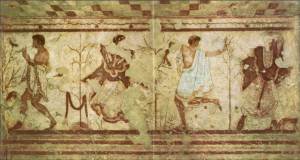
Lawrence’s thought is, at once, pantheistic, animistic, and vitalistic. He recognizes the oneness and the multiplicity in things, as well as the function of a creative duality.
Having read the foregoing, I was excited to read Sons and Lovers, but so far I have been disappointed. I am thinking about laying it down and instead starting Women in Love, his most popular novel, or The Plumed Serpent, about the revival of a pagan cult in Mexico. In any case, I did some internet research and found that, in addition to the sources cited above, Lawrence’s proto-paganism is best represented by a handful of statements in many different essays, poems, and letters.
One of the most interesting to me was the following, which Lawrence wrote as a kind of response to Benjamin Franklin’s own personal creed, found in Lawrence’s Studies is Classic American Literature:
Here’s my creed, against Benjamin’s. This is what I believe:
‘That I am I.’
‘That my soul is a dark forest.’
‘That my known self will never be more than a little clearing in the forest.’
‘That gods, strange gods, come forth from the forest into the clearing of my known self, and then go back.’
‘ That I must have the courage to let them come and go.’
‘That I will never let mankind put anything over me, but that I will try always to recognize and submit to the gods in me and the gods in other men and women.’
There is my creed. He who runs may read. He who prefers to crawl, or to go by gasoline, can call it rot.
Then for a ‘list’. It is rather fun to play at Benjamin.
1. Temperance
Eat and carouse with Bacchus, or munch dry bread with Jesus, but don’t sit down without one of the gods.
2. Silence
Be still when you have nothing to say; when genuine passion moves you, say what you’ve got to say, and say it hot.
3. Order
Know that you are responsible to the gods inside you and to the men in whom the gods are manifest. Recognize your superiors and your inferiors, according to the gods. This is the root of all order.
4. Resolution
Resolve to abide by your own deepest promptings, and to sacrifice the smaller thing to the greater. Kill when you must, and be killed the same: the “must” coming from the gods inside you, or from the men in whom you recognize the Holy Ghost.
5. Frugality
Demand nothing; accept what you see fit. Don’t waste your pride or squander your emotion.
6. Industry
Lose no time with ideals; serve the Holy Ghost; never serve mankind.
7. Sincerity
To be sincere is to remember that I am I, and that the other man is not me.
8. Justice
The only justice is to follow the sincere intuition of the soul, angry or gentle. Anger is just, and pity is just, but judgement is never just.
9. Moderation
Beware of absolutes. There are many gods.
10. Cleanliness
Don’t be too clean. It impoverishes the blood.
11. Tranquility
The soul has many motions, many gods come and go. Try and find your deepest issue, in every confusion, and abide by that. Obey the man in whom you recognize the Holy Ghost; command when your honour comes to command.
12. Chastity
Never ‘use’ venery at all. Follow your passional impulse, if it be answered in the other being; but never have any motive in mind, neither offspring nor health nor even pleasure, nor even service. Only know that ‘venery’ is of the great gods. An offering-up of yourself to the very great gods, the dark ones, and nothing else.
13. Humility
See all men and women according to the Holy Ghost that is within them. Never yield before the barren.
There’s my list. I have been trying dimly to realize it for a long time, and only America and old Benjamin have at last goaded me into trying to formulate it.
Lawrence’s understanding of the soul is almost Jungian. (Jung was a contemporary of Lawrence.) The idea that our souls are vaster than our conscious minds and that our soul is inhabited by “gods”, “gods” who must be respected — this is how I understand Jung.
This gem is “buried” in an essay on Benjamin Franklin of all subjects. This seems to be typical of Lawrence. His proto-Pagan philosophy is scattered throughout his writings, much of it published posthumously or in personal correspondence. I’m going to follow this with another post about Lawrence, in which I will try to collect many of his quotes of Pagan interest into some kind of organization. To be continued …
Previous Post

December 6, 2011
Why Unitarians Can't Dance: Spirituality
Next Post
December 10, 2011 First Snow
Browse Our Archives
Select a Category Ritual Scripts Theology Uncategorized
Select a Month January 2017 December 2016 November 2016 October 2016 September 2016 August 2016 July 2016 June 2016 May 2016 April 2016 March 2016 February 2016 January 2016 December 2015 November 2015 October 2015 September 2015 August 2015 July 2015 June 2015 May 2015 April 2015 March 2015 February 2015 January 2015 December 2014 November 2014 October 2014 September 2014 August 2014 July 2014 June 2014 May 2014 April 2014 March 2014 February 2014 January 2014 December 2013 November 2013 October 2013 September 2013 August 2013 July 2013 June 2013 May 2013 April 2013 March 2013 February 2013 January 2013 December 2012 November 2012 October 2012 September 2012 August 2012 July 2012 June 2012 May 2012 April 2012 March 2012 February 2012 January 2012 December 2011 November 2011 October 2011 September 2011 August 2011
TAKE THE
Religious Wisdom Quiz
Who built two gold calves, leading Israel into idolatry after the split?
Select your answer to see how you score.
Rehoboam Jeroboam Josiah Solomon
Related posts from The Allergic Pagan
Tell Me Again That Jungians Can't Be Pagan...

"Darkness Leaping Out of Light": The Summer Solstice...

Love, Earth, Body, Ritual: These are the threads...
Being the Allergic Pagan: My lover’s quarrel with...
TRENDING AT PATHEOS Pagan

When we talk about Greek religion, we often begin with the dodekatheion—the...

I was recently chatting with someone on Instagram. She asked me what...

While there are many people who share their results, the end of...

On July 23, I saw Christopher Nolan's The Odyssey which is Homer’s...

As I write this two big events have just finished up. One...

Restoring the Watershed of Divine Love
Perhaps cooperation is not something we manufacture through legislation, ideology, or moral...
view all Pagan blogs
Ad-Free & Subscriber Log-In Subscription Support
- About Us
- 2026 Calendar
- Videos
- Podcasts
- Library of World Religions
- Faith In Media Tracker
- Advertise With Us
- Write for Us
- Privacy Policy
- Terms of Service
- Do Not Sell My Data
- Contact Us
- Radiant Digital
- Manage Newsletter Subscriptions
- Unsubscribe From Notifications
- Sitemap
Copyright 2008-2026, Patheos. All rights reserved.
Subscription Support Ad-Free & Subscriber Log-In
Follow Patheos