
BuddhistCatholicContemplativeEvangelicalGeneral ChristianHinduJewishLatter-day SaintMuslimNew VisionsProgressive Christian
Beliefs
- Buddhist
- Catholic
- Contemplative
- Evangelical
- General Christian
- Hindu
- Jewish
- Latter-day Saint
- More Voices
- Muslim
- New Visions
- Pagan
- Progressive Christian
Topics
- Religion News
- Food and Religion
- Sports and Religion
- Religious Art
- Religious Music and Entertainment
- Religious Events
- History and Religion
- Style and Religion
- Politics and Religion
- Women in Religion
- Recreation Outdoors and Religion
- Business Finance and Religion
- Careers Workplace and Religion
- Education and Religion
- Family Parenting and Religion
- Health Fitness and Religion
- Home and Religion
- Relationships and Religion
- Technology and Religion
- Travel and Religion
Columnists
- Buddhist Columnists
- Business Finance and Religion Columnists
- Careers Workplace and Religion Columnists
- Catholic Columnists
- Contemplative Columnists
- Education and Religion Columnists
- Evangelists Columnists
- Family Parenting and Religion Columnists
- General Christian Columnists
- Health Fitness and Religion Columnists
- Hindu Columnists
- History and Religion Columnists
- Home and Religion Columnists
- Jewish Columnists
- More Voices Columnists
- Latter Day Columnists
- Muslim Columnists
- New Visions Columnists
- Nonreligious Columnists
- Pagan Columnists
- Politics and Religion Columnists
- Progressive Columnists
- Recreation Outdoors and Religion Columnists
- Relationships and Religion Columnists
- Religion News Columnists
- Religious Art Columnists
- Religious Events Columnists
- Religious Music and Entertainment Columnists
- Sports and Religion Columnists
- Style and Religion Columnists
- Technology and Religion Columnists
- Travel and Religion Columnists
- Women in Religion Columnists
Resource Library
- 2026 Calendar
- Library of World Religions
- The 100 Most Holy Places on Earth
- Patheos Answers
- Podcasts
- Videos
- Faith Leaders Database
- Anglican Episcopalian
- Bahai
- Baptist
- Buddhism
- Christianity
- Confucianism
- Eastern Orthodoxy
- Hinduism
- Holiness and Pentecostal
- ISKCON
- Islam
- Judaism
- Lutheran
- Methodist
- The Church of Jesus Christ of Latter-day Saints
- New Age
- Paganism
- Presbytarian and Reformed
- Protestantism
- Religion Behind the Scenes
- Roman Catholic
- Scientology
- Shia Islam
- Sikhism
- Sufism
- Sunni Islam
- Taoism
- Zen
- See all religions
Research Tools
 Ad-Free & Subscriber Log-In Subscription Support
Ad-Free & Subscriber Log-In Subscription Support
Follow Patheos 

- Trending:
- Forgiveness
- |
- Marriage
- |
- Consciousness
- |
- Death Penalty
- |
- Election
- |
- Halloween
 The Allergic Pagan
- Home
- Pagan
- Movies that are religious experiences, Part 2 (Solaris)
Movies that are religious experiences, Part 2 (Solaris)
Last updated on: October 19, 2011 at 6:23 pm by John Halstead
Movies that are religious experiences, Part 2 (Solaris) 2011-10-19T18:23:03-05:00 John Halstead
Patheos Explore the world's faith through different perspectives on religion and spirituality! Patheos has the views of the prevalent religions and spiritualities of the world.
A little while ago, I posted about my favorite movie, The Fountain. It is one of three of my all time favorite movies. The second one is Solaris. I first saw Solaris at the international film theater as an undergraduate. It was the 1972 Russian version by Andrei Tarkovsky.
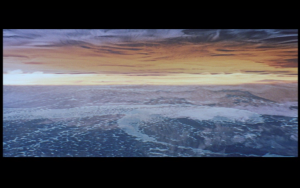
Solaris (1972)
I went right out at read the book by Stanislav Lem, which became one of my favorite books. It was remade in 2002 by Steven Soderbergh, and starred George Clooney.

Solaris (2002)
The remake is actually pretty good, with the exception of the last scene — but I will get to that.
The basic plot of Solaris is this: there is a distant planet, Solaris, which is circled by a space station. On the station, there is a miracle happening. And somehow the planet is causing it. Each of the inhabitants of the station has a “visitor”. The planet spontaneously generates these persons using information from the minds of the inhabitants while they are sleeping. In some instances, these visitors are unwanted. In the case of the main character, Kelvin, who is visited by his dead wife, the visitor is desired. It eventually becomes apparent that the visitors are not strictly-speaking human. They are immortal and will resurrect if they are killed.
What I get from the movie is summed up in a phrase from the last line of the book: “I persisted in the faith that the time of cruel miracles was not past.” Cruel miracles. The miracles in Solaris were cruel because they took place without regard for the wishes of the human beings involved. They were cruel because they were unpredictable. And they were cruel because their meaning was inscrutable. The humans could not communicate with Solaris and the planet seemed indifferent to human desires or needs. In short, Solaris is a metaphor for God.
Cruel miracles is perfect expression my understanding of divinity. Not only because I identify God with Nature, and Nature can seem cruel, but also because Nature is wonderful and awe-inspiring, so that it seems “miraculous”. Not “miraculous” in the sense of violating natural laws, obviously, but seemingly extra-ordinary, even when it is not. But throughout all this wonder and awe is threaded the “cruel” reality that Nature is ultimately indifferent to human life and unresponsive to our search for meaning.
In the movie, each of the characters copes with these miracles in different ways. One tries to destroy the miracle. One commits suicide. Only Kelvin, in the end, embraces the mystery, and persists “in the faith that the time of cruel miracles was not past.” Having faith in cruel miracles means, I think, just being willing to be present, as a witness to the wonder and beauty and terror of this world. As Annie Dillard in Pilgrim at Tinker Creek writes when she catches the awe-inspiring sight of a mockingbird’s descent:
“The fact of his free fall was like the old philosophical conundrum about the tree that falls in the forest. The answer must be, I think, that beauty and grace are performed whether or not we will or sense them. The least we can do is try to be there.”
The following excerpt comes from a critical analysis of the book Solaris. Unfortunately I have lost the source, but it sums up why I love Solaris:
“Terror for man arises from the universe’s inability or unwillingness to communicate with him. It is the tragedy of man’s imperfect machinery for gaining knowledge. The alien represents the limits of man’s knowledge and the implacable silence of the universe. The silence alludes to nature’s indifference about establishing contact with man and, on a deeper level, the fundamental nothingness of the universe. It symbolizes existential absurdity. When man exceeds these boundaries, he lapses into anthropomorphism. How does man react when confronted with the incomprehensible and uncommunicative, but benign? He may commit suicide, or try to destroy the alien, or refuse to acknowledge the validity of the alien. Each represents a capitulation or a refusal to come to terms with the new world. But the hero is transformed by the events. The change is to accept a new posture and a new world in which man is not supreme and must instead wait expectantly while believing in cruel miracles. The alien presents a challenge to man that frustrates while also elevating him so that he may pursue ever higher goals. The key to this philosophical puzzle is that man must eventually learn in certain situations to forgo control and to give into the subconscious aspects of his personality and the world. The hero is willing as no other to go with the mystery and chaos of the alien and, in the process of yielding ‘control’ over his destiny, to renounce his anthropomorphic vision of the universe. The possibility is that he will learn of an entirely new mode of being, which the other control-obsessed typical human beings could never entertain.”
When confronted with the silence of Nature in response to our pleas, for answers or salvation, we can despair, we can try to destroy Nature, we can imagine another world where human beings are supreme, i.e., heaven (what the writer above calls a lapse into “anthropomorphism”), or we can embrace the mystery that is this life. I wonder if our undeclared war on our planet is not a product of an unconscious desire to destroy the “alien” so to speak. Solaris challenges us to look the alien other in the face, and accept the miracle that is Nature (or God), in spite of the concomitant cruelty of its silence.
The reason why I don’t like the last scene of the American remake is because it implies that Kelvin and his deceased wife are in some kind of heaven, at least some place beyond death, where love endures. Where the Russian film ends, the American remake adds one more scene, the happy ending that seems to be obligatory in all American dramas. The American version tries to tie a bow on what is otherwise a perfectly framed unanswered question mark. To pose any kind of heaven as an answer to the fundamental mystery that is Solaris is, I think, to betray the real message of the movie/book: that if we are not to capitulate to the meaningless of life, then all we can do is “persist in the faith that the time of cruel miracles is not past.”
Previous Post

October 19, 2011
Justice, Karma, and the Savage Garden
Next Post
October 20, 2011 The Storm King
Browse Our Archives
Select a Category Ritual Scripts Theology Uncategorized
Select a Month January 2017 December 2016 November 2016 October 2016 September 2016 August 2016 July 2016 June 2016 May 2016 April 2016 March 2016 February 2016 January 2016 December 2015 November 2015 October 2015 September 2015 August 2015 July 2015 June 2015 May 2015 April 2015 March 2015 February 2015 January 2015 December 2014 November 2014 October 2014 September 2014 August 2014 July 2014 June 2014 May 2014 April 2014 March 2014 February 2014 January 2014 December 2013 November 2013 October 2013 September 2013 August 2013 July 2013 June 2013 May 2013 April 2013 March 2013 February 2013 January 2013 December 2012 November 2012 October 2012 September 2012 August 2012 July 2012 June 2012 May 2012 April 2012 March 2012 February 2012 January 2012 December 2011 November 2011 October 2011 September 2011 August 2011
TAKE THE
Religious Wisdom Quiz
According to 2 Thessalonians, what are believers told to stand firm and hold fast to?
Select your answer to see how you score.
The faith once delivered The traditions of the elders The teachings passed on to them The word of God
Related posts from The Allergic Pagan

Autumn Equinox: God is Climate Change

How "Gods Before Politics" Perpetuates Privilege

Why We Need A God/dess Who Does Not...
TRENDING AT PATHEOS Pagan

When we talk about Greek religion, we often begin with the dodekatheion—the...

I was recently chatting with someone on Instagram. She asked me what...

While there are many people who share their results, the end of...

On July 23, I saw Christopher Nolan's The Odyssey which is Homer’s...

As I write this two big events have just finished up. One...

Restoring the Watershed of Divine Love
Perhaps cooperation is not something we manufacture through legislation, ideology, or moral...
view all Pagan blogs
Ad-Free & Subscriber Log-In Subscription Support
- About Us
- 2026 Calendar
- Videos
- Podcasts
- Library of World Religions
- Faith In Media Tracker
- Advertise With Us
- Write for Us
- Privacy Policy
- Terms of Service
- Do Not Sell My Data
- Contact Us
- Radiant Digital
- Manage Newsletter Subscriptions
- Unsubscribe From Notifications
- Sitemap
Copyright 2008-2026, Patheos. All rights reserved.
Subscription Support Ad-Free & Subscriber Log-In
Follow Patheos