
BuddhistCatholicContemplativeEvangelicalGeneral ChristianHinduJewishLatter-day SaintMuslimNew VisionsProgressive Christian
Beliefs
- Buddhist
- Catholic
- Contemplative
- Evangelical
- General Christian
- Hindu
- Jewish
- Latter-day Saint
- More Voices
- Muslim
- New Visions
- Pagan
- Progressive Christian
Topics
- Religion News
- Food and Religion
- Sports and Religion
- Religious Art
- Religious Music and Entertainment
- Religious Events
- History and Religion
- Style and Religion
- Politics and Religion
- Women in Religion
- Recreation Outdoors and Religion
- Business Finance and Religion
- Careers Workplace and Religion
- Education and Religion
- Family Parenting and Religion
- Health Fitness and Religion
- Home and Religion
- Relationships and Religion
- Technology and Religion
- Travel and Religion
Columnists
- Buddhist Columnists
- Business Finance and Religion Columnists
- Careers Workplace and Religion Columnists
- Catholic Columnists
- Contemplative Columnists
- Education and Religion Columnists
- Evangelists Columnists
- Family Parenting and Religion Columnists
- General Christian Columnists
- Health Fitness and Religion Columnists
- Hindu Columnists
- History and Religion Columnists
- Home and Religion Columnists
- Jewish Columnists
- More Voices Columnists
- Latter Day Columnists
- Muslim Columnists
- New Visions Columnists
- Nonreligious Columnists
- Pagan Columnists
- Politics and Religion Columnists
- Progressive Columnists
- Recreation Outdoors and Religion Columnists
- Relationships and Religion Columnists
- Religion News Columnists
- Religious Art Columnists
- Religious Events Columnists
- Religious Music and Entertainment Columnists
- Sports and Religion Columnists
- Style and Religion Columnists
- Technology and Religion Columnists
- Travel and Religion Columnists
- Women in Religion Columnists
Resource Library
- 2026 Calendar
- Library of World Religions
- The 100 Most Holy Places on Earth
- Patheos Answers
- Podcasts
- Videos
- Faith Leaders Database
- Anglican Episcopalian
- Bahai
- Baptist
- Buddhism
- Christianity
- Confucianism
- Eastern Orthodoxy
- Hinduism
- Holiness and Pentecostal
- ISKCON
- Islam
- Judaism
- Lutheran
- Methodist
- The Church of Jesus Christ of Latter-day Saints
- New Age
- Paganism
- Presbytarian and Reformed
- Protestantism
- Religion Behind the Scenes
- Roman Catholic
- Scientology
- Shia Islam
- Sikhism
- Sufism
- Sunni Islam
- Taoism
- Zen
- See all religions
Research Tools
 Ad-Free & Subscriber Log-In Subscription Support
Ad-Free & Subscriber Log-In Subscription Support
Follow Patheos 

- Trending:
- Forgiveness
- |
- Marriage
- |
- Consciousness
- |
- Death Penalty
- |
- Election
- |
- Halloween
 The Allergic Pagan
- Home
- Pagan
- Pagan Archetypes
Pagan Archetypes
Last updated on: July 20, 2013 at 8:01 am by John Halstead
Pagan Archetypes 2013-07-20T08:01:55-05:00 John Halstead
Patheos Explore the world's faith through different perspectives on religion and spirituality! Patheos has the views of the prevalent religions and spiritualities of the world.
Over at Alison Leigh Lilly’s blog, Peace, Poesis, and Wild Holy Earth, she brings some wonderful insight to the question of Pagan (in her case Druid) identity:
“As a religion, modern Druidry has grown up around the archetype of the Druid as the wise sage, the inspired poet, the bright-eyed seer and the lover of nature. That archetype of the Druid is the acorn from which the oak of Druidry as a religion grows and expands, reaching limbs in all directions, sending down roots deep into the earth and the present moment. The Druid archetype is the ideal that helps to shape and guide the religious lives of those who practice Druidry — just as the acorn contains within itself the genetic patterns necessary to create the mature oak, and yet each oak itself must draw nutrients from its immediate environment and will grow in its turn to fit its own place and time. No two oaks that grow in the wild will be the same, and that process of growth is never-ending as each new branch, twig, leaf and root seek their own way towards sunlight and soil.”
I think what Alison says about Druidry could be said of Paganism, Witchcraft, etc. It is perhaps the archetypes of the Druid, the Pagan, the Witch, the Magician and so on that are the seeds of our respective identities, more than the reality of any ancient Pagan past. I also appreciate Alison’s observation that these archetypes do not limit or circumscribe our respective identities, as each of us has to grow our identity in the present, and each of us will do so in a different way. But what can bind us together is the shared archetype.
So, Alison is a Druid because the image of “the wise sage, the inspired poet, the bright-eyed seer, and the lover of nature” calls to her.
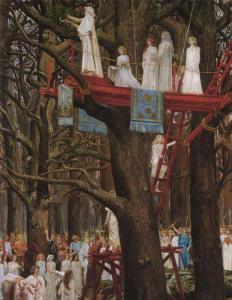
“Druids Cutting the Mistletoe on the Sixth Day of the Moon” by Henri Paul Motte
And I call myself a (Neo-)Pagan, because the image of the maypole-dancing, idol-worshiping, and fornicating-in-the-forest non-Christian calls to me.
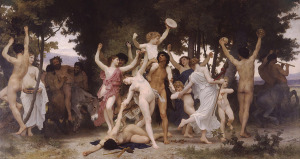
“The Youth of Bacchus” by William Bouguereau
While others are called by the image of the Witch, the powerful woman on the margins of society, the healer and visionary.
Of course, the Pagan and (even more so) the Witch archetypes are different from the Druid, in that they have strong negative connotations in our society. (I have never known someone to be called a Druid in a pejoritive sense.) But for some of us, it is precisely because these terms carry negative connotations that we embrace them and seek to reclaim them. Part of the reason I identify as (Neo-)Pagan is actually because the term is synonymous with irrelegion and hedonism for many Christians, and because my religion is so different from Christianity that some Christians don’t even recognize it as a religion. (Check out this article on Pagan religion in the world’s least “religious” country, recently posted on Wild Hunt. http://www.bbc.co.uk/news/worl…..e-14635021 ) I like the challenge that the name “Pagan” presents to others. And I suspect that many who identify as Witch feel the same. As Cynthia Eller writes in Living in the Lap of the Goddess:
“For spiritual feminists, being a witch, saying one is a witch, is most often a feminist statement, the symbolic encapsulation of a feminist political program. The witch is the powerful outsider, the despised and excluded person who is threatening the established order. All women are witches, according to some spiritual feminists, whether they want to be or not, because they possess nature (female) powers linked to childbirth and their intimate communion with nature, and they are therefore compelled to be outsiders to a male-dominant society.”
“Druid” also seems a little different because it actually was a specific religion, or as Alison points out, a class of people in a specific religious culture. Perhaps this is part of the appeal of the Druid archetype. As I understand it, “Pagan” and “Witch” were always pejoratives that were applied by people to outsiders and never really embraced by anyone until recently. I’ve heard (read) people from hereditary witchcraft traditions say that their grandmother or whatever told would acknowledge that other people might call what they do “witchcraft”, but they eschewed the terms themselves.
I am curious though if the archetype of the Druid, “the wise sage, the inspired poet, the bright-eyed seer, and the lover of nature”, like the archetypes of the Pagan and the Witch which our modern identities grow out of, is really more a product of Romanticism than any genuine reflection of an ancient culture. I suspect that Ronald Hutton addresses this in his recent book, Blood and Mistletoe: The History of the Druids in Britain, which I still need to check out.
Previous Post

August 26, 2011
Blog Response: UU and Pagan Aesthetics
Next Post
August 27, 2011 Blog Response: John the Pagan
Browse Our Archives
Select a Category Ritual Scripts Theology Uncategorized
Select a Month January 2017 December 2016 November 2016 October 2016 September 2016 August 2016 July 2016 June 2016 May 2016 April 2016 March 2016 February 2016 January 2016 December 2015 November 2015 October 2015 September 2015 August 2015 July 2015 June 2015 May 2015 April 2015 March 2015 February 2015 January 2015 December 2014 November 2014 October 2014 September 2014 August 2014 July 2014 June 2014 May 2014 April 2014 March 2014 February 2014 January 2014 December 2013 November 2013 October 2013 September 2013 August 2013 July 2013 June 2013 May 2013 April 2013 March 2013 February 2013 January 2013 December 2012 November 2012 October 2012 September 2012 August 2012 July 2012 June 2012 May 2012 April 2012 March 2012 February 2012 January 2012 December 2011 November 2011 October 2011 September 2011 August 2011
TAKE THE
Religious Wisdom Quiz
Which Old Testament book is composed mostly of love poems?
Select your answer to see how you score.
Ruth Proverbs Ecclesiastes Song of Solomon
Related posts from The Allergic Pagan

A Guide to Politics at Patheos Pagan

Call to Chicago Area Pagans: Come to Hammond...
Four "Godless Pagan" Authors on Pagan Musing Podcast...

Size Doesn't Matter: 5 Pieces of Advice for...
TRENDING AT PATHEOS Pagan

I was recently chatting with someone on Instagram. She asked me what...

While there are many people who share their results, the end of...

On July 23, I saw Christopher Nolan's The Odyssey which is Homer’s...

As I write this two big events have just finished up. One...

Restoring the Watershed of Divine Love
Perhaps cooperation is not something we manufacture through legislation, ideology, or moral...

Many UUs don’t pray because of bad experiences in a previous religion,...
view all Pagan blogs
Ad-Free & Subscriber Log-In Subscription Support
- About Us
- 2026 Calendar
- Videos
- Podcasts
- Library of World Religions
- Faith In Media Tracker
- Advertise With Us
- Write for Us
- Privacy Policy
- Terms of Service
- Do Not Sell My Data
- Contact Us
- Radiant Digital
- Manage Newsletter Subscriptions
- Unsubscribe From Notifications
- Sitemap
Copyright 2008-2026, Patheos. All rights reserved.
Subscription Support Ad-Free & Subscriber Log-In
Follow Patheos