
BuddhistCatholicContemplativeEvangelicalGeneral ChristianHinduJewishLatter-day SaintMuslimNew VisionsProgressive Christian
Beliefs
- Buddhist
- Catholic
- Contemplative
- Evangelical
- General Christian
- Hindu
- Jewish
- Latter-day Saint
- More Voices
- Muslim
- New Visions
- Pagan
- Progressive Christian
Topics
- Religion News
- Food and Religion
- Sports and Religion
- Religious Art
- Religious Music and Entertainment
- Religious Events
- History and Religion
- Style and Religion
- Politics and Religion
- Women in Religion
- Recreation Outdoors and Religion
- Business Finance and Religion
- Careers Workplace and Religion
- Education and Religion
- Family Parenting and Religion
- Health Fitness and Religion
- Home and Religion
- Relationships and Religion
- Technology and Religion
- Travel and Religion
Columnists
- Buddhist Columnists
- Business Finance and Religion Columnists
- Careers Workplace and Religion Columnists
- Catholic Columnists
- Contemplative Columnists
- Education and Religion Columnists
- Evangelists Columnists
- Family Parenting and Religion Columnists
- General Christian Columnists
- Health Fitness and Religion Columnists
- Hindu Columnists
- History and Religion Columnists
- Home and Religion Columnists
- Jewish Columnists
- More Voices Columnists
- Latter Day Columnists
- Muslim Columnists
- New Visions Columnists
- Nonreligious Columnists
- Pagan Columnists
- Politics and Religion Columnists
- Progressive Columnists
- Recreation Outdoors and Religion Columnists
- Relationships and Religion Columnists
- Religion News Columnists
- Religious Art Columnists
- Religious Events Columnists
- Religious Music and Entertainment Columnists
- Sports and Religion Columnists
- Style and Religion Columnists
- Technology and Religion Columnists
- Travel and Religion Columnists
- Women in Religion Columnists
Resource Library
- 2026 Calendar
- Library of World Religions
- The 100 Most Holy Places on Earth
- Patheos Answers
- Podcasts
- Videos
- Faith Leaders Database
- Anglican Episcopalian
- Bahai
- Baptist
- Buddhism
- Christianity
- Confucianism
- Eastern Orthodoxy
- Hinduism
- Holiness and Pentecostal
- ISKCON
- Islam
- Judaism
- Lutheran
- Methodist
- The Church of Jesus Christ of Latter-day Saints
- New Age
- Paganism
- Presbytarian and Reformed
- Protestantism
- Religion Behind the Scenes
- Roman Catholic
- Scientology
- Shia Islam
- Sikhism
- Sufism
- Sunni Islam
- Taoism
- Zen
- See all religions
Research Tools
 Ad-Free & Subscriber Log-In Subscription Support
Ad-Free & Subscriber Log-In Subscription Support
Follow Patheos 

- Trending:
- Forgiveness
- |
- Marriage
- |
- Consciousness
- |
- Death Penalty
- |
- Election
- |
- Halloween
 The Allergic Pagan
- Home
- Pagan
- My Spiritual Ancestor: John Trevor
My Spiritual Ancestor: John Trevor
Last updated on: August 26, 2011 at 9:56 am by John Halstead
My Spiritual Ancestor: John Trevor 2011-08-26T09:56:36-05:00 John Halstead
Patheos Explore the world's faith through different perspectives on religion and spirituality! Patheos has the views of the prevalent religions and spiritualities of the world.
There have been many writers I have encountered over the years that have had a transformative influence on my life: Annie Dillard (Pilgrim at Tinker Creek), Alan Watts (Behold the Spirit), Emerson (“Self-Reliance”), and Theodore Roszak (The Making of a Counterculture). But there has only been one author who I identified so closely with that I have been tempted to believe in reincarnation.
I’ve never believed in reincarnation really. I mean, I think it may happen for some people, but I haven’t had any reason to believe it has happened or will happen to me. However, reading the autobiography of John Trevor, the founder of the Labour Church in late 19th century England, I am so shocked by the resemblances, I have to wonder.
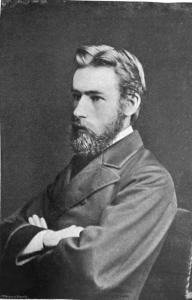
John Trevor, age 21 (1876)
I’d like to periodically write about Trevor’s life here and compare it with my own. Trevor’s autobiography is called My Quest for God, and very much focuses on his journey to find God*.* It is very introspective, which I think was unusual for an autobiography of the time. I recently came across a review of his book in American Fabian which was both accurate and entertaining:
“It has 274 large, closely filled pages. It is an autobiography, and he goes with minute detail and often wearisome repetition into his ancestry, birth, breeding, development and life. He gives long extracts from letters that he has written to prove a statement he has made about himself which a reader at once believes because he makes it. He quotes at length from older sermons to show his state of mind at a certain time. And all this mass revolves around himself. He is an interesting character, but not interesting enough to justify 274 pages of self-dissection and self-analysis.
“Henry Ward Beecher once said that if you want to get dyspepsia, follow every mouthful of food down to feel, if possible, whether it digests or not and what becomes of it. It would seem as if Mr. Trevor must have mental indigestion, so continual is the introspection.”
As a person who is prone myself to excessive introspection, I appreciated the reviewer’s characterization.
Trevor’s book was published in 1897, but Trevor lived from 1855 to 1930, which is interesting in itself, since he published his autobiography at the young age of 42 and then went on to live another 33 years. Trevor’s book is hard to find in any library, but you can download it here.
What drew me to the obscure book was actually reading another, more well-known, book: William James’ The Varieties of Religious Experience. In his chapter on mysticism, James quotes from Trevor’s autobiography as an example of a mystical experience. The experience stuck with me profoundly and years later I had to track down the source. Here was what Trevor wrote, near the end of his book:
“One brilliant Sunday morning, my wife and boys went to the Unitarian Chapel in Macclesfield. I felt it impossible to accompany them—as though to leave the sunshine on the hills, and go down there to the chapel, would be for the time an act of spiritual suicide. And I felt such need for new inspiration and expansion in my life. So, very reluctantly and sadly, I left my wife and boys to go down into the town, while I went further up into the hills with my stick and my dog. In the loveliness of the morning, and the beauty of the hills and valleys, I soon lost my sense of sadness and regret. For nearly an hour I walked along the road to the ‘Cat and Fiddle,’ and then returned. On the way back, suddenly, without warning, I felt that I was in Heaven—an inward state of peace and joy and assurance indescribably intense, accompanied with a sense of being bathed in a warm glow of light, as though the external condition had brought about the internal effect—a feeling of having passed beyond the body, though the scene around me stood out more clearly and as if nearer to me than before, by reason of the illumination in the midst of which I seemed to be placed. This deep emotion lasted, though with decreasing strength, until I reached home, and for some time after, only gradually passing away.”
Trevor then proceeds to explain the worth of such experiences as he understands it:
“The spiritual life justifies itself to those who live it; but what can we say to those who do not understand? This, at least, we can say, that it is a life whose experiences are proved real to their possessor, because they remain with him when brought closest into contact with the objective realities of life. Dreams cannot stand this test. We wake from them to find that they are but dreams. Wanderings of an overwrought brain do not stand this test. These highest experiences that I have had of God’s presence have been rare and brief—flashes of consciousness which have compelled me to exclaim with surprise—God is here!—or conditions of exaltation and insight, less intense, and only gradually passing away. I have severely questioned the worth of these moments. To no soul have I named them, lest I should be building my life and work on mere phantasies of the brain. But I find that, after every questioning and test, they stand out to-day as the most real experiences of my life, and experiences which have explained and justified and unified all past experiences and all past growth. Indeed, their reality and their far-reaching significance are ever becoming more clear and evident. When they came, I was living the fullest, strongest, sanest, deepest life. I was not seeking them. What I was seeking, with resolute determination, was to live more intensely my own life, as against what I knew would be the adverse judgment of the world. It was in the most real seasons that the Real Presence came, and I was aware that I was immersed in the infinite ocean of God.”
What struck me about Trevor’s experience was that he did not disassociate it from his real life in this world. He says he had these mystical experiences when he was living life to the fullest, and the experiences themselves made his life seem more real, not less. These were the kind of experiences I have had and want to continue to have.
So that’s it for Trevor for now. Next time I come back to him, I will write a little about his childhood: his intensity, his sensitivity, and the beginning of a long struggle with something he never names, but I think quite obviously was masturbation. Later I will write about how he lost his faith in the Christian religion and actually started sounding quite Pagan! (I honestly got chills when I read this part.)
Previous Post

August 26, 2011
My Daily Practice: Morning Ritual
Next Post
August 26, 2011 Blog Response: UU and Pagan Aesthetics
Browse Our Archives
Select a Category Ritual Scripts Theology Uncategorized
Select a Month January 2017 December 2016 November 2016 October 2016 September 2016 August 2016 July 2016 June 2016 May 2016 April 2016 March 2016 February 2016 January 2016 December 2015 November 2015 October 2015 September 2015 August 2015 July 2015 June 2015 May 2015 April 2015 March 2015 February 2015 January 2015 December 2014 November 2014 October 2014 September 2014 August 2014 July 2014 June 2014 May 2014 April 2014 March 2014 February 2014 January 2014 December 2013 November 2013 October 2013 September 2013 August 2013 July 2013 June 2013 May 2013 April 2013 March 2013 February 2013 January 2013 December 2012 November 2012 October 2012 September 2012 August 2012 July 2012 June 2012 May 2012 April 2012 March 2012 February 2012 January 2012 December 2011 November 2011 October 2011 September 2011 August 2011
TAKE THE
Religious Wisdom Quiz
How long did it take to rebuild Jerusalem's walls under Nehemiah?
Select your answer to see how you score.
7 years 12 months 52 days 40 days
Related posts from The Allergic Pagan
Why This Pagan Won't Be Honoring His Ancestors...

The Dictionary Is Not A Holy Book

Roots of the Deep Ecology Tree: John Muir,...

TRENDING AT PATHEOS Pagan

I was recently chatting with someone on Instagram. She asked me what...

While there are many people who share their results, the end of...

On July 23, I saw Christopher Nolan's The Odyssey which is Homer’s...

As I write this two big events have just finished up. One...

Restoring the Watershed of Divine Love
Perhaps cooperation is not something we manufacture through legislation, ideology, or moral...

Many UUs don’t pray because of bad experiences in a previous religion,...
view all Pagan blogs
Ad-Free & Subscriber Log-In Subscription Support
- About Us
- 2026 Calendar
- Videos
- Podcasts
- Library of World Religions
- Faith In Media Tracker
- Advertise With Us
- Write for Us
- Privacy Policy
- Terms of Service
- Do Not Sell My Data
- Contact Us
- Radiant Digital
- Manage Newsletter Subscriptions
- Unsubscribe From Notifications
- Sitemap
Copyright 2008-2026, Patheos. All rights reserved.
Subscription Support Ad-Free & Subscriber Log-In
Follow Patheos