
BuddhistCatholicContemplativeEvangelicalGeneral ChristianHinduJewishLatter-day SaintMuslimNew VisionsProgressive Christian
Beliefs
- Buddhist
- Catholic
- Contemplative
- Evangelical
- General Christian
- Hindu
- Jewish
- Latter-day Saint
- More Voices
- Muslim
- New Visions
- Pagan
- Progressive Christian
Topics
- Religion News
- Food and Religion
- Sports and Religion
- Religious Art
- Religious Music and Entertainment
- Religious Events
- History and Religion
- Style and Religion
- Politics and Religion
- Women in Religion
- Recreation Outdoors and Religion
- Business Finance and Religion
- Careers Workplace and Religion
- Education and Religion
- Family Parenting and Religion
- Health Fitness and Religion
- Home and Religion
- Relationships and Religion
- Technology and Religion
- Travel and Religion
Columnists
- Buddhist Columnists
- Business Finance and Religion Columnists
- Careers Workplace and Religion Columnists
- Catholic Columnists
- Contemplative Columnists
- Education and Religion Columnists
- Evangelists Columnists
- Family Parenting and Religion Columnists
- General Christian Columnists
- Health Fitness and Religion Columnists
- Hindu Columnists
- History and Religion Columnists
- Home and Religion Columnists
- Jewish Columnists
- More Voices Columnists
- Latter Day Columnists
- Muslim Columnists
- New Visions Columnists
- Nonreligious Columnists
- Pagan Columnists
- Politics and Religion Columnists
- Progressive Columnists
- Recreation Outdoors and Religion Columnists
- Relationships and Religion Columnists
- Religion News Columnists
- Religious Art Columnists
- Religious Events Columnists
- Religious Music and Entertainment Columnists
- Sports and Religion Columnists
- Style and Religion Columnists
- Technology and Religion Columnists
- Travel and Religion Columnists
- Women in Religion Columnists
Resource Library
- 2026 Calendar
- Library of World Religions
- The 100 Most Holy Places on Earth
- Patheos Answers
- Podcasts
- Videos
- Faith Leaders Database
- Anglican Episcopalian
- Bahai
- Baptist
- Buddhism
- Christianity
- Confucianism
- Eastern Orthodoxy
- Hinduism
- Holiness and Pentecostal
- ISKCON
- Islam
- Judaism
- Lutheran
- Methodist
- The Church of Jesus Christ of Latter-day Saints
- New Age
- Paganism
- Presbytarian and Reformed
- Protestantism
- Religion Behind the Scenes
- Roman Catholic
- Scientology
- Shia Islam
- Sikhism
- Sufism
- Sunni Islam
- Taoism
- Zen
- See all religions
Research Tools
 Ad-Free & Subscriber Log-In Subscription Support
Ad-Free & Subscriber Log-In Subscription Support
Follow Patheos 

- Trending:
- Forgiveness
- |
- Marriage
- |
- Consciousness
- |
- Death Penalty
- |
- Election
- |
- Halloween
 The Allergic Pagan
- Home
- Pagan
- Descensus Averni Day 2: Palingenesis
Descensus Averni Day 2: Palingenesis
Last updated on: August 5, 2011 at 8:54 pm by John Halstead
Descensus Averni Day 2: Palingenesis 2011-08-05T20:54:41-05:00 John Halstead
Patheos Explore the world's faith through different perspectives on religion and spirituality! Patheos has the views of the prevalent religions and spiritualities of the world.
Seek not, my soul, the life of the immortals;
but enjoy to the full the resources that are within thy reach.
— Pindar
Last night, before I did my ritual, I felt strongly compelled to watch Darren Aronofsky’s movie, “The Fountain”, again. It’s my favorite movie and is almost a religious experience for me to watch it. One part stuck with me; it’s actually the theme of the whole movie: “death as an act of creation”.
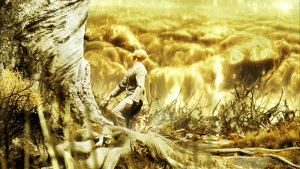
“The Fountain” by Darren Aronofsky
(Here are some stills from the movie.)
That is what Paganism is all about for me. It is the answer to that part of me which is a product of my (Mormon) Christian upbringing, which reifies the ego-self by calling it “spirit” and makes the immortality of that spirit the ultimate purpose of our lives. That same part of me that dreads death and gives birth to all kinds of unhealthy habits for avoiding the confrontation with the fact that I am going to die.
Now a lot of Pagans subscribe to the concept of reincarnation, and often it seems to take similar form as Christian eschatology: they say we have a spirit inside our body and it will survive the death of the body and enter another body. I accept reincarnation as a possibility (maybe it happens to some people but not others), but I don’t think it is the ego-self which would pass from one body to the next, but something more fundamental instead. I prefer the term “soul” (Greek psyche) to “spirit”, because it is harder to confuse the soul with the ego-self.
Some Pagans even believe in a version of heaven: the Summerland, where spirits go to await their next incarnation. To me, that seems like Christianity in Pagan disguise. When I told my (non-Pagan) wife about the idea of the Summerland, she remarked that it would make more sense, in the Pagan worldview, if such a place were called “Winterland”. And she is right: after all, Pagans associate winter and darkness, not summer and light, with death and rest.
Anyway, I came up with these two categories to describe these two different eschatologies: athanasia (without-death) and palingenesis (birth-again). The former, athanasia/deathlessness, is a Greek word applied to the gods, to distinguish them from mortals. The latter, palingenesis, Joseph Campbell defines as the “eternal recurrence of birth”. Often it is used to described literal reincarnation, but others (like Campbell, and the Cambridge Ritualists, Francis Cornford and Jane Ellen Harrison, for example), use it in the sense of “death as an act of creation” — death as birth.
Here is Jane Ellen Harrison explaining athanasia of the Greek Olympian gods in her book, Themis:
“The crowning disability and curse of the new theological order is that the Olympian claims to be immortal (athanatos). … All this, all life and that which is life and reality — Change and Movement — the Olympian renounces. Instead he chooses Deathlessness and Immutability — a seeming Immortality which is really the denial of life, for life is change. […] He will not be a daimon of Earth, nor yet even of the sky; above all he refuses to be a Year-daimon with his function of ceaseless toil. He will not rise again, but chooses instead a barren immortality. He withdraws himself from man and lives remote, a ‘jealous god’. … [T]he Olympian who will not die to live renounces life, he desiccates and dies. Such is the very nature of life that only through the ceaseless movement and rhythm of palingesesia is immortality possible. Athanasia, eternity through not dying, is almost a contradiction of words.”
In contrast, says Harrison, the Year-daimon (Frazier’s dying god) lives that he might die and dies that he might live. He “stands not for personal immortality in our modern sense, not for the negation of death, athanasia, but for the perennial renewal of life through death, for Reincarnation, for paligenesia.”
This, for me, is the quintessential theme of Paganism. It says to me: “You are going to die, just like everything else. Your body and the energy which animates it will return to where they came from — to the earth, to the physical universe. And you will live on only in the genes of your children and in the lives of those who you have touched and whom they will touch.” And to live fully in that awareness is, for me, a truly Pagan consciousness:
As Teilhard de Chardin writes:
“The world (its value, its infallibility and its goodness) – that, when all is said and done, is the first, the last, and the only thing in which I believe. It is by this faith that I live. And it is to this faith, I feel, that at the moment of death, rising above all doubts, I shall surrender myself.”
But last night, as I was watching “The Fountain”, I wondered: “How can I make my death an act of creation?” I can plant a tree over my remains, of course. But is there a more profound experience to be had.
I can illustrate my question by contrasting two different versions of the Wheel of the Year. There are many versions of the myth of the Wheel of the Year, and they all have a slightly different take on this theme of palingenesis. The one I have followed is this:
The god is born on the winter solstice, is fostered at mid-winter (Imbolc), mates with the Goddess at the spring equinox, marries her at mid-spring (Beltane), consummates their love at the summer solstice (at which time his dark twin is born), is consumed by the the fire of their passion at mid-summer (Lughnasadh), is reaped by the Goddess or the dark twin at the autumn equinox, and descends to the underworld at mid-autumn (Samhain), to be reborn again at the winter solstice. The dark twin follows the same pattern in reverse, sowing the seeds of his own rebirth at the autumn equinox, and being defeated by his light twin at the spring equinox.
Another version of the Wheel of the Year sets both the god’s dying and his dark twin’s rebirth at the summer solstice, and the dark god’s dying and his light twin’s rebirth at the winter solstice. The god plants the seeds of his own rebirth and dies in the same act. This latter version joins the deaths of the equinoxes to the births of the solstices.
What does all of this mean for me? The fact that I follow the former version, which separates the deaths of the equinoxes from the births of the solstices, reflects the fact that I do not know how to make of my death an act of creation. I understand living on through our children. But pro-creating my children did not require me to die (unless you consider the petite mort of orgasm a kind of death of the ego-self). It is no coincidence that I am asking this question in my mid-thirties, possibly the mid-point in my life, when my children are half grown.
I don’t presume to have an answer, but I came to the conclusion that the impetus I felt to watch the movie was not accidental. In my last post, I copied a quote from Joseph Campbell about union with God. And I wonder if my answer does not lie in there somewhere. Is it possible I would be given the answer before I had the question? I am going to be meditating on this during the rest of my Descensus Averni ritual.
Previous Post

August 4, 2011
Descensus Averni Day 1: Gospel of Eve
Next Post
August 8, 2011 Descensus Averni Day 3: Tarot
Browse Our Archives
Select a Category Ritual Scripts Theology Uncategorized
Select a Month January 2017 December 2016 November 2016 October 2016 September 2016 August 2016 July 2016 June 2016 May 2016 April 2016 March 2016 February 2016 January 2016 December 2015 November 2015 October 2015 September 2015 August 2015 July 2015 June 2015 May 2015 April 2015 March 2015 February 2015 January 2015 December 2014 November 2014 October 2014 September 2014 August 2014 July 2014 June 2014 May 2014 April 2014 March 2014 February 2014 January 2014 December 2013 November 2013 October 2013 September 2013 August 2013 July 2013 June 2013 May 2013 April 2013 March 2013 February 2013 January 2013 December 2012 November 2012 October 2012 September 2012 August 2012 July 2012 June 2012 May 2012 April 2012 March 2012 February 2012 January 2012 December 2011 November 2011 October 2011 September 2011 August 2011
TAKE THE
Religious Wisdom Quiz
Which Old Testament book does not mention God?
Select your answer to see how you score.
Esther Ruth Song of Solomon Ecclesiastes
Related posts from The Allergic Pagan
Wish upon Ostara: Why I wish Ostara was...

The Neo-Pagan Mysteries, Part 7: The Mother and...

The Neo-Pagan Mysteries, Part 6: Descent to the...

The Neo-Pagan Mysteries, Part 5: The Dying God
TRENDING AT PATHEOS Pagan

I was recently chatting with someone on Instagram. She asked me what...

While there are many people who share their results, the end of...

On July 23, I saw Christopher Nolan's The Odyssey which is Homer’s...

As I write this two big events have just finished up. One...

Restoring the Watershed of Divine Love
Perhaps cooperation is not something we manufacture through legislation, ideology, or moral...

Many UUs don’t pray because of bad experiences in a previous religion,...
view all Pagan blogs
Ad-Free & Subscriber Log-In Subscription Support
- About Us
- 2026 Calendar
- Videos
- Podcasts
- Library of World Religions
- Faith In Media Tracker
- Advertise With Us
- Write for Us
- Privacy Policy
- Terms of Service
- Do Not Sell My Data
- Contact Us
- Radiant Digital
- Manage Newsletter Subscriptions
- Unsubscribe From Notifications
- Sitemap
Copyright 2008-2026, Patheos. All rights reserved.
Subscription Support Ad-Free & Subscriber Log-In
Follow Patheos