
BuddhistCatholicContemplativeEvangelicalGeneral ChristianHinduJewishLatter-day SaintMuslimNew VisionsProgressive Christian
Beliefs
- Buddhist
- Catholic
- Contemplative
- Evangelical
- General Christian
- Hindu
- Jewish
- Latter-day Saint
- More Voices
- Muslim
- New Visions
- Pagan
- Progressive Christian
Topics
- Religion News
- Food and Religion
- Sports and Religion
- Religious Art
- Religious Music and Entertainment
- Religious Events
- History and Religion
- Style and Religion
- Politics and Religion
- Women in Religion
- Recreation Outdoors and Religion
- Business Finance and Religion
- Careers Workplace and Religion
- Education and Religion
- Family Parenting and Religion
- Health Fitness and Religion
- Home and Religion
- Relationships and Religion
- Technology and Religion
- Travel and Religion
Columnists
- Buddhist Columnists
- Business Finance and Religion Columnists
- Careers Workplace and Religion Columnists
- Catholic Columnists
- Contemplative Columnists
- Education and Religion Columnists
- Evangelists Columnists
- Family Parenting and Religion Columnists
- General Christian Columnists
- Health Fitness and Religion Columnists
- Hindu Columnists
- History and Religion Columnists
- Home and Religion Columnists
- Jewish Columnists
- More Voices Columnists
- Latter Day Columnists
- Muslim Columnists
- New Visions Columnists
- Nonreligious Columnists
- Pagan Columnists
- Politics and Religion Columnists
- Progressive Columnists
- Recreation Outdoors and Religion Columnists
- Relationships and Religion Columnists
- Religion News Columnists
- Religious Art Columnists
- Religious Events Columnists
- Religious Music and Entertainment Columnists
- Sports and Religion Columnists
- Style and Religion Columnists
- Technology and Religion Columnists
- Travel and Religion Columnists
- Women in Religion Columnists
Resource Library
- 2026 Calendar
- Library of World Religions
- The 100 Most Holy Places on Earth
- Patheos Answers
- Podcasts
- Videos
- Faith Leaders Database
- Anglican Episcopalian
- Bahai
- Baptist
- Buddhism
- Christianity
- Confucianism
- Eastern Orthodoxy
- Hinduism
- Holiness and Pentecostal
- ISKCON
- Islam
- Judaism
- Lutheran
- Methodist
- The Church of Jesus Christ of Latter-day Saints
- New Age
- Paganism
- Presbytarian and Reformed
- Protestantism
- Religion Behind the Scenes
- Roman Catholic
- Scientology
- Shia Islam
- Sikhism
- Sufism
- Sunni Islam
- Taoism
- Zen
- See all religions
Research Tools
 Ad-Free & Subscriber Log-In Subscription Support
Ad-Free & Subscriber Log-In Subscription Support
Follow Patheos 

- Trending:
- Forgiveness
- |
- Marriage
- |
- Consciousness
- |
- Death Penalty
- |
- Election
- |
- Halloween

- Home
- General Christian
- Religious Music & Entertainment
- A Magnificat We Might Not Want to Hear
A Magnificat We Might Not Want to Hear
Last updated on: December 11, 2020 at 5:42 pm by Delvyn Case
A Magnificat We Might Not Want to Hear 2020-12-11T17:42:19-05:00 Delvyn Case
Patheos Explore the world's faith through different perspectives on religion and spirituality! Patheos has the views of the prevalent religions and spiritualities of the world.
Join me on a musical exploration of Mary’s great song of praise. It might just change your view of this extraordinary poem.
The “Magnificat” is the name given to the poem we find in Luke 1:46-55.(“Magnificat” is simply the Latin translation of the beginning of the first line.) It is Mary’s response, spoken when she visits her cousin Elizabeth, to the news she has received from Gabriel: that she would bear the Son of God.
The Magnificat is a traditional reading for the third Sunday of Advent, which is December 12 of this year. (For an article about a famous musical setting of another Advent text, click here.) And as one of the greatest of all biblical passages, it has much to teach us.
Let’s see what we can learn about it by listening to a powerful musical setting of it by the English composer Sir Michael Tippett.
Though the piece is written for choir and organ, it may be unlike anything you have ever heard before. It’s full of surprising dissonances and shocking interruptions, as well as moments of almost spooky calm. It’s a study in opposites – and that’s one of the reasons why this piece of music brings Mary’s song to life so powerfully.
Here’s the complete text, presented in the English version that Tippett sets to music:
My soul doth magnify the Lord : and my spirit hath rejoiced in God my Saviour.
For he hath regarded the lowliness of his handmaiden.
For behold, from henceforth: all generations shall call me blessed.
For he that is mighty hath magnified me : and holy is his Name.
And his mercy is on them that fear him : throughout all generations.
He hath shewed strength with his arm : he hath scattered the proud in the imagination of their hearts.
He hath put down the mighty from their seat : and hath exalted the humble and meek.
He hath filled the hungry with good things : and the rich he hath sent empty away.
He remembering his mercy hath holpen [helped] his servant Israel : as he promised to our forefathers, Abraham and his seed forever.
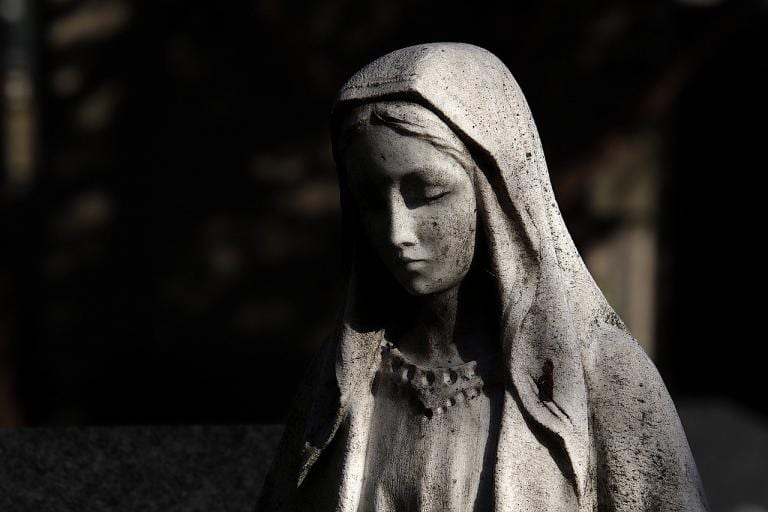
Mary begins the Magnificat by offering praise because God has “magnified” her: God has transformed a lowly handmaiden into the vessel of Messiah. As we see in David, Jacob, Moses, Ruth, Rahab – and in the Israelites themselves – God often chooses the underdog to do great things. Thus, on hearing the angel’s good news, Mary immediately recognizes herself in the story of her faith.
THE MUSIC WE WANT TO HEAR
For two thousand years, Christians have looked at the Magnificat as a testament to Mary’s faithfulness. Among Catholics, it has encouraged devotion and love for the Blessed Mother. Christians of all kinds often focus on its message of triumph. The Messiah is on his way!
Especially this time of year, as prepare to welcome the cute little cherub and the angels in the realms of glory, we are drawn to musical settings of the Magnificat that emphasize God’s glorious achievement in the Incarnation: songs and anthems that are inspiring or triumphant. Examples include Palestrina’s beautiful vocal setting, Bach’s triumphant choral masterwork, and even U2’s high-octane “Magnificent.” Another famous version is the contemporary Christian hit “Mary Did You Know?” (Spoiler alert: the answer is yes. Because Gabriel.)
We like these settings because they allow us to imagine ourselves as the beneficiaries of Mary’s faith and God’s faithfulness. It’s a great place to be.
But it’s not the whole story.
MARY’S SONG OF JUSTICE
The Magnificat is not a completely joyous song. In fact, parts of it are quite dark:
He hath shewed strength with his arm : he hath scattered the proud in the imagination of their hearts.
He hath put down the mighty from their seat : and hath exalted the humble and meek.
He hath filled the hungry with good things : and the rich he hath sent empty away
Mary praises God not just because of what God has done for her, personally. She praises God because of who God is: a God of justice.
As a young woman living in a land occupied by a colonial power, Mary knows a thing or two about injustice. Yet, she knows that God is ready, willing, and able to radically transform society. God has replaced the oppressors with the oppressed, fed the hungry with the food of the rich, and redistributed wealth from the rich to the poor. And God is about to do it again, starting with her.
Of course, this is not going to go over very well. Jesus’s prophetic calls for justice will precipitate conflict and anger. It will set brother against brother. It will culminate in his execution, of course, but it will also continue to motivate his followers to root our injustice, love the poor, and spread is live-giving message of forgiveness and salvation – no matter what happens.
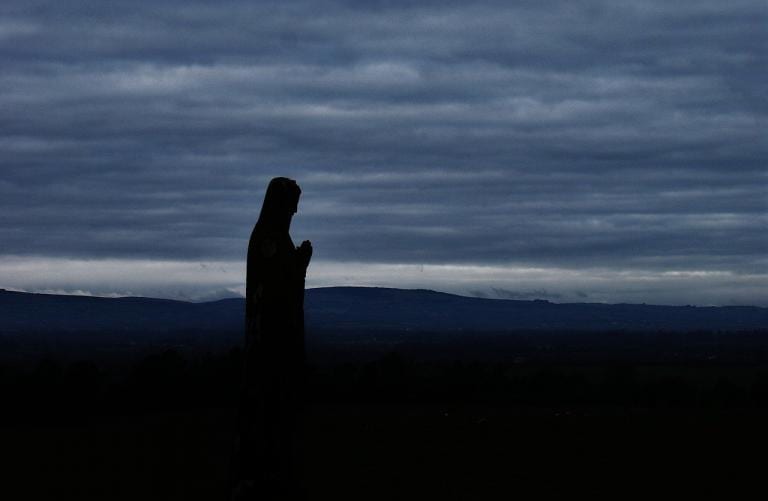
A MESSAGE WE MAY NOT WANT TO HEAR
Here’s the bad news. As wealthy Westerners, we are closer to the imperial Romans than to the Judeans. Our bellies are full and we sleep without fear, confident that we will fit through the eye of that needle.
This realization ought to make Mary’s song a difficult one for us to hear.
That’s why we need music that reminds us of how difficult and radical Mary’s song actually is: and how holy God is. We need a song that resists domestication, one that highlight the Magnificat’s prophetic message.
We need Michael Tippett’s “Magnificat” from 1961:
Tippett’s piece is dissonant and discordant. It begins with an acerbic fanfare that grabs us by the collar and shakes us awake. This is more like the trumpet of Revelation than that the one played by the angels on Christmas Eve. Something is going to happen – and it may not be good.
This fanfare continues through this piece, its dissonance keeping us from ever feeling comfortable. No matter what Mary says about God’s deliverance, no matter how ready we are to exult in God’s victory, that trumpet call keeps us wary. It reminds us that God does not work in the ways we expect.
It also reminds us that, perhaps, God’s transformation of the world will not be easy for us. And that can be a good thing, a refining fire that reminds us to examine ourselves to see if we are truly serving Mary’s God.
THE WAY THINGS ARE – AND THE WAY THEY ARE MEANT TO BE
Throughout this piece the choir moves back and forth between moments of dramatic intensity and mysterious calm. These contrasts illuminate the difference between the way things are and the way they are meant to be. Listen to the way Tippett sets the ending of the poem (from 2:18-3:00 in the recording; click here to listen to that exact passage.)
He hath filled the hungry with good things : and the rich he hath sent empty away.
He remembering his mercy hath holpen his servant Israel: as he promised to our forefathers, Abraham and his seed forever.
The dissonance of the organ at the end highlights the difficulty of its message. Though it is discordant, I like to think of this music not as portraying God’s anger, but instead the anxiety that we ought to feel when we hear these challenging verses.
This becomes even more apparent if you listen to the very end of the piece, when Tippett uses the words of the doxology (“Glory be to the Father…”) as a springboard for the final, triumphant conclusion. But while the music grows in splendor, it never resolves all of the tension it has built. Even the final “Amen” is a dissonant chord. The music stops, but it does not sound like it has “finished.”
THE REST OF THE STORY
Tippett’s Magnificat is the first of a pair of pieces. It is meant to be followed immediately by a setting of the “Nunc dimittis”: the song Simeon sang after encountering Jesus in the temple:
Lord, now lettest thou thy servant depart in peace : according to thy word.
For mine eyes have seen : thy salvation,
Which thou hast prepared : before the face of all people;
To be a light to lighten the Gentiles : and to be the glory of thy people Israel.
Though consistently more intimate and quieter than the Magnificat, this second piece is actually more dissonant. It is shadowy and eerie. Notes mysteriously slide between and behind each other. The mist clears near the end when the doxology returns, but that moment of praise stops almost immediately. The final Amen leaves us in a strange and unfamiliar place, uneasy, unfulfilled.
This is the mindset of Simeon: an old man who has waited faithfully his entire life to see the Messiah. But upon seeing him, he is left with more question than answers. As Simeon lays eyes on the Son of God, he sees yet another weak and vulnerable creature whom God will use to transform the world – and this time not just God’s chosen people, but the Gentiles as well. Tippett’s piece dramatizes the moment when Simeon comes to terms with the inconceivable implications of the Incarnation.

FAITHFULNESS?
At the same time, I wonder if this music is meant to perhaps portray something even darker: Simeon’s second thoughts. Were I in Simeon’s situation, with Roman soldiers patrolling outside the door of the synagogue, I might ask myself whether I really believed that this tiny baby would do what God said he would.
But, of course, Jesus did not. He did not expel the Romans, and he did not actually bring justice to first-century Judea. He died shamefully between two criminals.
And yet, his living presence continues to empower other frail, sinful creatures to carry out his mission, to spread is message of justice, and to care for the weak, the poor, and the hungry.
At the end of Tippett’s two pieces we are back where we started. God’s ways are just as revolutionary – and no less mysterious. Hearing the testimonies of two paragons of faith has reminded us of just how little we understand God, how far we are from a true life of faith, and how little we heed God’s call for justice.
Tippett’s music reminds us that we are, in a word, lowly.
Thank God.
Image by Jacques GAIMARD, Eric Blochet, andy Lukas Baumert from Pixabay
Previous Post

December 4, 2020
Handel’s Messiah and the Secret of Advent
Next Post

December 18, 2020 The Carol of the Bells: A Theological Reading
Browse Our Archives
Select a Category Advent bells ccm choir Christmas civil rights classical music country music Easter faith fourth of july Good Friday gospel music hip-hop Holy Week Jesus Lent Mary Maundy Thursday Messiah music Passion politics Popular Music psalms race rock secular music song Trinity Sunday Uncategorized Worship worship music
Select a Month May 2026 April 2026 April 2025 March 2025 October 2024 August 2024 March 2024 January 2024 July 2023 March 2023 June 2022 April 2022 December 2021 August 2021 March 2021 December 2020 November 2020 October 2020 August 2020 July 2020
Follow Us!
TAKE THE
Religious Wisdom Quiz
Who was Aquila's wife?
Select your answer to see how you score.
Mary Ruth Priscilla Lydia
Related posts from Alleluia! Music and the Christian Life

The Trinity in Sound and Motion
Alleluia! Music and the Christian Life
Jesus Christ Superstar's Holy Week Testimony, Part 2
Alleluia! Music and the Christian Life
Jesus Christ Superstar's Holy Week Testimony: Part 1
Alleluia! Music and the Christian Life
The Sound of Silence on Good Friday
Alleluia! Music and the Christian Life
TRENDING AT PATHEOS General Christian

A Biblical Vision of Success in Christian Life...
The Concern and Quest Recent trends and tendencies I note around me...

Indigenous Peoples’ Day and the Church
Indigenous' Peoples Day or Columbus Day? Depending on where you live...

When Spiritual Growth Looks Like Losing Ground
Four Passive Spiritual Disciplines: An Introduction When I was a college freshman,...

Faith and Finding Your Current Season
“To everything there is a season,” Ecclesiastes tells us, “and a time...

Did Jesus Fear God's Wrath in Gethsemane?
That Time Jesus Was Terrified Before we begin, let me say at...

A Generation Searching for God in All the...
Revival Begins With God’s People! Holidays Are Upon Us! Welcome to October!...
view all General Christian blogs
Ad-Free & Subscriber Log-In Subscription Support
- About Us
- 2026 Calendar
- Videos
- Podcasts
- Library of World Religions
- Faith In Media Tracker
- Advertise With Us
- Write for Us
- Privacy Policy
- Terms of Service
- Do Not Sell My Data
- Contact Us
- Radiant Digital
- Manage Newsletter Subscriptions
- Unsubscribe From Notifications
- Sitemap
Copyright 2008-2026, Patheos. All rights reserved.
Subscription Support Ad-Free & Subscriber Log-In
Follow Patheos