
BuddhistCatholicContemplativeEvangelicalGeneral ChristianHinduJewishLatter-day SaintMuslimNew VisionsProgressive Christian
Beliefs
- Buddhist
- Catholic
- Contemplative
- Evangelical
- General Christian
- Hindu
- Jewish
- Latter-day Saint
- More Voices
- Muslim
- New Visions
- Pagan
- Progressive Christian
Topics
- Religion News
- Food and Religion
- Sports and Religion
- Religious Art
- Religious Music and Entertainment
- Religious Events
- History and Religion
- Style and Religion
- Politics and Religion
- Women in Religion
- Recreation Outdoors and Religion
- Business Finance and Religion
- Careers Workplace and Religion
- Education and Religion
- Family Parenting and Religion
- Health Fitness and Religion
- Home and Religion
- Relationships and Religion
- Technology and Religion
- Travel and Religion
Columnists
- Buddhist Columnists
- Business Finance and Religion Columnists
- Careers Workplace and Religion Columnists
- Catholic Columnists
- Contemplative Columnists
- Education and Religion Columnists
- Evangelists Columnists
- Family Parenting and Religion Columnists
- General Christian Columnists
- Health Fitness and Religion Columnists
- Hindu Columnists
- History and Religion Columnists
- Home and Religion Columnists
- Jewish Columnists
- More Voices Columnists
- Latter Day Columnists
- Muslim Columnists
- New Visions Columnists
- Nonreligious Columnists
- Pagan Columnists
- Politics and Religion Columnists
- Progressive Columnists
- Recreation Outdoors and Religion Columnists
- Relationships and Religion Columnists
- Religion News Columnists
- Religious Art Columnists
- Religious Events Columnists
- Religious Music and Entertainment Columnists
- Sports and Religion Columnists
- Style and Religion Columnists
- Technology and Religion Columnists
- Travel and Religion Columnists
- Women in Religion Columnists
Resource Library
- 2026 Calendar
- Library of World Religions
- The 100 Most Holy Places on Earth
- Patheos Answers
- Podcasts
- Videos
- Faith Leaders Database
- Anglican Episcopalian
- Bahai
- Baptist
- Buddhism
- Christianity
- Confucianism
- Eastern Orthodoxy
- Hinduism
- Holiness and Pentecostal
- ISKCON
- Islam
- Judaism
- Lutheran
- Methodist
- The Church of Jesus Christ of Latter-day Saints
- New Age
- Paganism
- Presbytarian and Reformed
- Protestantism
- Religion Behind the Scenes
- Roman Catholic
- Scientology
- Shia Islam
- Sikhism
- Sufism
- Sunni Islam
- Taoism
- Zen
- See all religions
Research Tools
 Ad-Free & Subscriber Log-In Subscription Support
Ad-Free & Subscriber Log-In Subscription Support
Follow Patheos 

- Trending:
- Forgiveness
- |
- Marriage
- |
- Consciousness
- |
- Death Penalty
- |
- Election
- |
- Halloween
 Alignment
- Home
- Contemplative
- Education and Religion
- Clay Pots: Finding the Divine in the Ordinary
Clay Pots: Finding the Divine in the Ordinary
Last updated on: April 8, 2023 at 9:11 pm by Rev. Dr. Margaret Somerville
Clay Pots: Finding the Divine in the Ordinary 2023-04-08T21:11:54-04:00 Rev. Dr. Margaret Somerville
Patheos Explore the world's faith through different perspectives on religion and spirituality! Patheos has the views of the prevalent religions and spiritualities of the world.
A lump of clay thrown on the potter’s wheel became a vessel. Lester Morris, tech consultant by day, recognizes his time at the wheel as his spiritual practice. He invited Alignment into his basement studio virtually for a session of contemplative practice. The pots and bowls that Lester shaped during our time together became vessels for far more than anyone anticipated.
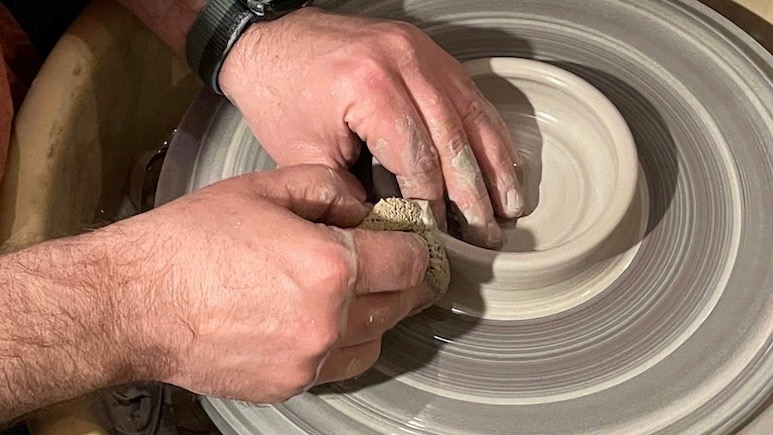
Lester Morris shares his practice creating vessels from clay at the wheel with Alignment in a session entitled Creative Clay (image by Baron Mullis)
One of the main intentions of Alignment: Interfaith Contemplative Practices is the recognition of the sacred in the ordinary. We look for the presence of the divine in the workings of our life that both center us and move us forward. That connect us to the divinity that exists at the depths of our existence. And the divinity that challenges us to step beyond our own circumstances. To connect with those who are different from us but also deeply a part of our human experience. We find our practices of prayer in the routines and rituals that are already a part of daily life. The ordinary, set apart in the very recognition of it, becomes the sacred. And so it is with Lester’s wheel spinning in meditative practice that yields a vessel. A symbol of our shaping, our abundance, and our voids.
The Clay and the Hands That Shape It
There is nothing much more common than a pot. A bowl. That which holds our sustenance. Which fills our tables and our cupboards. From which we bathe. And into which we pour that which no longer serves. Dredged up from the sea after 2500 years, a pot that carried oil or grain or wine from Roman transport speaks across the millennia – the earth made into vessel is part of the universal human experience. But when we step back to the view of the creation of the pot, that is when the divine enters. The hands of the potter become the hands of the creator, and we, the clay that is shaped by our encounter.
The Hebrew scriptures are replete with references to the potter and the clay, to pots and vessels. None more obvious perhaps than the words of the prophet Isaiah. But now, O Lord, you are our father, we are the clay, and you our potter, and we all are the work of your hand (Isa 64:8).
The prophet’s role is to be the voice of God for the people and the voice of the people for God.
The voice enabling divinity and humanity to be in relationship. Perhaps this reminds us that we are potters too. In recognizing the divine act of creation in the shaping of the pot on the wheel, we are reminded of the divinity that abides at the core of our being.
The Prophets Speak of Clay
The prophet Jeremiah who cries out at the time of the destruction of Jerusalem by the Babylonians speaks to the presence of the divine in the depths of human experience. We are assured that new life is not only a possibility but is the expectation when we place ourselves in the presence of the divine. Then I went down to the potter’s house, and there he was, making something on the wheel. But the vessel that he was making of clay was spoiled in the hand of the potter; so he remade it into another vessel, as it pleased the potter to make (Jer 18:3-4).
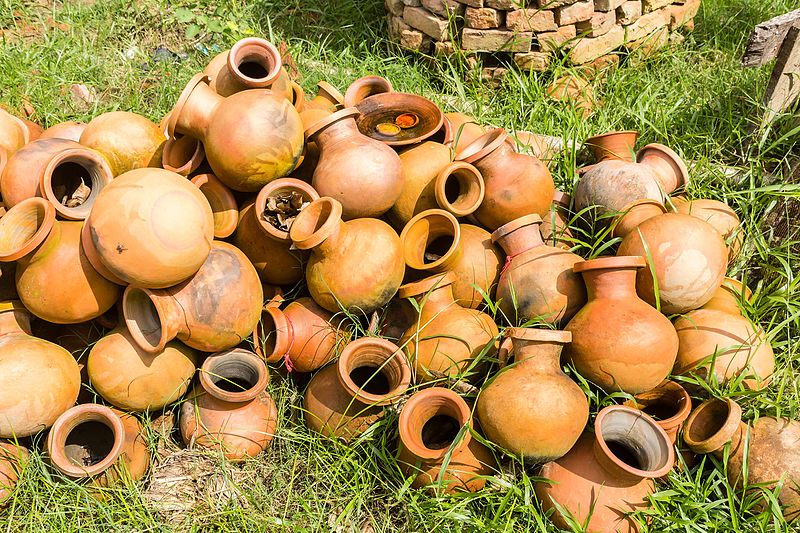
In the common clay pot we can find the vessel for the divine. In the forming of the pot we can find the contemplative practice that connects us to the divine. (Bijay chaurasia / Wikimedia Commons)
In the Islamic tradition of Jesus as prophet, Allah breathes into the clay form of a bird that Isa makes. The healing potential of the prophet comes from the will and permission of the one who makes the clay a living form. A symbol of that which came from the earth and which will fly to the outreaches of creation. Through the breath of the divine and the hands of the prophet potter, new life is given. From the Qur’an: Allah will say, when you designed from clay [what was] like the form of a bird with my permission, then you breathed into it and it became a bird with my permission (Surah Al-Ma’idah – 110)
إِذْ قَالَ ٱللَّهُ يَـٰعِيسَى ٱبْنَ مَرْيَمَ ٱذْكُرْ نِعْمَتِى عَلَيْكَ وَعَلَىٰ وَٰلِدَتِكَ إِذْ أَيَّدتُّكَ بِرُوحِ ٱلْقُدُسِ تُكَلِّمُ ٱلنَّاسَ فِى ٱلْمَهْدِ وَكَهْلًۭا ۖ وَإِذْ عَلَّمْتُكَ ٱلْكِتَـٰبَ
وَٱلْحِكْمَةَ وَٱلتَّوْرَىٰةَ وَٱلْإِنجِيلَ ۖ وَإِذْ تَخْلُقُ مِنَ ٱلطِّينِ كَهَيْـَٔةِ ٱلطَّيْرِ بِإِذْنِى فَتَنفُخُ فِيهَا فَتَكُونُ طَيْرًۢا بِإِذْنِى ۖ وَتُبْرِئُ ٱلْأَكْمَهَ وَٱلْأَبْرَصَ بِإِذْنِى ۖ وَإِذْ تُخْرِجُ ٱلْمَوْتَىٰ بِإِذْنِى ۖ وَإِذْ كَفَفْتُ بَنِىٓ إِسْرَٰٓءِيلَ عَنكَ إِذْ جِئْتَهُم بِٱلْبَيِّنَـٰتِ فَقَالَ ٱلَّذِينَ كَفَرُوا۟ مِنْهُمْ إِنْ هَـٰذَآ إِلَّا سِحْرٌۭ مُّبِينٌۭ ١١“
— Saheeh International
Clay as the Connector
Not only the earthen material of the pot but the function of the pot are foundationally common to our daily lives. In sacred ritual, we often see the ordinary clay pot as the point at which the divine comes into relationship with us. Madhvi Subrahmanian presenting at the International Academy of Ceramics writes of the Hindu use of earthen pots in ceremony. “The pot plays an important role in rituals where Gods and Goddess [sg] are projected to descend into the ghata or the pot during a ritual, which then becomes the intermediary between the devotee and the deity.” It symbolizes both abundance and the void. The overflowing pot symbolizes fertility and the empty pot represents the vastness of the cosmos.
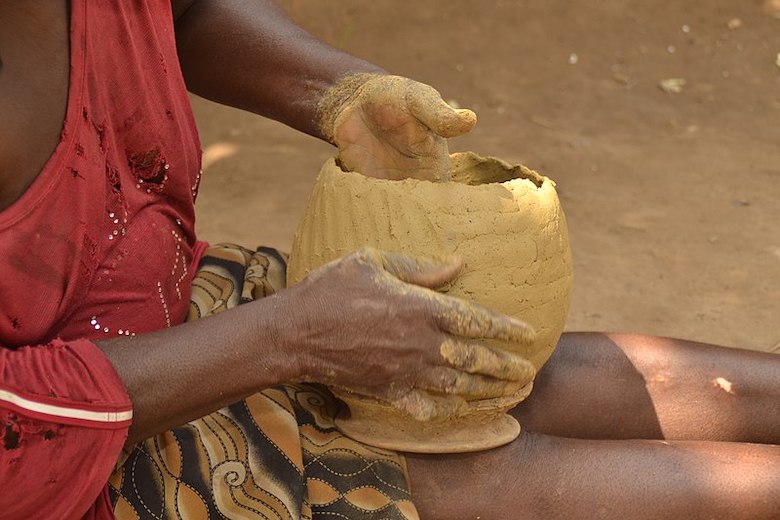
The making of traditional pottery by hand in Nigeria. This common pot may be used as a temporary house for divine essence. (Chukwukajustice / Wikimedia Commons)
Adam Posner studies the sacred rituals of African-Pan-American religious systems through the lens of his work with clay. Through his fascinating work To Serve the Divine, he discusses the use of ordinary clay pots, cooking vessels for instance, that become a part of sacred ritual. He says that often the way they are adorned or filled or decorated leads to the view that the ordinary has become sacred. That the pots themselves are being worshiped. But he makes clear that the widespread practice among African and African-Caribbean traditions is that the pots are “temporary seats or housing for the divine essence; in other words the pot is not itself sacred, but rather it contains the spiritual force.”
Reflections on the Practice
As Lester Morris threw mounds of unshaped clay on his wheel, participants in Alignment’s session, Creative Clay, spent the half hour in meditative reflection. They engaged in their own spiritual practice as they sat in witness to Lester’s. And this practice was a shared one. The chat filled with messages of wonder, transformation, nourishment, and hope. The significance of the gentle touch to the clay that produces ripples of change allowed some to remember the ways in which their connection to the divine can be imperceivable. The pattern of energy and then the pause. One participant noted:
I’m remembering all the times when I have felt like a simple lump of clay, times when I may lack confidence or think I’m nothing special…and there have been so many other times that I’ve allowed myself to be formed and opened, lovingly cared for and molded. Also remembering how many people in my life have been a vessel, a container for me.
Lester’s vessels had become a vessel for our contemplative practice. The ordinary became the sacred. The practice of creating the common vessel becomes the vehicle for creating the space into which the divine enters.
Progressive Christian
Religious Art
Interfaith Contemplative Practices
About Rev. Dr. Margaret Somerville
Rev. Dr. Margaret Somerville is a Quaker educator and a Presbyterian minister. The focus of her work in education is the way language shapes how we see ourselves in the world. The focus of her ministry is embracing the practices of a variety of traditions to deepen our connection to the divine. Director of Alignment: Interfaith Contemplative Practices, retreat leader, and associate member of the Iona Community. Find out more about Margaret's work at www.interfaithalignment.org. You can read more about the author here.
Previous Post

March 18, 2023
Crisis Contemplation: Barbara A. Holmes Visits Alignment
Next Post

May 1, 2023 Expanding the Posture of Prayer
Recent Comments
"denying prayer among people of different faiths b ased on the actions of secular governments ..."
"On October 15, I posted this article: https://www.patheos.com/blo...We hosted the Week of Prayer for World ..."
"Deeply moving reminder of what is needed to live a life in peace. Thank you ..."
Ground Level: The Basic Elements of ..."
"Thank you!"
Drinking Water as a Contemplative Practice: ..."
Browse Our Archives
Select a Category Earth Indigenous Interfaith Contemplative Practices Prayer Spiritual Practices Uncategorized
Select a Month February 2024 January 2024 December 2023 October 2023 September 2023 July 2023 May 2023 April 2023 March 2023 February 2023 January 2023 December 2022
Follow Us!
TAKE THE
Religious Wisdom Quiz
I danced before the ark with all my might, wearing only a linen ephod. Who am I?
Select your answer to see how you score.
Jonathan David Saul Solomon
Related posts from Alignment

What Is Your Prayer for Peace?

Ordinary Rituals That Create Sacred Space
Don't Know How to Pray? Here's How.
Can a Muslim and a Jew Pray Together?
TRENDING AT PATHEOS Contemplative

The Iron Gates and the Lion of the...
Yesterday, I didn't finish my report about, well, yesterday. So I'll...

Dolly Parton’s Last Song Wins Dove Award with...
Bluegrass band The Grascals, speaking on the red carpet at the 57th...

The Image: On the Horror of Capitalism and...
The Image Then went the Pharisees, and took counsel how they might...

We are approaching the date of our new American national holiday: October...

Letters on Living the Faith by C.S. Lewis
Most of us met C.S. Lewis as a public intellectual. Mere Christianity....

When Halloween Unmasks Married Hearts
Written by Dr. David K. Ewen from Eternal Truth Bible College Behind...
view all Contemplative blogs
Ad-Free & Subscriber Log-In Subscription Support
- About Us
- 2026 Calendar
- Videos
- Podcasts
- Library of World Religions
- Faith In Media Tracker
- Advertise With Us
- Write for Us
- Privacy Policy
- Terms of Service
- Do Not Sell My Data
- Contact Us
- Radiant Digital
- Manage Newsletter Subscriptions
- Unsubscribe From Notifications
- Sitemap
Copyright 2008-2026, Patheos. All rights reserved.
Subscription Support Ad-Free & Subscriber Log-In
Follow Patheos