
BuddhistCatholicContemplativeEvangelicalGeneral ChristianHinduJewishLatter-day SaintMuslimNew VisionsProgressive Christian
Beliefs
- Buddhist
- Catholic
- Contemplative
- Evangelical
- General Christian
- Hindu
- Jewish
- Latter-day Saint
- More Voices
- Muslim
- New Visions
- Pagan
- Progressive Christian
Topics
- Religion News
- Food and Religion
- Sports and Religion
- Religious Art
- Religious Music and Entertainment
- Religious Events
- History and Religion
- Style and Religion
- Politics and Religion
- Women in Religion
- Recreation Outdoors and Religion
- Business Finance and Religion
- Careers Workplace and Religion
- Education and Religion
- Family Parenting and Religion
- Health Fitness and Religion
- Home and Religion
- Relationships and Religion
- Technology and Religion
- Travel and Religion
Columnists
- Buddhist Columnists
- Business Finance and Religion Columnists
- Careers Workplace and Religion Columnists
- Catholic Columnists
- Contemplative Columnists
- Education and Religion Columnists
- Evangelists Columnists
- Family Parenting and Religion Columnists
- General Christian Columnists
- Health Fitness and Religion Columnists
- Hindu Columnists
- History and Religion Columnists
- Home and Religion Columnists
- Jewish Columnists
- More Voices Columnists
- Latter Day Columnists
- Muslim Columnists
- New Visions Columnists
- Nonreligious Columnists
- Pagan Columnists
- Politics and Religion Columnists
- Progressive Columnists
- Recreation Outdoors and Religion Columnists
- Relationships and Religion Columnists
- Religion News Columnists
- Religious Art Columnists
- Religious Events Columnists
- Religious Music and Entertainment Columnists
- Sports and Religion Columnists
- Style and Religion Columnists
- Technology and Religion Columnists
- Travel and Religion Columnists
- Women in Religion Columnists
Resource Library
- 2026 Calendar
- Library of World Religions
- The 100 Most Holy Places on Earth
- Patheos Answers
- Podcasts
- Videos
- Faith Leaders Database
- Anglican Episcopalian
- Bahai
- Baptist
- Buddhism
- Christianity
- Confucianism
- Eastern Orthodoxy
- Hinduism
- Holiness and Pentecostal
- ISKCON
- Islam
- Judaism
- Lutheran
- Methodist
- The Church of Jesus Christ of Latter-day Saints
- New Age
- Paganism
- Presbytarian and Reformed
- Protestantism
- Religion Behind the Scenes
- Roman Catholic
- Scientology
- Shia Islam
- Sikhism
- Sufism
- Sunni Islam
- Taoism
- Zen
- See all religions
Research Tools
 Ad-Free & Subscriber Log-In Subscription Support
Ad-Free & Subscriber Log-In Subscription Support
Follow Patheos 

- Trending:
- Forgiveness
- |
- Marriage
- |
- Consciousness
- |
- Death Penalty
- |
- Election
- |
- Halloween
 The Cordial Catholic
- Home
- Catholic
- Why I Pray to Dead People (And You Should Too!)
Why I Pray to Dead People (And You Should Too!)
Last updated on: May 22, 2016 at 7:23 pm by K. Albert Little
Why I Pray to Dead People (And You Should Too!) 2016-05-22T19:23:24-04:00 K. Albert Little
Patheos Explore the world's faith through different perspectives on religion and spirituality! Patheos has the views of the prevalent religions and spiritualities of the world.
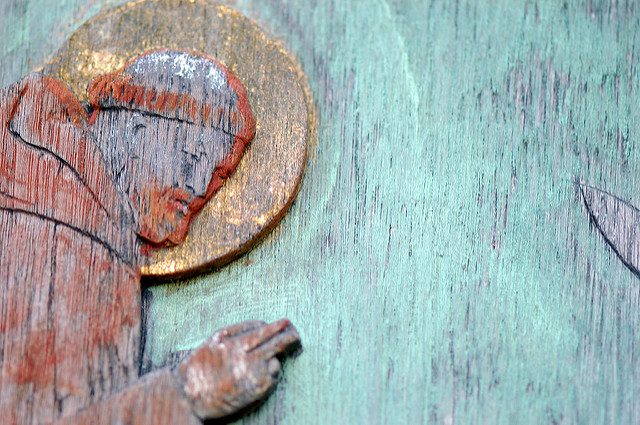
Photo Credit: Steve Snodgrass.
It was a Sunday morning after our ten o’clock service. I was in my final year of high school, maybe first year of university. It was billed as, I think, a “family Bible study” and part of a rigorous Adult Sunday School program which my Pentecostal church took great pride in.
It was my first encounter with praying to the dead.
The Senior Pastor leading the Bible study was working his way, slowly and methodically, through the anonymous Letter to the Hebrews. He was meticulous.
I can remember it clearly: sitting in the new chapel, an addition to the main part of the church that had just been recently completed. Back row; a seat in the middle.
I remember, clearly, because I had a question to ask.
A question to ask of the Senior Pastor. The brightest Bible-knowing guy that I knew.
It was a bit nerve-racking.
I’d been chewing on my question for weeks as the passage in Hebrews approached. As a diligent, zealous, and self-identified Bible scholar, I hadn’t been able to find a satisfying answer anywhere else.
It would be a question asked only after painstakingly trying to find the answer for myself first.
So, when the Pastor read aloud the words of Hebrews 12:1 I steadied myself,
Therefore, since we are surrounded by such a great cloud of witnesses, let us throw off everything that hinders and the sin that so easily entangles. And let us run with perseverance the race marked out for us.
“What does the author mean by ‘a great cloud of witnesses’?” I asked, when it was finally time for questions.
Funny, I don’t actually remember what the pastor said in response.
I do remember, for having whipped myself up into such a frenzy over actually asking a question, being incredibly disappointed by the response.
I do remember, too, being surprised that no one else asked it—or that no one else was as dissatisfied with the answer as I was.
Was it just me?
This was my first encounter with what the ancient churches call the Communion of the Saints: that, contrary to what many Protestant churches teach, the Christian dead are not tucked away behind an impenetrable curtain but instead part of a living, active Communion.
The Church.
What I did not know at the time, as a budding Bible scholar, was what the author of Hebrews was getting at was what the very first Christians believed, and what these ancient churches (Catholic and Orthodox) still believe today: That there are departed Christians who stand, still, as witnesses to our faith.
That we can pray to the dead.
Two quick distinctions need to be made.
First among them is that the notion of praying to is kind of a failing of the English language.
When I say we “pray to” the dead I do not mean I believe the dead have the power to answer prayers. When we, Catholics, say we’re “praying to” someone other than God we mean we asking them to pray for us.
Someone who says they’ve “prayed to St. Francis,” means, more clearly, that they’ve “asked St. Francis to pray for them.”
Catholics, by and large, know this. But the nomenclature is confusing.
The second distinction to make is that none of this makes sense if you do not believe that Christians, dead and alive, are part and parcel of the same Holy Church.
If the Christian dead are obscured from us by an impenetrable veil then my asking them to pray for me has no effect and the practice, instead, is a bit too much like fortune telling or witchcraft or what the Bible lovingly refers to as soothsaying.
That when we say, “pray to,” we mean “ask them to pray for us,” and that we believe that all Christians, dead and alive, are still part of the same indivisible Church, is important to understand.
So, why do we pray to dead people?
Because that’s what the Church has always taught.
If my encounter with the “cloud of witnesses” in Hebrews 12 began the conversation for me it was digging deeper into the history of the Church that led me to a clearer understanding.
Since the very beginning of Christianity, Christians in leadership believed that the dead had the ability to pray for us and that the Christian dead—especially those early holy martyrs—held a special place in communion with those Christians alive on earth.
We see a ringing example of this in the practice of the Early Church who built their church buildings on the bones of the great saints. On the bones of St. Peter and St. Paul in Rome, for example.
Or the example, often terrifying to non-Catholics, of the veneration of the relics of deceased Christian saints recorded in the writings of the Early Church Fathers as early as 150AD.
In both of these cases early Christians were essentially, praying to the bones of their dead Christian brethren.
These Christians believed in that their deceased brothers and sisters could still pray for them and they asked them for prayers, in a serious way. By burying their bones underneath the places where they worshipped on a Sunday morning; by seeing and touching what’s still left of them on Earth (akin to the way St. Paul’s handkerchief was touched for its power) they believed that they could experience a special closeness with the saints, who were now in the presence of God, and who could pray for them.
Hebrews 12, taken out of the context in which it was written, was difficult for me to understand. In the context of the persecuted Early Church—the context in which it was authored—it began to make some sense.
This was the practice of the Early Church.
But why pray to the dead?
Well it works this way. If you believe, as the ancient Church did, and as the ancient churches still do today, that our deceased Christian brothers and sisters can pray for us, wouldn’t you want those holy saints praying for you?
If I’m looking for a Christian, on earth, to pray for me I don’t often go search for the person whose life least reflects that of Christ. I look to friends who live godly lives—who radiate Christ—to pray for me.
How much more for the saints.
Amongst the early persecution of the Church it was these great saints and martyrs that the earliest Christians looked to to be strengthened by their prayers. They prayed for one another, of this we can be sure, but they also asked for the prayers of their dead companions, too. Those that sojourned before them—in very dangerous times.
I can think of a couple of objections. These were once mine so maybe they’re yours, too.
First, an approach which asserts that it’s not in the Bible so we don’t pray to the saints necessarily must neglect the experience of the Early Church; the same which in whose context the Bible was written and assembled. The same approach must ignore the Christian creeds—the very earliest apologetic of our Christian faith. The earliest example of this is what we believe clearly affirms the ancient Church’s understanding of prayers to the saints.
Are we to jettison the creeds?
Another objection says that only Christ is the mediator between God and man and we’re remiss to bring anyone else into the mix. While this is true, and foundational to the ancient churches, this does not negate the power of praying for one another. In fact, we’re commanded to that end.
In this sense, if I’m praying for you, I’m mediating your prayers to God. Mediation in this way cannot be what St. Paul and the other apostolic writers were referring to.
If we believe, as the ancient Church did, in the power of the deceased saints to pray for us in the same way our brothers and sisters on earth do, than they are not mediating between us and God in an inappropriate way. It’s the same as asking for prayers from my living, earthbound friend.
In the end, my struggle with the cloud of witnesses led me on an incredible journey. If you’ve read my blog for any length of time you likely know the story.
It led me, at any rate, into the arms of the ancient Church. A Church that holds, like the Early Church, to the power of the prayer of the saints. That cleaves to the ancient Creeds and the teachings of the very first Christians.
That holds that we can ask our departed Christian brethren for their prayers and in their very closeness with God they can pray for us—like the saints picture in the Book of Revelation, whose prayers rise up to God like incense.
Who worship around His very throne.
And whose prayers for us are—as has been demonstrated throughout the history of the Church—incredibly efficacious.
Stay in touch! Like The Cordial Catholic on Facebook:
Previous Post

April 26, 2016
The Catholic Church Must Become More Protestant
Next Post
May 23, 2016 So You Think You're Smarter Than the Early Church Fathers?
Browse Our Archives
Select a Category Appearances Christian Living Explaining the Faith Podcast Tough Questions Uncategorized Why I'm Catholic
Select a Month January 2024 December 2023 November 2023 July 2023 June 2023 May 2023 April 2023 March 2023 February 2023 January 2023 December 2022 November 2022 October 2022 September 2022 August 2022 July 2022 June 2022 May 2022 April 2022 March 2022 February 2022 January 2022 December 2021 November 2021 October 2021 September 2021 August 2021 July 2021 June 2021 May 2021 April 2021 March 2021 February 2021 January 2021 December 2020 November 2020 October 2020 September 2020 August 2020 July 2020 June 2020 May 2020 April 2020 March 2020 February 2020 January 2020 December 2019 November 2019 October 2019 September 2019 August 2019 July 2019 June 2019 May 2019 April 2019 March 2019 February 2019 January 2019 December 2018 November 2018 October 2018 September 2018 August 2018 July 2018 June 2018 May 2018 April 2018 March 2018 February 2018 January 2018 December 2017 October 2017 September 2017 July 2017 May 2017 April 2017 March 2017 February 2017 January 2017 December 2016 November 2016 October 2016 September 2016 August 2016 July 2016 June 2016 May 2016 April 2016 March 2016 February 2016 January 2016 December 2015 November 2015 October 2015 September 2015 August 2015 July 2015 June 2015 May 2015 April 2015 March 2015 February 2015 January 2015 December 2014 November 2014 October 2014
Follow Us!
TAKE THE
Religious Wisdom Quiz
What is the longest book in the New Testament by word count?
Select your answer to see how you score.
Luke Revelation Acts Matthew
Support this
Column


Related posts from The Cordial Catholic

228: The Catholic Tools for Spiritual Warfare (w/...
204: The Great Big Protestant Problem with Scripture...
201: Eucharistic Miracles, Marian Apparitions, and More... (w/...

200: Reasons to Doubt Sola Scriptura (w/ Jimmy...
TRENDING AT PATHEOS Catholic

Rejecting Doom: Christian Hope And Human Action
Christianity is a religion of hope. We are to have hope and...

It’s What Comes From Within Which Matters
One of the most difficult things for us to understand is why...

Why I Choose the Eucharist Over the Sermon
Choose the Eucharist, Not the Sermon What are we supposed to get...

5 Design Elements Found in Spiritually Rooted Homes
Putting Spirituality Into Home Decor Our homes are more than our living...

Credo: A Story of God Told with the...
About 10 years ago, I began to imagine a personal "Credo" that...

The Anatomy of Divine Revelation in Catholic Thought
The claim that God has made Himself known to human beings is...
view all Catholic blogs
Ad-Free & Subscriber Log-In Subscription Support
- About Us
- 2026 Calendar
- Videos
- Podcasts
- Library of World Religions
- Faith In Media Tracker
- Advertise With Us
- Write for Us
- Privacy Policy
- Terms of Service
- Do Not Sell My Data
- Contact Us
- Radiant Digital
- Manage Newsletter Subscriptions
- Unsubscribe From Notifications
- Sitemap
Copyright 2008-2026, Patheos. All rights reserved.
Subscription Support Ad-Free & Subscriber Log-In
Follow Patheos