
BuddhistCatholicContemplativeEvangelicalGeneral ChristianHinduJewishLatter-day SaintMuslimNew VisionsProgressive Christian
Beliefs
- Buddhist
- Catholic
- Contemplative
- Evangelical
- General Christian
- Hindu
- Jewish
- Latter-day Saint
- More Voices
- Muslim
- New Visions
- Pagan
- Progressive Christian
Topics
- Religion News
- Food and Religion
- Sports and Religion
- Religious Art
- Religious Music and Entertainment
- Religious Events
- History and Religion
- Style and Religion
- Politics and Religion
- Women in Religion
- Recreation Outdoors and Religion
- Business Finance and Religion
- Careers Workplace and Religion
- Education and Religion
- Family Parenting and Religion
- Health Fitness and Religion
- Home and Religion
- Relationships and Religion
- Technology and Religion
- Travel and Religion
Columnists
- Buddhist Columnists
- Business Finance and Religion Columnists
- Careers Workplace and Religion Columnists
- Catholic Columnists
- Contemplative Columnists
- Education and Religion Columnists
- Evangelists Columnists
- Family Parenting and Religion Columnists
- General Christian Columnists
- Health Fitness and Religion Columnists
- Hindu Columnists
- History and Religion Columnists
- Home and Religion Columnists
- Jewish Columnists
- More Voices Columnists
- Latter Day Columnists
- Muslim Columnists
- New Visions Columnists
- Nonreligious Columnists
- Pagan Columnists
- Politics and Religion Columnists
- Progressive Columnists
- Recreation Outdoors and Religion Columnists
- Relationships and Religion Columnists
- Religion News Columnists
- Religious Art Columnists
- Religious Events Columnists
- Religious Music and Entertainment Columnists
- Sports and Religion Columnists
- Style and Religion Columnists
- Technology and Religion Columnists
- Travel and Religion Columnists
- Women in Religion Columnists
Resource Library
- 2026 Calendar
- Library of World Religions
- The 100 Most Holy Places on Earth
- Patheos Answers
- Podcasts
- Videos
- Faith Leaders Database
- Anglican Episcopalian
- Bahai
- Baptist
- Buddhism
- Christianity
- Confucianism
- Eastern Orthodoxy
- Hinduism
- Holiness and Pentecostal
- ISKCON
- Islam
- Judaism
- Lutheran
- Methodist
- The Church of Jesus Christ of Latter-day Saints
- New Age
- Paganism
- Presbytarian and Reformed
- Protestantism
- Religion Behind the Scenes
- Roman Catholic
- Scientology
- Shia Islam
- Sikhism
- Sufism
- Sunni Islam
- Taoism
- Zen
- See all religions
Research Tools
 Ad-Free & Subscriber Log-In Subscription Support
Ad-Free & Subscriber Log-In Subscription Support
Follow Patheos 

- Trending:
- Forgiveness
- |
- Marriage
- |
- Consciousness
- |
- Death Penalty
- |
- Election
- |
- Halloween
 The Cordial Catholic
- Home
- Catholic
- Why Are Demons Afraid of Mary?
Why Are Demons Afraid of Mary?
Last updated on: March 16, 2018 at 9:43 am by K. Albert Little
Why Are Demons Afraid of Mary? 2018-03-16T09:43:32-04:00 K. Albert Little
Patheos Explore the world's faith through different perspectives on religion and spirituality! Patheos has the views of the prevalent religions and spiritualities of the world.
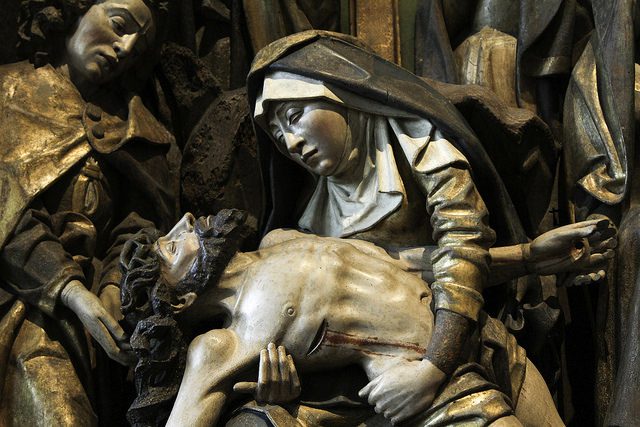
Our Lady of Sorrows. Photo Credit: Fr. Lawrence, OP.
Father Gabriele Amorth is a fascinating man. Until very recently, the elderly Italian priest served as one of Rome’s chief exorcists. As an exorcist he’s seen it all. For our benefit, he’s recorded it too in a couple of books called An Exorcist Tells His Story

He’s an interesting guy and I’ve always had a passing interest in the supernatural, even before becoming a Christian, and in the existence of demons, even before my journey into the Catholic Church so naturally I was drawn to Amorth’s work.
But something in his writings bothered me, deeply, as a Protestant.
Amorth made a point of highlighting Mary’s involvement in exorcisms: There was something about Mary.
For me, as a Protestant, there was something there that just didn’t add up.
The Catholic Church believes in the Communion of Saints. Deceased Christians, the Church tells us, don’t cease to be Christians when they die. They don’t go off somewhere into the corner of Heaven but instead, as pictured in the Book of Revelation, gather around the altar in Heaven and send up our prayers, with their prayers—they pray for us. And while this might sound radical to Protestant Christians it was actually the belief of the whole Church since the very earliest written records, and can be traced back to the most ancient of Christian traditions.
The locations of the deaths of both Peter and Paul were revered, from very early on, as important places.
Today they remain so, as Roman Catholic Churches.
It was the belief of the early Christian Church, and remains the belief of the Catholic and Orthodox churches, that deceased Christians don’t cease to be part of the Body of Christ but remain essential. They can pray for us in the same way we Christians, on earth, can pray for each other.
That said, what about Mary? Well, likewise, for most of the history of Christianity Mary was viewed with incredible importance. After all, she is the Mother of God, and her “yes” to God—her decision to work as part of the divine plan for salvation—brought about redemption for the entire human race. She’s important, clearly. And if Christians, after they die, continue to act as part of the Body of Christ and continue to pray for us, on our behalf, then of course Mary can play an important role in Heaven, too.
Catholic theology, therefore, comes to a simple conclusion: Deceased Christians continue to pray for us and act as the Body of Christ. Mary is a deceased Christian. Mary continues to pray for us and act as part of the Body of Christ.
So where does Mary come into the exorcism?
Exorcism, in the Catholic Church, is a rite with prescribed actions, liturgy, and gestures. The prayers, primarily, focus on recalling to the possessed person the power of the name of Christ. It’s extremely biblical in the language it uses—phraseology modeled on exorcisms performed by Jesus and the apostles. There are also appeals to particular saints and angels, too.
As a Protestant, I could stomach references to angels and even, to a degree, some of the saints, but what particularly shook me about Amorth’s accounts of several of his exorcisms was the presence and power of Mary.
Now I’ve written elsewhere, in regards to some of the more prominent Marian miracles, of Jesus’s principle of a divided house. I think it applies here, too. A house cannot be divided against itself. Satan cannot drive out Satan. Bear this in mind, because when a demon trembles at the name of Mary, doesn’t it follow that it must be Mary the demon is trembling at?
One of Amorth’s accounts that really bothered me went like this.
During a particularly challenging exorcism, the demon-possessed individual suddenly began screaming out. In their pain, the demon, speaking through the individual, agonized over the searing pain and light they were experiencing, “She’s here, she’s here!” the possessed individual—who was otherwise psychologically healthy—was screaming and explained it was Mary and it was her light that the demon could not bear.
There, in the exorcism, Mary, Mother of God, came to pray for the possessed individual and the demon responded.
In fact, it hurt the demon to be that close to her.
That got my attention. And reading this encounter as a Protestant I was struck by the fact that if a demon responded like that, to Mary, what was I to make of it?
What is the Protestant response?
I did not have one, and it bugged me.
Amorth highlighted several other exorcism encounters which featured Mary. Enough, I thought, to make me begin to become concerned. Enough encounters, at least, to challenge my thinking.
Why are demons so afraid of Mary?
As a Protestant, I believed she was important but that she was also dead. She couldn’t pray for me, and I shouldn’t be asking her to either.
But demons respond to Mary. Her name. And when she’s prayed to, in at least several of the encounters Amorth records, she makes herself present, and she prays for the possessed. And the demons hate it.
Like the famous wedding at Cana where Mary asks Jesus to perform a miracle and He does, in these recorded exorcisms it seems a similar thing is taking place—and that’s worth taking note of.
And here’s the conclusion I reached.
Either, Father Gabriele Amorth is a liar, or crazy, or there’s something about Mary. Either Amorth is making it all up, or there’s something about the Catholic doctrine of the Communion of Saints and the important place of Mary in everlasting Body of Christ and it’s played out in the fact that demons respond to Mary. They can do nothing else.
This, I thought, as a Protestant, was an interesting angle on Catholic doctrine. An interesting, and ironic, proof of the reality of Catholic beliefs. Demons proving Marian theology and the Communion of Saints? Well, it would seem so. As a Catholic that would make a lot of sense.
As a Protestant, I was stumped.
This article was originally published in a modified version on my personal website as “Why Demons So Afraid of Mary?”.
Stay in touch! Like The Cordial Catholic on Facebook:
Previous Post
December 14, 2015
An Evangelical at the Door of Mercy
Next Post

December 24, 2015 My First Christmas as a Catholic
Browse Our Archives
Select a Category Appearances Christian Living Explaining the Faith Podcast Tough Questions Uncategorized Why I'm Catholic
Select a Month January 2024 December 2023 November 2023 July 2023 June 2023 May 2023 April 2023 March 2023 February 2023 January 2023 December 2022 November 2022 October 2022 September 2022 August 2022 July 2022 June 2022 May 2022 April 2022 March 2022 February 2022 January 2022 December 2021 November 2021 October 2021 September 2021 August 2021 July 2021 June 2021 May 2021 April 2021 March 2021 February 2021 January 2021 December 2020 November 2020 October 2020 September 2020 August 2020 July 2020 June 2020 May 2020 April 2020 March 2020 February 2020 January 2020 December 2019 November 2019 October 2019 September 2019 August 2019 July 2019 June 2019 May 2019 April 2019 March 2019 February 2019 January 2019 December 2018 November 2018 October 2018 September 2018 August 2018 July 2018 June 2018 May 2018 April 2018 March 2018 February 2018 January 2018 December 2017 October 2017 September 2017 July 2017 May 2017 April 2017 March 2017 February 2017 January 2017 December 2016 November 2016 October 2016 September 2016 August 2016 July 2016 June 2016 May 2016 April 2016 March 2016 February 2016 January 2016 December 2015 November 2015 October 2015 September 2015 August 2015 July 2015 June 2015 May 2015 April 2015 March 2015 February 2015 January 2015 December 2014 November 2014 October 2014
Follow Us!
TAKE THE
Religious Wisdom Quiz
What symbolic act did Jeremiah perform to show Judah's coming captivity?
Select your answer to see how you score.
Built a model city Wore an ox yoke Laid on his side Walked naked
Support this
Column


Related posts from The Cordial Catholic

228: The Catholic Tools for Spiritual Warfare (w/...
205: Why You Should Love Mary More, and...
201: Eucharistic Miracles, Marian Apparitions, and More... (w/...
191: The Mind Blowing Miracles of Lourdes (w/...
TRENDING AT PATHEOS Catholic

Rejecting Doom: Christian Hope And Human Action
Christianity is a religion of hope. We are to have hope and...

It’s What Comes From Within Which Matters
One of the most difficult things for us to understand is why...

Why I Choose the Eucharist Over the Sermon
Choose the Eucharist, Not the Sermon What are we supposed to get...

5 Design Elements Found in Spiritually Rooted Homes
Putting Spirituality Into Home Decor Our homes are more than our living...

Credo: A Story of God Told with the...
About 10 years ago, I began to imagine a personal "Credo" that...

The Anatomy of Divine Revelation in Catholic Thought
The claim that God has made Himself known to human beings is...
view all Catholic blogs
Ad-Free & Subscriber Log-In Subscription Support
- About Us
- 2026 Calendar
- Videos
- Podcasts
- Library of World Religions
- Faith In Media Tracker
- Advertise With Us
- Write for Us
- Privacy Policy
- Terms of Service
- Do Not Sell My Data
- Contact Us
- Radiant Digital
- Manage Newsletter Subscriptions
- Unsubscribe From Notifications
- Sitemap
Copyright 2008-2026, Patheos. All rights reserved.
Subscription Support Ad-Free & Subscriber Log-In
Follow Patheos