
BuddhistCatholicContemplativeEvangelicalGeneral ChristianHinduJewishLatter-day SaintMuslimNew VisionsProgressive Christian
Beliefs
- Buddhist
- Catholic
- Contemplative
- Evangelical
- General Christian
- Hindu
- Jewish
- Latter-day Saint
- More Voices
- Muslim
- New Visions
- Pagan
- Progressive Christian
Topics
- Religion News
- Food and Religion
- Sports and Religion
- Religious Art
- Religious Music and Entertainment
- Religious Events
- History and Religion
- Style and Religion
- Politics and Religion
- Women in Religion
- Recreation Outdoors and Religion
- Business Finance and Religion
- Careers Workplace and Religion
- Education and Religion
- Family Parenting and Religion
- Health Fitness and Religion
- Home and Religion
- Relationships and Religion
- Technology and Religion
- Travel and Religion
Columnists
- Buddhist Columnists
- Business Finance and Religion Columnists
- Careers Workplace and Religion Columnists
- Catholic Columnists
- Contemplative Columnists
- Education and Religion Columnists
- Evangelists Columnists
- Family Parenting and Religion Columnists
- General Christian Columnists
- Health Fitness and Religion Columnists
- Hindu Columnists
- History and Religion Columnists
- Home and Religion Columnists
- Jewish Columnists
- More Voices Columnists
- Latter Day Columnists
- Muslim Columnists
- New Visions Columnists
- Nonreligious Columnists
- Pagan Columnists
- Politics and Religion Columnists
- Progressive Columnists
- Recreation Outdoors and Religion Columnists
- Relationships and Religion Columnists
- Religion News Columnists
- Religious Art Columnists
- Religious Events Columnists
- Religious Music and Entertainment Columnists
- Sports and Religion Columnists
- Style and Religion Columnists
- Technology and Religion Columnists
- Travel and Religion Columnists
- Women in Religion Columnists
Resource Library
- 2026 Calendar
- Library of World Religions
- The 100 Most Holy Places on Earth
- Patheos Answers
- Podcasts
- Videos
- Faith Leaders Database
- Anglican Episcopalian
- Bahai
- Baptist
- Buddhism
- Christianity
- Confucianism
- Eastern Orthodoxy
- Hinduism
- Holiness and Pentecostal
- ISKCON
- Islam
- Judaism
- Lutheran
- Methodist
- The Church of Jesus Christ of Latter-day Saints
- New Age
- Paganism
- Presbytarian and Reformed
- Protestantism
- Religion Behind the Scenes
- Roman Catholic
- Scientology
- Shia Islam
- Sikhism
- Sufism
- Sunni Islam
- Taoism
- Zen
- See all religions
Research Tools
 Ad-Free & Subscriber Log-In Subscription Support
Ad-Free & Subscriber Log-In Subscription Support
Follow Patheos 

- Trending:
- Forgiveness
- |
- Marriage
- |
- Consciousness
- |
- Death Penalty
- |
- Election
- |
- Halloween
 The Cordial Catholic
- Home
- Catholic
- When Jesus Said, “This is my Body,” He Meant It
When Jesus Said, “This is my Body,” He Meant It
Last updated on: December 29, 2015 at 11:10 am by K. Albert Little
When Jesus Said, “This is my Body,” He Meant It 2015-12-29T11:10:51-04:00 K. Albert Little
Patheos Explore the world's faith through different perspectives on religion and spirituality! Patheos has the views of the prevalent religions and spiritualities of the world.
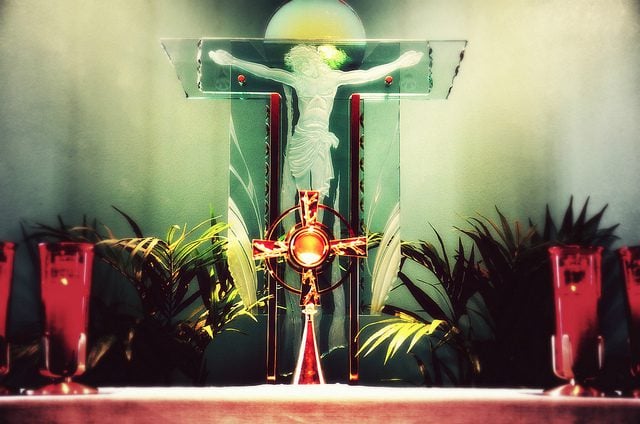
Photo Credit: Art4TheGlryofGod.
As a Catholic, I believe that Jesus is really present in the Eucharistic elements.
That is to say, I believe that through a genuine miracle, which happens at every Mass, the bread and the wine become Jesus’s real flesh and blood—while still appearing to be bread and wine (and that’s part of the miracle).
Does this sound crazy?
As a Protestant, I believed that the Lord’s Supper—Communion—was a memorial feast. It was a commemorative ceremony we celebrated as a church or small group of believers to remember Jesus’s once-and-for-all sacrifice. I also believed that when Jesus said, “This is my body,” he was speaking metaphorically and instead meant, “This represents my body.”
But I changed my mind; I’ve come to believe differently.
Jesus wasn’t instituting a mere memorial feast, He was giving us His real flesh and blood.
Jesus wasn’t simply asking us to do something, once in a while, in memory of Him. He was giving us a gift.
I went from believing that the bread and wine were symbols of Jesus’s sacrifice, to believing that the bread and wine were Jesus.
When Jesus stood in front of his followers and said, “This is my body,” I’ve come to believe he meant it.
The Early Christians Knew It
The first convincing piece of evidence for Jesus being really present in the Eucharistic was the testimony of the Early Church Fathers. These were the men appointed to positions of authority by the apostles themselves. These were men who were taught by the apostles themselves—and this is some of what they had to say.
St. Ignatius, whose writings are amongst the earliest we have after the New Testament epistles, wrote,
Consider how contrary to the mind of God are the heterodox in regard to the grace of God which has come to us. They have no regard for charity, none for the widow, the orphan, the oppressed, none for the man in prison, the hungry or the thirsty. They abstain from the Eucharist and from prayer, because they do not admit that the Eucharist is the flesh of our Savior Jesus Christ, the flesh which suffered for our sins and which the Father, in His graciousness, raised from the dead.
St. Justin Martyr, one of the earliest Christian apologists, writing around 148AD wrote,
…but as Jesus Christ our Savior being incarnate by God’s Word took flesh and blood for our salvation, so also we have been taught that the food consecrated by the Word of prayer which comes from him, from which our flesh and blood are nourished by transformation, is the flesh and blood of that incarnate Jesus.
And, St. Irenaeus around 180AD wrote,
[Christ] has declared the cup, a part of creation, to be his own Blood, from which he causes our blood to flow; and the bread, a part of creation, he has established as his own Body, from which he gives increase to our bodies.
The witness of the earliest Christians is unanimous and shockingly clear: in Communion, the Eucharist, we receive Jesus’s flesh and blood.
When Jesus said, “This is my body,” he meant it literally.
Jesus’s Followers Knew It
The second convincing piece of evidence for Jesus being present in the Eucharist was, ironically, our Lord’s very words—-and the remarkable reaction of those that heard him.
The episode unfolds in the Gospel of John and I’m sure you know the story. After miraculously multiplying food for a crowd of thousands (an obvious and symbolic foreshadowing) Jesus delivers what’s known as the “Bread of Life Discourse.”
In this incredible speech Jesus tells His followers that they must eat His real flesh. His real flesh. And He emphasizes it in shockingly graphic language, urging His followers to, literally, “gnaw” His flesh.
As an evangelical Protestant I heard this discourse explained as Jesus speaking metaphorically, but as I dug deeper, I was left wholly unsatisfied.
Because Jesus gives no indication He’s speaking in metaphor.
And because of the important reaction of the crowd.
Remarkably, many of Jesus’s followers question His teaching, they mutter and they complain, and they leave.
And Jesus makes no attempt to call them back, to explain, or to clarify.
Even to the disciples, to whom He often explained Himself, He makes no attempt at clarification.
In fact, and instead, Jesus goes so far as to challenge His disciples saying, to paraphrase, “This is a tough teaching, do you want to leave as well?”
Jesus does not clarify because, I’m convinced, He meant what He said—and He meant it literally.
And, like I’ve said, this is what the first Christians believed too.
The Christian Church Knew It
Finally, I’m convinced of the real presence of Jesus in the Eucharist because of the witness of the whole of the Christian Church for 1,600 years.
Incredibly, until the Protestant Reformation in the 16th century, Christians were unanimous in their belief that Jesus was present in the Lord’s Supper. Even the Eastern Churches, split from Western Christianity around the year 1,000, maintained this very same belief in tandem.
While many of the early Protestant Reformers believed, and wrote strongly, for Jesus’s real presence in the Eucharist, some, like Huldrych Zwingli, argued in the public square that the Communion elements were merely symbolic.
Remarkably, however, the Christian Church was unanimous in support of Jesus being really present in the Eucharistic elements for 1,600 years and while Zwingli certainly had his fair share of arguments in his favour, and his own theological bent, what he was proposing was a break from what had always been believed.
Incredibly, if Zwingli was right about Communion being merely symbolic this meant, in turn, that the whole of the Christian Church had been wrong for 1,600 years.
What seems more likely?
I was, as an evangelical Protestant, a product of the Reformation even if I didn’t know it. I stood on the shoulders of a theology whose origin I hadn’t fully understood when I accepted Communion as symbolic.
But Jesus didn’t intend it that way.
Do My Beliefs About Communion Really Matter?
Yes!
Communion was important to the New Testament community; it’s reflected clearly in the New Testament epistles.
The Apostle Paul writes, extensively, on the importance of how we take the Lord’s Supper—and what we believe about it. He writes about the very real spiritual dangers of taking Communion in an unworthy way—especially of the importance of satisfying any grudges you have against your fellow Christians before taking part. We see this, as well, reflected in the writings of the Early Church Fathers.
Communion is a serious thing.
Even if, because of the erosion of time and our inherited theology, we don’t view it as such.
As an evangelical Protestant I balanced the evidence.
I didn’t know the Church was unanimous for 1,600 years. I didn’t know the Early Church took Jesus at His literal word. I didn’t consider the reaction of those followers in the Gospel of John who left Jesus after hearing His difficult teaching—and the absence of any kind of clarification on the part of our Lord.
I balanced this, in my estimation, against a theology that originated some four hundred years ago—which ignores the witness of the Christian Church up until the 16th century, and the most logical interpretation of Jesus’s words.
I re-evaluated my stance on what exactly was happening in the Eucharist, and what Jesus really meant to institute, and I changed my mind.
The conclusion I came to was shocking, and the rest is history.
This article was originally published on my personal blog in April 2015 as “Why I Changed My Mind About Communion.”
Previous Post

December 24, 2015
My First Christmas as a Catholic
Next Post

December 30, 2015 The New Year's Resolution Every Catholic Should Be Making
Browse Our Archives
Select a Category Appearances Christian Living Explaining the Faith Podcast Tough Questions Uncategorized Why I'm Catholic
Select a Month January 2024 December 2023 November 2023 July 2023 June 2023 May 2023 April 2023 March 2023 February 2023 January 2023 December 2022 November 2022 October 2022 September 2022 August 2022 July 2022 June 2022 May 2022 April 2022 March 2022 February 2022 January 2022 December 2021 November 2021 October 2021 September 2021 August 2021 July 2021 June 2021 May 2021 April 2021 March 2021 February 2021 January 2021 December 2020 November 2020 October 2020 September 2020 August 2020 July 2020 June 2020 May 2020 April 2020 March 2020 February 2020 January 2020 December 2019 November 2019 October 2019 September 2019 August 2019 July 2019 June 2019 May 2019 April 2019 March 2019 February 2019 January 2019 December 2018 November 2018 October 2018 September 2018 August 2018 July 2018 June 2018 May 2018 April 2018 March 2018 February 2018 January 2018 December 2017 October 2017 September 2017 July 2017 May 2017 April 2017 March 2017 February 2017 January 2017 December 2016 November 2016 October 2016 September 2016 August 2016 July 2016 June 2016 May 2016 April 2016 March 2016 February 2016 January 2016 December 2015 November 2015 October 2015 September 2015 August 2015 July 2015 June 2015 May 2015 April 2015 March 2015 February 2015 January 2015 December 2014 November 2014 October 2014
Follow Us!
TAKE THE
Religious Wisdom Quiz
Who denied Jesus three times before the rooster crowed?
Select your answer to see how you score.
John Peter Thomas Judas
Support this
Column


Related posts from The Cordial Catholic

232: The Trajectory of Conversion (w/ Phillip Campbell)

230: One Heck of a Conversion Story (w/...

229: Can Catholics and Evangelicals Agree on How...

227: What was Medieval Catholicism Really Like? (w/...
TRENDING AT PATHEOS Catholic

Rejecting Doom: Christian Hope And Human Action
Christianity is a religion of hope. We are to have hope and...

It’s What Comes From Within Which Matters
One of the most difficult things for us to understand is why...

Why I Choose the Eucharist Over the Sermon
Choose the Eucharist, Not the Sermon What are we supposed to get...

5 Design Elements Found in Spiritually Rooted Homes
Putting Spirituality Into Home Decor Our homes are more than our living...

Credo: A Story of God Told with the...
About 10 years ago, I began to imagine a personal "Credo" that...

The Anatomy of Divine Revelation in Catholic Thought
The claim that God has made Himself known to human beings is...
view all Catholic blogs
Ad-Free & Subscriber Log-In Subscription Support
- About Us
- 2026 Calendar
- Videos
- Podcasts
- Library of World Religions
- Faith In Media Tracker
- Advertise With Us
- Write for Us
- Privacy Policy
- Terms of Service
- Do Not Sell My Data
- Contact Us
- Radiant Digital
- Manage Newsletter Subscriptions
- Unsubscribe From Notifications
- Sitemap
Copyright 2008-2026, Patheos. All rights reserved.
Subscription Support Ad-Free & Subscriber Log-In
Follow Patheos