
BuddhistCatholicContemplativeEvangelicalGeneral ChristianHinduJewishLatter-day SaintMuslimNew VisionsProgressive Christian
Beliefs
- Buddhist
- Catholic
- Contemplative
- Evangelical
- General Christian
- Hindu
- Jewish
- Latter-day Saint
- More Voices
- Muslim
- New Visions
- Pagan
- Progressive Christian
Topics
- Religion News
- Food and Religion
- Sports and Religion
- Religious Art
- Religious Music and Entertainment
- Religious Events
- History and Religion
- Style and Religion
- Politics and Religion
- Women in Religion
- Recreation Outdoors and Religion
- Business Finance and Religion
- Careers Workplace and Religion
- Education and Religion
- Family Parenting and Religion
- Health Fitness and Religion
- Home and Religion
- Relationships and Religion
- Technology and Religion
- Travel and Religion
Columnists
- Buddhist Columnists
- Business Finance and Religion Columnists
- Careers Workplace and Religion Columnists
- Catholic Columnists
- Contemplative Columnists
- Education and Religion Columnists
- Evangelists Columnists
- Family Parenting and Religion Columnists
- General Christian Columnists
- Health Fitness and Religion Columnists
- Hindu Columnists
- History and Religion Columnists
- Home and Religion Columnists
- Jewish Columnists
- More Voices Columnists
- Latter Day Columnists
- Muslim Columnists
- New Visions Columnists
- Nonreligious Columnists
- Pagan Columnists
- Politics and Religion Columnists
- Progressive Columnists
- Recreation Outdoors and Religion Columnists
- Relationships and Religion Columnists
- Religion News Columnists
- Religious Art Columnists
- Religious Events Columnists
- Religious Music and Entertainment Columnists
- Sports and Religion Columnists
- Style and Religion Columnists
- Technology and Religion Columnists
- Travel and Religion Columnists
- Women in Religion Columnists
Resource Library
- 2026 Calendar
- Library of World Religions
- The 100 Most Holy Places on Earth
- Patheos Answers
- Podcasts
- Videos
- Faith Leaders Database
- Anglican Episcopalian
- Bahai
- Baptist
- Buddhism
- Christianity
- Confucianism
- Eastern Orthodoxy
- Hinduism
- Holiness and Pentecostal
- ISKCON
- Islam
- Judaism
- Lutheran
- Methodist
- The Church of Jesus Christ of Latter-day Saints
- New Age
- Paganism
- Presbytarian and Reformed
- Protestantism
- Religion Behind the Scenes
- Roman Catholic
- Scientology
- Shia Islam
- Sikhism
- Sufism
- Sunni Islam
- Taoism
- Zen
- See all religions
Research Tools
 Ad-Free & Subscriber Log-In Subscription Support
Ad-Free & Subscriber Log-In Subscription Support
Follow Patheos 

- Trending:
- Forgiveness
- |
- Marriage
- |
- Consciousness
- |
- Death Penalty
- |
- Election
- |
- Halloween
 The Cordial Catholic
- Home
- Catholic
- What Mother Teresa (And Her Critics) Can Teach Us About Saints
What Mother Teresa (And Her Critics) Can Teach Us About Saints
Last updated on: September 6, 2016 at 8:28 am by K. Albert Little
What Mother Teresa (And Her Critics) Can Teach Us About Saints 2016-09-06T08:28:19-04:00 K. Albert Little
Patheos Explore the world's faith through different perspectives on religion and spirituality! Patheos has the views of the prevalent religions and spiritualities of the world.
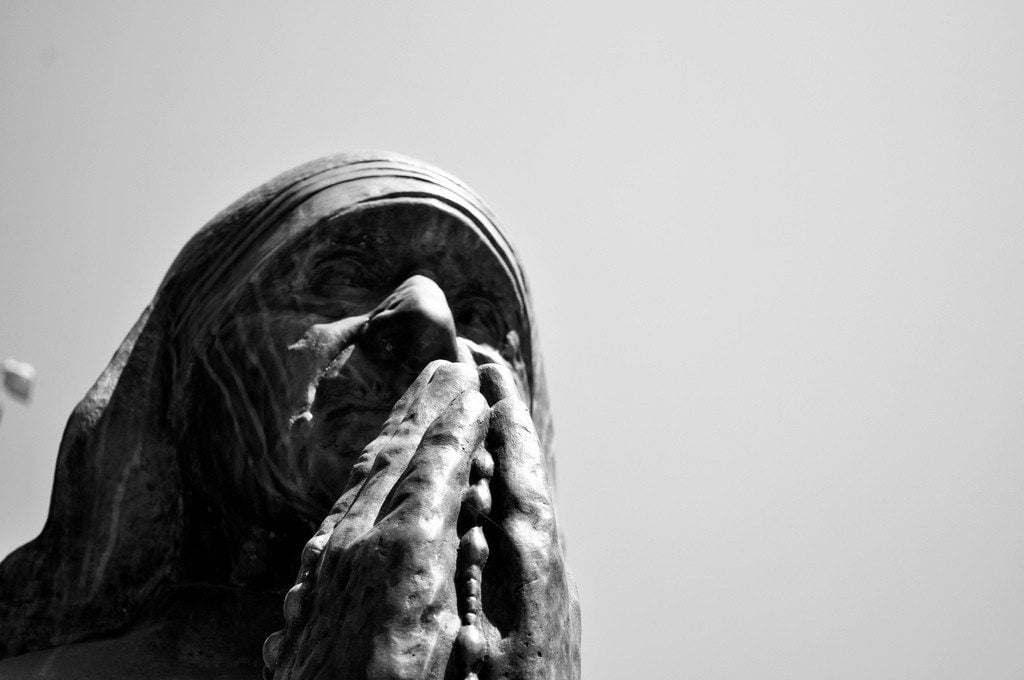
Photo Credit: Funky Tee.
I’m not going to lie, I’ve been intentionally avoiding all the negative press swirling around Mother Teresa’s canonization this past Sunday.
I’ve read the headlines as they’ve popped up in my newsfeed. I’m aware of the allegations and criticisms of her work, her character, and her saintliness. I even had the pleasure of reading a hilarious exchange between two of my good friends and a marginally well-known religious commentator on Twitter.
He hates Mother Teresa.
But I’ve avoided the bad press on purpose, and for good reason.
Because those who deride the elevation of Mother Teresa to sainthood fundamentally misunderstand the process: saints aren’t perfect, they’re redeemed.
Growing up in the 90’s Mother Teresa was one of those rare pillars of charity. Someone who stood—and served—in stark contrast to the rest of the world. Even as a kid, and then a teenager, Mother Teresa’s face, her frail little frame and white-and-blue habit, were immediately identifiable on any supper hour newscast.
Even as a kid, growing up in a secular household, the distinct mission of the future saint was unmistakable: Mother Teresa served the poor, relentlessly.
We knew who she was—everyone knew who she was—and her witness of Christian mercy and love was undeniable.
In Christian circles, Mother Teresa is famous for both her incredible works of mercy but also for the incredibly painful dry spell she went through for most of her life. Remarkably, after experiencing a time of intense spirituality, visions, and a deep sense of calling Mother Teresa found herself essentially abandoned by God in the midst of her most difficult trials; while working with the poor and destitute.
Incredibly, it was in the midst of this challenging work that God remained silent.
Yet she continued to serve; continued to live in poverty herself to meet the needs of the impoverished around her.
In the time since her death, the ranks of Mother Teresa’s Missionaries of Charity have swelled worldwide. These are women serving in dangerous and difficult places. In Haiti, Argentina, and Yemen where four members of her order were recently killed by Islamic terrorists.
But now, as the Vatican elevates her to sainthood, there are those bent on rewriting her legacy. Their charges are as varying as they are absurd.
That Mother Teresa forced those she served to convert to Catholicism before delivering them aid and comfort.
That Mother Teresa insisted that those living in poverty, those in the slums that she ministered to, remain in their destitute state.
That Mother Teresa was ultimately backed by high-rolling millionaires who somehow profited from her mission of mercy.
That she was corrupt, crooked, and her mercy was a false front for something more sinister.
And, well, maybe it’s all true. But that’s not the point.
That Mother Teresa was perfect is not, and never was, up for discussion as Pope Francis moved her cause towards canonization.
That is not the impossible standard to which saints must rise.
Remarkably, the Vatican does interview and consider the accounts of those critical of its future saints. In the case of Mother Teresa, her most vocal and vitriolic critics like Christopher Hitchens took an active part in the rigorous screening process which lead the future saint toward canonization. In these processes, not only is her character and her life’s work closely and painfully examined but miracles must also be brought forth to fundamentally prove her saintliness.
As Bishop Robert Barron explained in an interview on NPR this past week,
The saint is also someone who’s now in heaven, living in this fullness of life with God. And the miracle, to put it bluntly, is the proof of it.
And that is really the crux of the thing.
See, St. Teresa wasn’t a perfect human being but she didn’t need to be.
The Catholic Church elevates Christians who it recognizes as having exemplified the mission of Christ, who we’re called to emulate, who we have the distinct privilege of asking for help in prayer, and who are unmistakably living, right now, in the holy presence of God.
In the case of Mother Teresa, out of the scores of miracles brought forth for consideration it was two spontaneous and scientifically inexplicable healings which were ultimately decided upon to forward her cause.
According to the Church these miracles, screened by teams of doctors (including non-Catholic practitioners), ultimately indicate that Mother Teresa is in Heaven and can pray for us. That she is actively praying for our needs in the presence of God. This is what Catholics call the Communion of Saints, and it’s an ancient understanding of the Church.
These miracles, as Bishop Barron put it bluntly, are “the proof” that Mother Teresa is now with God.
Was she without flaw? Certainly not. Are there aspects of her life or mission which might be problematic? Even though the Vatican puts its candidates through a rigorous screening process, it’s always possible. But, more importantly, the miracles which have resulted from her prayers, so says the Catholic Church, indisputably place her within the presence of Christ.
In Heaven.
Flawed or not.
And that’s the whole point of the thing; what her critics miss.
Yes, we should emulate her good works but maybe she was deeply flawed and maybe, remarkably, she was secretly funded by a cabal of questionable characters and maybe, despite doing its homework, the Church got something wrong what is important—and important for all of us—is that Mother Teresa, according to the Church, is unequivocally in Heaven.
She’s been redeemed by Christ through the mystery of salvation and despite whatever good or bad work she ultimately carried out while alive she didn’t need to be perfect after all.
And the takeaway from all of this?
I think we need to understand that saints like Mother Teresa are holy people we can and ought to emulate but they aren’t necessarily perfect. What they are, above all else, are examples of Christians who leaned heavily on the cross, on Christ, and who reign with Him forever.
Christians who recognized, fundamentally, that they couldn’t do it on their own.
And this is what Mother Teresa’s critics fail to understand: That she, like all of us badly broken vessels, needed to be redeemed.
Stay in touch! Like The Cordial Catholic on Facebook:
Previous Post
August 31, 2016
Congratulations Fr. Roderick (And Thank You!)
Next Post
September 8, 2016 Why I Love The Sunday, 7PM Mass
Browse Our Archives
Select a Category Appearances Christian Living Explaining the Faith Podcast Tough Questions Uncategorized Why I'm Catholic
Select a Month January 2024 December 2023 November 2023 July 2023 June 2023 May 2023 April 2023 March 2023 February 2023 January 2023 December 2022 November 2022 October 2022 September 2022 August 2022 July 2022 June 2022 May 2022 April 2022 March 2022 February 2022 January 2022 December 2021 November 2021 October 2021 September 2021 August 2021 July 2021 June 2021 May 2021 April 2021 March 2021 February 2021 January 2021 December 2020 November 2020 October 2020 September 2020 August 2020 July 2020 June 2020 May 2020 April 2020 March 2020 February 2020 January 2020 December 2019 November 2019 October 2019 September 2019 August 2019 July 2019 June 2019 May 2019 April 2019 March 2019 February 2019 January 2019 December 2018 November 2018 October 2018 September 2018 August 2018 July 2018 June 2018 May 2018 April 2018 March 2018 February 2018 January 2018 December 2017 October 2017 September 2017 July 2017 May 2017 April 2017 March 2017 February 2017 January 2017 December 2016 November 2016 October 2016 September 2016 August 2016 July 2016 June 2016 May 2016 April 2016 March 2016 February 2016 January 2016 December 2015 November 2015 October 2015 September 2015 August 2015 July 2015 June 2015 May 2015 April 2015 March 2015 February 2015 January 2015 December 2014 November 2014 October 2014
Follow Us!
TAKE THE
Religious Wisdom Quiz
How many disciples did Jesus call as His closest followers?
Select your answer to see how you score.
Seven Twenty Twelve Ten
Support this
Column


Related posts from The Cordial Catholic
Would the Early Christians Be Welcomed by Evangelicals?

A Catholic Response to Evangelical De-Conversions
The Incredible Power of "In Persona Christi"

If Infants Can't Be Baptized, Women Can't Receive...
TRENDING AT PATHEOS Catholic

Rejecting Doom: Christian Hope And Human Action
Christianity is a religion of hope. We are to have hope and...

It’s What Comes From Within Which Matters
One of the most difficult things for us to understand is why...

Why I Choose the Eucharist Over the Sermon
Choose the Eucharist, Not the Sermon What are we supposed to get...

5 Design Elements Found in Spiritually Rooted Homes
Putting Spirituality Into Home Decor Our homes are more than our living...

Credo: A Story of God Told with the...
About 10 years ago, I began to imagine a personal "Credo" that...

The Anatomy of Divine Revelation in Catholic Thought
The claim that God has made Himself known to human beings is...
view all Catholic blogs
Ad-Free & Subscriber Log-In Subscription Support
- About Us
- 2026 Calendar
- Videos
- Podcasts
- Library of World Religions
- Faith In Media Tracker
- Advertise With Us
- Write for Us
- Privacy Policy
- Terms of Service
- Do Not Sell My Data
- Contact Us
- Radiant Digital
- Manage Newsletter Subscriptions
- Unsubscribe From Notifications
- Sitemap
Copyright 2008-2026, Patheos. All rights reserved.
Subscription Support Ad-Free & Subscriber Log-In
Follow Patheos