
BuddhistCatholicContemplativeEvangelicalGeneral ChristianHinduJewishLatter-day SaintMuslimNew VisionsProgressive Christian
Beliefs
- Buddhist
- Catholic
- Contemplative
- Evangelical
- General Christian
- Hindu
- Jewish
- Latter-day Saint
- More Voices
- Muslim
- New Visions
- Pagan
- Progressive Christian
Topics
- Religion News
- Food and Religion
- Sports and Religion
- Religious Art
- Religious Music and Entertainment
- Religious Events
- History and Religion
- Style and Religion
- Politics and Religion
- Women in Religion
- Recreation Outdoors and Religion
- Business Finance and Religion
- Careers Workplace and Religion
- Education and Religion
- Family Parenting and Religion
- Health Fitness and Religion
- Home and Religion
- Relationships and Religion
- Technology and Religion
- Travel and Religion
Columnists
- Buddhist Columnists
- Business Finance and Religion Columnists
- Careers Workplace and Religion Columnists
- Catholic Columnists
- Contemplative Columnists
- Education and Religion Columnists
- Evangelists Columnists
- Family Parenting and Religion Columnists
- General Christian Columnists
- Health Fitness and Religion Columnists
- Hindu Columnists
- History and Religion Columnists
- Home and Religion Columnists
- Jewish Columnists
- More Voices Columnists
- Latter Day Columnists
- Muslim Columnists
- New Visions Columnists
- Nonreligious Columnists
- Pagan Columnists
- Politics and Religion Columnists
- Progressive Columnists
- Recreation Outdoors and Religion Columnists
- Relationships and Religion Columnists
- Religion News Columnists
- Religious Art Columnists
- Religious Events Columnists
- Religious Music and Entertainment Columnists
- Sports and Religion Columnists
- Style and Religion Columnists
- Technology and Religion Columnists
- Travel and Religion Columnists
- Women in Religion Columnists
Resource Library
- 2026 Calendar
- Library of World Religions
- The 100 Most Holy Places on Earth
- Patheos Answers
- Podcasts
- Videos
- Faith Leaders Database
- Anglican Episcopalian
- Bahai
- Baptist
- Buddhism
- Christianity
- Confucianism
- Eastern Orthodoxy
- Hinduism
- Holiness and Pentecostal
- ISKCON
- Islam
- Judaism
- Lutheran
- Methodist
- The Church of Jesus Christ of Latter-day Saints
- New Age
- Paganism
- Presbytarian and Reformed
- Protestantism
- Religion Behind the Scenes
- Roman Catholic
- Scientology
- Shia Islam
- Sikhism
- Sufism
- Sunni Islam
- Taoism
- Zen
- See all religions
Research Tools
 Ad-Free & Subscriber Log-In Subscription Support
Ad-Free & Subscriber Log-In Subscription Support
Follow Patheos 

- Trending:
- Forgiveness
- |
- Marriage
- |
- Consciousness
- |
- Death Penalty
- |
- Election
- |
- Halloween
 The Cordial Catholic
- Home
- Catholic
- How I Learned to Discern to God’s Will (And Also How Not To)
How I Learned to Discern to God’s Will (And Also How Not To)
Last updated on: April 26, 2017 at 1:34 am by K. Albert Little
How I Learned to Discern to God’s Will (And Also How Not To) 2017-04-26T01:34:05-04:00 K. Albert Little
Patheos Explore the world's faith through different perspectives on religion and spirituality! Patheos has the views of the prevalent religions and spiritualities of the world.
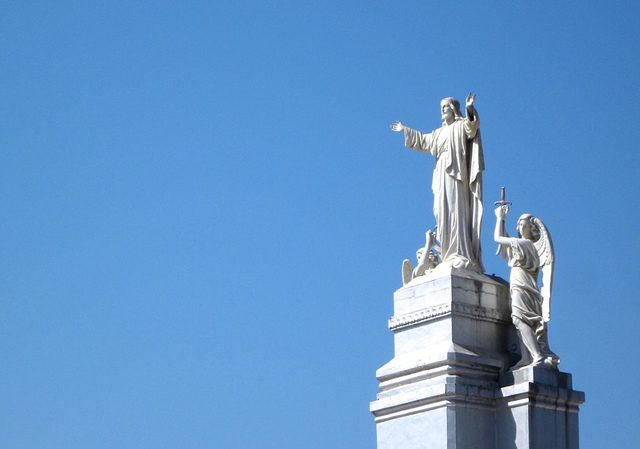
Photo Credit: Mr. Fun.
The whole thing—the will of God thing—is tricky.
As a teenager, in Evangelical circles, it was worn like something of a badge of honour: A young adult tromping off in this or that direction—following this or that fancy—would declare it to be the unequivocal “Will of God” and entertain no detractors.
It was a Trump Card—in every sense of the word.
But how we discerned such an important thing—what God wanted from us—what such a convoluted, serpentine process.
(The subject of at least a dozen sermons a year in the average Evangelical congregation.)
As a teenager, the two most time-tested and trusted means for discerning God’s purpose and will for each and every situation were simple: the Bible, and the gut.
When using our Bibles to discern God’s will the old “flip open the Bible to a random page” trick was our most common employ. If you’ve never practiced the page flip the premise is alarmingly simple: since God speaks to us through His Word it’s perfectly reasonable to ask a question then flip open the Bible—the Word of God—to a random page, point to a random word, and voila.
Ironically, in a faith tradition which lumped horoscopes in with Satanic ritual the flip-open-the-Bible technique was never appropriately shunned for what it was: a kind of bizarre fortune-telling crystal ball approach to discernment.
I do stand, years later, slightly corrected having recently discovered that some of the most laudable saints, like Augustine himself, used this same method to decide what God wanted them to do.
Can’t be that bad of a strategy, I guess, although I still hold it in somewhat suspect regard.
Of course the other, often prevailing, method of discernment for us young Christians was to simply rely on our gut—how we felt—which is, of course, the most accurate measure of God’s will for a group of hormone-saturated teenagers.
Yeah, right.
But those were, back then, how we decided upon God’s will: What felt right and what page our Bible opened to.
And maybe, in reality, those methods weren’t all that ridiculous to begin with.
If there’s something I’ve learned in the decade and a half since then it’s that God’s will can be uncovered in all sorts of ways and, more often than not, his will is simply whatever. As in, there are lots of different possible outcomes. Maybe a door closes here but another, eventually, will open somewhere else. Or maybe I’m deciding between two seemingly equally good choices; either is OK and neither is not God’s will. Maybe it’s a career choice, a move, or an adventure—if there’s anything I’ve learned about what God wills for us is that He wills us to pray, have patience, and then decide.
He’s going to be there to accompany us in any case.
Some of the best advice I received about discerning God’s will came about a year ago at a busy Catholic conference. I was discerning a career move from a full-time educator to working in parish ministry and it was a huge, emotional, life-changing choice.
Confession was available one night during the conference and with about a thousand people in attendance the line-up of Catholics eager to reconcile with God was breath-taking.
As was the number of willing and available priests.
As I waited in line I piously tried to spy out the priest that might make the best confessor. Would it be the priest in the cassock? I liked his appreciation of tradition. What about one of the auxiliary bishops? That could be thrilling and surely incredibly edifying.
Just then another priest joined the cue of available confessors. In jeans, he wore a pair of dad-from-the-70’s pop bottle glasses and a colourfully embroidered stole which screamed Spirit of Vatican II at an unseemly decibel.
Please Lord, I prayed, not him.
But, of course, like all good life lessons I learned this one the hard way and was ushered across the sprawling lobby into the chair across from Fr. Vatican II.
Apart from whatever else I had to confess that evening I reluctantly explained my predicament to the priest. I told him I felt ashamed to be even considering rejecting a job position in ministry because parish work must be God’s will for my life—it’s work for the Church, after all. I told him I didn’t want my attachment to my teaching job—I’d done it for 8 years at that point—to cloud my judgement; I didn’t want my lack of faith to hold me back.
The parish job seemed like it must be God’s will, but didn’t feel like a good fit.
I was worried, and a bit of a wreck, but what he said remains some of the best advice I’ve ever received on discerning God’s will.
He said, God’s will isn’t always going to be the choice which seems the most radical or the scariest.
God’s will isn’t always the difficult option in a series of possible choices.
And he related to me a story from his own experience.
Years ago, he said, he’d meet Mother Teresa and had a chance to work alongside her for a time. They developed something of a relationship and when he was finished his work there and had to move on she’d given him a rosary—her own personal rosary, he told me. And he was absolutely beside himself.
The rosary became a treasured spiritual aid; he’d use it for prayer himself and always counted Mother Teresa’s prayers alongside his own.
He was sure she’d be praying for him, and with him—after all, he was using her rosary.
But one day he met someone, he said, in particular distress. In the heat of the moment, because it felt like the difficult and sacrificial thing to do, he decided to give them his rosary, the one he’d receive from St. Theresa.
And before he knew it, it was gone.
He lamented, to me, the fact that the person who’d received it probably had no real idea the value of it. They’d never experienced that real, personal connection to the living saint that he had. They didn’t know her from the literal trenches she worked in; they wouldn’t use it and treasure it in the same way that he had and, he told me, he’d always regretted giving it away so hastily.
He lived in that deep regret.
God’s will, he said, isn’t always that rash or difficult choice and we cannot, and should never, automatically assume that if it’s hard and is going to cause us to suffer it must be the direction God wants us to travel.
Sometimes God’s will might very well be the easier choice like praying for that person in distress, but keeping the rosary.
I’ll never forget that advice from Fr. Vatican II, nor the shame I felt after having such a good conversation with him.
(Being terribly judgemental is something I confess constantly, for the record!)
But he’s right.
What we can count on, I know, is that if we cling tightly to Jesus—if we pray and are patient and faithful—we are doing God’s will.
What I learned in the time after a difficult break-up, after flipping open my Bible and going with my gut and assuming that God’s will must always be the most difficult choice, was that, actually, the most simple way to know and do God’s will is to simply put God first.
Seek first the Kingdom, Jesus said, and everything else will be given.
Previous Post
April 7, 2017
Thoughts from a Convert in the Confessional Line
Next Post

April 20, 2017 I Am But Dust and Ashes
Browse Our Archives
Select a Category Appearances Christian Living Explaining the Faith Podcast Tough Questions Uncategorized Why I'm Catholic
Select a Month January 2024 December 2023 November 2023 July 2023 June 2023 May 2023 April 2023 March 2023 February 2023 January 2023 December 2022 November 2022 October 2022 September 2022 August 2022 July 2022 June 2022 May 2022 April 2022 March 2022 February 2022 January 2022 December 2021 November 2021 October 2021 September 2021 August 2021 July 2021 June 2021 May 2021 April 2021 March 2021 February 2021 January 2021 December 2020 November 2020 October 2020 September 2020 August 2020 July 2020 June 2020 May 2020 April 2020 March 2020 February 2020 January 2020 December 2019 November 2019 October 2019 September 2019 August 2019 July 2019 June 2019 May 2019 April 2019 March 2019 February 2019 January 2019 December 2018 November 2018 October 2018 September 2018 August 2018 July 2018 June 2018 May 2018 April 2018 March 2018 February 2018 January 2018 December 2017 October 2017 September 2017 July 2017 May 2017 April 2017 March 2017 February 2017 January 2017 December 2016 November 2016 October 2016 September 2016 August 2016 July 2016 June 2016 May 2016 April 2016 March 2016 February 2016 January 2016 December 2015 November 2015 October 2015 September 2015 August 2015 July 2015 June 2015 May 2015 April 2015 March 2015 February 2015 January 2015 December 2014 November 2014 October 2014
Follow Us!
TAKE THE
Religious Wisdom Quiz
What was the primary material for writing in biblical times?
Select your answer to see how you score.
Parchment Papyrus Clay tablets Stone
Support this
Column


Related posts from The Cordial Catholic

235: Questions I Couldn't Answer (w/ John Martignoni)

234: The Mindblowing World of Sacramentals (w/ Shaun...

233: The Power of Good Catholic Witnesses (w/...

232: The Trajectory of Conversion (w/ Phillip Campbell)
TRENDING AT PATHEOS Catholic

Rejecting Doom: Christian Hope And Human Action
Christianity is a religion of hope. We are to have hope and...

It’s What Comes From Within Which Matters
One of the most difficult things for us to understand is why...

Why I Choose the Eucharist Over the Sermon
Choose the Eucharist, Not the Sermon What are we supposed to get...

5 Design Elements Found in Spiritually Rooted Homes
Putting Spirituality Into Home Decor Our homes are more than our living...

Credo: A Story of God Told with the...
About 10 years ago, I began to imagine a personal "Credo" that...

The Anatomy of Divine Revelation in Catholic Thought
The claim that God has made Himself known to human beings is...
view all Catholic blogs
Ad-Free & Subscriber Log-In Subscription Support
- About Us
- 2026 Calendar
- Videos
- Podcasts
- Library of World Religions
- Faith In Media Tracker
- Advertise With Us
- Write for Us
- Privacy Policy
- Terms of Service
- Do Not Sell My Data
- Contact Us
- Radiant Digital
- Manage Newsletter Subscriptions
- Unsubscribe From Notifications
- Sitemap
Copyright 2008-2026, Patheos. All rights reserved.
Subscription Support Ad-Free & Subscriber Log-In
Follow Patheos